

Red Sequoia, Qiming, and SIG Heavily Back Low-Code Platforms; BAT Invests and Incubates—How Far Has Its Medical Application Progressed?
In 2022, Microsoft CEO Satya Nadella made a prediction: by 2025, 70% of new applications deployed for enterprises will use low-code or no-code tools.
Low-code/no-code development platforms are tools that enable the rapid generation of applications without coding or with minimal coding, and they are widely used across numerous industries such as healthcare, intelligent manufacturing, and finance.
Capital, as a barometer of industry trends, has also been actively investing in the low-code/no-code market. According to incomplete statistics from VCBeat, since 2021, over RMB 1 billion has flowed into China’s low-code/no-code industry, with multiple companies completing several rounds of financing amounting to hundreds of millions of yuan within a single year. Prominent investment firms such as Sequoia China, Qiming Venture Partners, SIG Asia Investments, and Wuyuan Capital have also made strategic multi-point investments and increased their stakes across multiple funding rounds.
The active entry of tech giants such as BAT further demonstrates their confidence in the low-code/no-code development sector through concrete actions. They have not only invested in low-code companies—for instance, Alibaba made a strategic investment in Authing Network, and Tencent invested in DaoYi Cloud—but also launched their own flagship products, such as YiDa (incubated internally by Alibaba), AiSuDa (launched by Baidu), and WeDa (the low-code platform for cloud development introduced by Tencent Cloud).
Backed by capital, a wave of outstanding innovative enterprises has been identified, and low-code/no-code development platforms are accelerating their adoption. What are their application scenarios in the healthcare industry? What are the future evolution trends? To address these questions, VCBeat has interviewed multiple industry practitioners to gain insights into the answers.
Low-code/no-code is not a technical concept that has emerged only in the past two years; in 2014, the renowned consulting and research firm Forrester introduced the concept of low-code/zero-code.
“Literally, it means achieving the same development goals by reducing the amount of professional code programming. It not only supports custom development for professional coders but is also user-friendly for non-professionals, enabling beginners to quickly develop mature and professional applications.”Zhao Wanle, R&D Director at Huazhuo TechnologyIntroduction: Low-code is a concept/tool that enables the creation of desired forms through permutations and combinations, much like assembling building blocks or solving a Rubik’s Cube.
Its value lies in the ability to use low-code tools to handle repetitive programming tasks that would otherwise require significant manpower and time, thereby linking standardized processes. This enables a single individual to perform cross-domain, multi-role tasks, ultimately achieving cost reduction and efficiency improvement.
A well-known case is the 2021 Henan rainstorms, which caused severe waterlogging in many areas. With the assistance of a low-code development team, the “Henan Rainstorms: Finding Missing Persons” platform was successfully launched within 1.5 hours, becoming an effective tool for volunteer teams to carry out rescue operations.
Yuan Chong, Vice President of Haiyun Health (Cun Jiankang)Having been involved with low-code/no-code platforms since 2009, I have a clear understanding of their development trajectory and application value. “Low-code is highly valuable for startups, as it allows developers to dedicate time to more complex tasks. Moreover, given the flexibility of low-code platforms, the cost of trial and error is relatively low when software issues arise.”
In the healthcare industry, low-code platforms also have numerous application scenarios.
Yuan Chong sharedApplications of Low-Code in Pharmaceutical Retail Chains.Haiyun Health provides membership management services for retail pharmacies across China, currently serving over 130,000 stores. As the business expands, addressing the significant variability and rapid changes in customer needs among these 130,000+ pharmacies, along with multi-terminal compatibility, has become an urgent priority. To this end, Haiyun Health leveraged Tencent Cloud’s low-code development platform, “WeDa,” to upgrade its technology stack. By optimizing development workflows, enabling multi-entity deployment, providing cloud-native underlying services, and adopting a hybrid development model for main and sub-applications, Haiyun Health reduced business delivery time by 45% and cut costs by 60%.
Low-code platforms can also be introduced during specific periods and within specific processes to empower digital therapeutics.By leveraging visual drag-and-drop interfaces, low-code development further lowers the barrier to software development and can significantly accelerate development speed. For instance, digital therapeutics can acquire artificial intelligence capabilities by integrating AI and chatbot modules; furthermore, similar low-code platforms can optimize user experiences across the entire care continuum—pre-hospital, in-hospital, and post-hospital.
Low-code is also a key tool empowering pharmaceutical companies in their digital transformation.The demand for digital transformation in the business departments of pharmaceutical companies is growing increasingly, yet a shortage of talent and resources prevents IT development from keeping pace with business growth. Low-code development platforms empower business personnel without an IT background to independently develop customized application systems, complementing the strengths of IT departments and accelerating application deployment. For instance, low-code platforms facilitate the construction of integrated management platforms for pharmaceutical enterprises, leveraging order visualization applications to enhance customer service, improve efficiency across R&D, production, and marketing, and achieve standardization and normalization of business rules.
Huazhuo Technology listed someApplication Scenarios of Low-Code in Healthcare Institutions.For example, the emergency command center’s large monitoring dashboard (which can monitor the status of ambulances, ECG monitors, and other equipment), the hospital president’s executive cockpit, and applications within the hospital’s smart management system. The healthcare sector has substantial data reporting requirements to national standard systems; previously, this necessitated extensive manual operations. By leveraging low-code development platforms, hospitals can significantly reduce the manual effort required for data analysis and visualization. Additional use cases include homepage carousel banners and physician scheduling in internet hospitals.In summary, low-code platforms are well-suited for implementing generic, highly standardized applications in healthcare settings.。”
In an article titled “Why Should Hospital Information Departments Adopt Low-Code Development Platforms?” published on HIT Expert Network, senior healthcare IT engineer Feng Huo pointed out that software quality is largely determined by human factors, which are significantly influenced by external variables. These include variations in technical proficiency, lapses in adhering strictly to development processes leading to uncontrolled code quality, and labor cost considerations. Low-code development platforms have emerged as a solution to address these challenges.
Through interviews and industry insights, we have observed that low-code/no-code solutions are gaining greater visibility and adoption across various sectors, driven by the following factors:
Foreign-related companies have successively completed large-scale financing and seen their valuations rise, stimulating the domestic capital market.In June 2018, OutSystems, a U.S.-based low-code vendor, secured $360 million in investment from KKR and Goldman Sachs, achieving a valuation of over $1 billion and becoming a newly minted unicorn. In August of the same year, another low-code provider, Mendix, was acquired by Siemens for $700 million. Tech giants such as Amazon, Google, Microsoft, and Oracle have also actively developed their own low-code development platforms or expanded into the low-code space through acquisitions.
According to the “2021 China Low-Code Industry White Paper” released by iResearch, the United States has undergone a prolonged research and development process for low-code products, accumulating extensive technical models and practical implementation experience. Having progressed through the early nascent and exploratory phases, the U.S. market has now entered a stage of consolidation led by major international tech giants.
Favorable Policies Accelerate the Digital Transformation of Enterprises.In September 2020, the State-owned Assets Supervision and Administration Commission (SASAC) officially issued the Notice on Accelerating the Digital Transformation of State-Owned Enterprises, delivering positive news to China’s enterprise services market. In November 2022, the Ministry of Industry and Information Technology (MIIT) released the Guidelines for the Digital Transformation of Small and Medium-sized Enterprises (SMEs), strengthening support measures for SMEs by lowering digitalization barriers and accelerating digital empowerment. The Guidelines propose 14 specific measures across three areas: enhancing enterprises’ transformation capabilities, improving the quality of transformation-related supply, and increasing policy support for transformation. These measures aim to help SMEs advance their digital transformation in a scientific and efficient manner, while bolstering the capacity to provide digital products and services to SMEs.
Low-code is the product of the evolution and iteration of traditional software technology.Microservices, platformization, and cloud computing, as hot topics in IT technology, emphasize sharing and facilitate rapid software delivery and deployment. However, even with the adoption of microservices architecture or a platform-based approach, most software still requires significant redevelopment to accommodate changing business needs, leading to prolonged delivery times. Such development demands are highly customized yet have low technical barriers, which has spurred the emergence of low-code development platforms. The homepage of a low-code platform comes preloaded with commonly used functional modules for the industry, enabling developers without an IT background to rapidly build applications.
Furthermore,The entry of tech giants has also boosted the development of the low-code industry.On August 26, 2020, Huawei Cloud released its low-code development platform, AppCube, making an early entry into the market. In the first half of 2021, DingTalk launched its low-code development tool “DingTalk YiDa,” and Tencent Cloud introduced “Tencent Cloud Low-Code” (now renamed WeDa). In 2022, ByteDance acquired HeiPaYun and subsequently launched the aPaaS platform “Kunlun.”
Currently, China’s low-code/no-code sector has entered a phase of accelerated implementation. According to Gartner data, the global no-code/low-code market size reached $8.4 billion in 2020 and is projected to reach $16.8 billion in 2022. Of this, China’s no-code/low-code market size was $282 million in 2020 and is expected to reach $633 million in 2022, maintaining rapid growth over the next five years.
“The 2021 China Low-Code Industry White Paper” categorizes the competitive landscape of China’s low-code industry into three types: general-purpose platforms, vertical-specific platforms, and other low-code development platforms. Among these, general-purpose vendors are further subdivided into native low-code providers, application-development-focused vendors, and SaaS software or cloud providers transitioning into the low-code space. The overall market structure remains fragmented.
VCBeat has compiled a total of 30 financing events since 2021, covering 26 native low-code/no-code vendors. Among these, the highest number of deals occurred at Series A and earlier stages, with 14 transactions. This also reflects that China’s low-code/no-code market is still in its nascent stage.
All seven Series B financing rounds occurred in 2021. The low-code development platform ClickPaaS and the no-code development platform Shuru Data each completed two Series B funding rounds, while the no-code development platform Qingliu Technology secured both its A+ and Series B rounds within a single year. Aoze is the first low-code company reported in public records to have completed a Series C financing round. The remaining eight investment and financing events did not disclose their respective funding stages.
Some domestic IT companies have also developed low-code platforms primarily to enhance internal development efficiency and address secondary development needs of customers and partners, thereby compensating for the lack of personalization and flexibility in their own SaaS products.
Huazhuo Technology explains that to meet the demand for customized services in traditional hospital products, healthcare IT companies need to deploy software engineers to hospital sites for on-site service customization. The growth of traditional healthcare IT enterprises is directly proportional to their headcount; inadequate staffing leads to subpar service quality and customer churn, making it difficult for these companies to achieve deeper optimization after reaching a certain stage of expansion. The low-code development model can help companies resolve the longstanding industry challenges of “customized requirements” and “limited scalability.”
Huazhuo Technology’s development model allows for the engagement of third-party software service teams to handle implementation services. These third-party teams focus on customers’ customized requirements, performing only front-end customization and deployment based on a low-code platform. This approach achieves product standardization and leverages cloud-native architecture to overcome the implementation bottlenecks associated with traditional architectures, thereby addressing issues such as declining customer service quality or a surge in service personnel resulting from corporate expansion.
Furthermore,Kingdee, Yonyou, Seeyon Interconnect, Inspur, and other SaaS software or cloud service providers have also made strategic moves in the low-code sector.
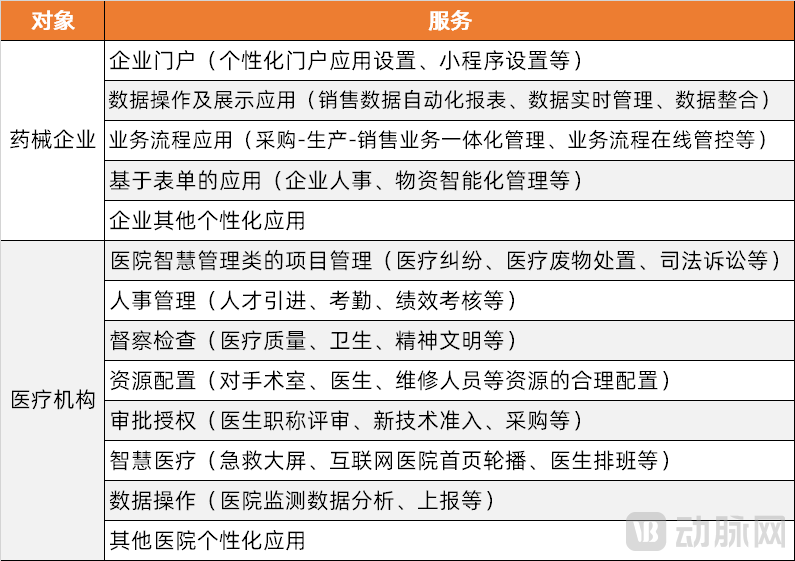
VCBeat reviewed publicly available case data from select companies and found that pharmaceutical enterprises and healthcare institutions are the most frequent adopters within the medical industry. It also compiled an overview of services offered by certain low-code development platforms:
Although the number of low-code applications and the scale of developers are growing rapidly, the low-code/no-code industry is also one with high technical barriers. In practical applications, it still faces many challenges:
First, low-code development platforms cannot replace professional software developers. Hangzhou Huazhuo Information Technology Co., Ltd. believes thatThe technical barrier of low-code platforms lies in the fact that they still require a large number of programmers to perform extensive underlying development work. This constitutes a moat—the invisible part.To achieve low-code development, platforms typically hide many unnecessary technical details. These details are either embedded in underlying frameworks that require professional coding or rely on the platform’s visual editor. Zhao Wanle cited an example: users of a low-code development platform can assemble various structures using building blocks, but the blocks themselves are created by programmers.
Yuan Chong also mentioned that low-code platforms can replace some business development with less complex logic, but for personalized in-depth requirements, professional IT personnel are still needed to implement them, just as the creation of software requires architects to build the overall business logic relationships.
Second, the manufacturer's understanding and accumulation of experience in the industry and application scenarios.In an interview, Bo Zhiyuan, founder of QingFlow Technologies, a no-code development platform provider, stated that beyond “building blocks,” the importance of “blueprints” is even greater. “If you want to build a car model with LEGO bricks, you first need to understand the structure of a car; more importantly, you must have blueprints detailing how to assemble the car using LEGO pieces. Therefore, the core challenge ultimately tests a vendor’s understanding of specific industries and scenarios.”
How to Develop Better and More “Building Blocks”? Huazhuo Technology Shares Three Key Points:End-to-end lifecycle management workflows/pipelines, visual programming for what-you-see-is-what-you-get (WYSIWYG) accessibility by non-experts, and extensibility through horizontal scaling and ecosystem integration.
Yuan Chong added from the user’s perspective,The complexity of using low-code development platforms, the completeness of platform functional modules, and platform stability affected by cloud resource scheduling also impact user experience.
Thirdly, low-code development platforms are still a nascent concept in the healthcare industry, with limited industry awareness and significant challenges in practical implementation.. The agility, speed, and flexibility of low-code development platforms can sometimes prove disastrous in complex real-world scenarios, such as those involving medical data.
Fourth, the development of high-quality low-code platforms is also a capital-intensive endeavor., while tech giants possess substantial capital and resources, innovative enterprises focusing on low-code solutions face significant challenges in their commercialization pathways and fundraising capabilities.
VCBeat learned from interviews that some industry insiders believe China’s low-code sector is roughly on par with global development in terms of progress, with an even broader scope of influence and application scenarios domestically, although its depth remains to be fully explored. Meanwhile, other industry professionals argue that “low-code will not work in China.” Admittedly, low-code is not a new concept, but its integration with healthcare is still in the early stages. Whether it can spark a new wave of information technology innovation remains to be seen through the practical explorations of industry innovators.
Reference Article:
iResearch: 2021 China Low-Code Industry White Paper
Low-Code Platforms Backed by Tencent, Inspur, and Yonyou Gain Momentum
A New Wave of IT Revolution? “Low-Code” Enables Rapid Application Development Without Coding Skills
After the Hype Subsides, Where Should Low-Code Head in 2022?
The Low-Code Trap: IT Revolution or High-End Outsourcing?