

SonoMotion Secures $12.4M Series C Funding to Advance FDA Breakthrough-Designated Non-Invasive Ultrasound Kidney Stone Therapy

National Institute of Health
National Institutes of Health

SonoMotion
Medical Device Developer

Advanced MedTech Holdings
Startup Venture Capitalists

MedVenture Partners
Early-stage Venture Capital Firms

Bioventures Investors
Private Equity Investment Firm
SonoMotion, a U.S. medtech company focused on non-invasive kidney stone management, recently announced the completion of a $12.4 million Series C financing round. The round was co-led by Advanced MedTech Holdings, a global leader in urology, and Lyndon Rive, co-founder of SolarCity. The funds will be used to advance Break Wave, its non-invasive device for kidney stone treatment.TMand Stone ClearTMof research and development and clinical trials.
Lyndon Rive stated: “Break WaveTM“It has the potential to become a key product for kidney stone treatment. We are delighted to help SonoMotion advance its commercial development.” Break WaveTMwith Stone ClearTMcombination may save OR time and reduce patient treatment costs. In September 2022,FDA Grants Break WaveTMBreakthrough Device Designation, this move has accelerated the pace of regulatory review and shortened the time required for devices to enter the market.
In the United States, more than 3 million people visit doctors for kidney stones each year,One in ten people is deeply affected by kidney stones.Among them,Many patients manage their pain with opioids, and some even undergo surgical treatment. According to statistics, in the United StatesThere are 750,000 related surgeries performed annually. This imposes a heavy care burden on the healthcare system and incurs high treatment costs—Annual treatment-related costs in the United States reach as high as $10 billion, with the majority attributable to surgical procedures and unplanned postoperative events.
Stones formed within the renal collecting system can often pass spontaneously through the urinary tract. However, an increasing number of patients require surgery due to pain, infection, or other sequelae of renal obstruction. Such procedures involve minimally invasive fragmentation and extraction of stones, but they may also result in stone fragments that require additional treatment. ForSmaller stones can be fragmented using extracorporeal shock wave lithotripsy (ESWL), thereby increasing the likelihood of their spontaneous passage.Other treatment methods also includeUreteroscopic Laser Lithotripsy (URS)。
However, ESWL and URSAll require performance in an operating room, during which the patient will be under anesthesia, andA 5% or higher probability of causing serious adverse events。If a stone fragment receives insufficient electrical shock during treatment, it will be difficult to pass spontaneously.
1BWL: Pulverizes 90% of stones into fragments smaller than 2 mm in less time
In this context, ultrasound has emerged as a tool with potential value. Ultrasonic propulsion can reposition stones throughout the urinary tract. Meanwhile, compared to large-scale shock wave lithotripters composed of shock wave generators, patient beds, and X-ray fluoroscopy systems, ultrasound-based burst wave lithotripsy (BWL) features a more compact footprint and a more user-friendly operating system. Most importantly,BWLTherapeutic ultrasound, when delivered in this form, can more efficiently fragment, dislodge, and expel urinary stones and stone fragments.
Ultrasonic bursts consist of continuous acoustic cycles that can accumulate to concentrate energy within the calculus, thereby enabling fragmentation at lower peak pressures of the incident acoustic field. In this manner, Burst Wave Lithotripsy (BWL) can induce stress and fractures in the stone through resonance, and the size of the fragments generated during calculus disintegration can be controlled by the ultrasound frequency.
Compared with the shock waves used in ESWL, BWL can fragment stones with a higher success rate in a shorter time, without the need for sedation or anesthesia. Studies have found that90% of stones can be completely fragmented by BWL during a brief treatment period.,Moreover, the majority of stone fragments are less than two millimeters in size.Therefore, they can be expelled naturally without causing excessive pain to the patient.
2SonoMotion: Licensing Technology to Bring Stone Treatment to Clinics and Space
After securing a technology license from the University of Washington, SonoMotion embarked on the research, development, and commercialization journey of its flagship product, Break Wave™. Leveraging BWL, Break Wave™ utilizes multi-cycle, low-amplitude ultrasound pulses,Non-invasively target and fragment kidney stones. This procedure takes only 30 minutes, requires no anesthesia, and can be performed in a standard clinic setting.Clinical simulations in porcine models demonstrated that the pressure levels required for stone fragmentation with Break Wave™ are lower than those causing renal injury.
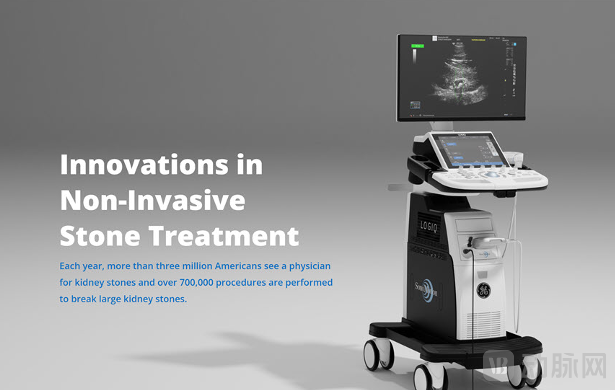
Break Wave™ Image source: SonoMotion official website
Therefore, this therapy may reduce the complications and costs currently associated with stone management, redefining the standard of care for millions of people. Additionally,SonoMotion has also licensed FUS ultrasound imaging technology. This technology can be used to address emergency medical situations during spaceflight., enabling astronauts to perform autonomous ultrasound scans to detect and facilitate the fragmentation of kidney stones at an early stage. This will break through the limitations of manpower and supplies in space and overcome the difficulties that microgravity poses for surgical procedures.
To further enhance the efficacy of stone fragmentation and clearance, SonoMotion is also conducting clinical trials for its Stone Clear™ therapy. This therapy repositions residual fragments after lithotripsy to facilitate their natural expulsion, requiring only 15 minutes and neither general anesthesia nor X-ray radiation.
Dr. Oren Levy, Co-Founder of SonoMotion, is a seasoned medical device expert and entrepreneur. He participated in the founding of SonoMotion in 2014 and subsequently oversaw the company’s management, strategic planning, clinical trials, recruitment, and fundraising activities. To date, Dr. Levy has secured over $38 million in funding for the company, along with $8 million in non-dilutive grants from the NIH and NASA.
Prior to joining SonoMotion, Oren earned a double bachelor’s degree in Physics and Astrophysics and a Ph.D. in Biophysics from the University of California, Berkeley. Subsequently,Oren has accumulated experience in business, client management, and project management at Accenture, a large management and technology consulting firm.Additionally, he was involved in Volcano Corporation’s (acquired by Philips) management and acquisition of the ultrasound medical device company Fluid Medical.

Oren Levy. Image source: LinkedIn
Under Oren’s leadership, SonoMotion acquired the intellectual property portfolio from the University of Washington. Additionally, the company has also partnered with GE’sHealthcare Business UnitGE Healthcare has established strategic partnerships and OEM relationships. In March 2019, the companyGE HealthcareSigned the second co-development agreement.
In July 2017, SonoMotion completed a $4.6 million Series A financing round. The round was led by MedVenture Partner, with participation from Bioventures Investors.
In November 2019, SonoMotion announced the completion of a $10 million Series B financing round. The round was led by Advanced MedTech Holdings (AMTH), the largest medical device company in Southeast Asia, with participation from MedVenture Partners and BioVentures Investors. The funds will be used to support the company’s development of non-invasive solutions for kidney stones.
Furthermore,SonoMotion has also received multiple grants from the National Institutes of Health (NIH) Small Business Innovation Research (SBIR) program.The SBIR program aims to promote R&D and product commercialization for U.S.-based startups through financial support. The SBIR program is divided into three phases, targeting technical feasibility studies, R&D initiation, and commercialization, respectively. Currently, SonoMotion has secured a Phase II grant under this program.
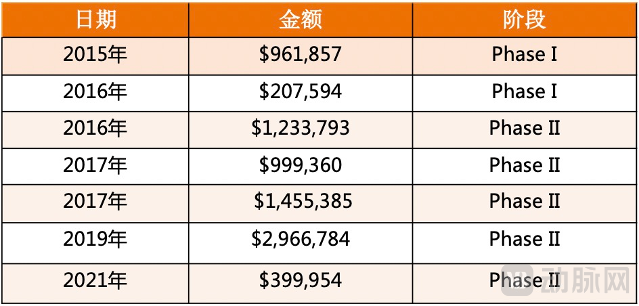
SonoMotion’s SBIR Grant History | Source: SBIR Official Website
It is estimated that,The global lithotripsy device market is projected to achieve a compound annual growth rate (CAGR) of 5.5%, reaching $2.68 billion by 2030.. The primary drivers of its growth include: the aging global population, rising prevalence of urolithiasis, increasing number of extracorporeal shock wave lithotripsy procedures, and advances in other technologies.The kidney stone sector dominates the entire industry.
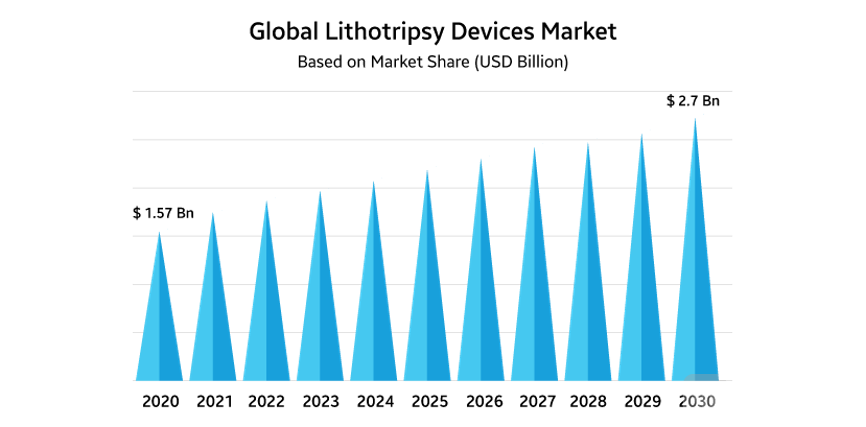
Global Lithotripsy Device Market Image Source: Strategic Market Research
The lithotripsy market can be segmented by type, including extracorporeal shock wave lithotripsy (ESWL), intracorporeal (endoscopic) lithotripsy, and percutaneous lithotripsy. The intracorporeal segment can be further subdivided into laser lithotripsy, electrohydraulic lithotripsy, mechanical lithotripsy, and ultrasonic lithotripsy. In 2020, extracorporeal shock wave lithotripsy (ESWL) devices dominated the market.
Regionally, the United States holds the largest share of the lithotripsy market, driven by high adoption rates and strong demand for advanced technologies among healthcare professionals. Europe ranks as the second-largest regional market. Meanwhile,The Asia-Pacific (APAC) region is the fastest-growing market and is expected to dominate the market by 2023.
Several governments are paying close attention to the global lithotripsy equipment market, investing heavily in developing economies and introducing relevant policies to create ample opportunities for overall market growth in the coming years. According to data from the U.S. National Library of Medicine, high-income countries allocate approximately 2–3% of their annual healthcare budgets to the treatment of kidney diseases. In addition, emerging products such as extracorporeal shock wave lithotripters, intracorporeal lithotripters, and pneumatic lithotripters will be commercialized in more countries, creating significant opportunities in the future.