

Dr. Dong Liang of the Second Affiliated Hospital of Zhejiang University School of Medicine: Putting Patients First and Making Medical Science Communication Go Viral
In the public eye, doctors are invariably portrayed as “saving lives and healing the wounded” and “selflessly dedicated,” with professionalism and hyper-rationality seeming to become their defining labels. However, Dr. Dong Liang from the Department of Cardiovascular Medicine at the Second Affiliated Hospital of Zhejiang University School of Medicine has gained widespread popularity for his endearing personality.
InVariety Show "The Offer 3"In the eyes of the audience, he is “Brother Dong,” always smiling with narrowed eyes and offering encouragement to novice doctors or comfort to patients with playful interjections.
On Weibo, he is“Dr. Dong Liang, Department of Cardiovascular Medicine, The Second Affiliated Hospital of Zhejiang University School of Medicine”, using witty and humorous text and videos to popularize cardiovascular medical knowledge, winning the favor of over 100,000 followers.
At the event “Cross-Boundary Exchange for Shared Joy” hosted by the Boston Scientific Innovation Training Academy, he bluntly stated: ““I am not an internet celebrity, but an ordinary doctor. I hope to use the media to convey accurate medical knowledge and concepts to more people.”
Accuracy and Truthfulness Are the Foundation of Science Popularization
When “The Offer That Makes Your Heart Skip a Beat” announced that filming would take place in a hospital, it sparked considerable controversy online: How could a variety show be filmed in such a solemn setting as a hospital?
Dr. Dong Liang told VCBeat’s Orange Bureau, “When I learned that our hospital had been selected as a filming location, I was very supportive. This not only helps educate a wider audience with accurate medical knowledge, but also allows viewers to see the real us behind the ‘white coats.’”
Prior to filming, the production team discussed with Dr. Dong Liang and his colleagues whether to select specific cases for filming, which would have enhanced the entertainment value of the show. However, Dr. Dong declined, as he believed thatAuthenticity Is the Foundation of Science Popularization。
Real people and real stories resonate most deeply with audiences. Through the lens, viewers can see disease from a physician’s perspective, and grounded in authentic cases, doctors’ science communication strikes an even deeper chord.
During the process of science popularization,Accuracy of information is the top priority.Dr. Dong Liang practices in the Department of Cardiovascular Medicine; therefore, whether on television programs or his personal Weibo account, his science communication content has always been confined to the field of cardiovascular health.
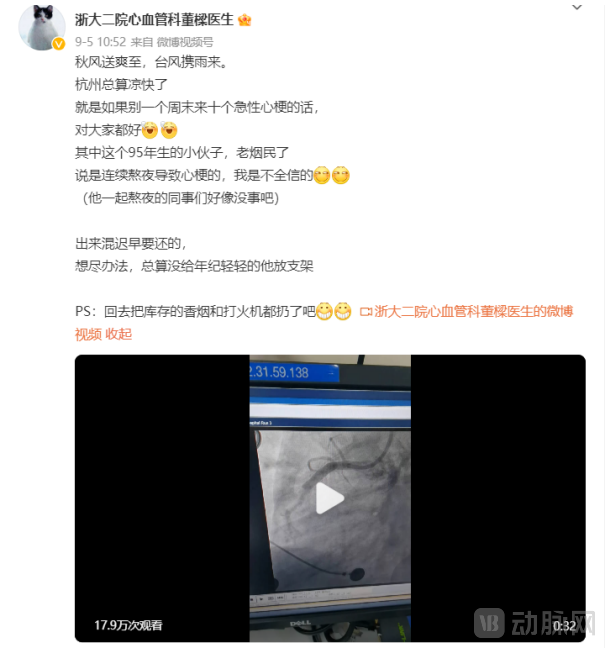
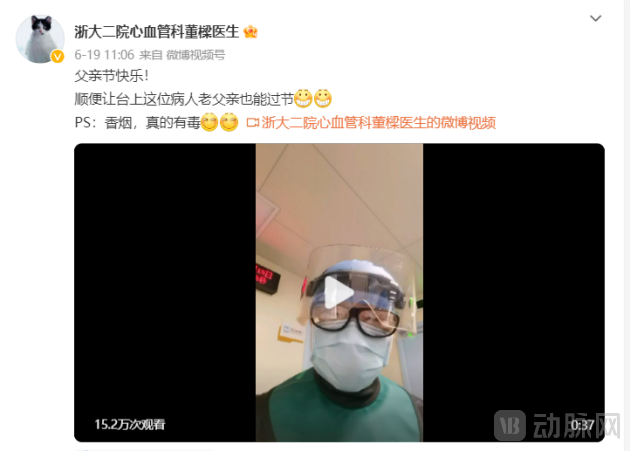
Dr. Dong Liang's Weibo Popular Science Video
He said, “In the field of medicine, different specialties are worlds apart. Although I may have some exposure to medical knowledge in other specialties, I will not provide professional-level popular science education from their perspective. After all, I am not fully aware of the latest advancements in those specialties, and thus the information I convey to the audience might be inaccurate.”Therefore, I focus exclusively on the cardiovascular field, where I have the deepest expertise and clearest understanding, to provide science popularization.”
"Science communication conveys not only knowledge, but also the benevolence of healthcare professionals."
The purpose of science popularization is to provide the general public with greater access to specialized knowledge. However, as a rigorous and highly academic discipline with significant barriers to understanding, medicine has long remained distant from the general public. How can we make professional medical knowledge more accessible to laypeople? Dr. Dong Liang offers the following answer:Do not use "medical jargon" for popular science communication.
Here, “medical jargon” refers to obscure professional principles in medicine. In Dr. Dong Liang’s view, only by explaining these concepts in plain language can effective public science education be achieved.
Dr. Dong Liang stated, “It takes medical students nearly eight years to complete their education from undergraduate studies through to a doctoral degree. Furthermore, after entering hospital practice, junior physicians require at least another 20 years of refinement to be considered competent. Therefore, we cannot expect patients to immediately grasp medical principles that take medical students over a decade to understand. Consequently, during health science popularization efforts, there is no need to require patients to comprehend the precise meaning of obscure terminology; understanding the general gist is sufficient.”
Guided by this philosophy, Dr. Dong Liang frequently uses analogies in his videos to replace complex medical principles, such as “plaque is simply waste buildup in the blood vessels; once we place a stent, we bypass the debris and restore vessel patency,” or “hypertension is like an active volcano—although it may not be erupting now, you must not arbitrarily reduce your medication; preventive measures are essential.” In Dr. Dong Liang’s view,Easy-to-understand analogies can satisfy patients' curiosity while helping them comprehend the treatment plan designed by their physicians., why not go for the best of both worlds?
However, such popular science explanations occasionally lead to unexpected situations. Once, after Dr. Dong Liang explained that a stent was needed for the patient’s plaque, the patient pressed further: “If there’s ‘garbage,’ why not just sweep it out instead of implanting a stent?” This left Dr. Dong Liang at a loss for words, torn between amusement and exasperation.
In retrospect, Dr. Dong Liang reflected that, beyond helping patients understand medical knowledge, the more important goal of science popularization is to help them recognize that physicians’ actions are intended for their benefit. Treating disease is not a battle fought by physicians alone; it also requires patient cooperation.Therefore, optimal treatment outcomes are achieved only when patients place complete trust in their physicians and align fully with them.
A Variety Show, Capturing a Glimpse of an Industry
When discussing how his Weibo followers had surpassed 100,000, Dr. Dong Liang was somewhat shy: “To be honest, the version of me on television is more authentic.”
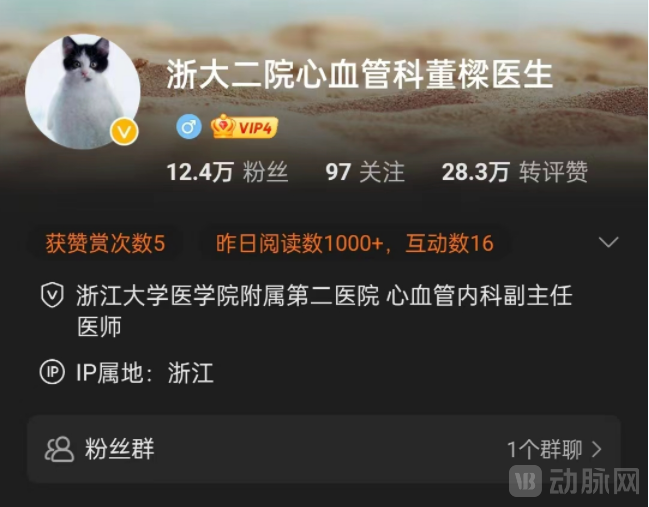
Dr. Dong’s Weibo followers surpass 100,000
“The Heart-Pounding Offer” featured nearly 80 camera angles during filming, aiming to comprehensively showcase the daily work routines of doctors. Compared with Weibo videos and vlogs, variety shows offer greater duration and continuity. In addition to popularizing medical knowledge, they more easily resonate with audiences by highlighting the “professional romance” of physicians.
The so-called “professional romance” of physicians is, in essence, a form of humanistic care.Since the outbreak of the COVID-19 pandemic, the mask-induced marks on doctors’ faces and their chapped hands have framed their image within the lexicon of “selfless contributors” and “heroes.” Yet, being a doctor is not merely a profession; it represents a group of individuals who, once they remove their white coats, also have their own families and personal lives.
The continuity of variety shows allows audiences to gain a clearer glimpse of the physicians behind the white coats, fostering an understanding of these “dedicated professionals” from their perspective, thereby bridging the gap between doctors and patients and building robust mutual trust.
Meanwhile, television programs have a broader audience reach compared to personal social media platforms such as Weibo and Xiaohongshu, enabling them to disseminate popular science content to a larger number of people. On some personal social media platforms, users must actively search for relevant popular science content, whereas television programs can proactively deliver information to their audience.
Dr. Dong Liang once quipped, “Not everyone can become wealthy, but everyone is susceptible to illness.” Through television, audiences can subtly acquire medical knowledge, be reminded to cultivate healthy lifestyle habits, and seek timely medical attention when certain symptoms arise, thereby taking preventive measures before issues escalate.
For Dr. Dong Liang, the original intention behind participating in variety shows was to help more people learn accurate medical knowledge and bridge the gap between doctors and patients; his rise to fame beyond the medical community was truly unexpected.
However, Dr. Dong Liang did not shy away from the enthusiasm of his “fans.” In the face of a surge in followers on Weibo, he leveraged his status as an “internet celebrity” to continue disseminating accurate and authentic medical information. For Dr. Dong, science popularization is not only a professional duty but also a personal passion.After all, behind every “warm-hearted and cheerful” doctor lies a profound respect for life and a deep passion for medicine.