

Xiatong Bio Completes Tens of Millions RMB Angel Funding Round: China's First iPSC-Based Stem Cell Therapeutics Company Focused on Demyelinating Diseases

ExoNeuglia
Developer of Stem Cell Therapeutics for the Nervous System
Recently,Suzhou Xiatong BioCompleted tens of millions of RMB in angel financing, byRedhill CapitalExclusive Investment.Xiatong Bio is a biotechnology company dedicated to the research and development of specialized stem cell therapies for neurological disorders, with profound expertise in the fields of oligodendrocytes and neurons.The company was established byDr. Ying GuoandProfessor Deng WenbinJointly initiated, with complete independent intellectual property rights, isChina's First Cell Therapy Company Dedicated to Treating Demyelinating Diseases Using Induced Pluripotent Stem Cell Technology. The company is based in Suzhou BioBay and moved into the national-level makerspace, Biotop Makerspace, a biotechnology incubator, in July.
Demyelinating diseases of the nervous system are a group of disorders primarily characterized by the destruction, disintegration, and loss of myelin in the nervous system. These conditions include spinal cord injury, multiple sclerosis, Guillain-Barré syndrome, and neuromyelitis optica, affecting tens of millions of patients in China. The myelin sheath is a membrane that envelops the axons of nerve cells. Its main physiological functions are to facilitate the rapid conduction of nerve impulses, provide electrical insulation for nerve axons, and offer protective support to nerve axons. Neurons, oligodendrocytes, and microglia all play crucial roles in demyelinating diseases of the nervous system.Traditional small-molecule and antibody-based drugs have shown limited efficacy in treating demyelinating diseases of the nervous system.
Induced Pluripotent Stem Cells(Induced pluripotent stem cells, iPSCs) are a cell type derived by reprogramming somatic cells. They possess pluripotency similar to that of embryonic stem cells, are free from ethical controversies, and offer broad availability and universality, thereby avoiding immune rejection. These attributes provide new hope for the entire field of neurobiology and clinical regenerative medicine.
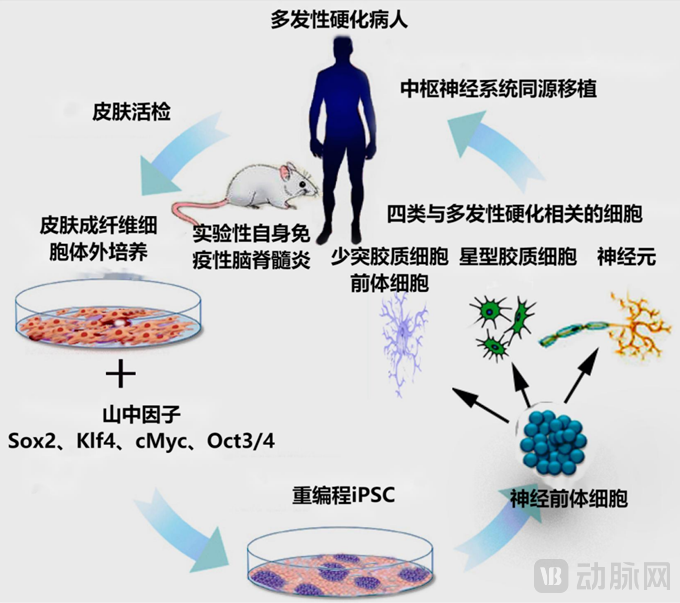
Schematic Diagram of the Procedure for Treating Multiple Sclerosis (MS) Using Pluripotent Stem Cell Technology
(Image source: Article published by the team in Int J Mol Sci. 2015)
Guo Ying, Founder and CEO of the Company, Ph.D. from the University of Barcelona, postdoctoral fellow at UC Davis, with 11 years of research experience in pharmaceuticals and stem cell therapies for demyelinating neurological diseases. Currently engaged in full-time entrepreneurship, leading the company to establish a platform for neural stem and glial cell differentiation and its clinical translational applications.Professor Deng Wenbin, Co-Founder and Dean of the School of Pharmaceutical Sciences (Shenzhen), Sun Yat-sen University, is one of the pioneers in the world to conduct applied research on cell therapy for demyelinating diseases. As early as 2011, Professor Deng’s team published the first article on the successful induction and generation of human glial cells, and has continued to publish a series of articles on the mechanisms, cellular therapies, and pharmacological treatments of demyelinating diseases in journals such as Nature Communications, Nature Protocols, Cell Reports, Cell Stem Cell, PNAS, and EMBO, while also obtaining authorization for relevant international patents.
Dr. Guo Yingstated: “We sincerely appreciate Redhill Capital’s recognition and support of Xiatong Bio. The clinical application of induced pluripotent stem cells (iPSCs) leverages the differentiation potential of stem cells, using reprogramming technologies to generate specific cell types tailored to therapeutic needs for various diseases, thereby achieving treatment objectives. This represents a safe, efficient, and cutting-edge therapeutic approach that offers new possibilities for treating numerous conditions. Although the clinical-grade application of iPSCs currently faces various challenges, our company remains committed to its vision of ‘Healthcare Accessibility, Shared Well-being.’ We strive tirelessly to innovate and develop safe and effective therapies for patients with neurological disorders, aiming to improve their quality of life and advance stem cell therapy toward becoming a standard treatment modality, thus contributing to alleviating human suffering. Xiatong Bio is dedicated to accelerating the R&D and manufacturing of clinical-grade stem cells and expediting their clinical application, so as to benefit patients with global demyelinating neurological diseases at the earliest possible time.”
Li Jie, Partner of Biopharmaceuticals at Redhill Capital“iPSC technology offers tremendous potential for diseases that remain intractable to existing therapies, such as neurodegenerative disorders. Dr. Xia Tong’s team has accumulated years of research experience and gained profound insights in the fields of oligodendrocyte and neuronal cell therapy. As the only iPSC-based cell therapy company in China focused on demyelinating diseases, we look forward to the early market launch of Xiatong Biologics’ products to benefit patients.”
About Redhill Capital
Redhill Capital is an investment firm focused on early-stage equity investments in innovative medical technologies. It was co-founded in early 2018 by Lu Qinchao, former Partner at Sequoia Capital China, and Su Zhenbo, former Managing Partner of Fenxiang Investment Management. Its core team members hail from renowned venture capital firms and possess extensive healthcare industry resources in both China and the United States. Redhill Capital continues to deepen its expertise in the early-stage healthcare sector, systematically investing across multiple areas, including innovative medical technologies such as high-value consumables, in vitro diagnostic reagents, consumer healthcare, and digital health, as well as innovative drugs and novel healthcare services.