

BLZ Technology Pioneers Domestic Medical Device Innovation Through Multi-Product Pipeline and Smart Sensing Integration
In recent years, “integration of medicine and engineering” has become a hot topic in the medical community.
With the continuous development of information technology and the iterative innovation of intelligent devices, the value of interdisciplinary collaboration between medicine and engineering in clinical practice is gradually becoming prominent, whileIntelligent Sensing TechnologyIt has even become a “star” in the highly sought-after field of medical-engineering integration.
This year’s “Two Sessions Report” also specifically emphasizes the need to start from the supply side of healthcare, integrate emerging technologies such as the Internet, artificial intelligence, and 5G, and thereby achieve the “connection,” “efficiency improvement,” and “downward distribution” of medical resources.Policy guidance and market demand both seem to herald the imminent arrival of the era of smart healthcare, ushering in deeper exploration of the interdisciplinary integration between medicine and engineering.
As the wind is about to blow, a team fromHuazhong University of Science and Technologythe team had long been fully prepared. In 2014,Dr. Bu NingbinDr. Bu Ningbin graduated from Huazhong University of Science and Technology with a major in Mechatronic Engineering, focusing his research on intelligent sensing and flexible electronics manufacturing. By integrating his academic expertise with prevailing market trends, Dr. Bu keenly recognized that the convergence of intelligent sensing technology and healthcare represented a major future direction. Immediately after completing his doctoral studies, he leveraged his years of accumulated scientific research foundation to enter the healthcare sector, embarking on his entrepreneurial journey.
Pioneering a Novel Path: Integrating Intelligent Sensing Technology into Medicine
Dr. Bu Ningbin has laid the groundwork for over a decade to achieve the perfect integration of intelligent sensing technology and healthcare.
In 2008, Bu Ningbin focused on intelligent sensing technology during his doctoral studies. After obtaining his Ph.D., he continued to followAcademician of the Chinese Academy of Sciences, Professor Xiong Youlun, engaged in research on intelligent sensing and flexible electronics manufacturing. Leveraging his outstanding research capabilities, Dr. Bu Ningbin has published numerous scientific papers and secured related patents, and has received“HIWIN Outstanding Mechanical Engineering Doctoral Dissertation Award”, the research project also received“Gold Medal at the Geneva Inventions Exhibition”。
Intelligent sensing is an emerging field and the foundation of intelligent machinery manufacturing. However, Dr. Bu Ningbin has never confined himself to the identity of a “male engineering student.” He thought:Technologies in the field of intelligent sensing, such as signal processing and sensor design, must not be confined solely to industrial applications; they should see broader adoption across other sectors.
This idea planted a seed in Dr. Bu Ningbin’s mind, leading him to frequently consider during his daily research whether intelligent sensing could be applied to other fields. After multiple rounds of investigation and assessment, he realized that integrating intelligent sensing technology with medical needs would be a promising approach.
However, the scope of healthcare is vast. Which specific sector should one focus on? Dr. Bu Ningbin provided his answer:“We must leverage our professional expertise while targeting market pain points to conduct valuable scientific research.”
After consulting numerous experts in the field of medical devices and conducting thorough market research, he identified significant challenges in China regarding non-invasive monitoring and measurement.First, with the advancement of medical technology, traditional monitoring’s “six-parameter measurement” can no longer meet the demands of precision medicine., there are new clinical demands for perioperative care and intensive care, creating an urgent market need for a continuous monitoring device capable of capturing all vital parameters in perioperative and ICU medical environments.
Secondly, there is still a significant gap between China and overseas markets in the field of non-invasive monitoring and measurement.Taking Medtronic, a globally renowned medical device manufacturer, as an example, its products had already undergone several generations of upgrades when non-invasive monitoring was just beginning to develop in China. It is no exaggeration to say that although we have been catching up year by year in this field, there is still more than a tenfold gap between Chinese medical device manufacturers and international leaders like Medtronic when it comes to emerging monitoring equipment. Meanwhile, the scope of non-invasive monitoring continues to expand annually, holding significant potential not only in clinical settings but also in the broader health and wellness sector.
Intelligent sensing technology is well-positioned to bridge this gap in China’s medical device sector. By leveraging technologies such as near-infrared spectroscopy and electroencephalography, intelligent sensing systems can monitor physiological parameters—including tissue oxygenation and depth of anesthesia—thereby providing physicians with more accurate and comprehensive data while also helping patients better understand their own health status.
Therefore, whether from the perspective of market demand or research direction, the field of non-invasive monitoring and measurement appears to be the optimal entry point for Dr. Bu Ningbin into the healthcare industry.Finally, in 2015, Dr. Bu Ningbin made up his mind to establish it in Wuhan East Lake High-Tech Development Zone, one of the first national high-tech industrial development zones.BI.Z TECH, thereby paving an innovative path for the integration of intelligent sensing into medicine.
Focus on the development of patient monitoring and dental digitalization to achieve product localization.
In Dr. Bu Ningbin’s view, healthcare is a continuously evolving process, with the focus of each stage shifting accordingly. Therefore, for BI.Z TECH to become an outstanding medical device enterprise, it must keep pace with the times and innovate constantly. Dr. Bu has also formulated a “Three-Year Plan” for BI.Z TECH—achieving a major milestone every three years to ensure the advanced nature of its products.
At the outset of its founding, BI.Z TECH took the lead in positioning itself in the field of patient monitoring, which accounts for the largest share of the non-invasive monitoring and measurement sector. Dr. Bu Ningbin designated his primary focus onPerioperative and Critical CareThis niche sector focuses on the development of products for tissue oxygen monitoring, anesthesia depth, and hemodynamics.
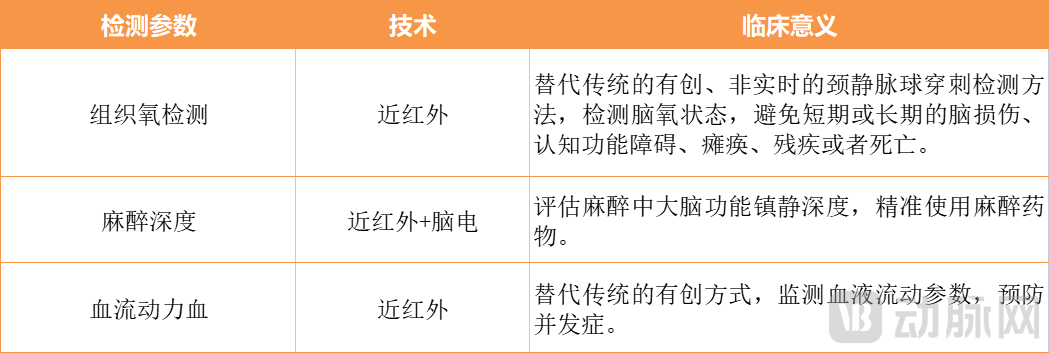
▲Figure 1. Technical Highlights and Clinical Significance of BI.Z TECH’s Perioperative Monitoring Products
Among the product series for patient monitoring, the BI.Z TECH team has innovatively integratedLB Algorithm for Oxygen Saturation in Intelligent Sensing and AI-Based Anesthesia Depth Algorithm for Bispectral Indexand other technologies, significantly improving the accuracy of the monitor.In addition, BI.Z TECH’s products can achieve integrated interoperability with one another., and intelligently integrates and analyzes important parameters such as tissue oxygen monitoring, depth of anesthesia, and hemodynamics, becoming an important component of medical informatization to enhance healthcare professionals' monitoring of physiological functions in perioperative or anesthetized patients.
Under the leadership of Dr. Bu Ningbin, BI.Z TECH completed its foundational layout in tissue oxygen monitoring, depth of anesthesia, and hemodynamics within three years of its establishment. For the next three-year plan, Dr. Bu Ningbin has set his sights onDental Digitalization。
The digital diagnosis and treatment model is widely recognized within the industry as a key development trend in the future of prosthodontics. Therefore, BI.Z TECH has decided to focus on the foundation of digital dental diagnosis and treatment—Intraoral ScannerInitiate the challenge.
Currently, intraoral impressions are commonly obtained using the “PVS impression + 3D printing” approach; however, this method is associated with a low success rate and poor patient comfort.
BI.Z TECH’s intraoral scanner is equipped with features such as automatic point cloud registration and matching. By using a compact, probe-style optical scanning head to scan the patient’s oral cavity, it can directly capture 3D surface topography and color texture information of both hard and soft tissues, including teeth, gingiva, and mucosa. This approach significantly simplifies clinical workflows and increases the impression success rate to over 95%.
Whether in the vital signs monitoring pipeline or the dental digitalization pipeline, BI.Z TECH’s products share a very distinct characteristic—Localization。
Statistics show that 80% of China’s high-end medical devices still rely on imports. Due to differences in healthcare development directions and physicians’ operational habits across countries, Chinese doctors often find most imported devices “unwieldy” or “not user-friendly.” Although Chinese medical device manufacturers have increasingly prioritized domestication in recent years, many domestically produced devices are still modeled after foreign counterparts. Their design processes fail to incorporate Chinese clinical practices or make empathetic, user-centered improvements. As a result, many such devices are merely “Chinese versions” of imported equipment, offering superficial changes without substantive innovation.
Based on this, Dr. Bu Ningbin established an “ironclad rule” for BI.Z TECH—“The localization we pursue must not be a hollow shell; rather, it must align with the thinking patterns of Chinese people in every aspect, from design to usage, and we must remain committed to independent research and development.”
Therefore, BI.Z TECH’s products, ranging from sensors and chips to operational settings, are developed independently as much as possible, with the goal of achieving localization in China. This approach not only better aligns with the usage habits of medical professionals in China but also controls costs, expands commercialization potential, and lays the foundation for large-scale mass sales of its products.
Most critically, a high degree of domestic production fundamentally eliminates risks to pricing and production levels stemming from shifts in international relations, thereby ensuring the stable supply and consistent quality of products, which allows healthcare professionals in China to use them with confidence and peace of mind.
Dr. Bu Ningbin told VCBeat’s Orange Fruit Bureau, “In my view, the healthcare industry carries a public welfare nature. Therefore, BI.Z TECH does not rely on mass manufacturing to control costs; instead, it leverages technological breakthroughs to provide cost-effective medical equipment for China’s healthcare sector.”
Striving for Excellence, Driven by Dual Domestic and International Engines
Currently, many renowned hospitals in China, such as Tongji Hospital, Peking Union Medical College Hospital, Bethune Hospital, and West China Hospital of Sichuan University, have adopted medical devices from BI.Z TECH. However, Dr. Bu Ningbin is not content with serving only the domestic market; therefore, the company continues to upgrade its products, striving for excellence and aiming for a dual-drive strategy in both domestic and international markets. The two “unique” advantages of BI.Z TECH appear to have become its strongest assets for global expansion.
These two “uniques” are respectively“The only team with comprehensive expertise in cerebral oxygenation monitoring, depth of anesthesia monitoring, and non-invasive hemodynamic monitoring.”and“The only product in China that adopts international standards.”
First, BI.Z TECH has mastered all the technologies in cerebral oxygen monitoring, anesthesia depth monitoring, and non-invasive hemodynamic monitoring.A closed-loop system has been established for perioperative and critical care vital signs monitoring., which lays a solid foundation for BI.Z TECH to develop a comprehensive perioperative anesthesia monitoring platform in the future.
In addition, “compliance with international standards” has also paved the way for BI.Z TECH to expand into global markets.By adopting international standards, BI.Z TECH has not only enhanced the overall quality of its products but also gained greater recognition overseas, thereby strengthening its global competitiveness.
Another implication of international standards is the globalization of industrial design through relentless refinement, creating high-end designs and shaping a premium form of “Made in China.”Currently, BI.Z TECH has won the “China Red Star Design Award” and the “German Red Dot Design Award,” with its products exported to more than 50 countries and regions worldwide, achieving innovative global expansion. Over the past two years, despite the ongoing impact of the pandemic on the domestic market, BI.Z TECH has maintained stable sales performance by leveraging its mature overseas channels and extensive sales experience.
BI.Z TECH’s advanced technological capabilities and strong market presence have drawn significant attention from venture capital firms. In August this year,BI.Z TECH Completes Tens of Millions in Series A Financing, Exclusively Invested by Shuimu Ventures, for product updates and upgrades as well as commercialization.
Shuimu Ventures stated, when discussing its rationale for investing in BI.Z TECH, “We fully recognize Dr. Bu and the core technical team’s years of accumulated research expertise in the field of intelligent sensing. The technical team, primarily composed of Ph.D. graduates from Huazhong University of Science and Technology, not only possesses strong R&D capabilities but has also developed significant synergy and mutual trust through years of collaboration. Furthermore, BI.Z TECH is built on platform-based technologies with strong scalability, which facilitates the subsequent development of a broader product matrix to meet more diverse market demands.”
With the support of Shuimu, BI.Z TECH has not only received financial assistance but also gained valuable commercialization experience. Dr. Bu Ningbin stated, “Shuimu Ventures provided us with many invaluable insights for our commercial promotion, helping us avoid numerous ‘pitfalls common to newcomers.’”I am confident that, with the support of Shuimu, BI.Z TECH will continue to enrich its product pipeline and provide more options for the medical community. Meanwhile, it will further expand into both domestic and overseas markets, establishing a solid foothold in China while maintaining a global perspective.”