NeuroXess Achieves Reproducible Clinical Breakthrough with China's First Fully Implantable, Wireless, and Functional BCI System

NeuroXess
Invasive Brain-Computer Interface Developer

Medical Device Media Reporting Pioneer
Share Professional Medical Device Knowledge
On April 23, NeuroXess announced significant clinical progress:Following the successful implementation of China's first "fully implanted, fully wireless, fully functional" ("three-all") brain-computer interface by the end of 2025, its second clinical trial has achieved a milestone breakthrough.
Through50 Milliseconds Full-Link Ultra-Low LatencyGlobally FirstBCI-FES Closed-loop TechnologyThrough the deep integration, a 29-year-old art teacher with high-level paralysis not only regained the ability to eat independently but also miraculously used his thoughts to control his hands, allowing him to pick up a pen again to draw and write blessings.This marks the official entry of China's brain-computer interface intoClinically Practical and Replicable PromotionA new era.
Notably, this product isThe first in China, the second in the worldFully Implanted Brain-Computer Interface Product with Built-in Battery.
The subject of this trial is a 29-year-old young father and art teacher who suffered a cervical spine fracture and high-level paralysis due to an accident, losing nearly all motor function below the shoulders, and was forced to leave his beloved teaching position. In December 2025, he underwent the "Triple-Complete" brain-computer interface implant surgery at the First Affiliated Hospital of Nanchang University, becoming the second trial subject in China. Postoperative recovery has exceeded expectations:
- Postoperative Day 1
: Transferred to a general ward, with minimal trauma and fast recovery. - Postoperative Day 5
: Achieve mind control upon the first boot. - One Month Post-Operation
: Core Breakthrough Emerges —— Through BCI-FES Technology,Independent control of the affected hand to complete precise grasping, writing, and drawing。
The warmth of technology is embodied in three deeply moving "firsts":
- The First Brain-Controlled Companionship: Playing a Video with Thoughts, Watching an Episode of a Cooking Tutorial with Kids, and Making up for the Missed "Early Education Class".
- First Self-Feeding: Using a Brain-Controlled Exoskeleton to Steadily Hold a Water Glass and Fork, Eating and Drinking Independently, Dignity Returns to the Fingertips.
- The First Stroke of the Pen: Through BCI-FES technology, he used his own hand to draw a family portrait and write birthday wishes. The moment the brush touched the paper, he not only regained his art but also reclaimed his complete life as a father and creator.
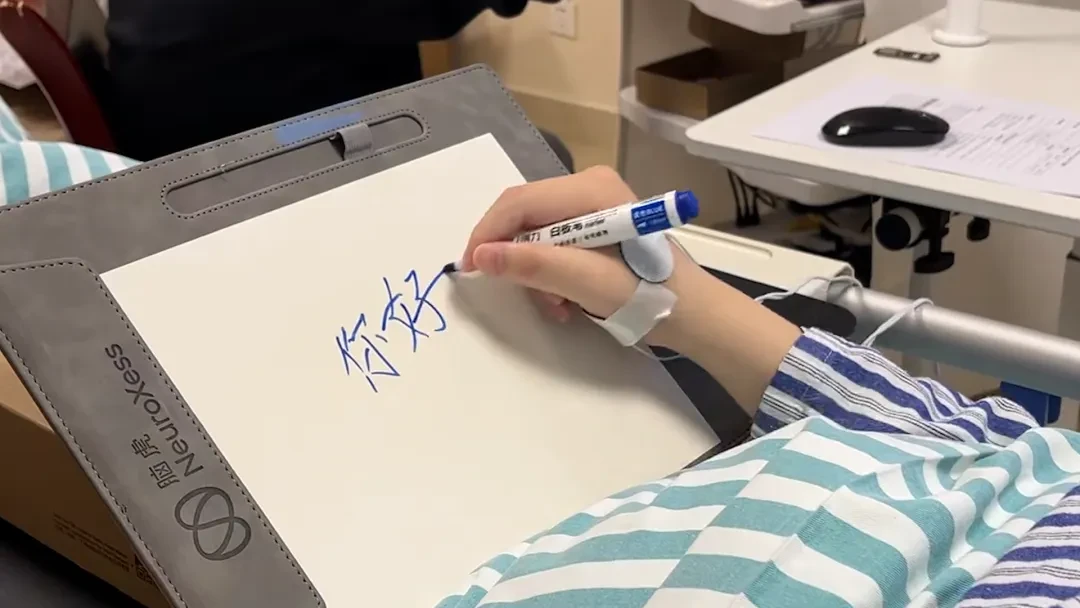
Patients Achieve Independent Writing with BCI-FES Technology
This success validated the technology across different patients.Stability and Universality, paving the way for large-scale clinical application.
The core of this breakthrough is NeuroXess's unique "Sanquan"Perfect Combination of Brain-Computer Interface System with Two Innovative Technology Pathways."
Fully Implanted: All core modules (including the battery) are fully implanted in the body, with no cables or interfaces exposed on the skin surface, completely eliminating infection risks associated with traditional external systems. By drawing on Deep Brain Stimulation (DBS) technology, the battery module is placed subcutaneously in the chest, effectively solving heat dissipation challenges by leveraging the high-temperature tolerance of human tissue. Compared to Neuralink's intracranial battery solution, heat generation is reduced by 90%.
All Wireless:The system integrates wireless power supply and wireless data transmission functions, freeing patients from the constraints of external devices. The system adopts a customized Ultra-Wide Band (UWB) transmission protocol, operating in the 6-8GHz frequency band, with a transmission rate of 1Mbps and power consumption controlled at 10mW, which is 50% lower than Bluetooth Low Energy (BLE) (power consumption 20mW) at the same transmission rate.
Full Function: The system integrates modules such as EEG acquisition, AI decoding, and multi-device control, powered by the self-developed operating system XessOs. It supports applications like mind-controlled cursor, gaming battles, and smart home management, and is capable of connecting to devices such as airbag gloves, intelligent wheelchairs, and humanoid robots, building an "extended body" ecosystem.
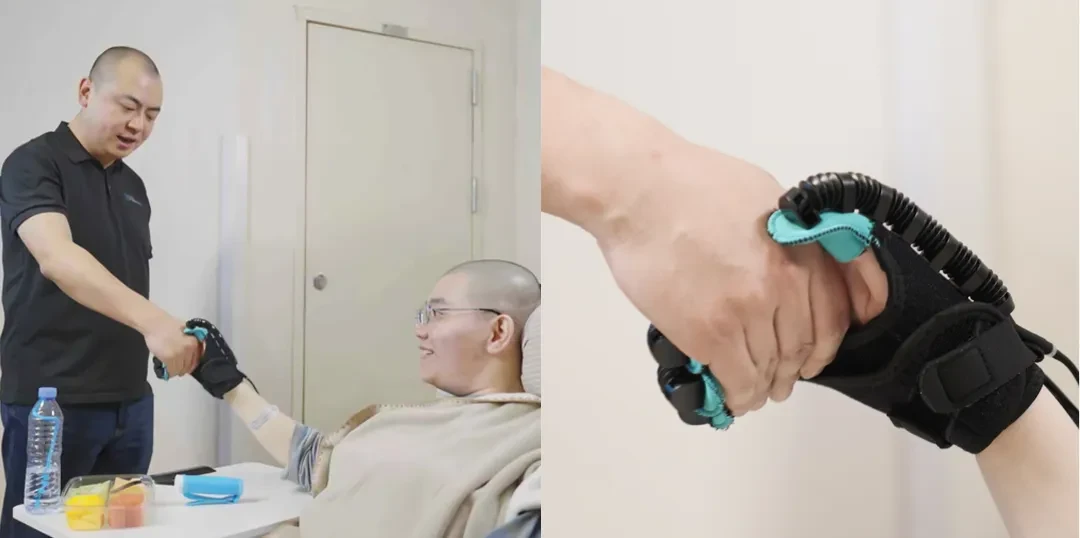
NeuroXess Founder and Chief Scientist Tao Hu (left) shakes hands and communicates with a patient (mind-controlled exoskeleton).
This ClinicalFor the First Time GloballySimultaneously validating two major technical pathways, covering the full cycle from early postoperative to long-term rehabilitation:
Brain-Controlled Exoskeleton——Regaining Self-Care Ability
Decoding motor intentions through brain-computer interfaces to precisely control exoskeletons, achieving functional compensation such as autonomous feeding and accurate grasping, allowing patients to regain their dignity in daily life at the earliest opportunity.
BCI-FES Closed-loop —— Move Your Own Hands
For the first time, Brain-Computer Interface-driven Functional Electrical Stimulation (BCI-FES) technology was adopted to build a complete closed-loop system of "Thought-Decoding-Stimulation-Movement." This bypasses the damaged spinal cord and directly stimulates peripheral muscles with precision. One month after the surgery, autonomous grasping and writing were achieved, marking a transition from "external assistance" to "self-rehabilitation."
AsThe first in China, the second in the worldNeuroXess, with its fully implantable brain-computer interface product powered by an internal battery, has joined the ranks of a small number of global enterprises that master this core technology. This breakthrough is not only a victory for NeuroXess but also a collective milestone for China's neurotechnology industry. As the "Three-Alls" solution scales up, tens of millions of patients with spinal cord injuries, stroke, and motor neuron diseases will see the dawn of returning to a normal life.China's Brain-Computer Interface Leads the Global Neurorehabilitation Era with Safety, Practicality, and Warmth。
More exciting content
Welcome to follow WeChat Video Channel


Philips Global CEO: To Expand Investment and Increase R&D in China
China's Leading Nuclear Medicine Company Signs Agreement in Suzhou
Harnessing the Core to Integrate Medicine (I) | Tracing Origins and Looking Ahead: The Past and Present of Cyclotrons
Johnson & Johnson, Another Major Acquisition
United Imaging × Ruijin Hospital's First Co-created Product: Empowering Brain-Computer Interface
The Father of Modern Cardiology Passes Away
Cardiovascular First Stock: Net Profit Surges 300%, Bets on Brain-Computer Interface
Orthopedic Leader on STAR Market Establishes Intelligent Surgical Robotics Company
Boston Scientific Q1: Performance Increased by 11.6% Year-over-Year
Up 38.85% Year-on-Year! Mindray's New Core Engine

BusinessBusiness cooperation email: qxzj@landianyiliao.com