

Dr. Yue Jianing of Zhongshan Hospital Fudan University Leverages Short Video Medical Education to Build Patient Trust
“Science popularization is a natural habit for doctors, as well as their responsibility.” FromDr. Yue Jianing, Department of Vascular Surgery, Zhongshan Hospital Affiliated to Fudan Universitystated thus.
Open Dr. Yue Jianing's Douyin account“Yue Hua Yue Mingbai”, we found that since May 2020, he has been conducting medical science popularization through short-video platforms. To date, he has uploaded 688 educational videos, accumulating 3.815 million likes and reaching 458,000 followers.
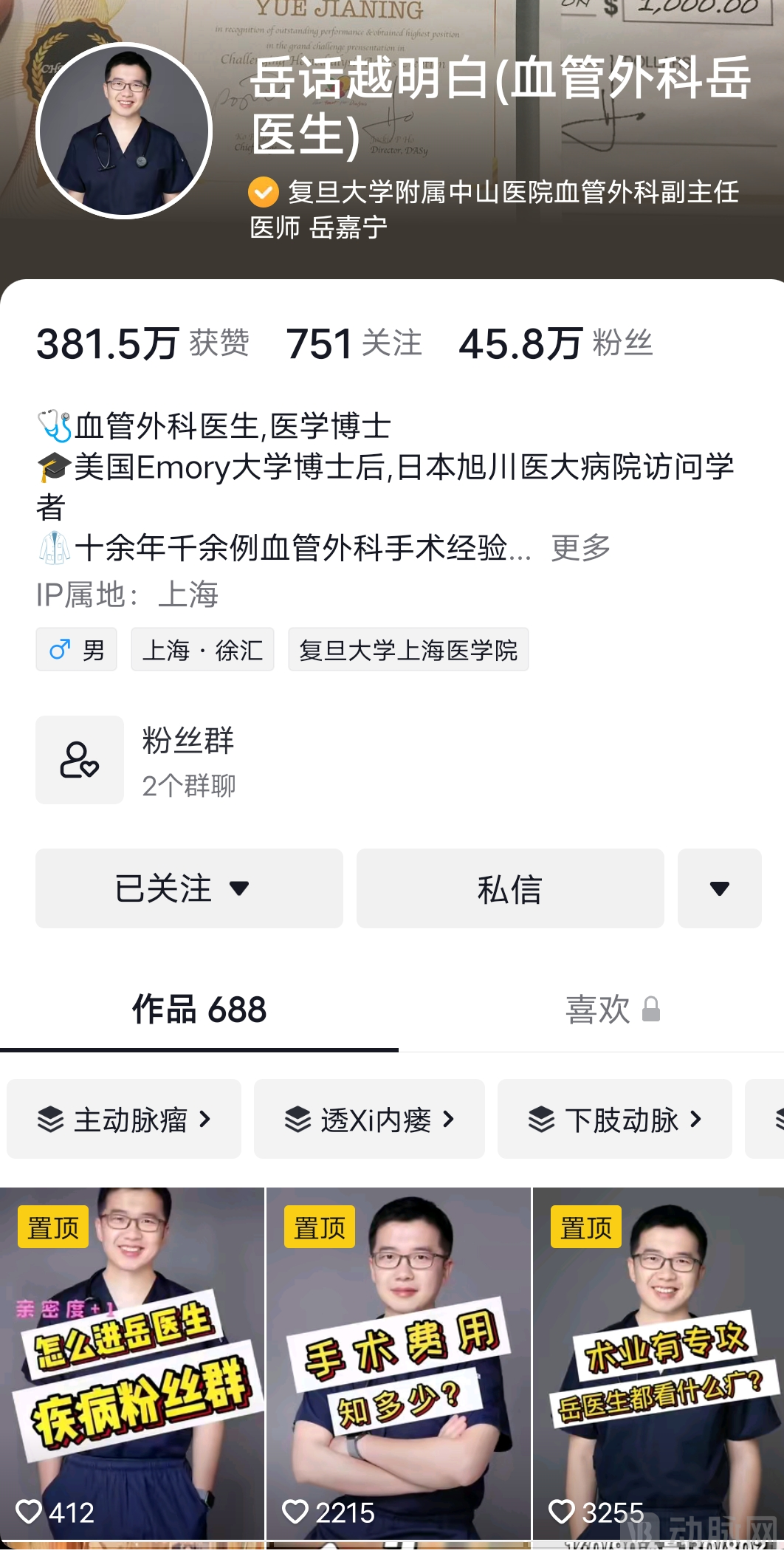
Through these shared insights, we have learned that Dr. Yue Jianing consistently draws material and inspiration from real-world clinical cases, leveraging his spare time to disseminate professional medical knowledge to the public. Furthermore, patient comments in the video section—such as “highly informative,” “his explanations are substantive and clearly reflect a solid theoretical foundation; Dr. Yue is well-suited for teaching, making complex topics accessible and easy to understand,” and “extremely beneficial; I had never paid attention to this issue before”—underscore the significance of Dr. Yue Jianing’s short-video science popularization efforts.
Indeed, this is a highly meaningful endeavor; in addition to saving lives on the operating table, Yue Jianing also saves lives through popular science outreach on short-video platforms.
"Becoming a Short-Video Medical Knowledge Blogger"
In a narrow sense, science popularization refers to the dissemination of knowledge using plain language, while medical science popularization takes diverse forms.
At the live broadcast of Boston Scientific’s Innovation Training Academy “Cross-Border Exchange for Joyful Learning,” Dr. Yue Jianing told the audience that medical science popularization can be divided into two major categories: “traditional science communication” and “new media science communication.”
Traditional health education refers to the conventional approach in which physicians disseminate medical knowledge through print media such as newspapers and magazines, television, or online platforms including Weibo, official accounts, and WeChat Moments. These formats present significant challenges: written content demands strong literary skills, while television appearances require physicians to have a certain level of public recognition and excellent communication abilities.
This is not an opportunity available to every physician. He then poked fun at himself, saying, “My writing skills are mediocre, and my article output efficiency is low.”
Moving away from the aforementioned popular science formats, Dr. Yue Jianing became a short-form video medical influencer out of personal interest. Given his strong interest in electronic devices, he experimented with using short videos for medical education, an approach he defines as “new media science communication.”
Compared with “traditional science popularization,”Short videos offer the advantages of higher efficiency and better effectiveness.. First, from the physician’s perspective, it requires less time and effort, making content creation more convenient; each knowledge point is produced as a short video, with each video kept to 1–2 minutes in length, which is highly accommodating for clinicians with busy schedules; second, from the patient’s perspective,AI algorithms on short-video platforms can push specific content to targeted audiences., making it easier for patients to see doctors' popular science content.
Certainly, as public demand for health-related content rises, an increasing number of physicians are engaging in science popularization on a personal basis online, with short-video formats seeing substantial growth.
According to statistics, the total number of individual doctor accounts on Douyin reached 941, with a total of 32,500 videos covering 40 specialized disease areas. Meanwhile, on Kuaishou, the total number of individual doctor accounts reached 702, with 16,560 videos covering 36 specialized disease areas.
Many doctors in China have flocked to the field of short-video-based science popularization, where the choice of direction is particularly crucial. Currently, there are three main approaches for physicians engaging in health education: the first is the general wellness model, which requires a comprehensive understanding of various diseases; the second is the specialized model, which explains professional medical knowledge in accessible language; and the third is the “expertise plus personal charisma” model, which presents professional knowledge to the audience in a humorous and witty manner.
Dr. Yue Jianing chose to leverage her professional expertise to explain concepts to the audience in plain, accessible language.Knowledge of Vascular Surgery.
# If You Can’t Avoid Traffic Theory, Seize It
The Essence of a Doctor’s Personal Brand Is That of a Knowledge Influencer,Content Is King, demonstrating professionalism, distinctiveness, and authenticity to the audience, while short-video techniques—such as account management, traffic-generation tactics, and editing skills—should serve only as supplementary tools for science communication.
Dr. Yue Jianing told us that medical science popularization by physicians is not about adopting an "internet celebrity" mindset; rather, it places greater emphasis on knowledge dissemination, aiming to earn patients' trust and recognition.
Therefore, for physicians, enhancing the precision of targeting specific audiences (target patients) is more important than simply increasing follower counts. In addition to crafting content that highlights professionalism and employs engagement techniques to boost completion rates, physicians must also leverage platform algorithms to identify and reach patients among the 600 million daily active users who have an interest in medicine or cardiovascular diseases.
Once short-video science communication is chosen, traffic theory becomes an inescapable reality for physician bloggers. Yet patient education content is often dry; how can creators keep viewers engaged? Yue Jianing shares his experiences and reflections from over two years in the field:
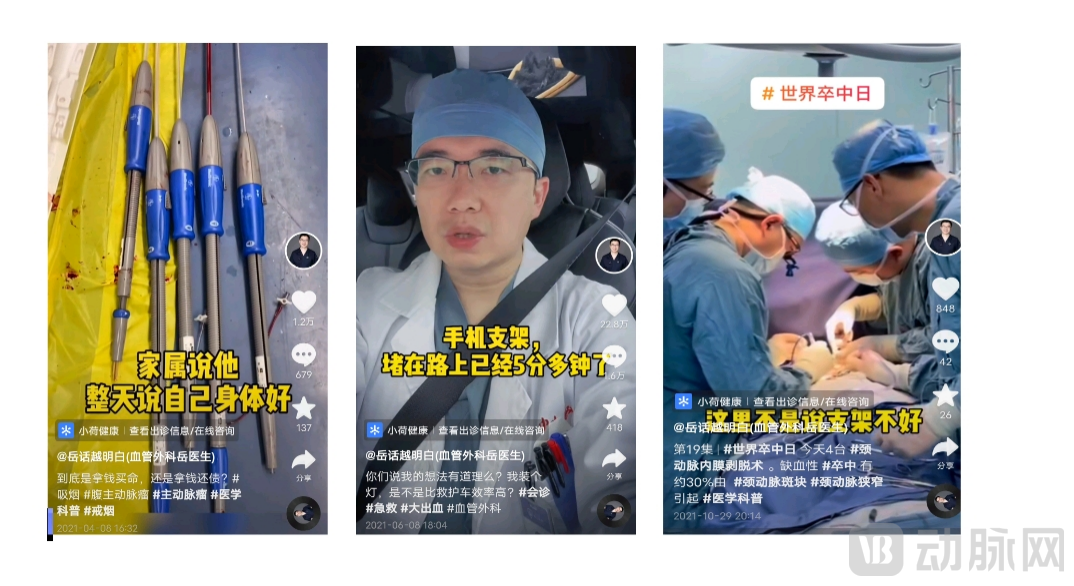
First isObscure Knowledge Needs Stories to Carry It, medical science popularization needs to find an appropriate approach.
“Science communication is not necessarily didactic; relentless lecturing will drive most people away from your channel.” With this understanding in mind, Dr. Yue Jianing has adopted a storytelling approach to transform dry, technical knowledge into engaging content.
Taking “Incision Size in Minimally Invasive (Radiofrequency) Treatment for Varicose Veins” as an example, he wove the surgical procedure and a nurse’s reflections into a compelling narrative to highlight the advantages of minimally invasive varicose vein treatment. These two elements did not occur simultaneously but were pieced together from daily records, with the benefits of varicose vein treatment articulated through the nurse’s perspective. The video ultimately garnered 220,000 views. According to Douyin’s algorithm, approximately 50,000–60,000 patients with varicose veins were exposed to the advantages of minimally invasive surgery for this condition.
Secondly,Learn to “ride” trending topics.
“Jumping on trending topics aligns with Douyin’s algorithm for maximizing traffic,” said Dr. Yue Jianing. Therefore, during the Shanghai lockdown, he uploaded a video titled “How Shanghai Doctors Went to Work During the Pandemic Lockdown,” documenting the daily routines of doctors using the then-popular “chronological log + background music” format.
Again isDemonstrate Professionalism to the Audience。
“The key to popularizing medical knowledge lies not in the number of followers, but in demonstrating professionalism to patients.” He has always emphasized this point.
Dr. Yue Jianing candidly stated that health education does not necessarily require explaining every detail of a disease’s etiology and progression to patients; rather, its purpose is to foster patients’ trust in the physician’s professionalism and encourage them to entrust their treatment to him.
Taking “Carotid Endarterectomy” as an example, the video educates patients on the differences between carotid endarterectomy and stent therapy. In this video, Dr. Yue Jianing not only shares extensive professional knowledge but also incorporates numerous intraoperative footage clips, allowing patients to more intuitively perceive that the physician has a genuine understanding of the disease and possesses substantial clinical experience.
Lastly,Science Popularization Must Maintain Consistent “Indications” from Start to Finish。
Every medical specialty involves controversies, particularly in surgery, where disagreements arise over whether to operate and which type of procedure to perform. Dr. Yue Jianing believes that while management approaches may vary among teams, they all remain within the bounds of established clinical practice guidelines.
Medical popularization videos are promoted to a wider audience through platforms; therefore, physicians must adhere to factual accuracy when creating such content, ensuring that their explanations do not exaggerate beyond actual clinical practice.
Ultimate Goal: Gaining Patient Trust
Demonstrating professionalism is the cornerstone of trust, and trust fosters harmonious doctor-patient relationships.
For physicians, demonstrating professionalism through short-form educational videos aims to garner greater patient understanding and recognition. In future patient interactions, this approach not only facilitates patient acquisition but also breaks down communication barriers between doctors and patients, improves patient adherence, fosters closer relationships, and saves time and energy in providing ongoing patient education.
Meanwhile, he also hopes to achieve this through short-video-based science popularization.“Education + Consultation + Treatment + Follow-up”: A Four-Wheel Drive Model, truly achieving a win-win situation for both doctors and patients.
Specifically, physicians must first create high-quality popular science content to establish a professional persona and educate patients about their conditions. Second, platform algorithms should be leveraged to identify and triage suitable patients, facilitating physicians’ guidance toward appropriate medical-seeking behaviors. Third, doctor-patient relationships should be established through reputable online and offline medical institutions to deliver high-quality medical services. Finally, long-term patient management should be conducted via patient communities, social media platforms, and online follow-up tools to enhance treatment and rehabilitation outcomes.
Trust is the most critical element throughout this entire process. Therefore, Dr. Yue Jianing will continue to use short videos for science popularization.Empower more patients with professional knowledge, and foster greater trust between doctors and patients.