

Jiufeng Medical Secures China's First Class III AI Certification for Tuberculosis Detection on Chest X-rays
Many people regarded 2020 as a pivotal turning point for AI in medical imaging. It was in that year that the approval process for AI-based medical imaging solutions gradually became streamlined. Subsequently, the industry experienced smooth growth, with Class III medical device certifications for AI products in multiple specialties and departments—including orthopedics, ophthalmology, and pulmonary nodule detection—being approved successively. The “Guiding Principles for Registration Review of Artificial Intelligence Medical Devices,” officially released in 2022, clarified the detailed review criteria for AI products. This made obtaining Class III certification an important safeguard for the safe application of AI products in clinical settings and laid the foundation for the standardized development of the AI industry in the years that followed.
However, due to the relatively limited information content in X-ray images, the application of artificial intelligence for assisted assessment of tuberculosis imposes extremely high demands on algorithmic capabilities and data accumulation. In the “puzzle” of AI medical imaging, solutions tailored for tuberculosis—the primary infectious disease driving poverty and causing relapse into poverty among rural populations—have long been absent.
Encouragingly, the application of artificial intelligence in tuberculosis prevention and control has finally achieved a breakthrough. On October 20, 2022, information on the official website of the National Medical Products Administration indicated thatJF HEALTHCARE’s “AI-Assisted Evaluation Software for Tuberculosis X-ray Images” Officially Receives NMPA Class III Medical Device Registration Certificate
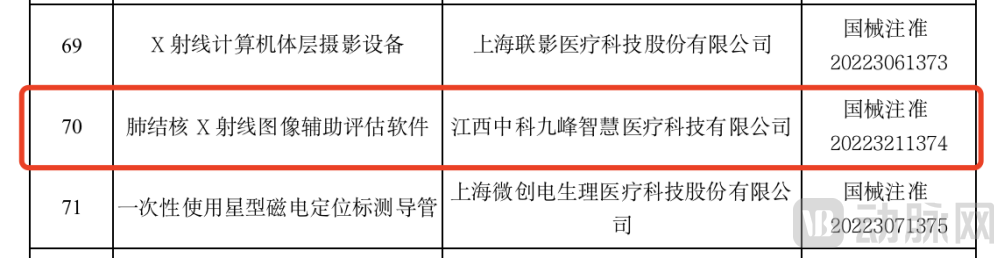
It is understood that this is the first Class III medical device certification for an artificial intelligence (AI) system targeting pulmonary tuberculosis in China, as well as the first Class III AI certification for X-ray imaging of lung diseases. The approval of this Class III certification not only provides a breakthrough solution to address weak links in China’s tuberculosis prevention and control efforts but also demonstrates JF HEALTHCARE’s capabilities in the fields of AI-powered X-ray imaging and respiratory infectious diseases.
JF Healthcare, holder of China’s first Class III medical device certification for an AI-based tuberculosis diagnostic system, has undoubtedly taken another major step toward its vision of “empowering China’s most grassroots medical institutions with artificial intelligence technology.”
Although tuberculosis emerged as early as 7,000 years ago, the number of tuberculosis patients continues to rise today.
According to the World Health Organization’s Global Tuberculosis Report 2022, there were an estimated 10.6 million new cases of tuberculosis worldwide in 2021, representing a 4.5% increase compared with 2020. China is one of the 30 high-burden countries for tuberculosis globally, with 780,000 new cases, ranking third in terms of estimated TB incidence.
Particularly severe is the fact that tuberculosis (TB) incidence is concentrated in regions with relatively underdeveloped medical conditions and economies, making it a primary infectious disease causing poverty or return to poverty due to illness in rural areas. However, early symptoms of TB are easily overlooked; patients typically seek medical attention only after experiencing cough and sputum production for weeks or even months. Given that TB prevention and control models are predominantly passive, this delay can lead to the infection of dozens of surrounding individuals. Furthermore, China faces challenges such as a large rural population and weak grassroots prevention and control capabilities. Under the existing traditional model, TB prevention and control efforts suffer from extremely high rates of misdiagnosis and missed diagnosis, making it exceedingly difficult to achieve the goal of ending the TB epidemic.
Therefore,The industry urgently needs to adopt innovative approaches and proactive detection measures to provide early intervention for tuberculosis patients and recent infections, thereby shifting the focus of tuberculosis prevention, screening, diagnosis, and treatment upstream.
Medical imaging is a critical tool for diagnosing pulmonary tuberculosis; however, primary healthcare institutions not only lack qualified radiologists but also do not possess the extensive CT/MRI equipment available at large tertiary hospitals, relying primarily on X-ray devices.
With chest X-rays, doctors can determine the location, extent, nature, and type of pulmonary lesions in the diagnosis of pulmonary tuberculosis. Combined with clinical symptoms, a definitive diagnosis can be made for most cases of pulmonary tuberculosis. In the 2016 World Health Organization (WHO) publication "The Role of Chest Radiography in Finding Tuberculosis," emphasis was placed on chest X-ray (CXR) examination as an important tool for early detection of tuberculosis and a crucial foundation for achieving the WHO's End TB Strategy.
After identifying the pain points in tuberculosis screening at the primary healthcare level, JF HEALTHCARE chose to make a breakthrough with an AI-powered product for chest X-ray image analysis and applied artificial intelligence technology to tuberculosis screening. After years of research and development, the company successfully obtained the first Class III medical device certificate from the National Medical Products Administration (NMPA) in this field.
Wu Wenhui, founder of JF Healthcare, told VCBeat: ““Tuberculosis X-ray Image-Assisted Evaluation Software” enables the early detection of tuberculosis patients, thereby preventing transmission to surrounding populations. This technology can significantly reduce the rates of missed and misdiagnosed cases of tuberculosis, saving substantial medical costs for both the public and the state each year.“And we will also move one step closer to JF Healthcare’s vision of helping more township patients access ‘affordable healthcare.’”
It is understood that JF HEALTHCARE's“Pulmonary Tuberculosis X-ray Image-Assisted Evaluation Software”Applicable to the storage, transmission, display, and processing of posteroanterior chest DR medical images, it can assist in indicating whether patients have active pulmonary tuberculosis without immunodeficiency, while simultaneously enabling the determination of normal versus abnormal lung findings, presenting probability scores for pulmonary tuberculosis, and intelligently differentiating between active and inactive pulmonary tuberculosis.
However, applying artificial intelligence to assist in the assessment of pulmonary tuberculosis using images with relatively limited information content, such as X-rays, poses a significant challenge to algorithmic capabilities. According to Dr. Li Jian, CTO of JF HEALTHCARE, X-ray-based algorithms for tuberculosis detection resemble “black boxes,” demanding exceptionally high standards for both training datasets and annotation quality.
Fortunately, JF HEALTHCARE has been rooted in primary healthcare since its inception, choosing medical imaging as its entry point. By applying artificial intelligence technology, it provides high-quality, low-cost, widely accessible, and efficient diagnostic services to county-level, township-level, and community-based primary healthcare institutions. Aimed at effectively addressing the fundamental challenge of a shortage of high-quality physicians in China’s tiered diagnosis and treatment system and rural revitalization efforts, the company continues to expand collaborations with medical institutions, research organizations, and industry partners, deeply exploring the value of technology and data to lay a solid foundation for future product development.
Dr. Li Jian told VCBeat, “Innovating to support the implementation of the national strategy for ‘Rural Revitalization’ has always been JF HEALTHCARE’s steadfast commitment. During our development, we realized“X-ray” is a key application scenario for artificial intelligence technologies in primary healthcare institutions,Primary care diagnosis can hardly bypass ‘X-ray’. Given that JF Healthcare’s strategic development direction is sufficiently focused, we have therefore fromSince its inception, it has collected a large volume of chest X-rays in this direction and established a labeling team with robust image annotation capabilities, as well as an excellent algorithm team.“Securing China’s first Class III AI certification for tuberculosis is, for JF HEALTHCARE, more of a continuous and natural progression.”
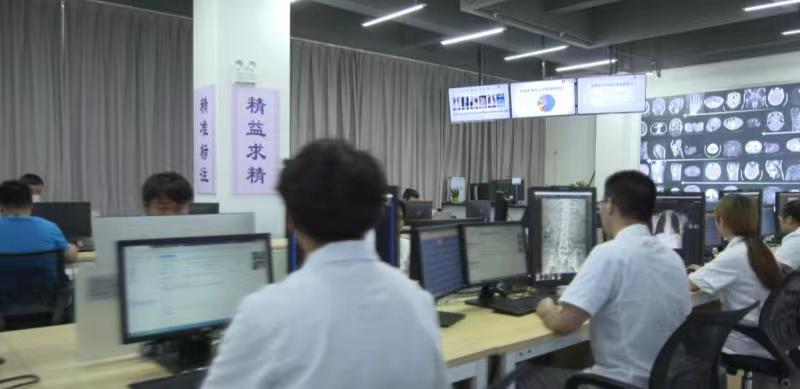
JF Healthcare Medical Team
Through solid algorithmic accumulation and rigorous clinical trials, JF HEALTHCARE has ultimately pioneered a new model for tuberculosis prevention and control.
It is reported that,The technical foundation of the “Tuberculosis X-ray Image Assisted Evaluation Software” stems from a National Science and Technology Major Project led by JF Healthcare. During the application process, this technology was selected as a frontier achievement by the China Association for Science and Technology and included in the NMPA’s Priority Review Program for Medical Devices.Not only that,Its training dataset comprises hundreds of thousands of chest radiographs, including normal images, cases of pulmonary tuberculosis, and other thoracic diseases. All data annotations were reviewed and verified by senior radiologists with more than 20 years of clinical experience. Clinical trial results demonstrated a positive agreement rate of 94.2%, a negative agreement rate of 91.2%, and an overall concordance rate of 93% with senior radiologists.
In the face of the current situation characterized by inadequate infrastructure and low levels of informatization in primary healthcare institutions,JF HEALTHCARE’s “Tuberculosis X-ray Image-Assisted Evaluation Software” delivers services to primary care facilities via a cloud-based platform.AI algorithms are deployed in the cloud. Primary healthcare institutions only need to connect DR equipment data through a simple client, and then they can access precise AI services via an ordinary browser.
Furthermore, the cloud platform features robust security solutions that comply with all regulatory requirements.JF HEALTHCARE obtained its Medical Institution Practicing License in 2022, enabling it to legally operate remote medical imaging services as a licensed medical institution., ensuring that the upload of primary-care imaging data to the cloud is free from legal issues, and enabling the conduct of various services with the assistance of remote imaging experts and artificial intelligence tools.
Achieving this is no easy feat. From scenario selection, data collection, sample training, and algorithm annotation to clinical trials, product deployment, and acquisition of medical qualifications and licenses, every stage demands substantial corporate effort to ensure a qualified product is successfully implemented. Nevertheless, JF HEALTHCARE has withstood numerous challenges; its “AI-Assisted Evaluation Software for Chest X-ray Images of Pulmonary Tuberculosis” ultimately received regulatory approval, providing valuable experience for subsequent product development in this field.
Primary care settings have always been a key application scenario for tuberculosis screening.
As early as 2019, the national government issued the “Notice on the Action Plan for Curbing Tuberculosis (2019–2022)” (hereinafter referred to as the “Notice”), which proposed prioritizing the enhancement of prevention and control capabilities at the primary care level., strengthen the foundation of tuberculosis prevention and control at primary healthcare institutions; implement the rural revitalization strategy to reduce and prevent people from falling back into poverty due to illness; in impoverished areas with high TB prevalence, carry out proactive tuberculosis screening in conjunction with national health examinations, record test results in personal health records, and implement unified management at the primary care level.
In December 2020, the Ministry of Education, in conjunction with the National Health Commission, issued the Guidelines for Tuberculosis Prevention and Control in Chinese Schools, which stipulates that schools at all levels and types shall conduct tuberculosis-related examinations during entrance medical examinations for new students and routine medical examinations for faculty and staff, andIncorporate physical examination results into the health records of students and faculty members.In 2020, there were 289 million students enrolled in schools across China, indicating a vast market for tuberculosis screening in Chinese schools.
The Notice categorizes the action plan for improving the quality of tuberculosis diagnosis and treatment services into three areas: maximizing case detection, strengthening standardized diagnosis, treatment, and full-course management, and enhancing the accessibility of diagnostic and therapeutic services.
In the section on improving the accessibility of diagnosis and treatment services, it is stated that all regions should enhance the diagnostic and treatment capabilities of city- and county-level hospitals, basically ensuring that patients with common pulmonary tuberculosis can be diagnosed and treated within their county, while patients with drug-resistant pulmonary tuberculosis can receive care within their city. Fully leverage “Internet+” technologies to support medical and health institutions, as well as qualified third-party organizations, in establishing internet-based information platforms for delivering remote tuberculosis medical care, health consultation, and health management services, thereby gradually forming an “Internet+ Tuberculosis Prevention and Control” medical service network. Support the development of cloud platform-based intelligent diagnostic and management systems for tuberculosis patients to improve disease diagnostic accuracy and patient treatment adherence. Regions with appropriate conditions should explore the establishment of regional tuberculosis testing centers to enhance the diagnostic and treatment capabilities of designated medical institutions.
Currently, JF HEALTHCARE is closely following policy directives and has successively implemented this solution in regions including Tibet, Guizhou, Henan, and Guangdong.
In Tibet, enterprises have established a medical imaging management and quality control system for tuberculosis that covers the entire autonomous region. This system connects 30 designated tuberculosis medical institutions across cities and counties, forming an imaging-based screening and quality control network. It provides artificial intelligence support for the early detection, standardized diagnosis, and treatment of tuberculosis.
It is reported that this project, with the Third People’s Hospital of Tibet as the hub, connects 30 designated tuberculosis medical institutions across cities and counties in the region, as well as the imaging-based AI-assisted screening system of the National Tuberculosis Resource Platform. Through a retrospective analysis of four months’ data from four county-level hospitals, a comparison between AI results and hospital diagnoses verified that JF Healthcare’s AI can significantly increase the detection rate of active pulmonary tuberculosis by 1.8-fold over the baseline.
In addition, JF HEALTHCARE has deployed an AI-based tuberculosis assessment system to support the Henan Provincial Center for Disease Control and Prevention in building comprehensive provincial capabilities for tuberculosis prevention, control, and surveillance, leveraging in-depth analysis of tuberculosis statistical data to assist competent authorities in conducting comprehensive epidemic monitoring. Furthermore, the company conducted a 10-day screening campaign in Guangzhou, providing tuberculosis screening to more than 3,000 individuals.
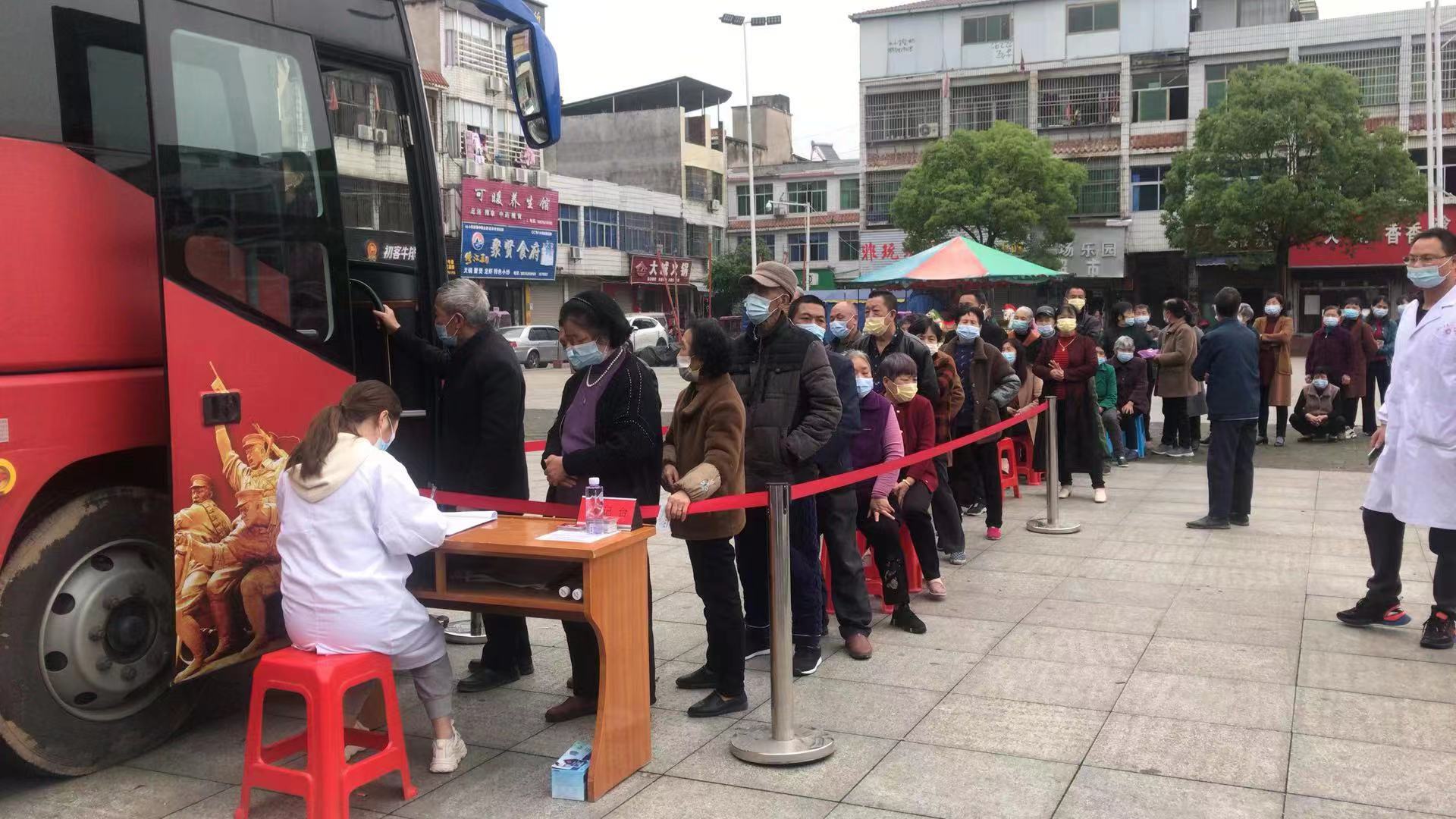
JF Healthcare's "Healthy China Tour: Retracing the Long March" Campaign
“Healthy China 2030” Planning OutlineEmphasizing “a focus on rural and grassroots levels to promote the equalization of basic public health services.” Through JF HEALTHCARE’s exploratory efforts, we can see that the approval of the Class III medical device certification for its “Tuberculosis X-ray Image Assisted Evaluation Software” is not only an attempt by JF HEALTHCARE to align with top-level design, but also a deep exploration rooted in grassroots communities, truly addressing their pressing challenges.
Medical imaging holds vast potential for growth in primary healthcare institutions. JF HEALTHCARE’s approval of its Class III medical device certification for X-ray-based solutions, tailored for primary care, signifies a key national initiative to promote the application of the digital economy in grassroots markets. This milestone ushers in a new era for the adoption of artificial intelligence in primary healthcare.
Following the successful approval of its Class III medical device certification, JF HEALTHCARE will expand application scenarios for tuberculosis prevention and control, while accelerating its nationwide rollout in China to contribute to grassroots infectious disease prevention and control efforts.