

Zhongfang Genomics: A 'Specialized, Sophisticated, and Innovative' SME Leveraging Third-Generation Sequencing for Neoantigen Discovery and RNAi Therapeutics
Second-generation high-throughput sequencing is currently widely used in life sciences, clinical medical research, and other fields. After more than a decade of practical application, scientists believe that due to the “short read lengths” (150–300 bp) of second-generation high-throughput sequencing, fragmented gene segments still need to be “assembled like a puzzle” during analysis. With advancements in sequencing technology, third-generation sequencing, also known as single-molecule sequencing, can achieve average read lengths of thousands to tens of thousands of bases, enabling better analysis and visualization of genomic maps. For example, PacBio’s third-generation sequencing technology achieves an accuracy rate of 99.9%.
Compared with second-generation sequencing, third-generation sequencers are emerging contenders with a relatively smaller user base. This is partly because previous third-generation sequencers struggled to achieve the high-throughput levels of second-generation platforms, but more importantly, because the analytical systems for processing the data generated by third-generation sequencing still require further development and refinement.
Regarding the further development and application of third-generation sequencing analysis, VCBeat recently interviewed Zhongfang Gene, a “specialized, refined, distinctive, and innovative” enterprise focused on genetic testing analysis and gene drug development.
Jiangsu Zhongfang Gene Biopharmaceutical Technology Co., Ltd.(hereinafter referred to as "Zhongfang Gene")Established in April 2017, who pioneered the design and publication of a co-expression vector for small interfering RNA (RNAi) and enhanced green fluorescent protein (EGFP) to investigate the regulatory role of RNAi in target gene degradationDr. Fangping Dai, Founder of the OrganizationDr. Dai Fangping holds a Ph.D. in Medicine from the University of Freiburg, Germany, and has nearly 15 years of research experience at its Faculty of Medicine. He currently serves as a visiting or adjunct professor at the Institute of Genetics of Fudan University in Shanghai, China; the Affiliated Hospital of Tongji University in Shanghai; and the National Engineering Research Center for Nanotechnology and Applications, among other institutions. Under the leadership of Professor Dai, Zhongfang Gene’s R&D team has brought together core scholars specializing in computer science, biology, and medicine, and has established in-depth collaborative partnerships with prestigious universities and research institutes such as Fudan University, Shanghai Jiao Tong University, the Shanghai Institute of Materia Medica of the Chinese Academy of Sciences, and Tongji University in Shanghai.
Although the company has a small team, Zhongfang Gene’s current achievements in the field of genetic testing are not to be underestimated.
First,Zhongfang Gene is equipped with PacBio third-generation sequencers and cluster servers., and a well-trained professional team, is the entity responsible for building an automated platform for third-generation sequencing and data analysis of the Chinese human standard material transcriptome. Zhongfang Gene also launched highly competitive scientific research services as early as 2019: 1.Analysis of Aberrant Insertion and Integration Status of Viruses in the Genome of Human Tumor Cells(Collaborated with Tongji University, with a paper published in the journal Translational Research in September 2022); 2.Detection of Neoantigens in Solid Tumors, as one of the few companies that have combined third-generation sequencing technology with second-generation sequencing for this emerging testing service, it holds an absolute competitive advantage internationally. Zhongfang Gene can analyze cancer neoantigens and provide visualized analysis by utilizing PacBio third-generation sequencing equipment and Illumina second-generation sequencing devices for fresh tumor tissues and adjacent non-tumor tissues/blood samples, in conjunction with its self-developed intelligent identification system for personalized cancer antigens, making it one of the very few companies mastering this technology.
In collaboration with its industry peer Wuhan Frasergen and universities, Zhongfang Gene has completed the development of an automated analysis system for third-generation high-throughput long-read sequencing data of single-cell transcriptomes (including antibodies and receptors).In light of the aforementioned lag in analytical applications currently faced by third-generation sequencing, it is not difficult to see thatZhongfang Gene has effectively addressed the challenges associated with analyzing third-generation sequencing data, thereby leveraging the significant advantage of long-read sequencing.Its independently developed third-generation long-read single-cell mRNA sequencing and analysis platform not only enables automated matching and identification of full-length heavy and light chains of novel antibodies, but also facilitates the analysis of tumor-specific fusion genes and their corresponding fusion proteins, as well as the characterization of viral integration sites within the human genome and the features of cellular antibodies, receptors, and MHC molecules, thereby supporting immunotherapies against viral infections and cancer.
Not only that,Zhongfang Gene has also applied its automated big-data analysis platform for sequencing to the analysis of viral genomes, and has conducted research on the design and efficacy evaluation of RNAi therapeutics.In fact, the story of gene and RNAi drugs in China can be traced back to an even earlier time, as early as2005, Professor Dai Fangping's article on "RNAi-Directed Induction of Gene Fragment Silencing” research findings paper has already been published,A year earlier than RNAi gained widespread recognition with the 2006 Nobel Prize.Therefore, leveraging Professor Dai Fangping’s extensive expertise in the RNAi field, along with the support of newly established automated sequencing and analysis platforms, Zhongfang Gene has developed an antiviral RNAi design and experimental workflow, aiming to create a closed-loop R&D system that integrates genetic testing analysis with gene drug development.
In response to the virus, China has adopted comparative analysis of big data from viral databases.Following a characterization analysis of specific pathogenic viruses, we initiate the design of RNAi therapeutics targeting the virus, leveraging our proprietary RNAi drug efficacy analysis system and nanoparticle delivery efficiency analysis system., evaluating drug efficacy at the molecular and cellular biology levels, with the aim of facilitating the subsequent development of therapeutic agents for refractory viral infectious diseases.
Currently, RN for infectious diseases such as anti-COVID-19 virus and anti-HPV virusResearch on the efficacy of AI drugs is one of Zhongfang Gene's primary R&D focuses.Wild-type pathogenic viruses exhibit various modes of transmissibility. At the cytological level of experimental research, leveraging its proprietary patents, the Chinese team first established a research model for evaluating the efficacy of RNA interference (RNAi) against infectious viruses. This model involves transgenic expression of only viral gene fragments in experimental cells to serve as target genes for RNAi. Consequently, it eliminates the risk of infection arising from the transcription of viral proteins, thereby ensuring high biosafety.
Zhongfang Gene analyzed the genomes of various SARS-CoV-2 mutant strains and the S protein gene, precisely selecting key conserved regions of the S protein-coding gene as therapeutic targets, and independently completed the design of RNAi drug sequences. The mechanism of action of this RNAi drug is well-defined; its target is applicable to all currently known viral mutations. Furthermore, the rapid chemical synthesis of the RNAi drug enables a swift response to unknown potential new mutations. Currently, the drug has demonstrated favorable efficacy results at both the molecular and cellular biology levels.The paper authored by Zhang Weiwei and other researchers from Professor Dai Fangping’s team at Zhongfang Gene was published in the journal *Nano Biomed Eng* in 2022. Additionally, two national invention patent applications have been accepted.。
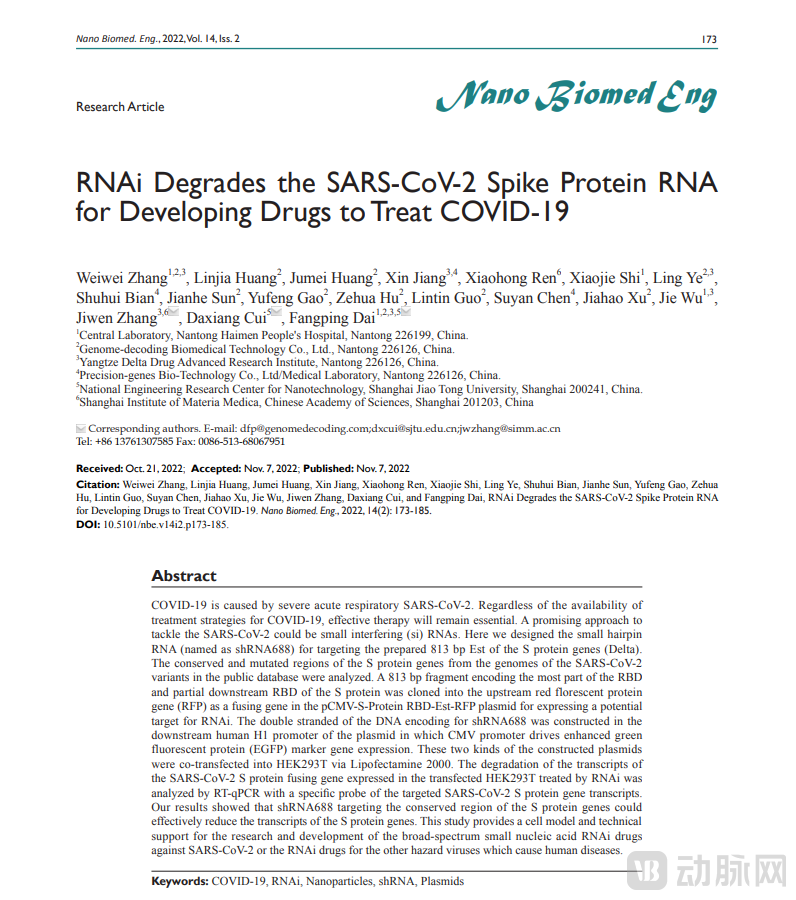
RNAi targeting the SARS-CoV-2 spike (S) protein gene, independently developed by Zhongfang Gene, has demonstrated therapeutic efficacy. Upon completion of further animal studies and drug safety evaluations, this RNAi therapeutic will be delivered via lipid-based carriers through nebulization into the respiratory system, directly reaching the lung surface without entering systemic circulation. This approach enables safe clearance of the SARS-CoV-2 S protein gene within infected cells and inhibits viral replication, potentially leading to the development of a broad-spectrum anti-SARS-CoV-2 nebulized medication.
In addition to SARS-CoV-2, other viruses also infect humans. For instance, cervical cancer, one of the most common malignant gynecological tumors in women, is almost invariably caused by high-risk human papillomavirus (HPV) infection.Zhongfang Gene’s other blockbuster RNAi drug in development targets the HPV virus.Based on the principles of RNA interference (RNAi), the team has developed RNAi therapeutics that target the mRNA of key genes (such as E6, E7, L2, and L1) from high-risk human papillomavirus (HPV) types associated with cervical cancer, including HPV16 and HPV18, thereby inhibiting viral expression and replication in the human body.
Currently, Zhongfang Gene has independently completed the RNAi drug design targeting the E6, E7, E1, E2, L2, and L1 genes of high-risk HPV types 16 and 18, as well as a comparative analysis of RNAi drug delivery vehicles. Through experimental screening, multiple RNAi active pharmaceutical ingredients capable of effectively degrading the mRNA of several HPV16 and HPV18 genes have been identified. Subsequently, drug design efforts for cutaneous HPV types, including HPV5, HPV6, and HPV11, have also entered the development stage.
Zhongfang Gene’s three pipelines currently under development have all achieved phased milestones. In addition to publishing related papers and filing patent applications, the company has collaborated with universities and hospitals—including the Shanghai Institute of Materia Medica of the Chinese Academy of Sciences, the National Engineering Research Center for Nanotechnology and Applications at Shanghai Jiao Tong University, the Affiliated Hospital of Tongji University in Shanghai, and Nantong Maternal and Child Health Care Hospital—to steadily advance drug safety assessments and explore subsequent clinical studies.
In the interview,Professor Dai Fangping also stated that the business model most anticipated by Chinese gene companies is “innovation + collaboration.”, which is also the company’s most ideal market relationship. By continuously deepening its expertise in its field to drive innovation, the company’s distinctive, innovation-driven characteristics will become the primary force attracting partnerships.
Therefore, continuous innovation has become a key theme for the future development of Zhongfang Gene. Currently, Zhongfang Gene will continue to expand its project collaborations with universities and research institutes in the field of tumor gene sequencing and analysis. Subsequently, it will also extend its scientific research services to third-generation mRNA sequencing, antigen-antibody detection and analysis, including single-cell transcriptome third-generation sequencing analysis. RNAi therapeutics will also be a key focus area for the company. As drug development deepens, technology transfer, collaborative manufacturing, and pharmaceutical sales are all part of its commercial roadmap.
Regarding long-term strategic planning, Professor Dai Fangping believes that the focus should remain on tumor analysis. With the development of immunotherapy and cell therapy technologies in China, attention to tumor neoantigens, antibodies, and receptors will significantly increase. Coupled with enhanced analytical capabilities in third-generation sequencing technology, it is believed that the industry will exhibit a trend of integrated development in the future, ultimately benefiting patients!