

Chen Huixing of Shanghai General Hospital: Medical Science Communication as the Third Language of Physicians
Humor may be the greatest misconception outsiders hold about Chen Huixing. He has always approached medical science popularization as a significant and serious endeavor.
Initially, Chen Huixing actually disdained engaging in medical science popularization. At that time, he believed that physicians should devote all their efforts to honing clinical and research skills, focusing solely on fulfilling their professional duties. What changed his perspective was a fellowship experience in the United States.
In 2019, Chen Huixing served as a visiting scholar at Cornell University in the United States. His mentor was a highly skilled medical professional who had abandoned the lucrative career of a clinical physician to pursue work in physician training. This decision puzzled Chen, who placed great value on clinical practice, as becoming a clinical physician offered superior financial compensation and social status.
“But I was too embarrassed to ask him,” Chen Huixing recalled. He held the question in until he was preparing to return to China, and his mentor’s answer surprised him: “I don’t understand it either, but my mentor said this approach could help more people.”
Choosing not to practice as a clinician in order to help more people—perhaps it was this very statement that shattered Chen Huixing’s original perceptions. He suddenly recalled the words spoken by Professor Wang Yifei during his tenure as President of Shanghai Second Medical University: “A good physician must master three languages: ‘politics’ for official discourse, ‘professional’ for communication with peers, and ‘public’ for engaging with the general populace.” Medical science popularization may well be this third language for physicians.
“It is essential to communicate with the public in a down-to-earth manner and clearly explain the matter so that they can accept it,” Chen Huixing stated.
In September 2019, upon returning to China, Chen Huixing formally incorporated medical science popularization into his work agenda. He initially published self-authored educational articles on Meipian. After gradually exploring the landscape, his content expanded to Douyin, Kuaishou, WeChat Channels, Bilibili, Jinri Toutiao, Xigua Video, Zhihu Video, Meipian, Weibo, Official Accounts, Zhihu, and Xiaohongshu. His formats now encompass short-form videos, mid-form videos, and text-and-image posts.
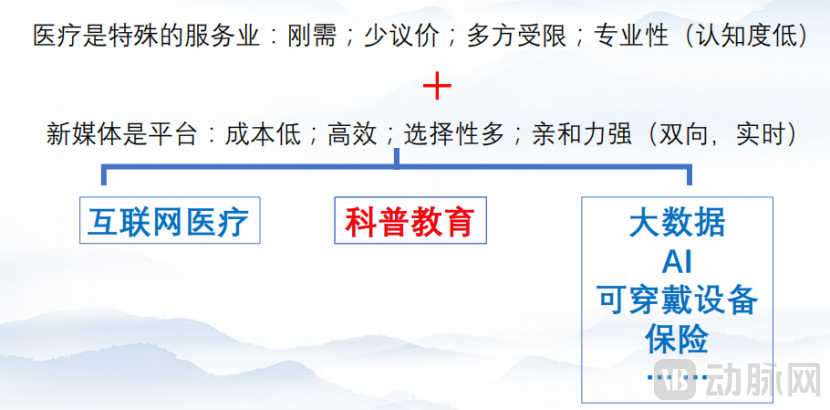
The essence of healthcare is service. This type of service represents a perpetual market necessity, with consumers having limited bargaining power. However, the delivery of healthcare services is constrained by multiple factors, such as geographic regions and policy environments. Similarly, healthcare is a high-barrier-to-entry service sector, requiring providers to possess substantial professional knowledge and clinical experience. Such knowledge and experience typically circulate only within professional circles and remain largely inaccessible to consumers.
This cognitive deficit has led to mistrust between doctors and patients, which not only compromises medical efficiency but also triggers numerous doctor-patient conflicts. Medical science popularization has become a social consensus for alleviating such tensions.
Typically, people assume that doctors engage in public health education with a casual, “leisure-time” mindset. However, Chen Huixing appears to approach it with the same professionalism he brings to his clinical work. He even hand-drew a structural diagram to analyze the advantages and distinctions among various forms of science communication, as well as to examine the relationship between healthcare and new media.
In terms of specific content formats, short videos serve as valuable tools for medical science popularization and are a preferred medium for many physicians. These efficient and easily accessible educational resources help reduce patients’ misconceptions. Furthermore, this format boasts broad reach and high virality, making it readily accepted and emulated by patients.
Of course, written text and infographics serve as essential supplements. Chen Huixing uses these visual and textual formats to educate patients on personalized quantitative metrics, follow-up schedules, medication frequency, and preoperative precautions. Beyond patient education, these resulting videos and infographics can also be utilized in clinical settings. Physicians can recommend them to specific patients, thereby enhancing the efficiency and quality of outpatient consultations.
Grounded content, coupled with a keen understanding and mastery of media, quickly established Chen Huixing as a leading science communicator in the field of urology. He is widely regarded as elegant and witty, with his popular science content described as humorous and accessible. However, this perception seems to differ from Chen’s self-assessment; he sees himself as pragmatic and steady, much like most people from northern China. As for the perceived humor, he attributes it to deliberate narrative and linguistic choices made during content creation.
“Perhaps I have the genes for stand-up comedy,” he joked. He enjoys crafting a distinctive rhythm in his verbal expression, modulating tone and intonation while pairing them with varied facial expressions. When addressing serious issues, he engages his audience through apt satire; by appropriately exaggerating real-life events, introducing contradictions into certain topics, and recounting actual surgical scenarios to satisfy some people’s curiosity for the sensational—all these carefully crafted elements lend a darkly humorous touch to the “science-communication” version of Chen Huixing.
“Short videos can feature humorous, witty, and exaggerated performances, but the scientific facts presented must be accurate.” He emphasized that substantive content is the cornerstone of humor and online appeal in science communication, and one should avoid sensationalism.
When discussing the sense of fulfillment and objectives physicians derive from engaging in medical science popularization, Chen Huixing was remarkably candid. He openly acknowledged that doctors’ initial motivations for participating in such efforts often include personal factors, such as enhancing their influence and personal brand, or attracting a larger and higher-quality patient base.
“Everyone has a touch of vanity,” he remarked. He believes this is a normal and widespread phenomenon, and that once popular science content gains recognition, it will inevitably enhance the physician’s personal brand.
Healthcare, particularly high-end healthcare, is often exclusive in nature, as every patient seeks the best physician for their treatment. Once a market segment accepts a physician’s knowledge and perspectives, a relationship of trust is established. For early- and mid-career physicians, medical science popularization presents a significant opportunity.
“The emergence of new media has enabled young physicians engaged in medical science popularization to cultivate their own audiences,” he explained.
But is this the purpose of doctors engaging in medical science popularization? Certainly not. “Do not seek to profit from science communication” was the consensus among all the panelists present. Their aim is to disseminate objective medical knowledge and perspectives, assist and care for patients, promote healthy lifestyles, and prevent disease.
Patients lack reliable channels to access the information they need in a timely manner. Although a significant number of physicians have joined new media platforms to provide patient education, their influence remains limited compared to that of commercially driven marketing agencies. Therefore, medical science popularization must be premised on the dissemination of accurate and objective medical knowledge and perspectives. Only under this premise can such educational efforts achieve meaningful impact while remaining compliant with regulatory standards.
The prerequisite for realizing the value of medical science popularization is influence, and the root of such influence lies in the value that educational content delivers to patients. Ultimately, the value physicians derive from engaging in medical science popularization circles back to patient benefit. Treating personal interest as the end goal would put the cart before the horse in medical science popularization.
“Rather than focusing on how to realize personal value, putting your heart into it is the best approach,” said Chen Huixing.
The Boston Scientific Innovation Training Academy provides training venues, advanced facilities, and laboratory equipment for the EDUCARE professional education program; organizes educational, academic, or innovation activities; and collaborates extensively with Chinese medical schools, academic organizations, and clinical centers to deliver various clinical courses, thereby supporting the development of healthcare talent in China.
EDUCARE is Boston Scientific’s global professional education brand. Offering a comprehensive suite of specialized educational courses, it upholds the mission of innovating for life and is committed to empowering healthcare professionals with industry-leading educational resources, thereby enabling them to extend care to more patients.