

AI-Powered Drug Discovery in China: Progress, Pipelines, and Commercial Evolution
From the initial accumulation of technology and exploration of business models to the validation and delivery of preclinical candidate drugs and drug pipelines, dozens of artificial intelligence (AI) + drug R&D companies have been established in China after nearly a decade of development.
An industrial sector has suddenly become crowded within a short period. The primary reason for the integration of AI technology into pharmaceutical R&D is that the research and development costs in the pharmaceutical industry have reached an intolerable level. Meanwhile, as artificial intelligence technologies continue to mature, they have brought a new wave of talent into the pharmaceutical R&D process, such as AI specialists and computer hardware engineers. Although these newcomers to the pharmaceutical industry lack traditional R&D expertise, they are introducing a host of novel technologies and mindsets to the sector.
In this new era of pharmaceutical research and development,What New Business Models Has AI Technology Spawned?Which application scenarios does AI technology cover in empowering drug R&D?What Stage Has AI-Empowered Drug Development Reached?AI+ Drug R&D Companies: Where Will the Future Breakthroughs Lie Amid Fierce Competition?
To gain further insight into the development of China’s AI-driven drug R&D enterprises, VCBeat recently conducted a comprehensive analysis of 74 companies in this sector, structured around the drug development process.
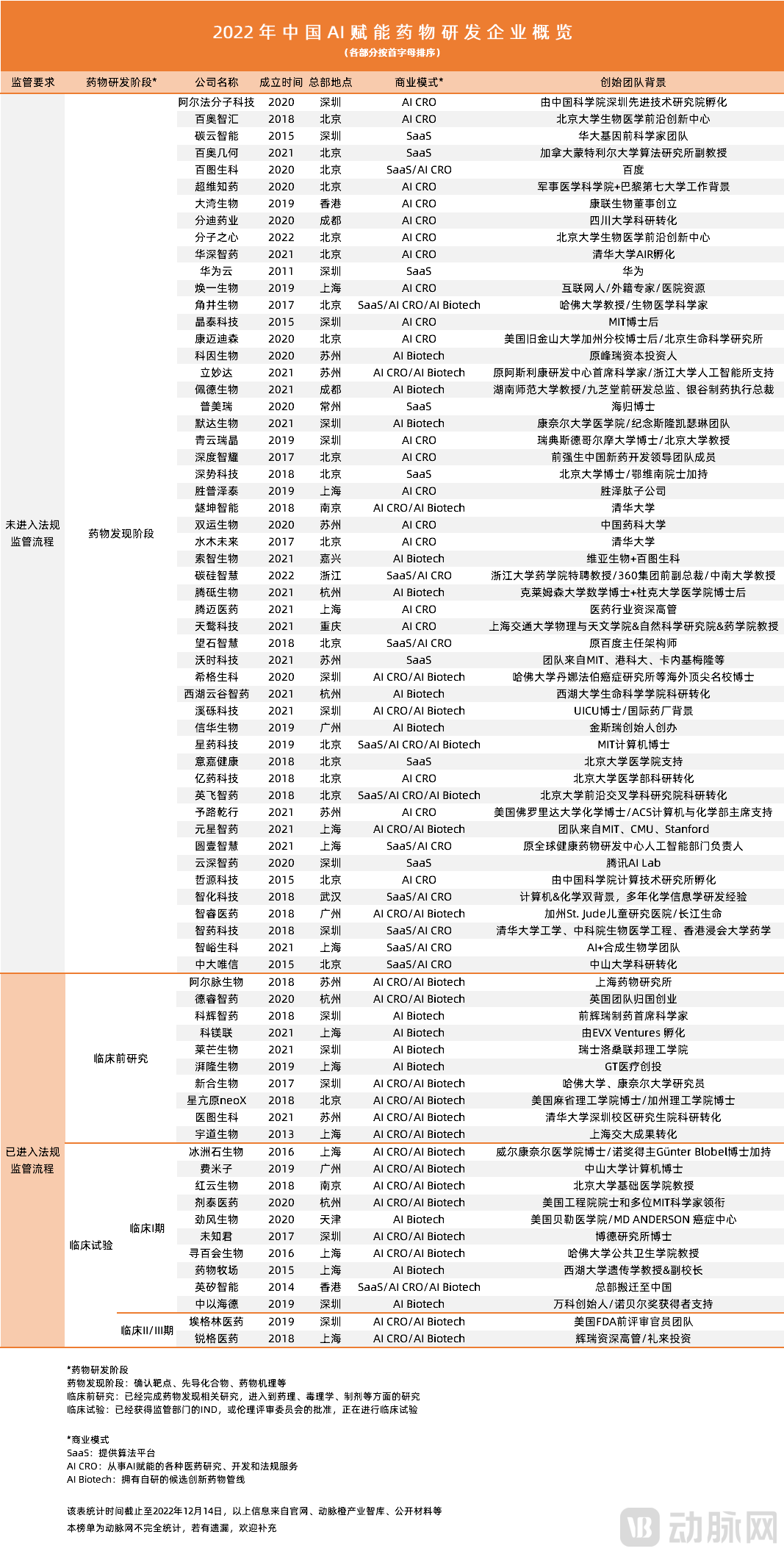
2014–2017: China’s First Wave of AI-Driven Drug Discovery Companies Established, the development of AI technologies and the exploration of business models in the drug R&D industry subsequently unfolded. During this period, companies primarily assisted drug development by providing AI computing tools, with Software-as-a-Service (SaaS) being the typical business model.
2018–2019: The first wave of AI-driven new drug development companies basically completed their preliminary technological accumulation., and have successively begun to achieve validation milestones such as the identification of pre-clinical candidates (PCCs). During this period, some AI-driven drug discovery companies started providing more comprehensive and in-depth end-to-end AI technical services to pharmaceutical companies or contract research organizations (CROs). A new business model has emerged: AI+CRO.
After 2020, the industry entered a phase of rapid development., the sector is becoming increasingly crowded. The frequency, scope, and depth of collaborations between AI-driven new drug companies and pharmaceutical firms continue to expand. Some AI-enabled drug discovery companies have also begun to independently apply and develop full-process drug pipelines, giving rise to enterprises with an “AI Biotech” business model.
At this point,SaaS, AI CRO, and AI Biotech have become the three primary business models for AI-driven new drug development companies in China.The evolution of these three business models also reflects, from a different perspective, the development of China’s AI-driven drug discovery enterprises.
When applied to the new drug development process, it primarily encompasses three stages: drug discovery, preclinical research (focusing mainly on pharmacology and toxicology), and clinical trials. Among these,Apart from the drug discovery phase, the subsequent two phases are subject to varying degrees of regulatory oversight.. For example, neurotoxicity or nephrotoxicity induced by a candidate drug in a few animals may be sufficient for regulatory authorities to reject its entry into Phase I clinical trials. Furthermore, all clinical trial procedures, ethical considerations, and study designs must be strictly monitored by regulatory authorities.
According to statistics from VCBeat, approximately 70% of AI-driven drug development companies in China are currently engaged in the drug discovery phase, while only about 15% have advanced to the preclinical research and clinical trial phases.
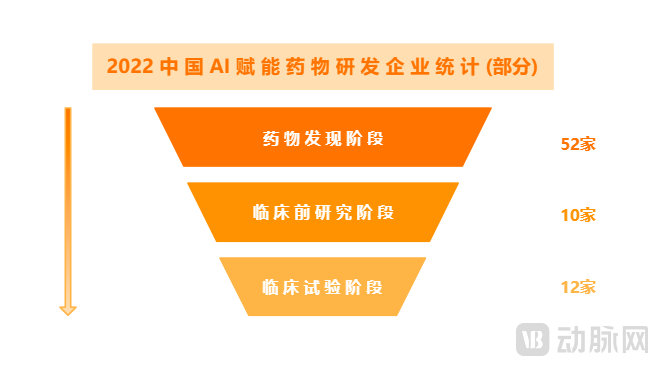
Overall, from drug discovery to clinical trials, China's AI-enabled drug development has nearly reached the "end point" at the technical level,“Run"Companies that have progressed more rapidly" have entered the mid-to-late stages of clinical trials。
1Drug Discovery: Led by SaaS and AI CRO Companies, Competing on Algorithms and Delivery
From the perspective of the specific R&D process, the most fundamental drug discovery phase is mainly divided into four steps: selection and validation of drug targets and biomarkers, identification of lead compounds, study of structure-activity relationships and screening of active compounds, and selection of preclinical candidate (PCC) drugs.
Corresponding steps for this phase,Application Scenarios Where AI Technology Is Currently Relatively MatureThese include virtual screening, molecular generation, target discovery and validation, ADMET prediction, and drug repurposing. Companies providing these technologies primarily adopt SaaS, AI CRO, or hybrid SaaS–AI CRO business models. Additionally, there are biotech startups that have been established in the past two years.
withSaaS Service ModelCompanies that provide AI-assisted drug development algorithm platforms, theirFounding TeamMost are top-tier talents in fields such as computer algorithms, physics, and mathematics, or platforms built directly by major tech companies like Baidu, Huawei, and Tencent. Examples include BioMap, Huawei Cloud ElHealth, Insilico Medicine, iCarbonX, DP Technology, and XtalPi.
Under this business model,Build More Accurate Algorithmic Models、Development of more comprehensive structural simulations、Virtual Screening with Higher Iterative Throughput、Provide a more streamlined user experience, etc., are areas where enterprises continuously strive for self-breakthrough and compete with one another.
withAI CROCompanies with this as their primary business model are mostly derived from the commercialization of scientific research achievements at prestigious universities, such as Huashen Zhiyao, Limiaoda, Suikun Intelligence, Yingfei Zhiyao, and Tianwu Technology. There are also enterprises represented by XtalPi, founded by PhD graduates from world-renowned universities. Unlike computational service providers, these companies excel in identifying druggable targets, lead compounds, or preclinical candidates (PCCs), and commercially translating these research outcomes for pharmaceutical companies and other stakeholders.Collaborate to Advance the Drug Development Pipeline。
Some AI CRO companies adopt a collaborative model with SaaS enterprises., leveraging their respective technological strengths to dedicate more resources and time to PCC discovery and the advancement of collaborative pipelines with pharmaceutical companies. With accumulated experience, these enterprises hold significant potential to establish in-house drug development pipelines in the future.
Meanwhile, at this stage, alsoSome SaaS companies have begun exploring the AI CRO model in recent years.. Taking Yuan Yi Intelligence and Zhiyu Life Sciences as examples, the primary advantage of such enterprises lies in their strong emphasis on building interdisciplinary teams with expertise in both AI and biotechnology (AI+BT), thereby unlocking greater potential for corporate innovation and growth.
2Preclinical Research: Led by AI CROs and AI Biotechs, with a focus on IND approval readiness and differentiation
Following drug discovery, drug development enters the regulatory process, which comprises two phases: preclinical studies and clinical trials.
InPreclinical Research Phase, which requires five key activities: CMC, pharmacokinetic evaluation, safety pharmacology studies, toxicology studies, and formulation development, with the aim of validating the PCC and assessing its translatability.
This phase primarily encompasses two business models: AI CRO and AI Biotech.Unlike AI CRO companies focused on the drug discovery phase, those operating in the preclinical research phase are not only capable of identifying preclinical candidate compounds (PCCs) but also required to conduct multi-dimensional experimental evaluations and validations of these PCCs to demonstrate their suitability as viable candidates for Investigational New Drug (IND) applications.
Overall, the AI Biotech model is the dominant business paradigm at this stage, characterized by companies whose internal pipelines have completed drug discovery, identified preclinical candidates (PCCs), and are either preparing for or currently undergoing Investigational New Drug (IND) application. Most of these enterprises were established after 2018, indicating that PCC identification can be achieved in approximately three years, thereby fully demonstrating the technical feasibility of AI technologies in the drug discovery phase. Notably, recently founded companies such as Kemei Lian and Yitu Shengke have already advanced to the IND application stage.The Greater Potential of AI Technology to “Reduce Costs and Increase Efficiency” in Drug Development Is Self-Evident。
3Clinical Trials: AI Biotech Takes the Lead—Competing on Compliance, Progress, and Success Rates
After a compound has passed preclinical studies, an Investigational New Drug (IND) application must be approved by the relevant drug regulatory authorities, or approval must be obtained from the Ethics Review Committee, before Phase I clinical trials can commence.
Encouragingly,China currently has 12 AI biotech companies that have advanced their proprietary pipelines from drug discovery to the clinical trial stage., with 10 in Phase I clinical trials,Two companies have entered mid-to-late stage clinical trials.. Half of these companies are among the first wave of AI-driven drug discovery enterprises established between 2014 and 2017.
It is worth noting that many such enterprisesAmong the founding teamAll possess relevant talent or support from overseas universities, research institutions, or large pharmaceutical companies.. Although no AI-enabled drugs have yet been approved for market launch globally, AI technology in drug R&D started earlier abroad than in China, with more companies having entered clinical trial stages, thus offering richer experience for reference.
This stage requires reliance on experience and multifaceted support due to the extremely high failure rate in clinical trials. It is well known that the primary objective of Phase I clinical trials is to assess the safety of drug candidates. Approximately 60% of candidate drugs fail at this stage. The main reasons for failure include excessive in vivo toxicity, an narrow therapeutic window, and irreversible toxicity in major target organs. This phase of testing is often referred to as the “Valley of Death” in pharmaceutical research and development.
Accelerating the Progression of Clinical Trial Phases、Selecting an Appropriate Pharmacodynamic Evaluation Model、Determination of Appropriate Indication Use、Develop a Compliant Clinical Trial Plan, every step is crucial,This not only requires companies to possess robust AI and drug R&D capabilities, but also tests their familiarity with and understanding of relevant regulatory registration procedures and key points in this highly regulated phase, as well as their ability to conduct clinical trials.。
Currently, two companies have entered the mid-to-late stages of clinical trials., one is"Team of Former FDA Reviewers from the United States"ofEglin Pharma, one isBacked by Both Pfizer and Eli LillyofRigMed. Although the two companies have accumulated industry experience in two different roles—"regulatory agency" and "top-tier pharmaceutical company"—both have achieved remarkable phased results in advancing their pipelines through the mid-to-late stages. Currently, Eglin Pharma has two pipelines entering the mid-to-late clinical stages, and Regor Pharmaceuticals has also announced that patient enrollment for one of its Phase II clinical trials began in April this year.
It must also be pointed out that developing candidate drugs addressing urgent clinical needs is key for any drug entering Phase II clinical trials. For example, Eglin has developed two innovative candidate drugs: one for the treatment of dry age-related macular degeneration (dry AMD) and another for the treatment of preeclampsia in obstetrics. Both of these clinical indications currently represent conditions with no available therapeutic options. The Chinese pharmaceutical industry has long been plagued by the phenomenon of having dozens, or even hundreds, of so-called "First-in-Class" candidate drugs. These "candidate champions" risk becoming meaningless if they fail to achieve successful clinical translation in a timely manner.
A review of the past decade of AI technology empowering drug R&D in China, alongside the continuous evolution of business models, also reflectsThe Favorable Trend of Chinese Innovative Drug Companies Running Wider and Further in the AI-Driven Drug R&D Track。
The entry of traditional pharmaceutical companies and internet giants has made this sector increasingly crowded in recent years, with competition intensifying particularly in the drug discovery phase prior to regulatory review. In the long run, the CRO model for AI-driven drug development will tend toward homogenization.Directly Engaging in Drug Development Is a Business Model That Enhances Corporate Value-Added, of courseIt also serves as a multifaceted test of a company’s AI R&D capabilities, clinical drug development capabilities, and regulatory understanding.. From a horizontal perspective,What Enterprises Compete on: Market, Speed, and Precision. Longitudinally,Accelerating the tangible advancement of drug pipelines and integrating AI applications across the entire drug R&D process test a company’s “end-to-end” capabilities more than anything else.。
Faced with such multidimensional challenges, SaaS, AI CRO, and AI Biotech companies have remained steadfast in their mission and unceasing in their efforts to extend the cost-reducing and efficiency-enhancing advantages of AI across the entire drug development process, thereby facilitating the approval and market launch of more “First-in-Class” and “Best-in-Class” therapeutics.
Globally, AI-driven technological exploration in preclinical research and clinical trials has already begun.New AI application scenarios are emerging, including dosage form design, novel drug delivery systems, clinical patient stratification, optimization of clinical trial design, prediction of clinical outcomes, virtual clinical trials, and real-world studies.
It is not difficult to predict that, in the future, both the exploration of AI technology applications and the strategic focus of AI-driven drug development enterprises willGradually extending to the preclinical research and clinical trial stages regulated by laws and regulations.。
With the advancement and penetration of AI technology, and driven by the industry’s steadfast pursuit of “accelerating drug R&D,”We have reached the point where we can look forward to AI-developed drugs hitting the market!