

CG Oncology Files IPO Amid Promising Oncolytic Virus and PD-1 Inhibitor Combination Therapy for Bladder Cancer

CG Oncology
Oncolytic Immunotherapy Developer

Sirona Capital
Private Equity Investment Firm

Longitude Capital
Venture Capital Firms

RA Capital
Life Sciences Venture Capital Firms
Acorn Bioventures
Biotech Investment Service Provider

Decheng Capital
Life Sciences Investment Firms

Malin
Life Science Investment Institution

ORI Capital
Venture Capital Fund
In November 2022, CG Oncology announced the completion of a $120 million Series E financing round, co-led by ORI Capital, Longitude Capital, and Decheng Capital, with participation from RA Capital Management, Acorn Bioventures, Malin Corporation, Ally Bridge Group, and Sirona Capital. To date, CG Oncology has raised over $200 million across five financing rounds.
This round of financing will be used to advance the company’s leading clinical programs in bladder cancer toward FDA approval and to expand its product portfolio to address unmet medical needs in urologic cancers, such as first-line treatment for Bacillus Calmette-Guérin (BCG) and intermediate-risk non-muscle-invasive bladder cancer (NMIBC).
As a biopharmaceutical company focused on developing oncolytic immunotherapies for patients with urologic cancers, it continues to attract strong interest from multiple investment firms despite not yet having any approved drugs. Given the low success rate of immunotherapy drug development, what makes this particular therapy so highly anticipated?
A closer look at the institutional and corporate investors in CG Oncology reveals a significant number of Chinese entities, such as ORI Capital (Hong Kong, China). Similarly, an examination of CG Oncology’s management team and board of directors shows considerable Chinese representation. This is closely tied to the founder Paul DeRidder’s strong affinity for the Chinese market.
Paul graduated from the University of Michigan Medical School. He has served as a urologist at St. Joseph Hospital for over 22 years and previously held the position of Chief of Urology. During this period, he also served as an Assistant Clinical Professor of Urology at the University of California, Irvine School of Medicine.
In 1999, Paul left the hospital to begin his venture capital career with the angel investment group Tech Coast Angels, and subsequently joined Crystal Cove Capital. In 2009, Paul moved to Beijing to join Fengxiang International Capital and BioValleyCHINA as a partner specializing in life sciences.Paul has been engaged with the Chinese market for over a decade, during which he lived in Beijing for more than six years.
Despite his many years in the investment industry, Paul has never lost sight of his commitment to healthcare. In 2010, he founded the biopharmaceutical company CG Oncology and served as its Chief Marketing Officer, dedicating himself to the development of novel cancer therapies. He is also a co-founder of Urotherapies, which is committed to providing physician practice management and administrative support services for urology practices. In addition, Paul has served asVice Chair of the Board, Sino-American Biotechnology and Pharmaceutical Association (SABPA), holding multiple medical device patents.
Currently, Paul continues to serve as Chairman of BioValley CHINA, dedicated to supporting biopharmaceutical incubators across China. Although Paul has held no position at CG Oncology since 2018, the company maintains a natural affinity with the Chinese region.
An article published in the World Journal of Urology indicates that bladder cancer is one of the common malignant tumors of the urinary system, with 75% of cases classified as non-muscle-invasive bladder cancer (NMIBC) and 25% as muscle-invasive bladder cancer (MIBC); the number of diagnosed cases in men is four times that in women.
Bladder cancer is a highly recurrent and progressive disease. Currently, treatment options for non-muscle-invasive bladder cancer (NMIBC) are very limited. The most commonly used treatment regimen is transurethral resection of bladder tumor (TURBT), followed by intravesical instillation therapy based on postoperative recurrence status.
Research data indicate that patients receiving this type of treatment may experienceUp to 60% Recurrence Rate, of whom only more than 60% can subsequently receive bacillus Calmette-Guérin (BCG) therapy (a live bacterium used to treat bladder cancer). For patients with high-risk non-muscle-invasive bladder cancer who are refractory to BCG or experience recurrence, there is an urgent need for new treatment options.
CG0070 is an engineered oncolytic adenovirus drug based on serotype 5 adenovirus (Ad5), and alsoThe world's first oncolytic adenovirus drug for bladder cancer in clinical development,Designed with a unique mechanism of action.
CG0070 incorporates two coding genes: the tumor-selective E2F-1 promoter and the human granulocyte-macrophage colony-stimulating factor (GM-CSF) gene. The modified adenovirus serotype 5 (Ad5) selectively replicates within tumor cells exhibiting defects in retinoblastoma (Rb) regulation, ultimately leading to tumor cell lysis. The ruptured cancer cells subsequently release tumor antigens and GM-CSF, thereby stimulating a systemic anti-tumor immune response and demonstrating the dual oncolytic mechanism of the oncolytic adenovirus.
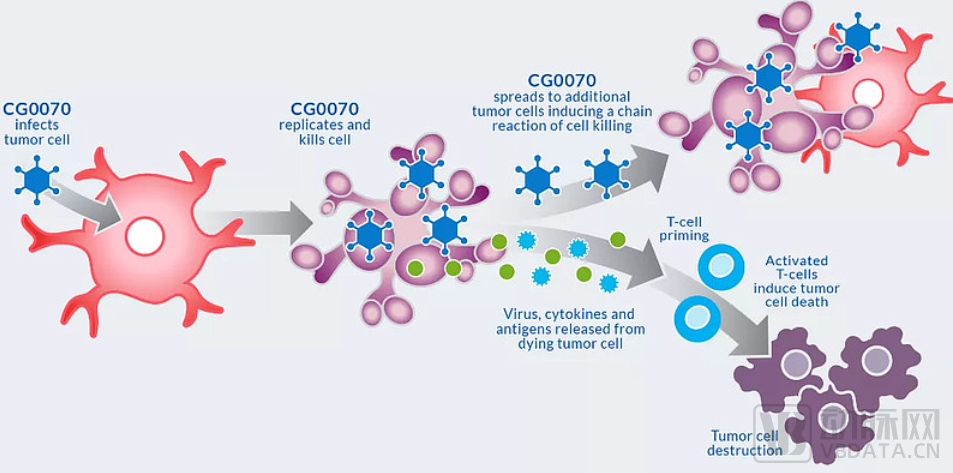 Mechanism of Action of CG0070
Currently, as an oncolytic immunotherapy drug administered via intravesical delivery, CG0070 is in the stage of developing its potential for multiple indications.
Prior to this round of financing, CG0070, as a monotherapy, had completed a Phase 2 trial for the treatment of BCG-unresponsive non-muscle-invasive bladder cancer (NMIBC) and is currently conducting a Phase 3 trial (BOND3).
As a combination therapy, CG0070 is being tested with the PD-1 inhibitors KEYTRUDA (pembrolizumab), OPDIVO (nivolumab), and atezolizumab (Tecentriq).
KEYTRUDA (pembrolizumab) is a PD-1 monoclonal antibody developed by Merck for the treatment of various cancers, and it was approved for marketing in the United States in 2014. Currently, CG Oncology is collaborating with Merck on a Phase 2 clinical study (CORE-001), for the combination treatment of high-risk NMIBC in the BCG-unresponsive population.
OPDIVO (nivolumab) is a monoclonal antibody drug developed by Bristol Myers Squibb. Currently, CG Oncology is conducting a Phase 1b study (CORE-002) to evaluate the safety and efficacy of CG0070 in combination with nivolumab in patients with muscle-invasive bladder cancer (MIBC) who are ineligible for cisplatin-based chemotherapy.
Atezolizumab (Tecentriq) is a PD-L1 monoclonal antibody developed by Roche. In late 2021, CG Oncology entered into a collaboration with Roche to jointly conduct clinical trials. To date, no additional data from this trial have been disclosed.
At the 2022 Society for Immunotherapy of Cancer (SITC) Annual Meeting, CG Oncology announced that Phase 2 data from the CORE-001 study continued to demonstrate robust antitumor activity and tolerability of CG0070 in combination with pembrolizumab in patients with BCG-unresponsive non-muscle-invasive bladder cancer (NMIBC).
Lepu BiopharmaIn 2019, licensed CG0070 from CG Oncology, along with the rights to develop, manufacture, and commercialize it in mainland China, Hong Kong, and Macau,In November 2022, the clinical trial application for CG0070 injection, a Class 1 new drug developed by the company, was accepted by the Center for Drug Evaluation (CDE)., applicable to male urogenital diseases, female urogenital diseases, pregnancy complications, and tumors.
Tumor immunotherapy has become a cornerstone of the anti-tumor drug market, with oncolytic viruses emerging as a critical component of combination cancer immunotherapies. As oncolytic viruses continue to evolve and treatment regimens are further refined, the clinical safety and efficacy of oncolytic virus therapy have improved, driving sustained growth in future industry demand. Currently, more than 20 types of viruses are being utilized in oncolytic virus research worldwide, and numerous companies in China are also engaged in this field.
According to Emergen Research, the global market size for oncolytic virus therapy was USD 94.7 million in 2020 and is projected to reach USD 609.7 million by 2028, with a compound annual growth rate (CAGR) of 26.2% from 2021 to 2028, positioning it as one of the fastest-growing technologies.
According to data from Guan Yan Baogao Wang, the Chinese oncolytic virus market grew from RMB 11.34 million in 2017 to RMB 45.99 million in 2021, representing a compound annual growth rate (CAGR) of 19.13%, indicating rapid expansion. The overall market size of China’s oncolytic virus industry is projected to reach RMB 19.1 billion by 2029, with an estimated CAGR of 112.47% from 2022 to 2029.
Factors such as future technological advancements, support for R&D investment, a large volume of unmet clinical needs, and favorable government policies will drive the continuous development of China’s oncolytic virus market.