

YiduTech Empowers High-Quality Medical Innovation with Digital Solutions for Research-Oriented Wards
How to Leverage New Technologies, Methodologies, and Models to Enhance Clinical Trial Efficiency and Benefit Patients? How to Improve the Quality of Clinical Research?
In recent years, policy documents issued in Beijing, Shanghai, Jiangsu, and other regions have encouraged tertiary medical institutions to evolve into research-oriented and innovative hospitals. Many hospitals have taken the lead in establishing research wards. As a crucial carrier and platform for conducting clinical research, research wards have garnered increasing attention from hospital administrators. They not only effectively enhance the innovation capabilities and research proficiency of clinical research personnel but also promote high-quality hospital development through technological innovation, ultimately benefiting patients.
At the recently held “2022 Yidu Tech Medical Intelligence Conference and Launch Event for Intelligent Solutions in Hospital Settings,” multiple experts in the field engaged in in-depth discussions on the construction, opportunities, challenges, and future development directions of research-oriented wards. They unanimously agreed that building such wards can facilitate high-quality clinical research, accelerate collaborative innovation in pharmaceuticals and healthcare, and vigorously promote the translation and industrialization of innovative medical and pharmaceutical achievements.
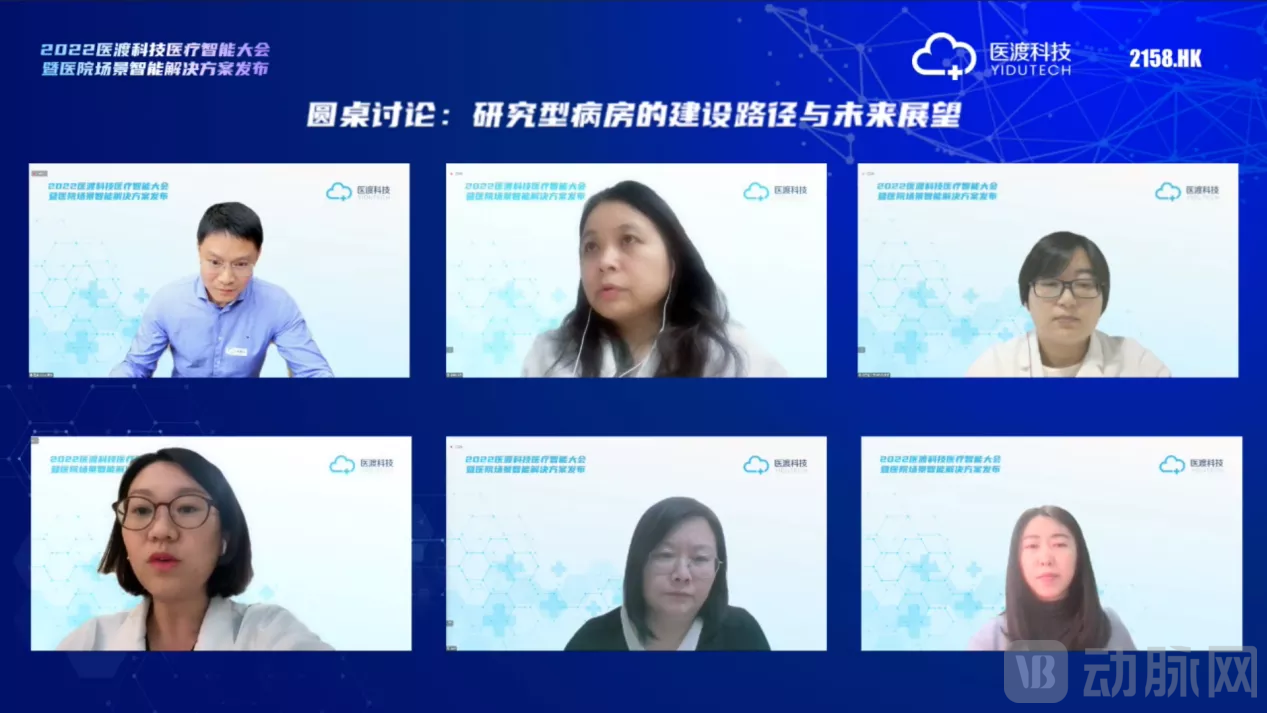
The roundtable discussion was moderated by Meng Min, Head of Intelligent Business at Happy Life Technology (HLT), a subsidiary of Yidu Tech. Participants included Jiang Min, Director of the National Drug Clinical Trial Institution Office at Peking University Cancer Hospital; Li Su, Director of the Clinical Research Department and Director of the Institution Office at Sun Yat-sen University Cancer Center; Zhang Yiwen, Deputy Director of the Pharmacy Department and Deputy Director of the GCP Office at Zhejiang Provincial People’s Hospital; Cui Yan, Director of the Drug Clinical Trial Institution Office at Beijing Friendship Hospital, Capital Medical University; and Li Zhen, Deputy Director of the Clinical Research Center (presiding) and Director of the Drug Clinical Trial Institution Office at Shanghai First Maternity and Infant Hospital, Tongji University.
The Center for Drug Evaluation (CDE) of the National Medical Products Administration has released multiple technical guidelines for clinical trials with a patient-centric focus (for public comment), guiding the industry to drive innovation based on patient needs. Meanwhile, the industry continues to explore new technologies, methodologies, and models to enhance the quality and efficiency of clinical trials.
Director Cui Yan:Patient-centered clinical trials rely on the integration of intelligent information systems; in the era of digitalization, clinical trials must adapt to evolving times. Beijing Friendship Hospital was an early adopter of intelligent information systems in clinical trials. Its electronic informed consent process ensures that participants fully understand and provide informed consent, while its electronic payment system facilitates more timely compensation disbursement, earning high recognition from both participants and investigators. Beijing Friendship Hospital continues to deepen its collaboration with Yidu Tech to implement remote monitoring and intelligent information systems related to Decentralized Clinical Trials (DCT). By introducing new models of intelligent and digital management into clinical trial processes, the hospital aims to enhance trial efficiency and maximize benefits for participants.
Director Jiang Min:The ultimate goal of drug development is to benefit patients. A patient-centric approach requires greater consideration of patients’ needs and experiences throughout the clinical trial process. In the intelligent screening phase, data technologies enable willing participants to access research projects more rapidly. Electronic informed consent provides a remote pathway that ensures patients are more fully informed. Electronic payment systems streamline the reimbursement and disbursement processes for patients. It is crucial to continuously improve the informatization platform for clinical trials, achieving interoperability, one-stop management, and scalability, thereby better serving drug development and benefiting patients.
Director Li Zhen:In the era of big data, a patient-centric approach that integrates intelligent recruitment with internet hospitals and mobile devices provides patients with greater access to information about clinical studies, thereby enhancing their proactivity in selecting clinical trials. By leveraging intelligent technologies, researchers can promptly monitor changes in participants’ conditions and closely track adverse events during follow-up visits. This enhances patient safety, benefits patients, and contributes to the overall success of the projects.
Director Zhang Yiwen:Although hospitals currently have various information systems in place, most operate in silos and have not yet fully achieved data integration and coordinated analysis across these systems. It is essential to establish interoperability among these systems to enable end-to-end management of clinical trials, to rationally develop and apply the modules required for building clinical research capabilities or research-oriented wards, and to provide robust technical support.
Director Li Su:Patient compliance is the strongest support for clinical research. How can we ensure that patients actively engage in reporting their disease status during the survival follow-up phase? This requires providing more humanized care to enhance patients’ healthcare experience. We should gain deeper insights into the perspectives of both clinicians and patients, and integrate these insights into information systems to develop more personalized, patient-centered solutions.
Yidu Tech is committed to enhancing the efficiency of clinical trials through intelligent technological innovation, thereby benefiting trial participants. At the launch event, Hao Yuan, Head of Product for the iGCP Intelligent Clinical Trial Solution under Happy Life Technology (a subsidiary of Yidu Tech), officially unveiled the “Research-Oriented Ward Platform.”
As a key component of Yidu Tech’s intelligent solutions for hospital settings, the platform comprises three major segments: data infrastructure, informatization modules, and intelligence modules. The lightweight clinical research data center enables on-demand data integration. The informatization module offers various management tools, including research project management and scientific performance management. Applications such as feasibility analysis, intelligent patient screening, decentralized clinical trials (DCT), remote monitoring, and digital quality control collectively constitute the intelligence module of the research-oriented ward platform, optimizing every stage of clinical trials.
Hao Yuan stated, “Our goal is to leverage the research ward platform to accelerate key research processes—including registration clinical trials, real-world studies, and investigator-initiated trials—by 30%, ultimately leading a new era of patient-centric clinical trials.”
The development of research-oriented wards relies on top-level design and overall planning by leadership, supported by an efficient organizational management system and corresponding evaluation mechanisms, constituting a long-term, comprehensive endeavor.
Director Jiang Min:Research-oriented wards support a clinical needs-driven approach, incubating scientific achievements through clinical research. This requires holistic hospital planning, with system and institutional development serving as a key foundation. During the development process, these wards should align with hospital needs and actual conditions to serve clinical research projects and achieve coordinated, optimized development.
Director Cui Yan:Beijing has provided substantial support for the development of research-oriented wards, leading to increased investment in clinical research resources by hospitals and enhanced capacity for innovative research. However, challenges remain, such as a shortage of research-oriented talent and inadequate performance-based incentive mechanisms. Furthermore, it is essential to accelerate the informatization of clinical research. On the premise of ensuring data accuracy and reliability as well as protecting participant privacy, existing information systems should be integrated to achieve accessibility and usability of clinical data resources.
Director Li Zhen:The quality of patients’ out-of-hospital follow-up data and the challenges associated with its collection pose significant obstacles to conducting research. How research-oriented wards can integrate with patients’ out-of-hospital data and foster collaborative development with other institutions requires strategic planning at the leadership level. Regarding personnel incentives, Shanghai has introduced a dedicated support track for clinical research within the researcher professional series this year, providing individuals engaged in clinical research with an exclusive pathway for professional title advancement.
Director Zhang Yiwen:The construction of research-oriented wards requires technical support, and cooperation with companies such as Yidu Tech is essential to complete informatization development and achieve improvements at the technical level. Regarding talent, researchers also undertake clinical diagnosis and treatment tasks; it is expected that future institutional reforms will improve their career development pathways.
Director Li Su:We have established multiple incentive measures to actively support and advance clinical research. Achievements in clinical research serve as both a qualifying criterion and a mandatory requirement for professional promotion. The layout of research-oriented wards extends beyond patient care spaces to include a series of incubators, such as pathology facilities, enabling the conduct of clinical research within these wards.
Roundtable Moderator: Meng Min
Meng Min, Head of Intelligent Business at Happy Life Technology (HLT), a subsidiary of Yidu Tech, summarized that, as the directors have noted, implementing the patient-centric principle requires robust information system construction, and the application of technologies such as intelligent patient screening, remote monitoring, and decentralized clinical trials (DCT) is essential. For the development of research-oriented wards, hospital-level support is critical, including incentives for talent and support for information technology infrastructure.
“In the context of clinical trials in hospitals, more practical needs are constantly emerging,” said Meng Min. “We hope to collaborate more extensively with experts and colleagues, leveraging Yidu Tech’s research-oriented wards and intelligent solutions for hospital settings, to truly adopt a patient-centric approach. This will enable more high-quality and effective drugs to enter clinical trials, ultimately bringing greater benefits to patients.”