OFFSHORE Global Early-Stage Medical Innovation Roadshow Features Five Cutting-Edge Projects from Three Countries
Recently, China has entered a new phase of “all-out economic push.” Local governments have been leading delegations of entrepreneurs on chartered flights abroad to participate in overseas exhibitions and conduct business negotiations, helping companies expand into international markets.
Meanwhile, many overseas companies have also set their sights on the Chinese market. In recent years, as China has placed increasing emphasis on medical innovation and the market has continued to recover, numerous innovative foreign healthcare companies have chosen to establish operations in China or set up dedicated China market departments. For example,Boston Scientific, Siemens Healthineers, Varian Medical Systems...and other internationally renowned medical companies have all placed the Chinese market in a strategically important position for development.
Certainly, the market is by no means developing in a single direction. While multinational corporations are accelerating their expansion in the Chinese market, Chinese investment institutions are continuously identifying high-quality overseas projects. According to data from the “2022 Report on Overseas Investment and M&A by Chinese Capital,” overseas investments by Chinese capital declined sharply in 2020 due to the global pandemic impact,However, a rebound was achieved in 2021, with the number of investment deals reaching 454, setting a new historical high, and the data for 2022 continued to surge.
In short, the Chinese healthcare market holds promise for all stakeholders, whether domestic or foreign, investors or enterprises. Much like the “chartered flight” initiatives launched by various regions to expand overseas, the healthcare sector still needs to establish platforms for international exchange to foster deeper interaction between global medical innovation projects and China’s industry.
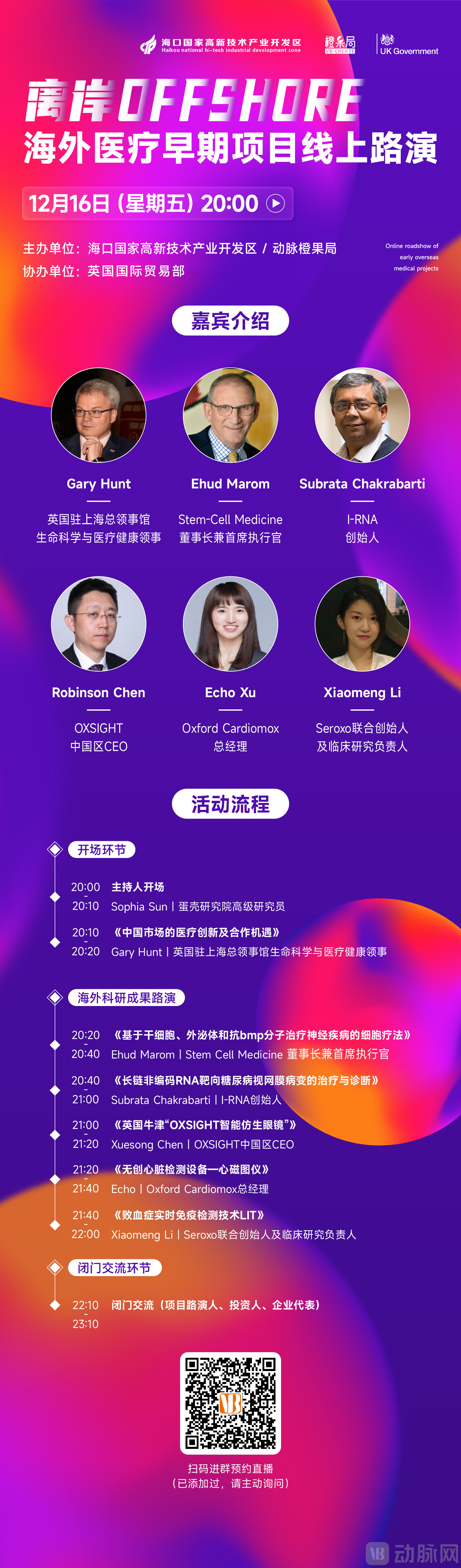
Therefore, to facilitate exchanges and collaboration between global healthcare innovation projects and Chinese capital, enterprises, and local governments,Haikou National High-Tech Industrial Development ZoneJointVCBeat, British Consulate-General in ShanghaiatDecember 16, 2022, 20:00Co-hosted by“Offshore · Global Early-Stage Medical Project Online Roadshow”with a view to promoting the industrialization of more valuable innovative achievements and injecting new vitality into the development of the medical and big health industry in Haikou National High-tech Industrial Development Zone.
01. Conference Agenda and Guests
02. Roadshow Projects and Introductions
Company:Stem-Cell Medicine
Country:Israel

Guest Speaker:Ehud Marom, Chairman and CEO of Stem-Cell Medicine
Team Profile:Mr. Marom earned his Bachelor of Science in Chemical Engineering with honors from the Technion – Israel Institute of Technology. He has extensive experience in management, operations, business development, and strategic planning within the pharmaceutical industry, having held various senior positions over the years. These include Vice President of Operations for the API and Innovation Division at Teva Pharmaceuticals, where he contributed to its market success; Chief Operating Officer at Peptor; and Chief Executive Officer of Gamida Cell, a Jerusalem-based biotechnology company and leader in hematopoietic (blood) stem cell therapies. He also served as President and CEO of Makhteshim Chemical Works, followed by Senior Vice President of Supply Chain for the Makhteshim-Agan Group. In addition to serving as Chairman and CEO of Stem Cell Medicine, Mr. Marom is the Chairman and CEO of Mapi Pharma.
Project Overview:SCM focuses on the development of cell therapy products, either as standalone treatments or in combination with pharmaceuticals, with an emphasis on addressing chronic diseases that lack adequate medical solutions. The company’s product pipeline primarily targets indications within the nervous system, including multiple sclerosis, pain, and neuromuscular injuries. SCM’s therapeutic approaches are based on adipose-derived mesenchymal cells, genetically modified muscle progenitor cells, and innovative small molecules, as well as their combinations with conventional and biologic drugs. Additionally, SCM develops cosmetics based on proteins derived from cells and manages the production, registration, and commercialization of its medical products.
Company:I-RNA
Country:Canada

Guest Speaker:Founder of I-RNA — Subrata Chakrabarti
Team Introduction:Professor Subrata Chakrabarti, PhD, FRCP(C), is a Pathologist at LHSC and a Professor of Pathology at Western University in Canada. He is also the inventor of this technology. As a clinical scientist, Professor Chakrabarti has over 25 years of experience in clinical pathology and research on diabetic retinopathy.
Project Introduction:I-RNA has discovered that a long non-coding RNA (lncRNA) named HOTAIR plays a significant role in the pathogenesis of diabetic retinopathy. I-RNA has developed siRNA-based therapies, which have been successfully tested in rats and mice. This lncRNA is also critically involved in diabetes-associated fibrosis. Preclinical study results indicate that this lncRNA can be targeted with siRNA for the treatment of proliferative diabetic retinopathy and other ocular diseases. Additionally, I-RNA has developed a PCR-based serum non-coding RNA detection panel for the diagnosis of diabetic retinopathy. This assay simultaneously measures the levels of nine lncRNAs, including HOTAIR. I-RNA believes that this test can be used for screening diabetic retinopathy and assessing its progression. The company has filed a PCT application for this technology. Currently, I-RNA is seeking partners to further advance its development.
Company:OXSIGHT
Country:United Kingdom
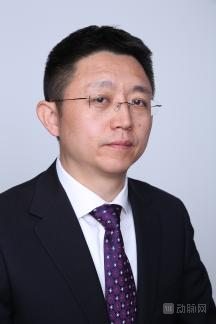
Report Speaker:OXSIGHT China CEO——Robinson Chen
Team Introduction:Chen Xuesong holds an MBA and has over 20 years of experience working for multinational corporations. He possesses extensive team management expertise, as well as market development experience in both B2C (home users/SOHO users) and B2B sectors (hospitals, government entities, SMBs, and key enterprise accounts). With rich experience in sales and marketing communications, he has previously served at EPSON in various roles, including Product Manager, Branch Manager, Industry Sales Manager, National Channel Sales Manager, and Head of Public Relations and Advertising for China. He participated in establishing and leading a sales channel network comprising more than 1,500 partners, covering over 10,000 hospitals across China. He later served as the Marketing Director for Asia-Pacific at AAVID. Currently, he is the CEO of OXSIGHT China.
Project Introduction:OXSIGHT, originating from the University of Oxford in the United Kingdom, is a premier wearable artificial intelligence vision company that has successfully commercialized its products by seamlessly integrating three key technologies: machine learning and deep learning, wearable technology, and machine vision. Deep learning algorithms based on mobile technology represent one of the core technologies underpinning its current product offerings. This technology stems from a fundamental vision science research project commissioned by the UK Department of Health in 2010 and undertaken by the University of Oxford, which investigated how the brain interprets visual information. Consequently, OXSIGHT has also conducted extensive in-depth research in the fields of neurology and brain science.
Smart Bionic Glasses, a new product category pioneered globally by OXSIGHT, are “cutting-edge” devices developed based on wearable artificial intelligence vision technology for individuals with low vision (visual impairment). They help patients with low vision suffering from “visual field loss” due to conditions such as “macular degeneration” and “glaucoma” to “see the world again.”
Company:Oxford Cardiomox
Country:United Kingdom

Guest Speaker:Oxford Cardiomox General ManagerLi – Echo Xu
Team Introduction:Mr. Feng Xie, Project Leader of the Magnetocardiography (MCG) System, University of OxfordHolds a Master’s degree in Engineering and has eight years of experience in management and market development, with extensive expertise in team building, introduction and assimilation of advanced technologies, and production line setup. In 2011, at Yangzhou Shang...During his tenure at Hua Gao Polymer Materials Co., Ltd., he spearheaded the development of mirror-integrated turn signals for major automotive clients including Volkswagen, Geely, Soueast, and JAC. These products now generate annual sales exceeding RMB 40 million. In 2012, he collaborated with ISIS Innovation Ltd., a wholly-owned technology transfer company of the University of Oxford, and the Changzhou Productivity Promotion Center to establish Changzhou ISIS International Technology Transfer Center Co., Ltd. The company secured Jiangsu Provincial International Platform Cooperation Project funding for three consecutive years, achieving a 200% increase in corporate value. Core team members Dr. Illya Chaykovskyy and Dr. Volodymyr Sosnytskyy hold Ph.D.s in Medicine from the University of Duisburg-Essen (Germany) and in Automation and Electronic Engineering from Taras Shevchenko National University of Kyiv (Ukraine), respectively. With over 30 years of experience in the research and development of magnetocardiography (MCG) instruments, they lead one of the world’s earliest research teams dedicated to MCG technology.
Project Introduction:Magnetocardiography (MCG) systems are used to measure and analyze the magnetic fields generated by cardiac electrical currents. Ionic activity across myocardial cell membranes creates potential differences on the body surface, which can be recorded by an electrocardiogram (ECG). Concurrently, this electrical activity produces corresponding changes in the magnetic field. Magnetocardiography is the technique and methodology for recording these electromagnetic field variations originating from the heart. In comparison, MCG systems can highly sensitively detect tangential and vortex current signals that are insensitive to conventional ECG devices. Since the electromagnetic signals generated by the heart are not affected by surrounding organs, MCG systems can accurately reflect the true electrophysiological status at specific cardiac locations. An MCG system can be conceptualized as an aggregate of countless internal ECG recorders.
Magnetocardiography (MCG) is non-invasive, involves no radiation exposure, and requires only the measurement of physiological magnetic fields above the thoracic cavity. Therefore, this examination is entirely risk-free and can be repeated as needed based on clinical frequency requirements. Currently, in clinical practice, MCG is used for the early diagnosis of acute and chronic myocardial ischemia, detection of viable myocardium within infarcted areas after myocardial infarction, assessment of the risk level for malignant arrhythmias, and follow-up evaluation of patients with coronary heart disease undergoing treatment (including pharmacological therapy, coronary stenting, and coronary artery bypass grafting).
Company:Seroxo
Country:United Kingdom

Guest Speaker:Co-Founder and Head of Clinical Research — Dr. Xiaomeng Li
Team Introduction:Founder David Sarphie is a biotechnology entrepreneur with over 18 years of experience in project management, senior management, and CEO roles at newly established companies specializing in drug delivery, diagnostics, and medical devices. Dr. David Sarphie holds a DPhil in Medical Engineering from the University of Oxford, an MS in Mechanical Engineering from Stanford University, and a BS in Mechanical Engineering from the University of Notre Dame.
Project Introduction:UK-based rapid testing company Seroxo provides real-time immune detection via LITTM™ to 50 million sepsis patients worldwide. The device has been patented in the United States, Europe, and China, and is currently undergoing FDA and UKCA certification. By integrating a digital app and cloud platform, the LITTM™ device enables healthcare professionals to achieve over 99% accuracy in sepsis diagnosis and prognosis within 10 minutes using a small sample of capillary blood from a finger prick, while also facilitating data tracking and sharing. Its portable design and robust technical support allow for rapid, real-time patient testing in ambulances, emergency departments, inpatient wards, and intensive care units. In contrast, existing sepsis tests typically require 6–24 hours, often leading to serious consequences due to delayed treatment. LITTM™ addresses the critical lack of rapid testing capabilities in time-sensitive sepsis management.
03. Introduction to the Organizer
· About Haikou National High-Tech Industrial Development Zone
Haikou National High-Tech Industrial Development Zone, approved by the State Council in 1991, is among the first batch of national-level high-tech zones in China and the only such zone in Hainan Province’s Free Trade Port. The zone focuses on three pillar industries: tourism, modern services, and high-tech industries. Within the high-tech sector, it prioritizes a “3+X” industrial framework, where “3” refers to biopharmaceuticals and medical devices, high-end food processing, and energy conservation and environmental protection industries, while “X” encompasses emerging sectors such as advanced manufacturing. To date, the zone has registered a total of 9,557 enterprises, including 177 high-tech enterprises and 154 foreign-funded enterprises. In 2021, the industrial output value of pharmaceutical companies in the zone reached RMB 18.4 billion, accounting for 77.4% of Hainan Province’s total.
· About VCBeat
VB Orange is a professional platform under VCBeat, dedicated to innovation and translation in the medical field. Guided by the principles of exploration, cognition, and service, it deeply connects every participant in the innovation industry chain, continuously tapping into their innovative potential. With a core focus on addressing practical needs, VB Orange genuinely supports the growth of scientists, ensures that each link in the ecosystem receives equitable returns for their efforts, and facilitates the effective implementation of more valuable medical innovation projects in China.
04. Live Stream Reservation
Scan the QR code below to contact the assistant and schedule a live stream!