

ZOLL Medical, FIFA's Exclusive AED Provider for a Decade, Files IPO Prospectus

ZOLL
Developer of Medical Devices and Software Solutions
The 2022 Qatar World Cup is underway, captivating football fans worldwide with this premier global event.
Ensuring player safety and providing timely medical assistance in the event of injury during intense matches is a key focus for the Fédération Internationale de Football Association (FIFA).
In football matches, physical exertion and medication may pose a significant risk of sudden cardiac arrest (SCA). During the 2003 FIFA Confederations Cup in France, professional footballer Marc-Vivien Foé died from SCA. In response to this tragedy, FIFA implemented a series of initiatives to help prevent SCA and raise awareness among football players.
In 2012, FIFA announced the provision of automated external defibrillators (AEDs) to its member associations, designating ZOLL Medical as the official service brand. For the past decade, ZOLL Medical has remained the sole AED provider on football pitches worldwide.
Danish player Eriksen, who took the field with a defibrillator during this year’s World Cup, once suffered cardiac arrest for five minutes during a match. It was an AED that saved Eriksen during those critical five minutes.
On June 13, 2021, during the UEFA Euro 2020 Group B match, Danish player Christian Eriksen suddenly collapsed and lost consciousness without any physical contact. The team physician arrived at the scene within 8 seconds, and an automated external defibrillator (AED)—the “life-saving hero”—was in place within 52 seconds. After approximately 14 minutes of on-site cardiopulmonary resuscitation (CPR) and AED-assisted defibrillation, Eriksen was out of life-threatening danger.
ZOLL Medical is a global leader in emergency resuscitation, offering a diverse portfolio that includes ventilators, patient monitors, and defibrillators. Its solutions span multiple sectors, including cardiac defibrillation, sleep apnea management, cardiopulmonary resuscitation, and therapeutic temperature management. In the automated external defibrillator (AED) market, ZOLL Medical holds the largest global market share. What sets ZOLL Medical apart and enables its dominance in the global defibrillation market?
As the domestic AED market heats up, with a growing number of participants and the market size gradually doubling, what opportunities remain in China’s AED market? VCBeat (WeChat ID: vcbeat) conducted research.
Paul M. Zoll, a professor at Harvard Medical School and the founder of ZOLL Medical Corporation, is widely regarded as the pioneer of defibrillation technology. In 1952, Dr. Zoll demonstrated that external electrical stimulation applied to the chest during cardiac arrest could induce effective heartbeats, making him the first physician to successfully use external defibrillation to regulate a patient’s heart rhythm.
In 1980, Dr. Zoll co-founded ZOLL Medical Corporation with several other co-founders. Over decades of development, ZOLL has established a comprehensive product portfolio centered on emergency care, with automated external defibrillators (AEDs) as its core products in the public access defibrillation sector.
In the 1990s, as the American Heart Association recommended that first responders immediately use defibrillators to address cardiac arrest, and emphasized that the speed of treatment delivery is the most critical factor in promoting patient survival, the U.S. AED market began to experience growth. ZOLL Medical Corporation also entered the AED market.
AED (Automated External Defibrillator) is a portable medical device capable of diagnosing specific arrhythmias and delivering defibrillation shocks. Non-medical personnel can master its use after receiving basic first aid training, enabling them to assist in resuscitating patients with sudden cardiac death. Studies have shown that performing CPR within one minute and administering AED defibrillation within 3–5 minutes can increase the survival rate of cardiac arrest patients to 50%–70%.
In 2021, the global market size for external defibrillators was $2.9 billion, and it is projected to grow at a compound annual growth rate (CAGR) of 9.3% from 2022 to 2023.
Major players in the global AED market include ZOLL Medical Corporation, Philips, Primedic, NIHON KOHDEN, PhysioControl, and SCHILLER.
Among these, the technology that ZOLL Medical takes pride in is its biphasic rectangular waveform defibrillation technology.The core technology of automated external defibrillators (AEDs) has evolved through three stages: monophasic sine wave, biphasic truncated exponential wave, and biphasic square wave. In 1999, ZOLL announced the launch of its revolutionary biphasic waveform technology, which reduces the energy required for successful defibrillation and cardioversion. ZOLL Medical Corporation lowered the defibrillator energy from 360 J to 120 J. This lower energy level minimizes damage to the patient’s myocardium, thereby achieving better therapeutic outcomes. This technology has also been recognized by the U.S. Food and Drug Administration (FDA) as superior to monophasic defibrillators.
Zheng Jie, founder of Viatom, stated, “The core technical barrier for AED products lies in ensuring that the defibrillation current passes through the heart as much as possible, rather than being dissipated by the skin, bones, or lungs. Achieving this with lower energy levels is highly challenging.”
ZOLL Medical Corporation introduced low-energy technology as early as the last century. Decades later, ZOLL’s biphasic truncated exponential waveform defibrillation technology remains a global leader. Even Philips, a second-tier competitor, still lags behind ZOLL Medical Corporation in defibrillation energy performance.
Another key technological highlight of ZOLL Medical is its patented Real CPR Help® technology, which provides real-time feedback on the depth and rate of chest compressions during cardiopulmonary resuscitation.
In fact, when managing patients with cardiac arrest, CPR is regarded as the cornerstone of resuscitation. High-quality cardiopulmonary resuscitation combined with the correct use of an automated external defibrillator (AED) constitutes the “life-saving code” for victims of sudden cardiac death. During CPR, if the AED can guide rescuers to perform compressions correctly—adhering to the recommended rate and depth to achieve high-quality resuscitation—it can improve the success rate of CPR, particularly when performed by lay rescuers.
“Compared to ZOLL’s globally unparalleled low-energy defibrillation technology, the technical barriers for CPR depth and frequency detection are relatively low. The technology for monitoring CPR depth and frequency primarily relies on accelerometers, similar to how fitness trackers count steps. However, ZOLL filed patents early on for using accelerometers to measure CPR depth and frequency, thereby establishing barriers for other companies worldwide entering this space.”
In addition to AEDs, ZOLL Medical Corporation has another core product in the field of cardiac defibrillation: the LifeVest® Wearable Cardioverter Defibrillator (WCD). Within ZOLL’s global market strategy, the WCD holds even greater strategic importance.
LifeVest generates $1 billion in annual revenue for ZOLL Medical Corporation in the U.S. market alone.
LifeVest is a vest-style wearable device primarily designed for patients at risk of sudden cardiac death (SCD). The vest makes direct contact with the skin, and its embedded electrodes continuously monitor the patient’s heart. The monitor on the vest collects EKG (electrocardiogram) data from the electrodes. If an impending arrhythmia is detected, it emits an audible alarm to alert the patient and bystanders that a shock is about to be delivered. The electrodes then release conductive gel and deliver a shock to restore normal heart rhythm.
ZOLL Medical Corporation has a development history spanning over forty years. Over the past two decades, ZOLL’s breakthroughs in defibrillation technology have elevated global defibrillation standards to a new level. In 2012, ZOLL was acquired by the Japanese chemical company Asahi Kasei. In recent years, ZOLL has increasingly favored expanding its product portfolio through acquisitions. The LifeVest originated from LIFECOR, a company acquired by ZOLL.
The Life-Saving AED That Stole the Show at the World Cup Has Also Drawn Significant Attention in China: What Stage Has China’s AED Market Reached?
A review of the AED market’s development reveals that policy-driven initiatives were key to the takeoff of overseas markets. In 1995, the United States launched the Public Access Defibrillation (PAD) program, implementing large-scale deployment of AEDs nationwide. In 2008, the South Korean government mandated the installation of AEDs in public places.
China’s laws and regulations governing AED deployment have been progressively improved in recent years. In 2017, Article 184 of the General Provisions of the Civil Law of the People’s Republic of China stipulated that rescuers who voluntarily provide emergency assistance shall not bear civil liability for any harm caused to the person being aided. The implementation of this provision marked China’s formal entry into a nationwide era of liability exemption for Good Samaritans, providing legal support for the promotion of AEDs.
At the end of 2021, the National Health Commission issued the "Guidelines for the Configuration of Automated External Defibrillators in Public Places (Trial)," specifying that AEDs should be prioritized in public places with high population mobility, high incidence of accidents, relatively enclosed environments, or where pre-hospital emergency medical services cannot be accessed within a short time after an accident occurs.
Currently, there is a significant gap between the number of automated external defibrillators (AEDs) deployed in China and the actual demand. According to the "Report on Cardiovascular Diseases in China 2019" released by the National Center for Cardiovascular Diseases, approximately 540,000 cases of sudden cardiac death occur annually in China, ranking first worldwide, which equates to about 1,500 deaths per day due to sudden cardiac arrest.
However, the deployment of automated external defibrillators (AEDs) in China is characterized by unbalanced, inadequate, and non-standardized development. While a few major cities—such as Hangzhou, Shenzhen, Shanghai, and Haikou—are prioritizing the improvement of their medical emergency response systems, enacting relevant regulations on emergency medical services, and publishing detailed AED locations along with AED maps, most other cities remain in the initial stages of implementation.
Even in major Chinese cities with relatively advanced configurations, there remains a certain gap compared to developed countries. According to data from the 2020 "Expert Consensus on the Layout and Deployment of AEDs in China," the United States has 700 AEDs per 100,000 people, and Japan has 276. In contrast, China’s figures are significantly lower: Shenzhen has 17.5, Haikou 13, Shanghai’s Pudong New Area 11, and Hangzhou 5 AEDs per 100,000 people. There is still a substantial disparity between China’s central cities and some developed countries in terms of the number, distribution density, and coverage of AEDs.
The market gap has also driven the rapid growth of China’s AED market in recent years. Zheng Jie told VCBeat, “Before the outbreak of COVID-19, China’s AED market was in a ramp-up phase; since then, it has been doubling every year.”
In 2022, public data revealed that local governments spearheaded multiple large-scale procurements of automated external defibrillators (AEDs). In September this year, the Wuhan Municipal Health Commission issued the “Public Tender Announcement for the Automated External Defibrillator (AED) Project by the Wuhan Municipal Health Commission,” with a total budget of RMB 64 million; Mindray’s products were awarded the bid. In September 2022, Xiamen conducted a tender procurement of AEDs worth RMB 2.9 million. In November 2022, the AED procurement project of the Fujian Provincial Health Commission had a total winning bid amount of RMB 2.82 million, with Jiuxin Medical as the successful bidder.
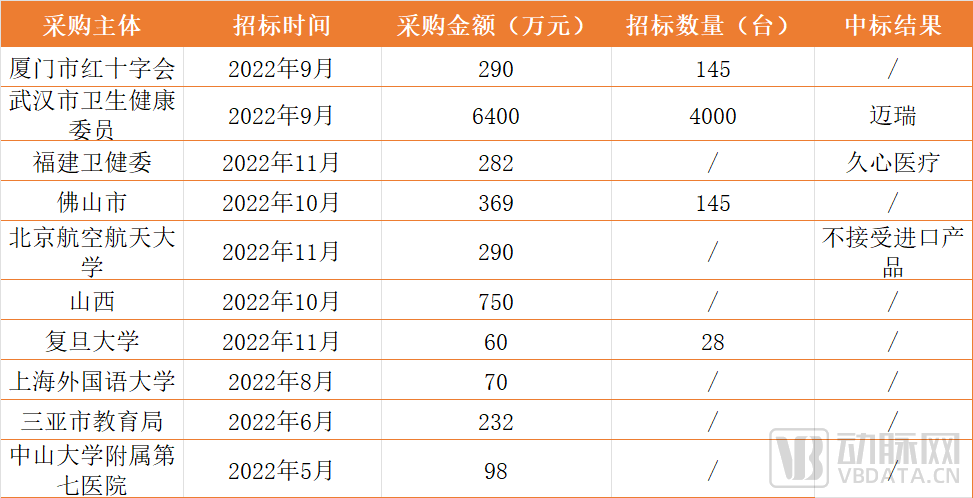
AED-Related Procurement in 2022
According to Frost & Sullivan data, the market size of China’s AED industry grew from RMB 560 million in 2014 to RMB 1.02 billion in 2018, representing a compound annual growth rate (CAGR) of 16.2% during this period.
The rapid growth of China’s AED market is driven, on the one hand, by increased public awareness of cardiac defibrillation and the continuous improvement of relevant laws and regulations, and on the other hand, by the sustained investment from domestic manufacturers.
Domestic companies are driving the development of the AED market in China, primarily through investments in public education, reducing equipment costs, and providing training. Before domestic AEDs received regulatory approval, the Chinese AED market was dominated by imported brands such as Philips, ZOLL Medical Corporation, PRIMEDIC, and Nihon Kohden, with each unit priced at approximately RMB 40,000, making them considerably expensive.
In recent years, domestic medical device companies have significantly increased their investment and R&D efforts in automated external defibrillators (AEDs). Yuwell Medical acquired 100% equity of the German company Metrax GmbH for €11.7 million, introducing the AED brand PRIMEDIC™. This September, Tencent invested nearly RMB 300 million in a subsidiary of Yuwell Medical’s AED business.
Mindray Medical listed AEDs as a seed business. In the first half of 2022, Mindray Medical achieved large-scale installations of its AEDs in European countries including the United Kingdom, France, the Netherlands, Italy, and Norway.
Other domestic manufacturers have also intensively obtained certifications in the past two years, with multiple Chinese companies such as Jiuxin Medical, Vivasys, Comen Medical, and Xi’an Ruixin Kangda receiving registration certificates.
In this field, which has been developing overseas for decades, how can domestic enterprises build their own competitive advantages?
First, in terms of defibrillation technology, although there is still a certain gap between domestically produced products and imported ones, Chinese manufacturers are rapidly catching up with their international counterparts by leveraging the advantages of domestic supply chains.
Regarding defibrillation energy, ZOLL Medical Corporation delivers 120 J, while another major imported brand, Philips, provides 150 J. Domestic manufacturers are steadily approaching this level: ViVest Medical’s AED delivers 150 J, and Ruixin Kangda has reduced its defibrillation energy to 120 J.
Zheng Jie stated: Another aspect where domestically produced devices can build competitive advantage lies at the application level. Given that AEDs are deployed for emergency use, a major challenge remains in systematically managing and mobilizing AEDs scattered throughout urban areas, integrating them with city-wide emergency medical services, and thereby improving the efficiency of pre-hospital emergency response.
Jiuxin Medical, a domestic enterprise, leverages IoT, 5G, and big data technologies to enhance the management and deployment efficiency of automated external defibrillators (AEDs). IoT technology addresses AED management challenges by enabling real-time monitoring of device location, status, battery levels, and consumable usage. For emergency deployment, big data systems can integrate with urban emergency response and healthcare systems to upload emergency data, facilitating timely dispatch.
Weiweisi has miniaturized its AED to enhance portability, reducing the device weight to under 700g and making its front face approximately the size of a smartphone, thereby successfully enabling mobile AED deployment. The device can be carried by trained personnel such as traffic police, firefighters, and outdoor first responders, significantly reducing the precious time lost in decision-making, searching, and retrieving the device, thus greatly improving AED utilization efficiency and coverage effectiveness.
As the world’s premier football arena, the development of medical emergency systems at the World Cup reflects the growing importance of advances in cardiopulmonary resuscitation. As a critical device in pre-hospital emergency care, the availability of Automated External Defibrillators (AEDs) not only indicates the level of emergency medical services in a given region but also mirrors the overall standard of emergency medical technology in China. Pre-hospital emergency care has long been neglected and even marginalized in China. It is hoped that, driven by advancements in AED technology, China’s pre-hospital emergency system will be further improved in the future.