

3D Medicines Inc. Lists on HKEX Led by Former FDA Oncology Drug Review Expert Dr. Gong Zhaolong

3D Medicines
Developer of Tumor Immunotherapy Drugs

Hillhouse
Long-Term Structural Value Investment Institution
Hong Kong stocks finally welcome another biopharmaceutical company.
Today, 3D Medicines Inc., a biopharmaceutical company focused on the R&D and commercialization of innovative oncology immunotherapies, successfully listed on the Hong Kong Stock Exchange.
Its parent company, 3D Medicines, is an oncology precision medicine company with two subsidiaries: 3D Medicines Pharmaceuticals and 3D Medicines Diagnostics, which were spun off in 2018. Prior to its IPO, 3D Medicines Pharmaceuticals secured multiple rounds of financing from prominent investment firms, including Hillhouse Capital, Yifeng Capital, CSC Financial’s investment arm, and Hyde Capital.
3D Medicines has one core product, the PD-L1 monoclonal antibody Envafolimab, and 11 candidate drugs. Most of its products, including Envafolimab, are licensed from other companies. Its portfolio covers tumor immunotherapy monotherapies, innovative candidates with mechanisms of action compatible with combination therapies using its pipeline products, and pain management assets; however, the company has not yet achieved profitability.
Since 2018, listing on the Hong Kong Stock Exchange (HKEX) has become a crucial step for unprofitable biopharmaceutical companies to raise capital. The sharp decline in the HK market since last year has severely impacted these companies’ stock prices, with pricing distortions and insufficient liquidity causing sustained pressure on biotech firms’ market valuations. Following the bottoming out of negative sentiment, the HK market has recently shown signs of recovery. Notably, since the beginning of December, several biopharmaceutical companies have made new IPO progress on the HKEX: in addition to 3D Medicines, YZY Biopharma, a company specializing in the research, development, and manufacturing of bispecific antibodies, has filed its IPO application with the HKEX; Boan Biotech, a subsidiary of Luye Pharma Group, has passed the HKEX listing hearing; and others.
3D Medicines was the fifth biopharmaceutical company to list on the Hong Kong Stock Exchange in 2022, following the year’s first four HK IPOs by Lepu Biopharma, Reikoo Biologics, Biocytogen, and Aim Vaccine.3D Medicines’ CEO is Dr. Gong Zhaolong, a former FDA new drug review expert,Partners include Alphamab Oncology, Simcere Pharmaceutical, SELLAS, and Aravive. The ability to complete an IPO within four years after the spin-off further validates its clinical development capabilities, resource deployment and integration, as well as commercialization advantages.
Successfully Listed on the HKEX After Three Attempts
This marks the third time 3D Medicines has filed its prospectus for an IPO on the Hong Kong Stock Exchange. Previously, the company had submitted prospectuses to the Hong Kong Stock Exchange on June 30, 2021, and December 31, 2021, respectively; however, both lapsed as they failed to pass the HKEX hearing within six months.
Although its sprint toward the secondary market has been fraught with twists and turns, 3D Medicines has consistently remained a favored investment target in the primary market. Prior to filing its IPO application, the company had completed several rounds of financing, attracting investments from prominent institutions including Hillhouse Capital, New Horizon Capital, Yifeng Capital, China Securities Capital Investment, Simcere Pharmaceutical, and Tigermed, with cumulative fundraising reaching $230 million (approximately RMB 1.55 billion). According to the prospectus, the post-money valuation of 3D Medicines has reached $700 million.
3D Medicines, which remains committed to its IPO plans despite intensive fundraising, clearly has a significant need to maintain its cash flow.
The growth trajectory of innovative pharmaceutical companies typically involves substantial upfront R&D expenditures, with financial recovery occurring only after product commercialization. According to the prospectus, 3D Medicines invested RMB 230 million and RMB 264 million in research and development in 2019 and 2020, respectively. Furthermore, in February 2021, construction officially commenced on 3D Medicines’ R&D and production base in Xuzhou. This self-built GMP-compliant facility covers an area of approximately 80,000 square meters, with a total investment of RMB 2.5 billion.
In 2020, 2021, and the first five months of 2022, 3D Medicines reported operating revenues of RMB 0, RMB 60 million, and RMB 161 million, respectively; the corresponding net losses were RMB 635 million, RMB 1.462 billion, and RMB 293 million, respectively. As of the end of May this year, the Group had remaining cash and cash equivalents of RMB 660 million.
However, like most biotechnology companies that have gone public on the Hong Kong Stock Exchange this year, 3D Medicines raised a relatively modest amount of capital. Based on the offer price, the company’s maximum proceeds amounted to HK$429 million. According to the prospectus, the IPO proceeds are primarily intended for the research and development, regulatory filings, and commercialization of its products and drug candidates; for business development activities to expand its drug pipeline and portfolio; and for potential acquisitions of high-value and unique innovative assets.
An examination of 3D Medicines’ drug pipeline reveals that nearly all its candidates are licensed from other companies, while its internally developed drugs remain in early clinical or preclinical stages. The company’s recent listing on the Hong Kong Stock Exchange, despite not yet being profitable, may be attributed to the formal approval and commercialization progress of its core product, envafolimab (brand name: Enweida).
Envafolimab was approved in November 2021 and commercialized in December 2021. This PD-L1 monoclonal antibody is indicated for the treatment of adult patients with unresectable or metastatic microsatellite instability-high (MSI-H) or mismatch repair-deficient (dMMR) advanced solid tumors. It is administered via subcutaneous injection, whereas most competitors’ products are delivered by intravenous infusion. In April 2022, Envafolimab was included in three guidelines from the 2022 edition of the CSCO Guidelines. Official data show that as of May 31, 2022, its cumulative sales revenue since commercialization reached RMB 221 million.
The CEO is a former FDA new drug review expert, with “BLA submission” as a core strength.
It is worth noting that Envafolimab is not exclusive to 3D Medicines. Initially developed independently by Alphamab Oncology under the internal code KN035, Envafolimab saw 3D Medicines join as a co-developer in 2016. Subsequently, the promotion rights for this PD-L1 inhibitor in mainland China were granted to Simcere Pharmaceutical, which is also a shareholder of 3D Medicines.
According to the sales plan, Alphamab Oncology will sell the drug to Simcere Pharmaceutical at an ex-factory price after applying a certain markup. Following commercialization, Simcere Pharmaceutical will retain a specified sales commission from the revenue, and the remaining pre-tax profit will be shared equally between 3D Medicines and Alphamab Oncology.
Although sharing a PD-L1 inhibitor with three other innovative drug companies will dilute the revenue for 3D Medicines, this collaboration highlights the company’s advantages in resource deployment and integration, as well as its commercialization capabilities.
According to the Chinese Antibody Society, Envidah—then known as KN035—was the first project in China to submit an Investigational New Drug (IND) application directly to the U.S. FDA and obtain approval to conduct the world’s first clinical trial in the United States without prior clinical data. Under the collaborative development agreement between Alphamab Oncology and 3D Medicines, Alphamab Oncology is responsible for the production of clinical samples and post-approval commercial manufacturing, while 3D Medicines leads global regulatory registration, clinical development, and commercialization.
The collaboration between 3D Medicines and Alphamab Oncology can be described as highly efficient. Within just nine months of signing the cooperation agreement, the partners successfully filed for the world’s first-in-human clinical trial in the United States without prior clinical data. Furthermore, they completed the entire new drug development process within four years, from Investigational New Drug (IND) application submission to Biologics License Application (BLA) approval.
Envida is the world’s first subcutaneously injected PD-L1 antibody to receive BLA approval. As required by the FDA, a drug must undergo preclinical studies, an Investigational New Drug (IND) application, and clinical trials before ultimately submitting a Biologics License Application (BLA) or a New Drug Application (NDA) for market authorization.
Frost & Sullivan research indicates that it typically takes five to six years for innovative oncology drugs to advance from the Investigational New Drug (IND) stage to the Biologics License Application (BLA) or New Drug Application (NDA) stage. According to the prospectus of 3D Medicines, “BLA submission” is a core competency of the company, which leverages its clinical team’s expertise in trial management and technical advantages to efficiently recruit patients for clinical trials across multiple countries and regions.
Meanwhile, 3D Medicines’ strengths in international regulatory registrations are closely tied to its CEO, Dr. Gong Zhaolong. With ten years of experience reviewing new drug applications at the U.S. Food and Drug Administration (FDA), Dr. Gong was among the first former FDA reviewers to return to China and launch entrepreneurial ventures. After returning, he held senior executive positions at several innovative drug development companies, including BeiGene, where he played a key role in advancing three innovative drugs into rapid clinical development and facilitating the out-licensing of their overseas rights. He is well versed in international regulations governing drug development and regulatory review.
Currently, 3D Medicines has established an extensive commercialization partnership network. Other domestic and multinational pharmaceutical and biotechnology companies with which it has formed collaborations include Merck, TRACON, SELLAS, Aravive, Haihe Pharmaceuticals, Y-Biologics, and ImmuneOncia. Specific collaborations include conducting clinical trials of envafolimab for patients with soft tissue sarcoma in the United States, Canada, and Mexico in partnership with TRACON, as well as initiating combination therapy studies of envafolimab with cetuximab, a monoclonal antibody targeting the epidermal growth factor receptor (EGFR) developed by Merck.
Initial Glimpse of the Ecosystem Layout for Treating Cancer as a Chronic Disease
Centering on its co-commercialized products, 3D Medicines is striving to build an ecosystem matrix for the chronic management of cancer.3D Medicines’ prospectus specifically highlights that the chronic management of cancer is becoming a major future trend in oncology treatment. The company is focused on building and developing therapeutic combinations to assist cancer patients requiring long-term treatment.
According to official website data, positioning itself as a “key market participant in the market for treating cancer as a chronic disease,” the company’s strategic layout is as follows: with its oncology immunotherapy pipeline as the core, it has deployed a matrix of monotherapy and combination oncology products, including novel multi-indication antibodies and cancer vaccines; pain management solutions serve as a supplement, covering areas such as cancer-related pain and postoperative dental pain; future product development will continue to focus on multi-indication oncology immunotherapies, while also expanding into pipelines for metastatic solid tumors and locally advanced solid tumors as complementary offerings.
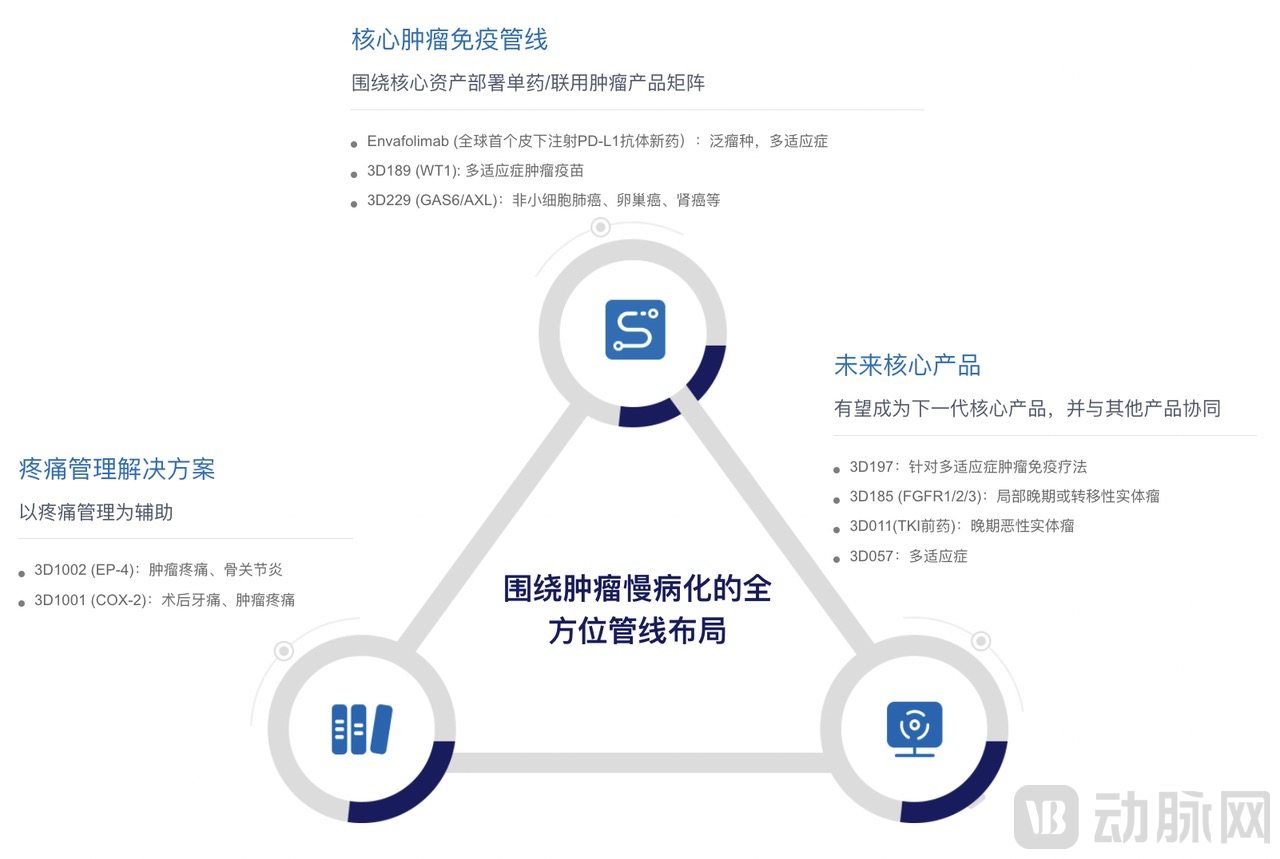
3D Medicines’ Pipeline Portfolio, Source: Company Website
Based on its current core products, prognosis, delayed recurrence, and optimized dosing are the key themes driving 3D Medicines’ participation in the growth of China’s oncology drug market.
Galinpepimut-S (3D189), an investigational peptide cancer vaccine developed in collaboration with SELLAS, was approved by the NMPA this April to initiate a Phase I clinical study evaluating its safety and immunogenicity in patients with hematologic malignancies.
3D189 is a novel, potential first-in-class tumor immunotherapy targeting WT1 (Wilms’ tumor protein). It demonstrates targeted therapeutic potential in more than 20 types of cancers that overexpress WT1, including lung cancer and colorectal cancer. The drug is designed to prevent and delay recurrence by prolonging progression-free survival, with the expectation of extending overall survival in these patients.
Additionally, there is 3D229 (also known as AVB-500), a GAS6-AXL signaling pathway inhibitor developed in collaboration with Aravive. This novel anti-ovarian cancer drug was approved by the Center for Drug Evaluation (CDE) last July to enter an international multicenter Phase III clinical trial.
Ovarian cancer is associated with a poor prognosis, with a 5-year survival rate of only 40% and a high propensity for recurrence. Approximately 70–80% of patients initially sensitive to platinum-based therapy eventually develop resistance to platinum chemotherapy after multiple recurrences. The GAS6-AXL signaling pathway plays a critical role in promoting tumor growth. AVB-500, a therapeutic agent that potently and selectively neutralizes GAS6, inhibits tumor growth through targeted intervention. In the treatment of platinum-resistant recurrent ovarian cancer, AVB-500 has demonstrated favorable safety profiles and anti-tumor efficacy.
Furthermore, Envida itself received approval from the NMPA in August this year for a supplemental application to add a dosage regimen of 300 mg administered once every two weeks. The approval of this new dosing regimen is based on data from Japan and the United States, which will reduce the frequency of drug administration and provide cancer patients with better treatment options through optimization of the dosing schedule.
Amid fierce domestic competition in the monoclonal antibody sector, 3D Medicines is positioning itself as the “first stock for chronic cancer management” in its IPO push on the Hong Kong Stock Exchange. The emergence of more such “first stocks” indicates growing opportunities in vertical niche segments. However, transforming these niche tracks from mere “concepts” into viable business models may prove to be an even greater challenge for companies after going public.