Yiming Technology's AI Algorithm Capabilities Recognized Again with Successful Application in Medical Data Processing
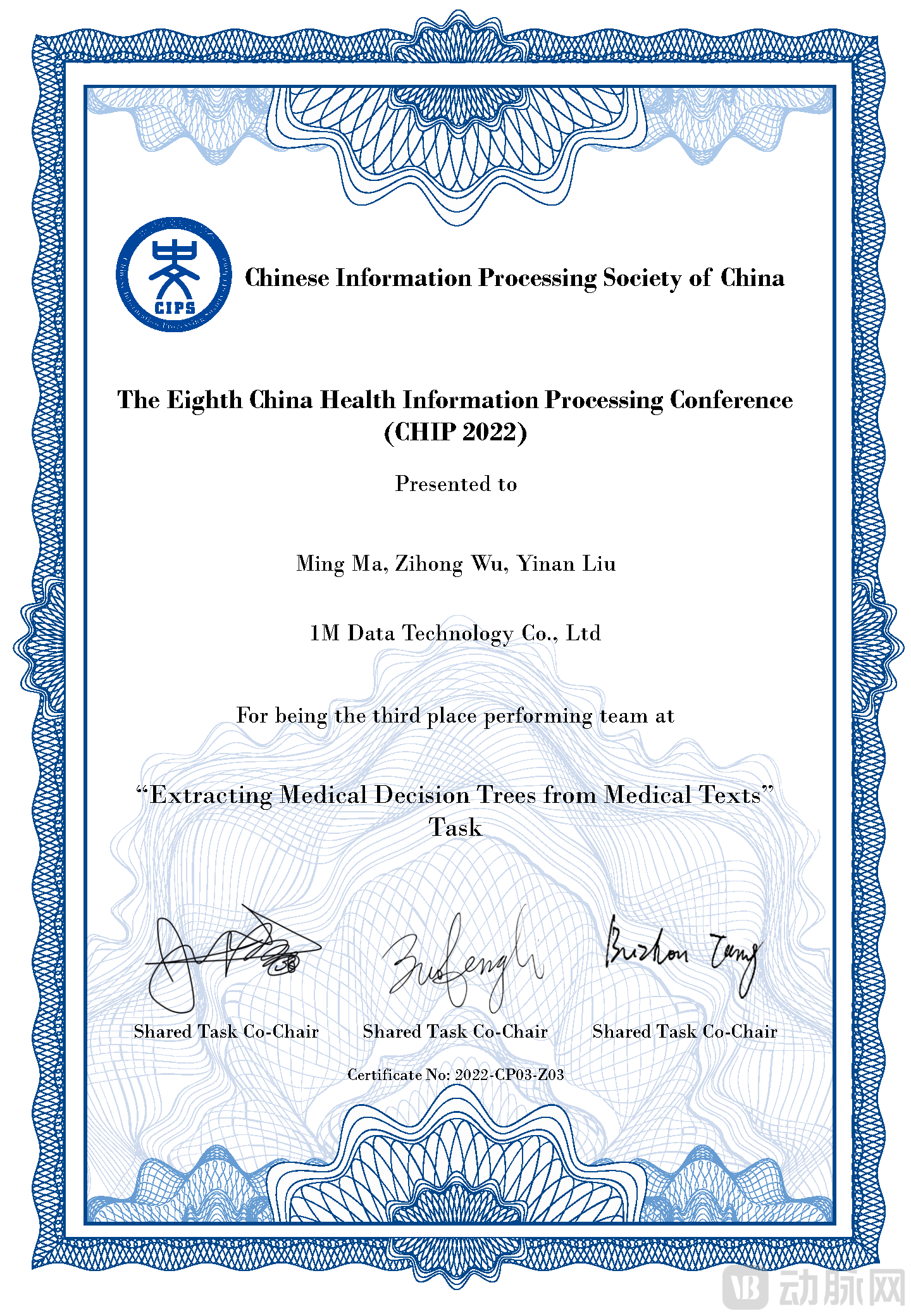
Recently, at the 8th China Health Information Processing Conference (CHIP 2022), Yiming Technology achieved an outstanding third-place finish in the evaluation competition titled “Extracting Diagnosis and Treatment Decision Trees from Medical Texts.” This marks another breakthrough for Yiming Technology in the field of medical artificial intelligence, following its first-place achievement in the Chinese Medical Named Entity Recognition (CMeEE) task of the Chinese Biomedical Language Understanding Evaluation (CBLUE 2.0) benchmark. The 8th China Health Information Processing Conference (CHIP 2022), organized by the Professional Committee on Medical Health and Bioinformatics Processing of the Chinese Information Processing Society and hosted by Harbin Institute of Technology (Shenzhen), is one of the most significant academic conferences in the field of health information processing in China. Yiming Technology’s consecutive top-tier performances in medical AI evaluations fully demonstrate its profound data accumulation and robust research capabilities as a big data and artificial intelligence technology company specializing in the healthcare sector.
Yiming Technology’s participation in the task of “Extracting Diagnostic and Treatment Decision Trees from Medical Texts” addresses a core challenge in developing intelligent healthcare systems, such as clinical decision support systems and medical education platforms. Traditionally, constructing diagnostic and treatment decision trees relies on manual efforts by medical experts, which is time-consuming, labor-intensive, and requires extensive domain knowledge. Therefore, exploring automated methods to extract diagnostic and treatment decisions from knowledge sources—such as clinical practice guidelines and medical textbooks—is highly significant. This task not only requires models to identify core entities and relationships within texts but also to integrate this information into a coherent decision-making workflow. It poses substantial demands on algorithmic performance and solution architecture, while offering considerable practical application value. In this evaluation, Yiming Technology leveraged its proprietary 1M-MedBert medical AI semantic model. Senior Algorithm Engineer Wu Zihong proposed a novel entity and entity-relation extraction architecture tailored for generating decision trees from medical texts, significantly improving the accuracy of triplet extraction and logical reasoning between triplets.
As a medical big data technology company, Yiming Technology possesses extensive capabilities in medical data acquisition and governance. The company specializes in medical data governance services. In terms of data acquisition, the Yiming Data Acquisition System replaces traditional manual entry, seamlessly integrating with all hospital systems to achieve fully automated data capture without human intervention. Regarding data parsing, the Yiming Intelligent Data Processing System enables data structuring and complex computations. By leveraging technologies such as data pipelines, rule engines, and natural language understanding, it assists healthcare institutions in the structured processing, analysis, and mining of electronic medical record (EMR)-related clinical documents, achieving accuracy levels that rank among the industry’s best. Meanwhile, Yiming Technology continues to invest in artificial intelligence R&D, having independently developed the 1M-MedBert medical AI semantic model. This model supports various medical natural language processing tasks, including medical text entity extraction, relation extraction, and text classification. Built upon 1M-MedBert, Yiming Technology has developed multiple algorithm models for practical applications, such as adverse event extraction from medical texts and surgical instrument extraction from operative records, thereby providing richer technical solutions for data processing in the medical field.
As a benchmark company in China’s medical big data sector, Yiming Technology has served hundreds of hospitals, institutions, and research groups across the country. Its continuous investment and technological breakthroughs in medical artificial intelligence will expand the scope of its services, deliver higher-dimensional and higher-quality data governance capabilities, and better serve its clients.