

Xiamen Cardiovascular Health Industry Collaborative Innovation Base Empowers Medical Ecosystem Amid Surge in Domestic Innovation
A Wave of Cardiovascular Technological Innovation Is Sweeping In, with the Sector Remaining Red-Hot.
According to statistics from the Arterial Orange database, global investment and financing in the cardiovascular consumables sector showed a clear upward trend from 2015 to 2021. The year 2020 witnessed explosive growth, with total financing increasing by 237% year-on-year. In 2021, financing saw a slight increase, with 58 deals completed and a total funding amount of $1.943 billion. This lucrative sector has attracted overseas giants such as Medtronic, Abbott, and Edwards Lifesciences, while domestic innovative enterprises are also breaking through, striving to catch up with these industry leaders and fostering original R&D capabilities.
Against this backdrop, what are the prospects for China’s cardiovascular health industry? How can a new model for industrial innovation and development be established? These are questions worthy of consideration.
Recently,“The 13th Cross-Strait Cardiovascular Disease Summit Forum (CSCSF2022)”Successfully held in Xiamen. During the event,2022 Xiamen Cardiovascular Health Industry Innovation Forum Held Concurrently, stakeholders from various sectors involved in the base’s construction and development gathered together, drawing on their respective areas of expertise to elaborate on the development and future of the cardiovascular health industry from multiple perspectives, and unveiled the plaque for the innovation base.
VCBeat also took this opportunity to gain insights into the industry’s explorations and achievements in innovative technologies, jointly exploring future industry trends and solutions.
Leverage Industrial Advantages to Support Technological Innovation
As one of the key events of this forum,Kong Shuguang, Secretary of the Xiamen Municipal Science and Technology Bureau; Sui Guoyu, Deputy Director of the Xiamen Torch High-Tech Industrial Development Zone Administrative Committee; Wang Yan, President of Xiamen University Affiliated Cardiovascular HospitalThe leaders jointly unveiled the plaque for the “Cardiovascular Health Industry Collaborative Innovation Base.” Subsequently,Shenqi Medical, Qichen Medical, Duanyou Medical, Yinglv MedicalFour companies, as the first batch of enterprises to settle in the base, signed settlement agreements with Xiamen University Affiliated Cardiovascular Hospital and Xiamen Torch Biomedical Professional Incubator.

Leaders Jointly Unveiled the “Collaborative Innovation Base for the Cardiovascular Health Industry”
Kong Shuguang, Secretary of the Xiamen Municipal Science and Technology BureauIndicate, “Health requires technological support, while technology requires industrial support.””
In fact, as early as 2003, the Xiamen Science and Technology Bureau took the lead in promoting the development of three pioneering industries, including biomedicine. Today, Xiamen’s biohealth industry has become, amid the current pandemic situation, a focal point for stakeholders from all sectors.The industrial platform that has garnered the most attention, received the greatest support, and is at the forefront of strategic deployment to secure innovative resources.
Furthermore, in 2019, Xiamen’s biomedical and health industry was selected as one of the first national-level strategic emerging industry clusters and was included on the State Council’s list for inspection-based incentives for three consecutive years, demonstrating strong competitiveness in collaboration and talent, as well as distinctive industrial specialization.
—where the base is located—The Torch High-Tech Zone is a key platform for innovation and entrepreneurship in Xiamen., a hub for high-tech enterprises and the primary carrier of Xiamen’s trillion-yuan industrial clusters. Sui Guoyu, Director of the Administrative Committee of Xiamen Torch High-Tech Zone, stated, “Since the implementation of the ‘One Zone, Multiple Parks’ cross-island development strategy, the development efficiency and effectiveness of the Torch High-Tech Zone have been leading the nation.”
Here, Xiamen City leverages its industrial strengths to build an innovation hub, unlocking greater possibilities for the development of healthcare and medical services.
In other words, driven by Xiamen’s biomedical industry and underpinned by deep expertise across various specialized sectors, the Innovation Base leverages its professional strengths to attract more innovative enterprises, top-tier talent, and investment firms. Together, they engage in collaborative innovation, public platform services, coordinated industrial investment promotion, technology enterprise incubation, investment and financing matchmaking, and academic forums, thereby advancing the development of China’s cardiovascular health industry.
So, under these circumstances, how is specific empowerment implemented?
Multi-Party Collaboration to Establish an Open Platform for the Cardiovascular Industry
In fact, within the overall layout of the biopharmaceutical and health sector, Xiamen has placed a particular focus on the cardiovascular health industry. The Report on Cardiovascular Health and Diseases in China 2021 points out that the prevalence of cardiovascular diseases in China is on the rise. Currently, there are approximately 330 million patients with cardiovascular diseases in China, and two out of every five deaths in the country are attributable to cardiovascular diseases.
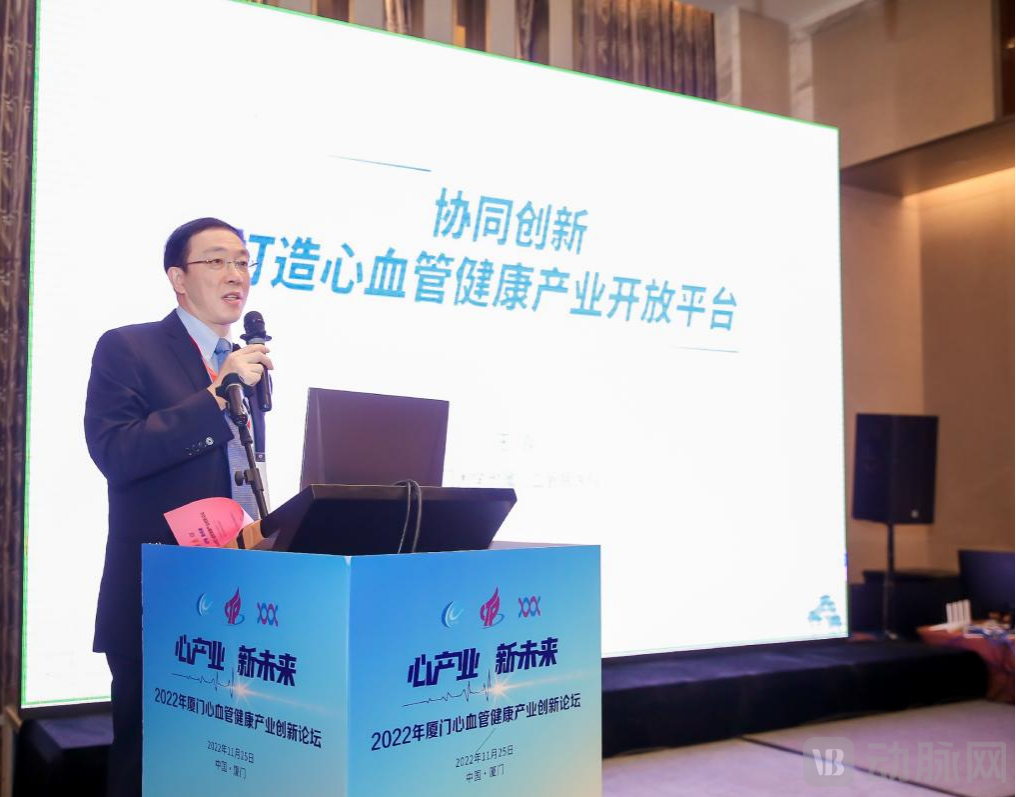
A Share by Dr. Wang Yan, President of Xiamen University Affiliated Cardiovascular Hospital
Wang Yan, President of Xiamen University Affiliated Cardiovascular HospitalIt was also stated that innovation in cardiovascular medical devices occupies a leading position within China’s medical device innovation landscape. However, the translation of scientific and technological achievements into practical applications in the medical device sector, including the cardiovascular industry, still faces “bottlenecks.” First, R&D outcomes tend to prioritize academic research, with the majority failing to achieve industrialization. Second, healthcare institutions have not been fully integrated into the broader trend of achievement translation, making it difficult for physicians to collaborate effectively with universities, research institutes, and enterprises on joint technology R&D initiatives.
The key to resolving bottlenecks lies in advancing collaborative innovation, by building an integrated industrial innovation ecosystem encompassing government, industry, academia, research, healthcare, and capital, and establishing a joint R&D model “oriented toward clinical applications.”
Specifically, within the Cardiovascular Health Industry Collaborative Innovation Base, policy, industry, and technology are all effectively supported. In terms of policy, the Xiamen Municipal Science and Technology Bureauto provide policy support and allocate resources rationally,Promote the development of industrial clusters, providing spatial and policy support for industrial growth.
In terms of industry, the Administrative Committee of Xiamen Torch High-Tech Zone willProvide industrial support and establish a specialized cardiovascular health seed fund., and establish a regular communication mechanism between medical institutions and enterprises to incubate early-stage projects.
Technically, Xiamen University Affiliated Cardiovascular HospitalProvide Technical Support, developing cutting-edge technologies for cardiovascular devices to achieve innovation-driven growth.
Meanwhile, Xiamen University Affiliated Cardiovascular Hospital also proposedBRICS Innovation CenterConcept, Xiamen University Affiliated Cardiovascular Disease Hospital has initiated the establishment of the BRICS Cardiovascular Health Innovation Center, aimed at providing international cardiovascular health services, promoting academic exchanges in cardiology among BRICS nations, cultivating cardiovascular professionals within the BRICS framework, establishing a cardiovascular industry base, and fostering cooperation under the “BRICS+” and “Cardiovascular+” initiatives.
To date, the BRICS Cardiovascular Health Innovation Center has completed a series of initiatives, including hosting the BRICS Cardiovascular Health Innovation Center Interventional Salon, signing a letter of intent for cooperation with Apollo Hospitals, India’s largest healthcare group, and holding the unveiling ceremony for the BRICS Cardiovascular Innovation Center.
Starting next year, the hospital will also launch a visiting scholar program, through which 8–10 outstanding young physicians from BRICS countries will come to the innovation platform each year to study clinical knowledge or engage in scientific research.
Technological Upgrades and Diversified Innovation Are Key to Breaking “Involution”
Meanwhile, at the Cardiovascular Health Industry Innovation Forum,Mr. Adoor Dalakode, Executive Director of the Federation of Indian Chambers of Commerce and Industry (FICCI) and Chairman of the Advisory Committee of the BRICS Cardiovascular Health Innovation Center; Mr. Jiang Tianjiao, Dean of VCBeat Research Institute; Mr. Marco, Managing Director of Qiaokang Capital; and Mr. Wan Xiangxin, Founder of Yinglv MedicalThey have also successively elaborated on the development and future trends of cardiovascular care from various perspectives, including industry evolution, technological advancement, and investment prospects.
Director Abdul DalagodiCardiovascular disease is considered the greatest health threat to humanity today, claiming 17.9 million lives annually. Of these, 8.38 million deaths occur in BRICS countries, accounting for 46.8% of global cardiovascular disease mortality. These figures underscore the significant importance of cooperation among BRICS nations in the prevention and control of cardiovascular diseases.The Prospects for Cardiovascular Health-Related Industries in Future BRICS Nations Are Promising.
To build a community with a shared future for mankind, BRICS countries need to join hands in the field of cardiovascular health. The BRICS Cardiovascular Health Innovation Center will collaborate with more innovative Chinese medical devices to “go global” into international markets and reach more BRICS nations, jointly enhancing the level of cardiovascular health across BRICS countries.
Dean, VCBeat InstituteMr. Jiang TianjiaoIt emphasizes that the current period isThe cardiovascular field is full of innovation opportunities, with product innovation being extremely active in various sub-sectors.. From a holistic perspective, it is essential to embrace the four major waves of innovation currently shaping the cardiovascular field—namely, coronary artery disease, structural heart disease, cardiac rhythm and electrophysiology, and heart failure management—by fostering continuous, overlapping, and cross-disciplinary innovation rather than engaging in mere imitation and replication.
Furthermore, Chinese listed valve manufacturers still lag behind international giants such as Edwards Lifesciences. This gap is partly attributable to the severe homogenization of cardiovascular device innovation in China, which has failed to achieve more granular segmentation.
To bridge the gap and move beyond involution, the key lies in technological upgrading and diversified innovation. First, innovation must shift from mere “technical showmanship” to a balanced approach; it is not simply about increasing engineering complexity, but rather about achieving equilibrium among clinical efficacy, safety, and ease of use. Second, beyond “core” products, there are also opportunities for innovation—for instance, peripheral ancillary devices such as clipping systems used for repair in cases of severe aortic calcification present significant potential for innovative development.
Finally, Mr. Jiang Tianjiao also mentioned that,Do not fear volume-based procurement, nor fear failure., draw lessons from failures and keep moving forward.
Switching to the investor perspective, Managing Director of QianKang CapitalMr. MarkIt was stated that outstanding early-stage growth companies in China share the following common characteristics: first, they are best-in-class or rank first within their peer group; second, they possess strong R&D capabilities, establishing high technological barriers; third, they have scalable platform capabilities, with a focus on patent protection and expansion of industrial lines; fourth, they boast excellent teams, favoring serial entrepreneurs and those with prior entrepreneurial experience; fifth, they face low volume-based procurement risk; and sixth, they demonstrate global competitiveness.
Currently, China's cardiovascular industry presents substantial market potential. Specifically, China accounts for 14% of the global medical device market, ranking as the world's second-largest market. Meanwhile, population aging, coupled with improvements in residents' quality of life and healthcare conditions, is driving sustained growth in high-quality demand from cardiovascular patients.
A key driver behind the development of domestically produced cardiovascular devices isStrengthen the Application of New Technologies to Enable Domestic Products to Replace ImportsOn this basis, Kangqiao will leverage its robust medical expertise to conduct a “top-down” comprehensive analysis of epidemiological data, potential market size, and current therapeutic advances across various diseases, with a particular focus on areas with unmet medical needs.
In the cardiovascular industry, Kangqiao focuses primarily on three areas: first, technological iteration and innovation to address critical bottlenecks; second, innovative procedures that deliver better therapeutic outcomes for patients; and third, opportunities for domestic substitution to achieve a balance between cost and efficacy.
Finally, from the perspective of innovative enterprises, the founder of Yinglv MedicalWan XiangxinMr. emphasized,Yinglv Medical focuses on the research, development, and production of heart failure electrical stimulation and cardiac rhythm management products, breaking international monopolies., the core team includes several globally renowned scientists in the cardiovascular field. The company’s relocation to the Xiamen Cardiovascular Health Industry Collaborative Innovation Base has also instilled great confidence in Yinglv Medical, which is currently in its startup phase.