

WeDoctor Showcases Digital Healthcare Ecosystem at 2022 Forbes China Innovation Summit, Eyes Broader Industry Collaboration
On December 8, the 2022 Forbes China Innovation Summit was held in Shanghai under the theme “Global Innovation Bellwether.” At this summit, guests from various sectors including business and investment, along with representatives from companies selected for the “2022 Forbes China Top 50 Innovative Companies,” jointly explored new drivers, technologies, and trends in global innovation.
This August, to honor high-quality enterprises and forces that dare to innovate and break through, Forbes released the "2022 China's 50 Most Innovative Companies" list. Five companies in the big health sector, including WeDoctor Group, WuXi Biologics, and Hengrui Medicine, were selected. Among them, WeDoctor Group was listed for the third time, having first been included in 2018 and retained its position in 2019. It was also the only company from the digital healthcare industry to be included in the 2022 list.
As a representative of the selected enterprises, Wang Yang, President and Chief Technology Officer of WeDoctor Group, was invited to attend this summit. He shared insights on the theme “Difficulties and Challenges of Continuous Innovation,” detailing WeDoctor’s journey in leading continuous breakthroughs and innovation in the digital healthcare industry, as well as its efforts to sustain innovation amid the ever-evolving social, policy, and technological landscapes and to build a diversified ecosystem for its digital healthcare platform.
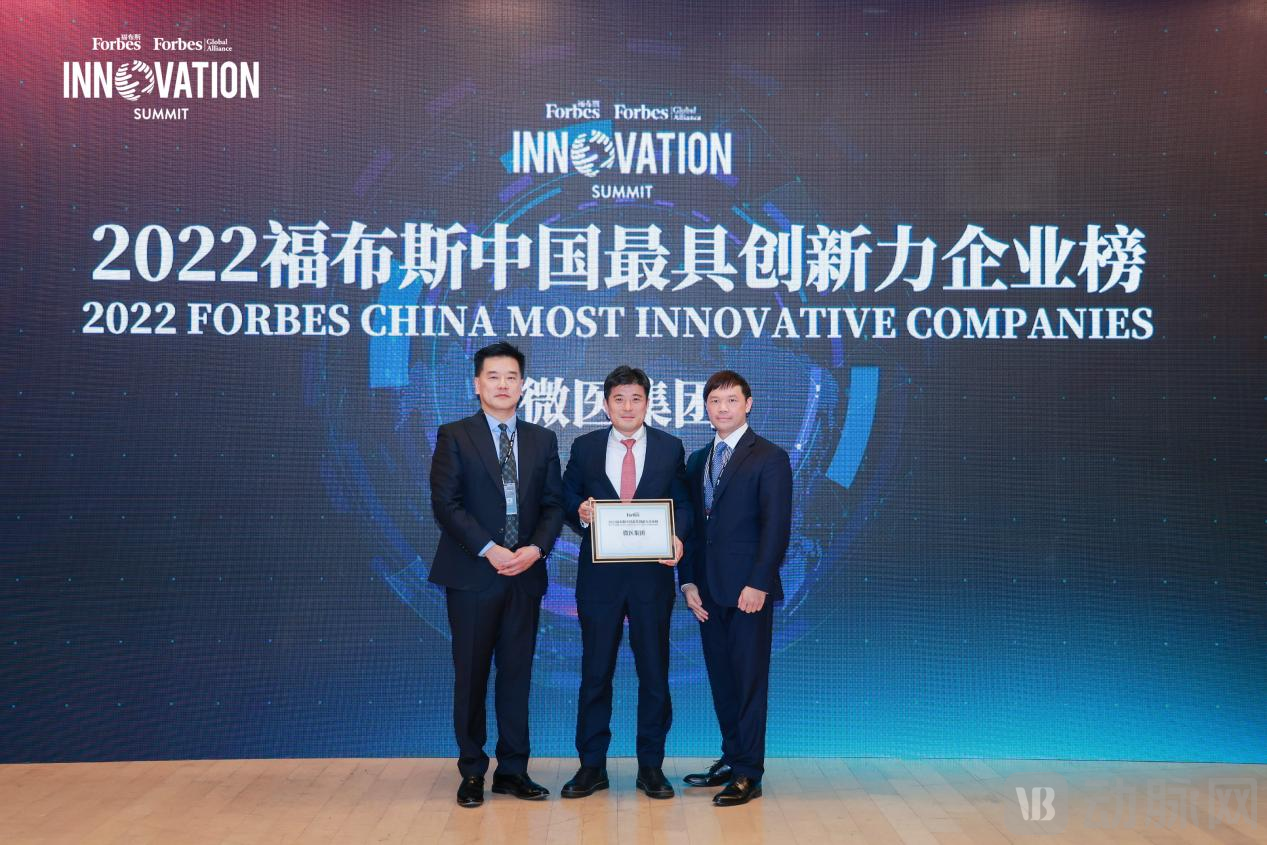 WeDoctor Awarded “Forbes China’s Most Innovative Companies 2022”
“During the pandemic, digital healthcare experienced rapid development, connecting patients with healthcare providers and offering more convenient ways to access medical care and purchase medications. This highlights the advantages of digital healthcare, but its benefits extend far beyond this.”
Dr. Wang Yang introduced that WeDoctor, as a vital “aerial force” in the fight against the epidemic, has carried out extensive work. For instance, in the early stages of the outbreak in 2020, WeDoctor took the lead in launching the “Real-Time Assistance Platform for COVID-19” through its internet hospital, mobilizing experts nationwide to provide online support to Wuhan. During the Shanghai outbreak in April this year, WeDoctor collaborated with institutions such as the Shanghai Digital Medical Innovation Center and Shanghai Ruijin Hospital to establish the “Shanghai Emergency Platform for Medical Consultation and Medication,” pooling resources from various parties and streamlining medication delivery to ensure that patients in Shanghai could access medical care and medicines under epidemic prevention and control measures.
“Meanwhile, within WeDoctor’s ecosystem, there are numerous innovations and many areas ripe for further exploration. The healthcare and wellness sector is remarkably broad, encompassing far more than just online consultations and medication purchases,” stated Dr. Wang Yang. As a pioneer in the development of digital healthcare, WeDoctor has continuously expanded the scope and reach of its digital medical services—from establishing China’s first internet hospital, Wuzhen Internet Hospital, to spearheading the creation of regional health management organizations known as Digital Health Communities.
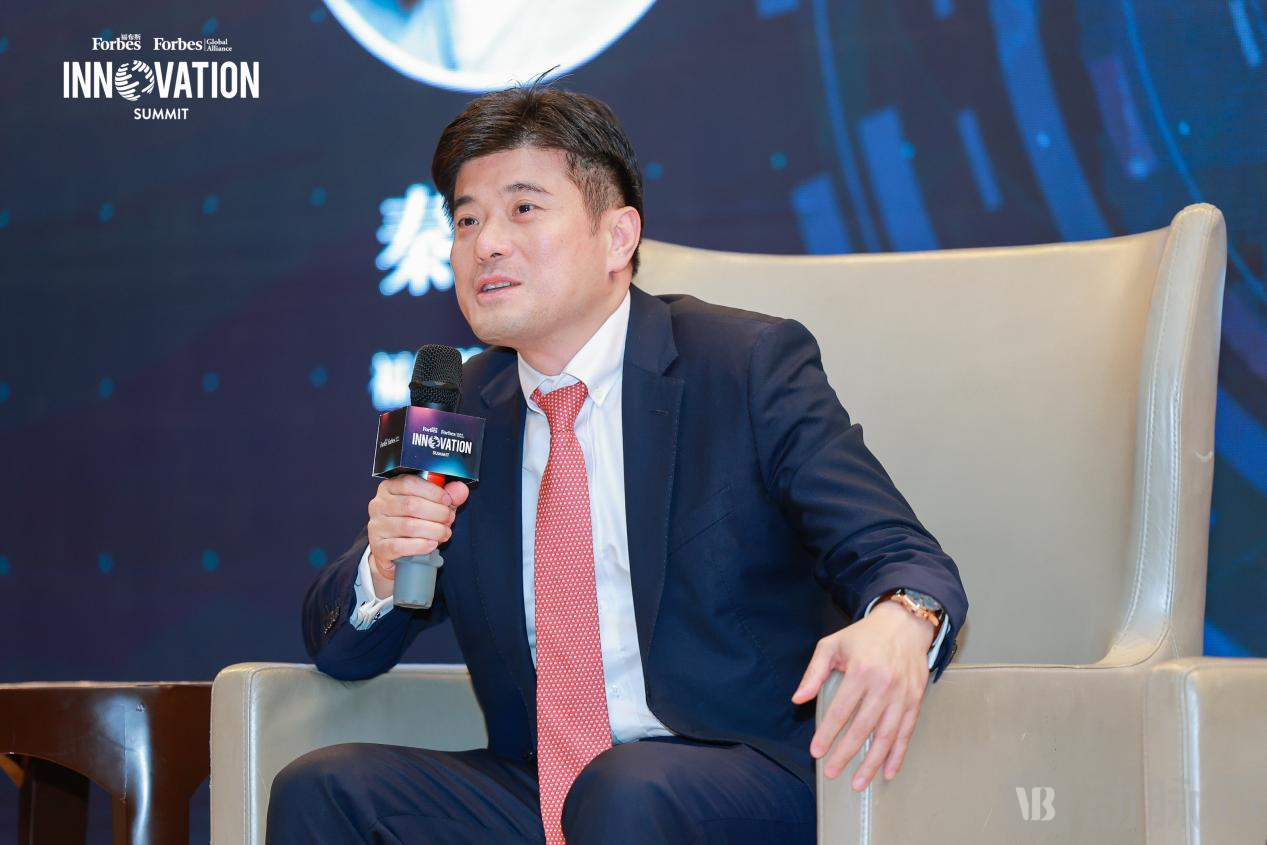 Dr. Wang Yang Shares WeDoctor's Innovative Practices
Currently, WeDoctor has connected with over 8,000 hospitals across China, including more than 95% of Grade A tertiary hospitals; it operates 33 internet hospitals, 19 of which have enabled online medical insurance payments; and it links more than 300,000 registered physicians with nearly 280 million registered users.
“Such vast amounts of data will make significant contributions to health management, healthcare improvement, and pharmaceutical R&D. WeDoctor is an open, integrated platform. We look forward to engaging with a more diverse range of partners—whether health service providers, pharmaceutical and related enterprises, or innovative companies in AI and big data—all of whom can integrate into the digital healthcare ecosystem built by WeDoctor, working together to strengthen and optimize this ecosystem.”
“Technological innovation is the soul of a company, and the pace of innovation on the WeDoctor platform must keep abreast with the development of the internet.” Dr. Wang Yang introduced that, leveraging its extensive accumulation of medical resources and digital R&D capabilities, WeDoctor is continuously developing and refining an integrated “device-cloud-brain” digital intelligent healthcare service system, which combines the Intelligent Health Cloud, Digital Medical Brain, and smart medical devices.
Through intelligent terminals such as smart fundus cameras, gene scanners, WeDoctor Health Connect, smart all-in-one kiosks, and mobile hospitals, we can reach scenarios in rural areas, communities, households, and schools. This enables residents to access medical resources from over 8,000 hospitals and 300,000 doctors across China connected via the WeDoctor Smart Health Cloud anytime and anywhere, along with smart services powered by emerging technologies such as the internet, the Internet of Things (IoT), and artificial intelligence (AI), thereby facilitating the decentralization of high-quality medical resources to grassroots levels and communities and extending them to every household.
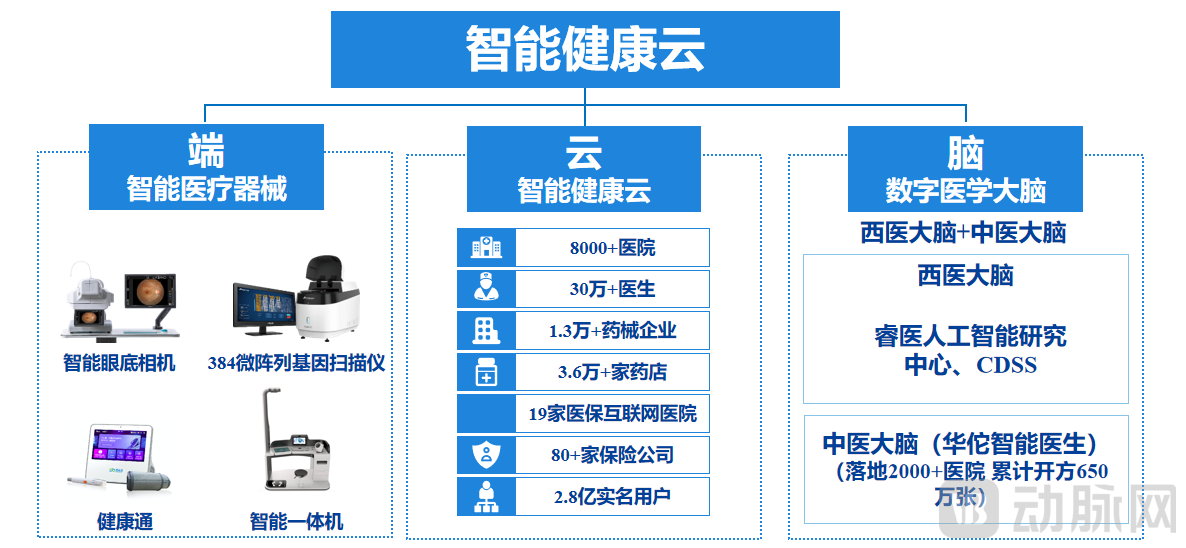 WeDoctor’s “Device + Cloud + Brain” Digital Intelligent Healthcare Service System
“Connecting so many hospitals, doctors, and families involves various interfaces and technical implementations, but more importantly, it requires the ‘brain’ that drives this system. On the WeDoctor platform, there are two parallel ‘brains’: one for Traditional Chinese Medicine (TCM) and one for Western medicine.” Dr. Wang Yang introduced that, as an open platform, WeDoctor Intelligent Health Cloud, supported by the interconnectivity among devices, cloud, and brain, uploads medical data accumulated from intelligent terminals to the cloud for processing. This further forms a powerful “Digital Medical Brain,” enabling high-level, diversified development and application of “AI + Healthcare.”
In the field of Western medicine, WeDoctor and Zhejiang University jointly established the Ruiyi Medical AI Research Center. Leveraging digital technologies such as artificial intelligence, big data, and cloud computing, they developed an AI-driven diagnostic and therapeutic application for Western medicine—the Ruiyi Intelligent Doctor. In the realm of Traditional Chinese Medicine (TCM), WeDoctor developed the TCM Brain “Huatuo Cloud” to assist grassroots TCM practitioners in prescribing formulas. It has currently been deployed in over 2,000 hospitals, cumulatively assisting physicians in generating 6.5 million prescriptions.
“We have made substantial efforts in technological innovation in these areas, including significant improvements to our organizational coordination, talent development, and incentive mechanisms.”
Dr. Wang Yang stated that, thanks to the continuous accumulation and steady improvement of technological innovation and application capabilities, WeDoctor has achieved breakthrough progress in multiple fields, including intelligent fundus screening, computer-aided diagnosis of pulmonary nodules, AI-assisted ECG interpretation, colposcopic aided diagnosis for cervical conditions, and clinical decision support for liver cancer. Furthermore, intelligent devices developed by WeDoctor, such as gene chips, all-in-one smart health kiosks, and the WeDoctor Health Connect platform, have been widely adopted, significantly enhancing the quality and efficiency of primary healthcare services.
“When it comes to innovation, we often overlook another critical type: model innovation, or business model innovation. This resonates deeply with me, because delving into the healthcare industry reveals a paradox: Do healthcare providers want you to be sick or healthy? If the healthcare business model is based on prescribing medications, we fall into a contradiction that runs counter to our original entrepreneurial intent,” stated Dr. Wang Yang. He emphasized that without breaking this paradox through model innovation, even the most advanced technological innovations will pale in comparison.
“We hope that people can be healthy and achieve health at the lowest cost, so WeDoctor has proposed a model innovation for digital health communities.”
Dr. Wang Yang introduced that in the Digital Health Community model, the health of the public is the ultimate goal of medical services. For example, under the leadership of the Tianjin Municipal Health Commission, the Tianjin Weiyi Internet Hospital took the lead in collaborating with 266 primary healthcare institutions across the city to establish a close-knit medical consortium—the Tianjin Primary Care Digital Health Community. While providing integrated online and offline medical and health services covering “prevention, diagnosis, treatment, management, and wellness,” the initiative used chronic disease management, such as for diabetes, as an entry point to explore and implement diagnosis-related group (DRG) and capitation-based payment methods for medical insurance funds. By enforcing the medical insurance payment policy of “retaining surpluses and not covering deficits,” it established a health-stewardship accountability system oriented toward health outcomes, along with corresponding performance-based incentive mechanisms. Under this mechanism, medical insurance has shifted from “paying for treating diseases” to “paying for health,” thereby mobilizing primary care physicians to proactively provide comprehensive health management services to patients.
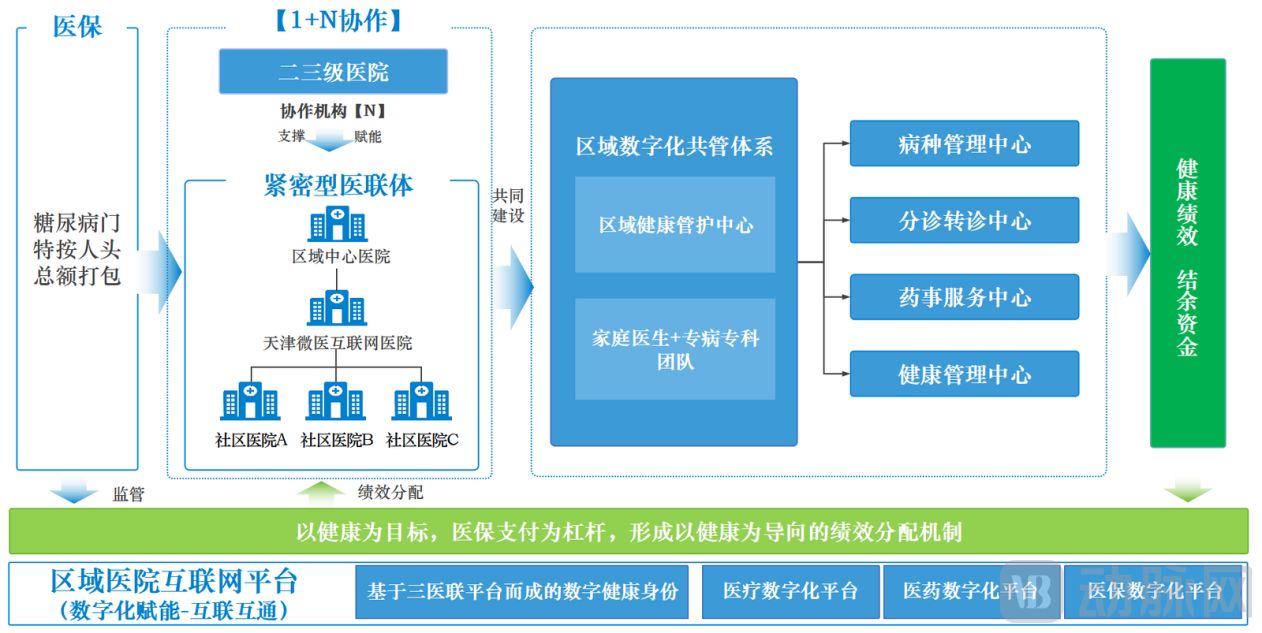 Health-Oriented Model Innovation in the Digital Health Consortium
“During the innovation process, change is difficult to predict; our original aspiration serves as a constant guiding direction. WeDoctor’s original aspiration is to safeguard everyone’s health. Whether through technological innovation or business model innovation, we are moving forward in this direction.” Finally, Dr. Wang Yang shared, “What is most fundamental? By staying true to our original aspiration and driving innovation based on actual needs, we can withstand harsh winters and adapt to various environmental changes. WeDoctor will always serve the health of the people.”