

Watmind Initiates a Technological Revolution in Immunoassay POCT by Integrating Microfluidics, Magnetic Particle Chemiluminescence, and Point-of-Care Testing
As policies such as tiered diagnosis and treatment and the “Five Major Centers” initiative continue to advance, point-of-care testing (POCT) is gaining increasingly widespread recognition in clinical departments for rapid diagnosis, dynamic monitoring, and assessment of therapeutic efficacy in emergency care for critically ill patients, owing to its operational convenience, low cost, and short turnaround time.
However, challenges such as high R&D complexity, high entry barriers, and a scarcity of specialized talent have continued to constrain the development of China’s high-end POCT market.Test accuracy is the critical determinant of whether POCT devices can serve as a basis for clinical diagnosis; achieving an upgrade in accuracy necessitates prior advancements in methodology and technology.
Since its establishment in 2014, Watmind has been dedicated to enhancing the accuracy of POCT testing, initiating a revolution in foundational technologies. The company’s independently developed microfluidic magnetic particle chemiluminescence immunoassay analyzer marks the world’s first integration of microfluidic technology with chemiluminescence immunoassay, achieving a series of breakthroughs in advancing the precision, speed, and quality control of POCT.
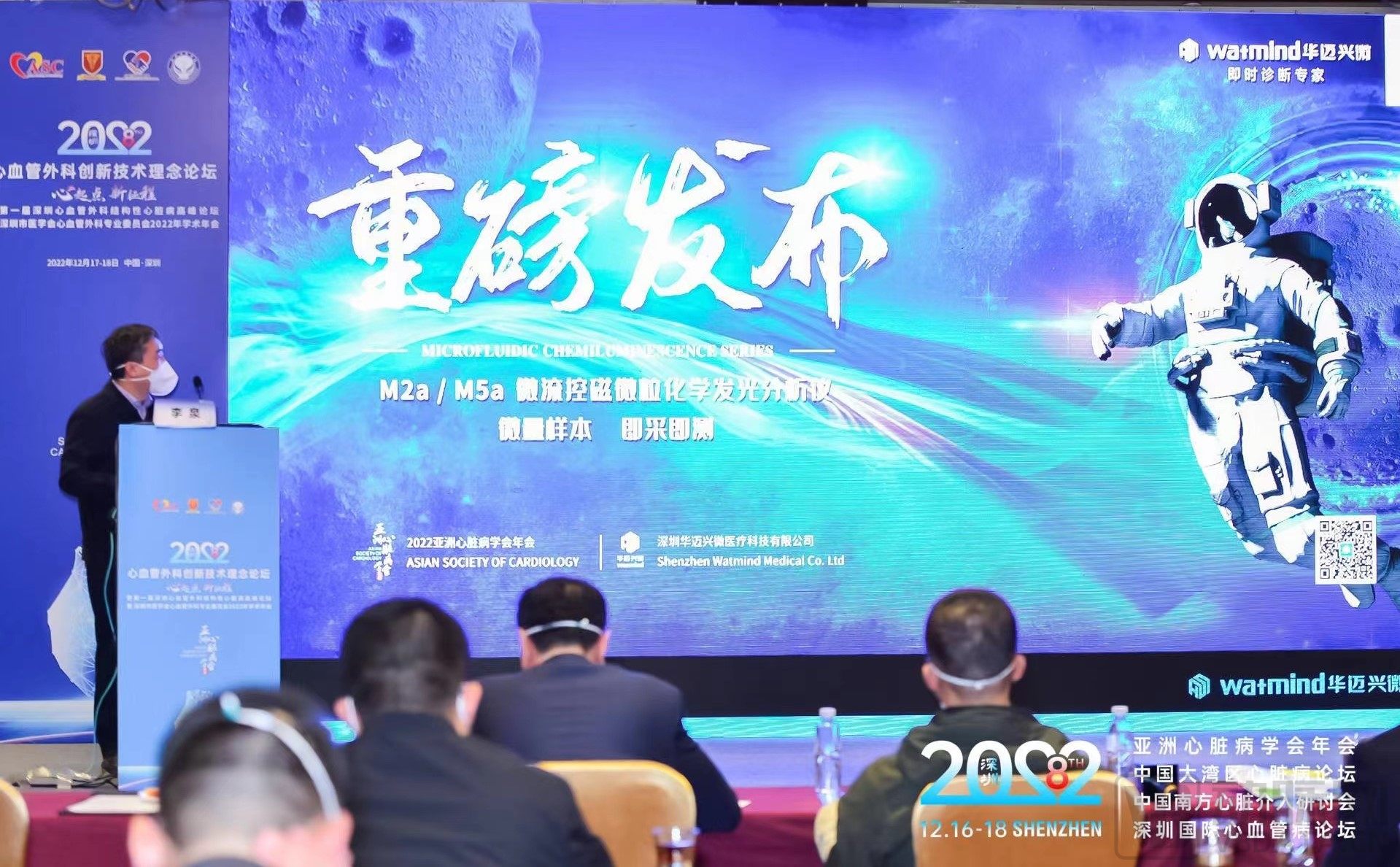
At the Asian Society of Cardiology,
Watmind Launches M2a/M5a Products On-Site
From December 16 to 18, 2022, the 2022 Annual Conference of the Asian Society of Cardiology was grandly held in Shenzhen. Watmind unveiled its new products—the M2a/M5a Microfluidic Magnetic Particle Chemiluminescence Immunoassay Analyzers—at the conference, engaging with attendees in discussions on the application of microfluidic technology in cardiovascular clinical diagnostics.
Microfluidics + Chemiluminescence + POCT:
“A Leap in Precision, Speed, Simplicity, Quality, and Miniaturization”
As previously mentioned, analytical accuracy is the critical determinant of whether POCT devices can serve as a basis for clinical diagnosis.The key advantage of chemiluminescence is its exceptionally high precision, while microfluidics provides a highly advantageous technical platform for the application of chemiluminescence technology in point-of-care testing (POCT).
On one hand, microfluidic technology enables the integration of multifunctional units and automation of operations involved in complex analyses on miniaturized devices, thereby eliminating the need for specialized laboratories and skilled personnel required by traditional, complex, multi-step bioanalytical equipment. On the other hand, at the microscale, reaction and analysis speeds are faster, sample and reagent consumption is reduced, and rapid, high-throughput analysis is easily achieved.

Li Quan, Founder and General Manager of Watmind
According toLi Quan, Founder and General Manager of WatmindIntroduction: The M2a/M5a Microfluidic Magnetic Particle Chemiluminescence Immunoassay Analyzer integrates three cutting-edge technologies—microfluidics, magnetic particle separation, and chemiluminescence—to achieve more precise and stable test results. Specifically, the product offers five major advantages:
First, "accuracy," using mainstream chemiluminescence methods,Results were directly compared against Roche’s large-scale automated chemiluminescence immunoassay workflow., with accuracy meeting clinical requirements.
The second is “speed”: compared to large chemiluminescence products, which take about 20 minutes to deliver results, this product achievesCTnl results are available in 12 minutes, and other test results in 10 minutes.
Third is “simplicity”: home blood glucose meters are easy to operate,Supports whole blood, serum, plasma, and capillary blood samples,Doctors, nurses, or the patients themselves have undergoneSimple training required for operation, easy to use.
Fourth is “quality,” which can be assessed using products from Roche, Randox, Bio-Rad, etc.Third-party quality control enables mutual comparison of results., with extremely high credibility.
Fifth is “small,” as this product is currentlyThe World's Smallest Chemiluminescence Analyzer, suitable for various scenarios such as clinical departments and chest pain centers; community health centers and township health clinics; and home use.
Eight Years in the Making: From “0” to “1”
Compact Chemiluminescence Immunoassay Systems Rival Large-Scale Automated Lines
Li Quan, founder and general manager of Watmind, graduated from Wuhan University of Technology with a major in electromechanical engineering. In 1999, he joined Mindray Medical as its 108th employee and participated in the development of China’s first fully automated biochemical analyzer. Later, Li served as the head of the IVD division at Landwind Medical. Having witnessed the rapid growth phases at both Mindray and Landwind, Li became inclined toward entrepreneurship when the companies’ subsequent development failed to meet expectations.
In 2014, Watmind was established, deeply cultivating the microfluidic chemiluminescence sector and focusing on the R&D, manufacturing, sales, and service of IVD products, with a commitment to providing high-quality POCT diagnostic solutions to the global healthcare market.
Deeply integrating the three mainstream IVD technologies: chemiluminescence, microfluidic chips, and POCT, is based on a comprehensive analysis of market space and technological frontiers.
On one hand, immunochemiluminescence accounts for 38–40% of the in vitro diagnostics (IVD) market share, demonstrating strong market potential. On the other hand, first-tier players in the IVD market—Roche, Abbott, Danaher, and Siemens—all offer large-scale, fully automated laboratory automation lines designed for use by specialized laboratory professionals. Microfluidics combined with point-of-care testing (POCT) technology can miniaturize these large diagnostic systems, enabling general practitioners to operate them with ease, while also aligning with China’s national policy promoting tiered diagnosis and treatment.
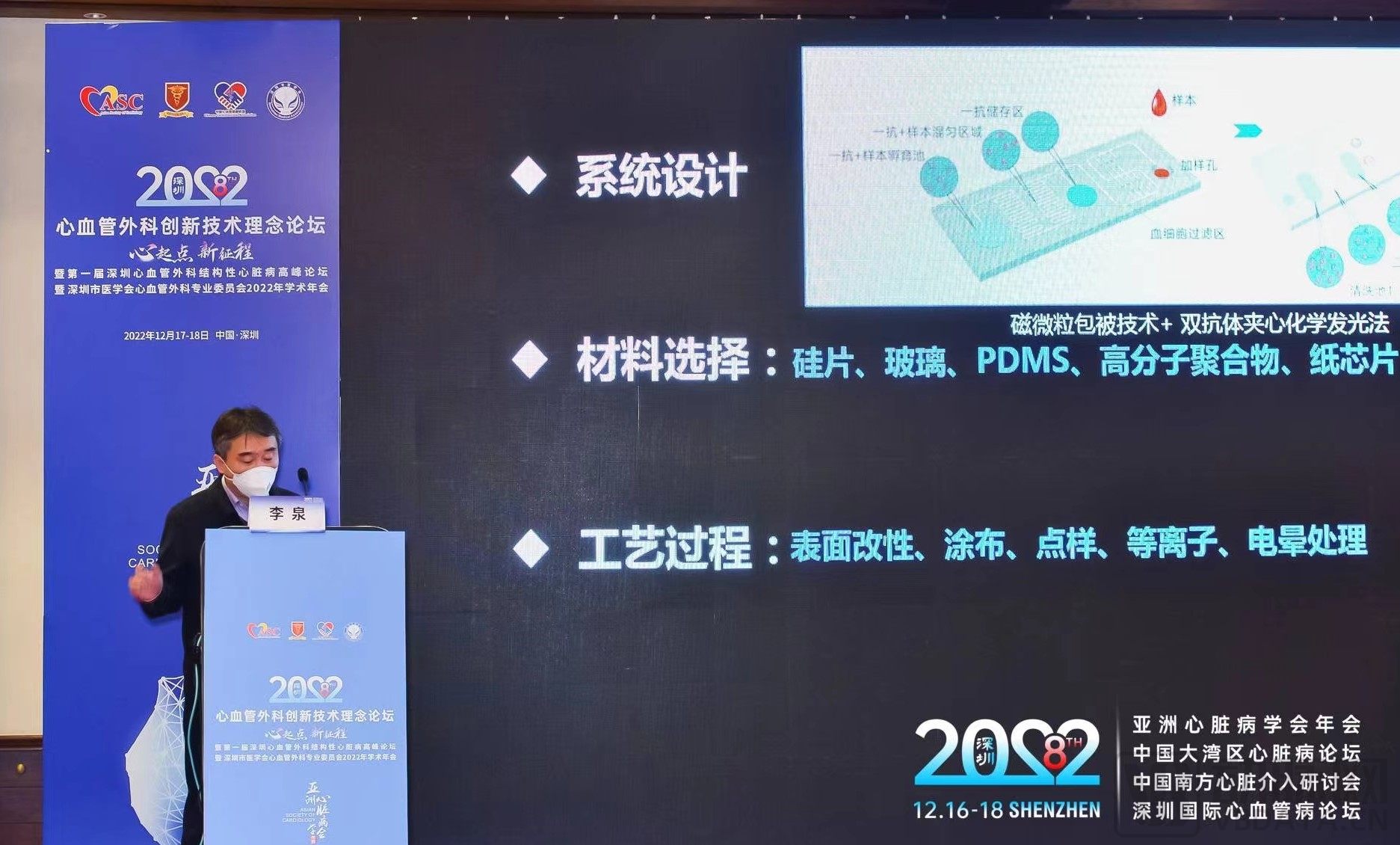
Li Quan, Founder and General Manager of watmind, Introduces the Product R&D Process
However, correspondingly, there has been no comparable product globally over the past eight years, leaving no reference during the R&D phase and requiring nearly every stage to be developed from scratch.
“We actually took the most difficult path.” In the first few years after the company’s founding, voices of doubt kept emerging. “So many manufacturers failed to develop it—was this route fundamentally unviable? At that time, we had already secured substantial investment, but there were still no signs of success, and the pressure was immense. Fortunately, through eight years of relentless effort, we overcame numerous challenges and achieved technological breakthroughs,” recalled Li Quan.
The primary challenge in the system design phase lies in integrating complex chemiluminescence reactors onto a microchip. WatmindIntegrating reagent components and blood separation devices into a chip, with clever microchannel design and coordinated device manipulation, enables one-touch testing., revolutionizing the complex operations of traditional large-scale fully automated chemiluminescence analyzers.
Secondly, in terms of the implementation of chemiluminescence technology, watmind adoptsMagnetic particle-based dual-antibody sandwich chemiluminescence assay overcomes technical challenges such as easy loss and poor reproducibility when magnetic particles are applied in microfluidic chips., thereby achieving an active immune response and significantly improving sensitivity and reproducibility metrics.
Meanwhile, in terms of material selection, watmind's microfluidic chips are chosenPolymer injection molding process, which enables surface modification while offering certain cost advantages, addressing the issue of cost control at the grassroots level.
According to the introduction, watmind'sM2a Single-Channel Product, targeting the primary healthcare market, such as laboratories in community health centers and township health clinics,CanAddressing the Inability of Primary Care Facilities to Perform Chemiluminescence Immunoassays。M5a Four-Channel Product,Enhanced channel performance, primarily applied to clinical departments in large Grade A tertiary hospitals, toMeeting the demands of large hospitals for precision and throughput.
Promoting "One Chip, Multiple Tests" for Home Use
Making High-Tech Healthcare Accessible to the Public
Currently, Watmind operates an R&D base spanning nearly 3,000 square meters in the Nanshan Science and Technology Park of Shenzhen, with R&D personnel accounting for over 35% of its workforce. At the Pingshan National Bio-industry Base, it maintains a Class 10,000 GMP-standard cleanroom facility and an instrument and reagent production center covering more than 2,000 square meters, and possesses the world’s first automated production line for chemiluminescence microfluidic chips.
M2a/M5a Microfluidic Magnetic Particle Chemiluminescence Immunoassay AnalyzerCovers a wide range of testing items, including cardiovascular, inflammatory, and hormonal markers.Next, Watmind will deploy differentiated projects, such as critical care services in specialized hospitals, to address the specific needs of clinicians. It will also develop screening indicators for primary care settings, including those for Parkinson’s disease and Alzheimer’s disease.
According to Li Quan, the company’s M2a/M5a microfluidic magnetic particle chemiluminescence immunoassay analyzer has been equipped with 4G, Bluetooth, Wi-Fi, and GPS capabilities, enabling the transmission of user data to a cloud platform. As its use expands into primary care and home settings in the future, more comprehensive and diverse data will be accumulated, providing big data support for future disease diagnosis and treatment, as well as early warning of adverse events.
In the future, based on mastered microfluidics technology,Watmind will also expand into testing fields such as hematology, clinical chemistry, blood gas analysis, and molecular diagnostics., leveraging microfluidic platforms to expand diverse methodologies and enable the initiation of additional projects,Develop a comprehensive, full-platform diagnostic solution based on microfluidics technology.
“Our ultimate goal is to integrate different methodologies onto a single chip. Diagnostic testing serves clinical practice; what physicians desire are simple and rapid methods, with the ideal scenario being the ability to measure multiple indicators from a single drop of blood,” said Li Quan.