

Full Circles Therapeutics Files IPO Prospectus, Pioneering Next-Generation Gene Writing with Non-Viral, Large-Fragment Integration

Full Circles Therapeutics
Gene Therapy Researcher
The emergence of the CRISPR-Cas9 gene-editing technology in 2012 spurred unprecedented prosperity in the development and investment of gene-editing therapies, while also posing challenges in effectively controlling the timing and sequence of editing events. Scientists have been seeking more advanced tools and methods to develop safer and more effective treatments for patients with genetic disorders and cancers who have limited therapeutic options.
In the past two years, “gene writing” has gradually entered the public eye.Compared with CRISPR, gene writing simultaneously eliminates the limitations of gene therapy and gene editing in terms of scope, utilization rate, and efficacy, enabling easier insertion of complete functional genes. Notably, this year has seen a substantial financing round in the field: Tessera Therapeutics announced the completion of over $300 million in Series C funding, sparking market expectations for a new revolution in genetic medicine.
However, gene writing is still in its early stages, and there are currently few companies that have laid out strategies or focused specifically on this field.To gain a clearer understanding of this technology and its competitive landscape, VBInsight recently interviewed Full Circles Therapeutics, an innovative company in the field of gene writing, and spoke with the company’s CSO, Howard Wu.
“Final Version” Gene Writing: Large-Fragment Non-Viral Site-Specific Gene Insertion
Although CRISPR has been around for only a decade, gene-editing technology has undergone multiple iterations.
CRISPR/Cas9 is widely used in the field of cancer therapy through targeted knockout of tumor immune checkpoint molecules or via rapid and convenient gene editing; however, it exhibits low efficiency in precise targeted insertion and replacement of long DNA fragments and causes DNA double-strand breaks during the gene editing process.
In 2016, another extension of CRISPR/Cas9 technology—Base Editing—emerged. Developed by the team of Dr. David Liu, a Chinese-American scientist in the United States, base editing enables precise modification of single or multiple point mutations. Compared to first-generation CRISPR technology, it acts more like a “sniper rifle” that can “hit exactly where aimed,” allowing for targeted alteration of specific bases at designated genomic locations. It modifies only the intended single base without affecting surrounding bases. However, limitations remain, including off-target effects and a narrow editing window.
In 2019, the public unveiling of prime editing, a novel genome-editing technology developed by Dr. David Liu, elevated precise genome editing to new heights. This technique enables arbitrary conversions among the four nucleotide bases as well as precise insertion and deletion of small DNA fragments, with a minimal off-target effect. However, its limitations include a constraint on the size of insertable fragments to within hundreds of base pairs (bp) and relatively low editing efficiency.
The trajectory of gene therapy technology is toward greater precision, safety, and efficiency. Some companies are advancing the transition of gene therapy from “editing” to “writing,” such as Beam Therapeutics, Prime Medicine, and Tessera Therapeutics, which has gained significant prominence this year.
However, current gene-editing technologies struggle to achieve an all-around “hexagon warrior” profile. Full Circles Therapeutics aims to further advance existing technologies to enable highly efficient knockout, ensure safety, and substantially increase the upper limit for insert size. Its technical approach leverages single-stranded circular DNA—C4Non-viral large-fragment gene writing into DNA.

“Full Circles can achieve non-viral, site-specific insertion of large gene fragments, with a maximum size of up to 10 kb and even the potential to reach 20 kb or 30 kb. We refer to this as the ultimate form of gene writing,” introduced Howard Wu. “We employ a universal approach targeting various disease-causing genes, without the need to consider specific mutation mechanisms. This is because, for many genetic diseases, the mutation sites and types are highly complex, and mutations vary from individual to individual. Large-fragment gene writing enables gene insertion or knockout regardless of the mutation type. For example, cystic fibrosis is such a genetic disorder caused by mutations in the Cystic Fibrosis Transmembrane Conductance Regulator (CFTR) gene. This pathogenic gene exceeds 5 kb in size and harbors more than 900 different point mutations. Another example is beta-thalassemia, a form of hereditary anemia, where over 350 different mutations have been identified in the disease-causing gene among 100,000 patients.”
Where Do the Efficiency and Cost Advantages of the Pioneering Single-Stranded Circular DNA Lie?
Non-viral gene writing using single-stranded circular DNA is a pioneering innovation by Full Circles Therapeutics. More commonly available on the market are double-stranded linear DNA, single-stranded linear DNA, or double-stranded circular DNA.
Most gene-editing technologies rely on the fundamental principle of double-strand DNA breaks, thereby facing significant safety challenges. Double-strand DNA breaks represent one of the highest risks to the cellular genome, with potential consequences including chromosomal translocations, p53 activation, and direct carcinogenic risk. Meanwhile, virus-based gene editing poses substantial challenges in terms of manufacturing, quality control, and immunogenicity.
The challenges associated with single-stranded linear DNA primarily lie in scalable production, characterized by complex processes and high costs. Although the size limit can exceed 5 kb, large-scale production of sequences longer than 5 kb remains highly challenging.
The fatal drawbacks of double-stranded circular DNA are the immunogenicity and cytotoxicity induced by double-stranded DNA, as well as its excessively low gene writing efficiency.
This was precisely the impetus for Richard Shan, Founder & CEO of Full Circles Therapeutics, to establish the company. During his academic research, Richard Shan specialized in the molecular mechanisms of genetic recombination. He discovered that single-stranded circular DNA and gene writing could be organically integrated. While single-stranded DNA is an active molecule and double-stranded DNA is a structurally stable, inert molecule, the process of genetic recombination requires creating more opportunities for interaction; therefore, single-stranded DNA, with its higher activity and capacity to generate more reactions, proves more efficient. In his experiments, Richard Shan found that using single-stranded circular DNA as a template for gene writing was 30 times more effective than using double-stranded DNA.
Richard Shan’s exploration into the application of single-stranded circular DNA in gene editing began in late 2016, while his research on this molecule traces its origins back nearly three decades to his doctoral studies at the University of Wisconsin. At that time, he and his mentor, the renowned molecular biologist Michael Cox, discovered that single-stranded circular DNA exhibits a higher affinity for the recombinase RecA than single-stranded linear DNA. In late 2019, Richard Shan began translating the project into a commercial venture, establishing Full Circles Therapeutics and seeking initial funding.
In April 2021, the company officially welcomed Howard Wu. With extensive expertise in genetic disorders, Dr. Wu is among the first wave of scientists worldwide to apply CRISPR technology for gene editing. Prior to joining Full Circles Therapeutics, he served as Head of Cell Biology at Fulcrum Therapeutics, a small-molecule drug discovery company, where he led teams in disease modeling and drug screening, advancing two projects to mid-to-late stage clinical development.
The company has garnered support from leading figures in academia, including Professor Rudolf Jaenisch, a member of the U.S. National Academy of Sciences, recipient of the U.S. National Medal of Science, and one of the founders of the Whitehead Institute. He previously served as President of the International Society for Stem Cell Research and is a preeminent scientist in the field of epigenetics.
Also notable is Professor Michel Sadelain of Memorial Sloan Kettering Cancer Center. As the Director of the Center for Cell Engineering at MSK, a pioneer in the CAR-T field, and the scientific founder of the renowned cell therapy company JUNO Therapeutics, Professor Sadelain holds strong confidence in the application of Full Circles’ non-viral site-specific gene writing platform technology in cancer cell therapy. He has provided Full Circles with a broad-spectrum genomic safe harbor (GSH) for patenting purposes, recognizing that patents constitute a critical source of competitiveness for gene therapy companies.
Another is synthetic biologist Professor Christopher Voigt of the Department of Biological Engineering at MIT, who provided technical assurance and patent support for Full Circles Therapeutics’ engineered production of miniaturized single-stranded circular DNA.
After two years, Full Circles Therapeutics has launched the GATALYST platform, which is poised to become a highly precise, safe, efficient, and targeted genomic integration platform. Leveraging single-stranded circular DNA molecules as non-viral donor templates, it enables the insertion, deletion, and repair of large DNA fragments in the genome without triggering innate immune responses, with a payload capacity seven times that of AAV6 viral vectors.
Notably, a major barrier to cell and gene therapy is its high cost, which non-viral single-stranded circular DNA may help alleviate. Compared with viral vector systems, non-viral vector systems feature simpler manufacturing processes and easier quality control. In terms of storage, plasmid DNA used in non-viral vectors exhibits greater stability, has lower storage requirements than RNA-based viral vectors, offers a longer shelf life, and does not require cold-chain logistics. For instance, during the transfection step, the cost of non-viral vectors is only one-tenth that of viral vectors.
“Due to production costs, its pricing will be significantly lower than that of virus-based products; we estimate it will be priced at 10%–20% of virus-based products, making it more affordable for a larger number of patients.”Howard Wu outlined the cost advantages of this technology to us.
“Gene writing is definitely the trend of the future”
Gene therapy is a technology that sparks boundless imagination: a one-time treatment offering a lifelong cure is the dream of countless patients and healthcare professionals. However, in the field of gene therapy, new therapeutic modalities may not yield visible benefits for patients in the near term. Moreover, some adverse cases have not only failed to promote the acceptance and widespread adoption of the technology but have instead instilled significant public fear.
Currently, there are few gene-editing therapies that have successfully become approved drugs. One of the leading companies in this field is CRISPR Therapeutics, which expects to submit a Biologics License Application (BLA) for CTX001, a therapy for transfusion-dependent beta-thalassemia and severe sickle cell disease. The company is poised to become the first to secure regulatory approval for a CRISPR-Cas9-based program.
Gene writing, which can overcome the limitations of gene-editing technology, will face greater scrutiny due to its cutting-edge nature. After establishing the company, the Full Circles team found that gaining acceptance for this disruptive technology requires time and data.
“Investors always need to see more case studies to be convinced, which is perfectly normal. We need to first solidify our moat to demonstrate that we offer an advanced solution, rather than representing a purely high-risk investment.”
In October 2021, Full Circles Therapeutics secured seed funding from Langyu Capital and Via Capital. The company currently has a team of 15 members, based in the Bay Area and Boston.
“Currently, the efficacy of ex vivo non-viral single-stranded circular DNA is highly promising. We are also exploring its in vivo applications and are advancing investigator-initiated trials (IITs) in collaboration with domestic companies,” said Howard Wu, describing the company’s progress. “We are also partnering with several major pharmaceutical companies. In fact, both large pharma firms and numerous gene-editing biotech companies are actively pursuing this novel technology to truly enable the genetic surgeries they aim to perform.”
Currently, Full Circles Therapeutics has four synergistic technology platforms: GATALYST™,C4DNA™, TESOGENASE™, and UGSH™ focus on addressing the three key challenges currently facing gene writing: what to use as templates and editors for gene writing, how to perform non-viral site-specific gene writing, and where to conduct safe and effective gene writing.
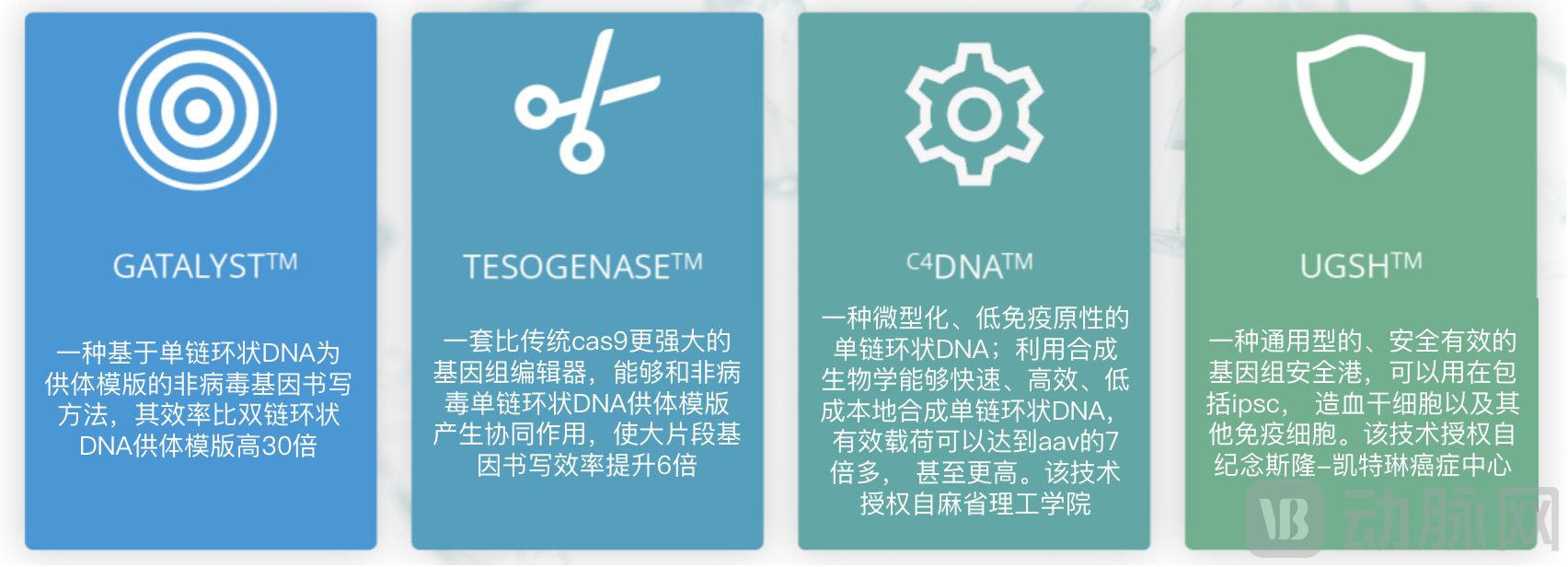
Full Circles’ Four Synergistic Technology Platforms
The field of gene therapy has continuously seen the emergence of new modalities, many of which have undergone a transition from skepticism to high demand. For instance, it took 30 years for circular RNA therapy to break through its long period of stagnation and become a new hotspot after its discovery. It is now regarded as a next-generation star molecule, with startups raising substantial capital from world-class venture capital firms, large pharmaceutical companies, and other investment groups.
The stance of regulatory authorities is equally important.Fortunately, the FDA has long placed significant emphasis on genetic diseases. The agency has cataloged 7,000 to 8,000 such conditions, each with a well-defined one-to-one correspondence between the causative gene and the resulting disease phenotype. While proof-of-concept development based on mechanistic studies typically requires at least five to ten years, leveraging this genotype-phenotype correlation to fundamentally repair pathogenic genes offers a novel approach that can substantially accelerate progress. On one hand, the FDA encourages companies such as Tessera Therapeutics and Prime Medicine to advance genetic disease treatments using disruptive technologies. On the other hand, the agency is promoting the standardization of gene therapy; for instance, its draft guidance issued this year mandates comprehensive monitoring of any off-target editing events and thorough assessment of unintended consequences arising from both on-target and off-target edits.
However, Howard Wu also pointed out: “Another issue in the field of gene writing is that there are indeed few companies currently engaged in this area. Advancing clinical applications requires joint efforts from gene writing companies, biotech or pharmaceutical firms, and the FDA to continuously refine standards.”
“Gene writing is definitely the trend of the future,” Howard Wu said optimistically about the prospects. “Our original intention is for good technologies to ultimately benefit patients and help solve some unresolved problems.”