

Professor-Led Startups and Surging Investment Propel China's Gene Sequencing Instrument Sector Back into the Spotlight
QitanTech
Gene Sequencing Technology R&D Provider
In early December, a WeChat Moments post allegedly from He Jiankui stated that he would once again lead MGI Tech toward an initial public offering (IPO). This modest goal has once again drawn industry attention to the current survival challenges facing Chinese-made gene sequencer manufacturers.
Indeed, in 2022, the domestic gene sequencer industry was thriving, with capital once again flooding into this sector. This year, MGI Tech, founded six years ago, listed on the STAR Market, multiple gene sequencer companies secured new rounds of financing, and new, highly competitive gene sequencer manufacturers continue to emerge.
These domestic gene sequencer manufacturers, established at various times, appear to have once again become the center of attention overnight.
Beyond their generally enhanced revenue-generating capabilities, the most striking hallmark of maturity among Chinese domestic gene sequencer manufacturers is that they have all launched commercialized, independently developed gene sequencing instruments.
In January, SinaBio launched the S100 gene sequencer. At the launch event, attended by numerous clinical experts, SinaBio stated that this instrument, featuring core technologies such as one-step sequencing chemistry, two-phase flow biochips, and a three-dimensional encoding system, is characterized by its flexibility, efficiency, and enhanced precision.
Four months later, in Chongqing, Mingyi Intelligent Manufacturing also held a product launch event, unveiling the UniSeq2000™, a single-color fluorescence high-throughput gene sequencer developed over four years. The event was attended by numerous clinical experts from both China and abroad. Mingyi Intelligent Manufacturing stated that the UniSeq2000™ is particularly well-suited to the needs of localized laboratories and can address the pain points of difficult and costly instrument startup faced by hospitals.
In June, QitanTech held its second product launch event within six months online, officially unveiling the upgraded QNome-3841hex nanopore sequencer. Featuring a completely new nanopore technology, the QNome-3841hex has increased sequencing read lengths from approximately 300 kb to 2 Mb, thereby demonstrating the long-read advantage characteristic of fourth-generation sequencing platforms in this version of the nanopore sequencer.
In September, MGI Tech launched the G99 high-throughput sequencer, featuring a compact design. It is touted as one of the fastest models among sequencers with comparable throughput worldwide, suitable for targeted gene sequencing and small-genome sequencing, delivering rapid data output with high quality.
Subsequently, in November, MGI Tech held two new product launch events, successively unveiling the GenoCare 1600 and ASTASeq 300 gene sequencers. The former features single-molecule sequencing technology and emphasizes penetration into and widespread adoption by primary healthcare institutions. The latter is a small-to-medium throughput desktop gene sequencing system, characterized by extreme flexibility, minimalist operation, and rapid delivery, catering to needs such as targeted sequencing and low-coverage whole-genome sequencing.
Also in November, Sailu Medical, a company just two years old, unveiled its new sequencer, the Salus Pro, only one month after officially announcing a financing round worth hundreds of millions of yuan. This product is also dedicated to significantly enhancing the adaptability and flexibility of gene sequencers, fully meeting the diverse needs of various scenarios in both clinical and research settings.
It seems that the “crown jewel” of scientific instruments, the gene sequencer, is being conquered by innovative domestic teams.
As is well known, gene sequencers are characterized by extremely high technical barriers and stringent patent barriers. In the past, most domestic manufacturers relied on technology licensing from overseas brands, which became the defining feature of the previous generation of Chinese-made gene sequencers. In contrast, models such as the S100, UniSeq2000, and QNome-3841hex are largely built on independently developed core sequencing technologies. These instruments have completed the entire journey from technological conception to prototype and finally to commercial product under the stewardship of domestic teams, undoubtedly ushering in a more diverse and vibrant next chapter for Chinese-made gene sequencers.
VCBeat’s review of public information reveals that companies such as SinaBio, Mingyi Intelligent Manufacturing, QitanTech, and Genetron Bio, which have successively launched their own gene sequencers within the year, all feature university professors among their core founding teams.
For instance, the founding team of Sinobiomics includes Professors Xie Xiaoliang and Huang Yanyi from Peking University; Mingyi Intelligent Manufacturing was co-founded by Professor Ju Jingyue from Columbia University in the United States along with several PhDs; Dr. Bai Jingwei, a member of the founding team of the star project QitanTech, also serves as a doctoral supervisor at the School of Pharmaceutical Sciences, Tsinghua University; while Hanhai Gene, the predecessor of Genetron Biology, was founded by He Jiankui, a former professor at Southern University of Science and Technology.
A further search of relevant patent information reveals that these professors and their patents constitute the core strength of the aforementioned companies. In other words, the professors holding core patents for gene sequencing, along with the domestically produced gene sequencers they have developed, represent a successful model of translating scientific research achievements into commercial applications.
In April 2015, Professor Xie Xiaoliang, Professor Huang Yanyi, and Dr. Wu Lei founded Sinano Biosciences in Beijing. Professor Xie Xiaoliang is a member of both the U.S. National Academy of Sciences and the American Academy of Arts and Sciences, Director of the Beijing Advanced Innovation Center for Genomics at Peking University, and an internationally renowned scientist. Professor Huang Yanyi is a professor at the College of Engineering, Peking University, and a researcher at the Peking University Advanced Innovation Center for Genomics; he previously served as the chief expert for the “Research and Development of Next-Generation Sequencers and Supporting Reagents” project under China’s National 863 Program.
According to reports, the one-step sequencing chemistry used in S100, namely Fluorogenic sequencing chemistry technology, was first proposed by Professor Xie Xiaoliang. The core team repeatedly improved upon this foundation, developing a triple-encoding Error-Correction Code (ECC) technology. This technology achieves a geometric increase in detection accuracy through a self-correcting mechanism, which ultimately led to the establishment of Sinocelltech. ECC sequencing technology can generate error-correcting codes with 50% redundant information through three rounds of degenerate sequencing without additional sequencing time, thereby identifying true mutations.
In fact, after the ECC technology was established, Sina Biology made rapid research progress, completing the development of a principle prototype of its gene sequencer in just one year and finishing external testing of the engineering prototype in 2019. Although the S100 gene sequencer was not officially launched until early 2022, it had already entered production in 2020.
On September 26, 2016, Qitan Technology Ltd., Chengdu was established. This star team, which attracted significant attention from its inception, comprises Dr. Dan Xie, a bioinformatics expert from Professor Michael Snyder’s laboratory at the Stanford University School of Medicine; Dr. Jingwei Bai, a nanopore protein expert from Peking University; and Geng Hu, an electronics expert from Tsinghua University.
The principle of nanopore sequencing involves driving single-stranded nucleic acid molecules through nanoscale protein pores via an electric field. As different bases pass through the nanopore, they generate distinct current blockade signals, enabling the identification of base sequences on each nucleic acid molecule and thus achieving single-strand sequencing. Key technological hurdles in this process include fluidic chips, speed-control proteins, nanopore proteins, signal processing circuits, and bioinformatics analysis. Among these, the quality of the nanopore protein largely determines the performance of the sequencer. At QitanTech, Dr. Bai Jingwei is primarily responsible for addressing protein-related challenges.
As previously mentioned, QitanTech increased the read length of its nanopore sequencing from the kilobase (kb) level to the megabase (Mb) level with the transition from QNome-3841 to QNome-3841hex, primarily due to iterations in nanopore technology. A patent search by VCBeat revealed that QitanTech’s invention patent titled “A Novel Pore Protein Monomer and Its Application” was published in August 2022. The patent was jointly applied for by Tsinghua University and QitanTech, with Dr. Bai Jingwei listed as the lead inventor.
According to the introduction, this patent provides a novel porin monomer, a mutant pore, and their applications in characterizing target analytes. This porin monomer contains multiple site-specific mutations, introducing a completely new mode of action during nanopore sequencing. It positively impacts the stability of the interaction interface between the porin and the processivity enzyme, thereby improving the resolution of nanopore sequencing.
Mingyi Intelligent Manufacturing was founded in Shenzhen in 2018. Co-founded by Professor Jingyue Ju, Director of the Center for Genome Technology at Columbia University and a renowned scientist in the field of gene sequencing, along with Dr. Jian Wu and others, the company is a technology enterprise specializing in the research and development, translation, manufacturing, and application of gene sequencing analysis platforms and related technologies.
A search by VCBeat revealed that the sequencing principle of Uniseq2000 is derived from the patent titled “Monochromatic Fluorescent MRT Gene Sequencing Reagents and Methods Based on Environment-Sensitive Dyes.” Although this new patent was published in March 2022, with Dr. Wu Jian and others as the primary inventors, it essentially represents a further optimization of the SBS sequencing method developed by Professor Ju Jingyue. In brief, in this new sequencing system, the incorporated dNTPs are modified as follows: A is labeled with Cy5 (Cy5 fluorophore), T with HCyC647 (HCyC647 fluorophore), and C with biotin; G carries only an azide modification, similar to conventional methods, without any other modifications. During the first detection and imaging step, A and T emit fluorescence, while G and C do not. Upon completion, Cy5-labeled streptavidin is added to bind to C, and the pH is adjusted to quench the fluorescence of T-HCyC647 without affecting Cy5 emission. A second imaging step then yields fluorescence from A and C, while T and G remain non-fluorescent.
Thus, behind the surge in domestically produced gene sequencers lies the deep involvement of top professors from universities both at home and abroad in startup ventures. This differs from previous models based purely on technology licensing or where professors served merely as scientific advisors. When professors holding technical patents join as core founding team members, it undoubtedly reshapes the fundamental logic underlying the growth of innovative enterprises, thereby creating more favorable conditions for the development of highly complex, high-end instruments such as gene sequencers.
In fact, whether it is Professor Xie Xiaoliang and Professor Huang Yanyi from Sinobiomics, Bai Jingwei from QitanTech, or Professor Ju Jingyue from Mingyi Intelligent Manufacturing, they are all exceptional researchers in specific fields of gene sequencing. Having previously held positions at the world’s most advanced gene technology laboratories and companies, they represent rare talent with first-mover advantages in the gene sequencing sector. Their emergence in the field of innovation and entrepreneurship has naturally drawn significant attention from investment institutions. From MGI Tech, Sinobiomics, and QitanTech to TrueOmics and Mingyi Intelligent Manufacturing, each company received substantial institutional funding shortly after its establishment, providing strong momentum for the early-stage development of their products.
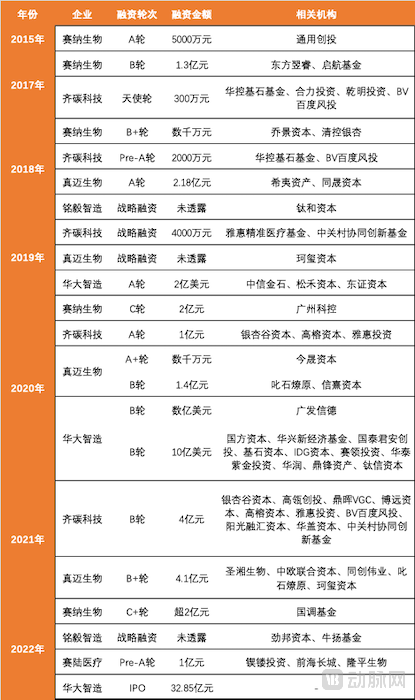
Partial Financing History of Relevant Companies
A brief review of the financing histories of Chinese domestic sequencer manufacturers that launched new instruments in 2022 reveals several distinct characteristics of investment in this sector.
First, invest early. Domestic gene sequencer companies founded by professors often attract the attention of investment firms right from their inception, commanding substantial valuations even at an early stage. For instance, Sinocelltech completed a RMB 50 million Series A financing round in its founding year and raised hundreds of millions of yuan in external capital within its first three years. QitanTech was spotted by prominent investors, including BV Baidu Ventures, in its second year of operation, with its valuation multiplying several-fold within just one year. Genetron Health secured over RMB 200 million in Series B financing in its third year. Considering that these fundraising activities took place before the emergence of the medical innovation bubble, the remarkable capital-raising prowess of domestic gene sequencer companies led by renowned professors is evident.
An interesting phenomenon is that Dr. Zhao Luyang, the founder of Sailu Medical—which completed a pre-A financing round of over RMB 100 million in October 2022—was originally an investor who had worked at Guotai Junan Securities and Qielou Investment. His co-founder is an assistant professor from a U.S. university. This demonstrates that investment institutions’ favor for gene technology professors can begin even earlier than the early startup stage.
Second, continuous follow-on investment. Most institutions that invested in professors’ ventures at their inception have chosen to continually increase their stakes during the subsequent long journey of R&D and trial-and-error. For instance, since taking an equity stake in QitanTech through its angel round in 2017, BV Baidu Ventures has provided two additional rounds of funding in the Pre-A round the following year and the Series B round in 2021. Yahui Investment has also invested in QitanTech twice. Meanwhile, Genetron Health received sustained support from Kexi Capital across its Series A and Series B+ financing rounds spanning three years, and introduced Chishi Liaoyuan as a lead investor in both its Series B and Series B+ rounds completed in 2020 and 2021, respectively.
It is rare to see such success stories of early equity investment followed by participation in multiple subsequent rounds in the high-risk field of medical innovation. However, this has occurred frequently in the sector of domestically produced gene sequencers. This demonstrates that the commitment and perseverance of top-tier professors, while anchoring the company’s growth trajectory, have also instilled greater confidence in institutional investors.
Third, investment enthusiasm has continued to rise. It is evident that since the professor led the establishment of a domestic gene sequencer company, investment in this field has persisted for several years, with new investment institutions continuously entering the market. In 2020, MGI Tech’s Series B financing attracted nearly 10 investment firms, including IDG Capital, Huatai Zijin, and Keytone Capital. In 2021, QitanTech’s Series B financing saw significant participation from top-tier investors such as Hillhouse Investment, Huagai Capital, and CDH VGC, marking another highlight moment for the domestic gene sequencer sector.
Meanwhile, the financing amounts for independent events have continued to climb, as new investors increasingly recognize the growth potential of domestically produced gene sequencers. For instance, in 2017, when Saina Biotechnology completed its Series B financing, the valuation for equity stakes in companies with leading R&D progress in high-throughput gene sequencers was slightly over RMB 100 million. By 2021, when QitanTech completed its Series B financing, the corresponding equity valuation for fourth-generation gene sequencers, which had a lower level of market application maturity, had reached as high as RMB 400 million. Notably, Sailu Biology secured RMB 100 million in its Pre-A financing round in 2022, whereas QitanTech had raised only RMB 20 million in the same round several years earlier.
Of course, for domestic gene sequencer manufacturers, achieving a high valuation is not synonymous with success. As products progressively enter the market, it becomes increasingly essential to return to the core of addressing unmet market needs. As indicated by the preceding analysis, although different Chinese gene sequencer vendors have adopted varying core technologies, their final product forms are predominantly characterized by miniaturization, emphasizing flexible and convenient user experiences. This trend inevitably raises concerns about product homogenization.
This necessitates that domestic gene sequencer manufacturers possess the dual capabilities of both equipment manufacturing and ecosystem building. In this regard, companies with a slight first-mover advantage have already taken the lead.
Previously, leveraging BGI Genomics’ robust sequencing service capabilities, MGI Tech quickly established a foothold in the field of reproductive testing and, driven by its strong breakthrough capabilities, expanded into clinical oncology, scientific research, agriculture, and other sectors. Similarly, downstream application companies such as Mingma Bio, Huisuan Bio, Biodyne, Hongyuan Bio, and Yijian, as well as upstream and midstream players like Novoprotein and Yeasen, have successively forged partnerships, rapidly intensifying competition in the layout of the sequencing ecosystem. In this sense, for the professors who have just launched new instruments, delivering a satisfactory application ecosystem may well be the most critical challenge in this major test.