

Chongqing ShanwaiShan Becomes First Sci-Tech Innovation Board Listed Company from Chongqing, Led by a Founder from Rural Mountains
SWS MEDICAL
Blood Purification Equipment R&D and Manufacturer
The First Chongqing-Based Company Lists on the STAR Market.
On December 26, Chongqing Shanwaishan Science&Technology Co.,Ltd. (hereinafter referred to as “SWS MEDICAL”) was officially listed on the STAR Market of the Shanghai Stock Exchange, with an issue price of RMB 32.30 per share.
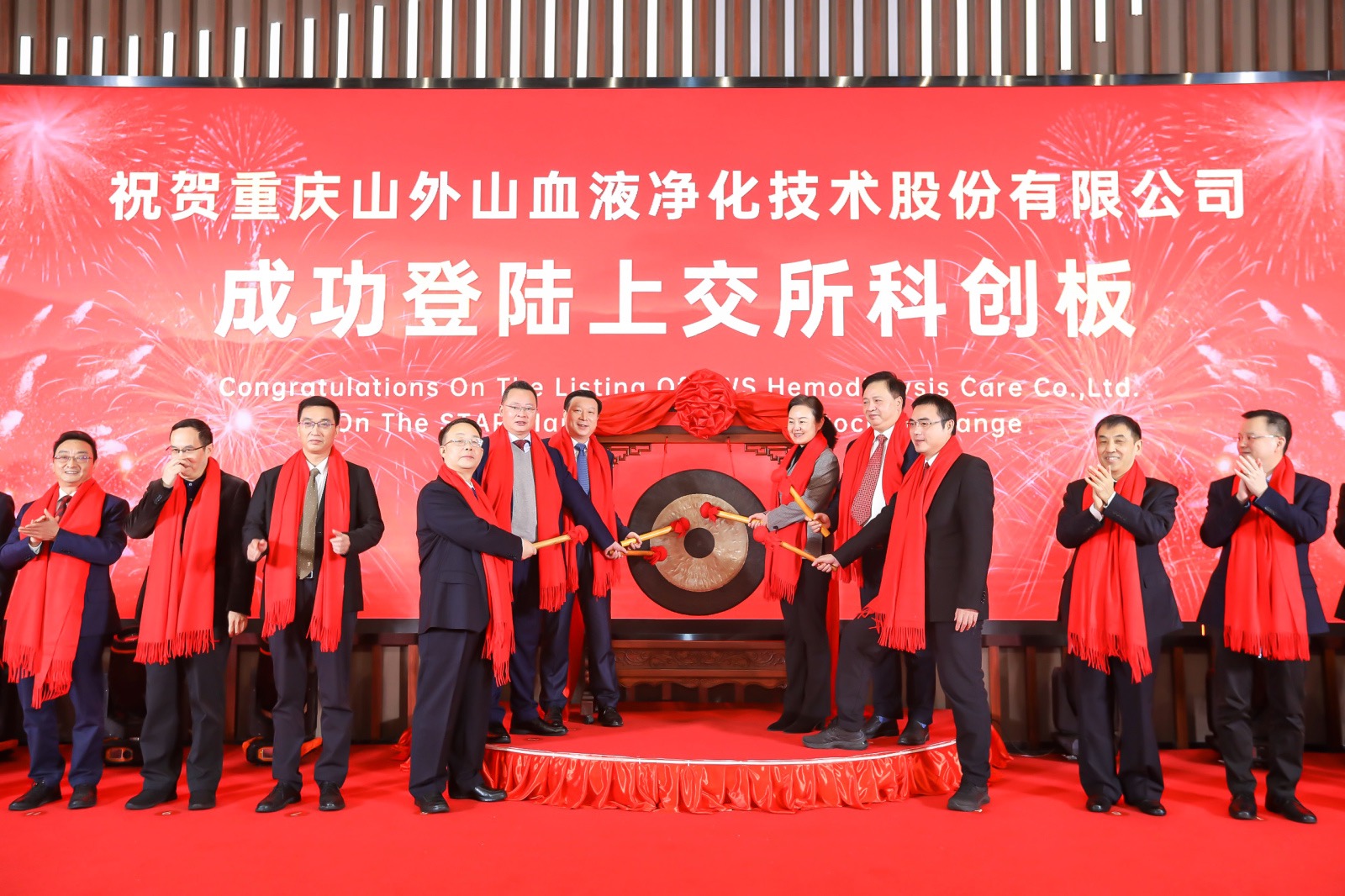
SWS MEDICAL is a national high-tech enterprise specializing in the research and development, production, and sales of blood purification equipment and consumables, as well as providing chain hemodialysis medical services. Leveraging its proprietary core technologies in blood purification equipment, the company has developed hemoperfusion machines, hemodialysis machines, and continuous renal replacement therapy (CRRT) devices. It has also independently developed blood purification consumables, including hemodialyzers, dialysate filters, concentrated hemodialysis solutions, and hemodialysis powders. These products are widely used in the treatment of various conditions, such as acute and chronic renal failure, uremia, multiple organ failure, and poisoning.
According to the prospectus, SWS MEDICAL’s blood purification devices have achieved a cumulative installation base of over 10,000 units both domestically and internationally, with terminal installations in more than 1,000 hospitals across China. Its primary customers include major medical institutions at home and abroad, such as the Chinese PLA General Hospital, Qilu Hospital of Shandong University, Xiangya Hospital, The Second Xiangya Hospital of Central South University, the General Hospital of Eastern Theater Command, and Xinqiao Hospital of Army Medical University, among other well-known large tertiary hospitals in China. The products are exported to 62 countries and regions, including Italy, Spain, Indonesia, India, and South Africa.
Since its establishment, the company has adhered to independent innovation as the primary driving force for its development. The company participated in the drafting of three national standards and five industry standards, holds independent intellectual property rights and hundreds of authorized patents, and operates several technological innovation platforms, including a National Enterprise Technology Center, a National-Local Joint Engineering Research Center, and a National Postdoctoral Research Station. It has received numerous awards, such as the Second Prize of the National Science and Technology Progress Award, the Major Technological Invention Award of the National Information Industry, and the China Patent Silver Award. The company has been recognized as a “National Demonstration Enterprise for Technological Innovation” and a “National Demonstration Enterprise for Intellectual Property.”
It was precisely due to these achievements that in August 2021,SWS MEDICAL has been certified by the China Association of Medical Device Industry as the “leading domestic manufacturer of high-end blood purification equipment” and holds the “No. 1 market share among domestically produced blood purification equipment.”。
Gao Guangyong, the founder of SWS MEDICAL, was born in a remote mountain village deep in the mountains at the junction of Banan, Fuling, and Nanchuan districts in Chongqing. In his own words, “It was such a place that if a manure bucket rolled down the slope, it would take two hours of trekking along mountain paths to retrieve it from the river.” The poverty and hardships of his childhood became Gao Guangyong’s most valuable life assets, as he firmly believed that even the harshest environments could be transformed through hard work. Unwilling to submit to fate, and driven by his tenacity and unwavering belief, Gao Guangyong eventually gained admission to university, becoming the first college student from his village.
During his university years, Gao Gaoyong not only completed two majors while working part-time to support himself but also financed his younger brother’s high school education. It was through these experiences that he engaged with numerous enterprises, drawing inspiration and entrepreneurial insights from them. Upon graduation, Gao turned down coveted job assignments in the power grid and water supply sectors—positions widely regarded as desirable—and instead proactively sought a technical role at Chongqing Qingling Motors Group Corporation.
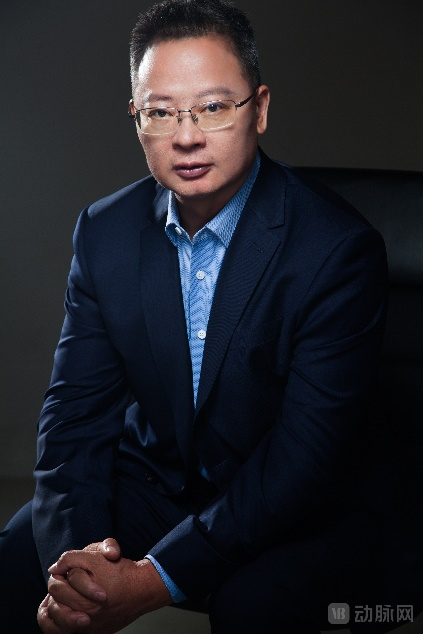
Gao Guangyong, founder of SWS MEDICAL. Image source: official corporate website
A few years later, Gao Guangyong left his job to work in sales for medical devices. During one pitch for medical equipment, the first words out of the client’s mouth were, “We don’t dare use domestically produced medical equipment.” “There are excellent domestic brands like Haier and Lenovo,” he replied. “Is the product you’re selling from such a reputable domestic brand?” The client’s rhetorical question left him with no rebuttal, but it also ignited Gao Guangyong’s ambition to start his own company and build a world-class medical device enterprise.
At that time, Gao Guangyong had not yet realized that he would have the opportunity to reshape the market landscape of hemodialysis machines in China. It was a fellow villager suffering from uremia who first brought hemodialysis machines to Gao’s attention; due to prohibitively high treatment costs, the patient ultimately had to forgo therapy. The blood purification equipment for uremia was monopolized by multinational corporations. China could launch rockets and satellites into space, yet it could not manufacture this type of hemodialysis machine. Wasn’t this an absurd irony? Thus, Gao Guangyong resolved to develop such a machine domestically.
In March 2001, Gao Guangyong founded Chongqing Shanwaishan Science&Technology Co., Ltd. to research and manufacture blood purification equipment, embarking on an arduous entrepreneurial journey. Although he had anticipated various challenges, reality proved far more difficult than expected. The 2003 SARS outbreak dealt a double blow to the company, bringing sales operations to a standstill and triggering a crisis of confidence among employees. Some early-stage employees left one after another, unable to endure the prolonged hardships of entrepreneurship. The prolonged business hiatus also strained the company’s finances, causing multiple breaks in its capital chain and pushing the company to the brink of collapse.
During the company’s most difficult period, Gao Guangyong mortgaged his home to the bank, moved air conditioners from his house to the factory for technicians to use, and personally returned to the front lines as a sales representative. Senior executives even lent out their wedding savings and funds earmarked for purchasing homes to help the company cope with the emergency. What sustained the team was precisely the sense of mission to achieve a breakthrough in domestically produced blood purification equipment.
Through the concerted efforts of all personnel, SWS MEDICAL successfully developed China’s first continuous blood purification system, the first online hemodiafiltration machine, and other related products. These products subsequently obtained authoritative certification from national regulatory authorities as well as CE certification from the European Union; nevertheless, the promotion of these new products encountered unexpected difficulties.
Nearly all hospitals would shake their heads at the mention of domestically produced equipment, citing a lack of trust. Gao Guangyong still vividly remembers the first device he ever sold. At 1 a.m., while fast asleep, he received a call from a hospital in a suburban county of Chongqing. The hospital had admitted a patient in deep coma after ingesting Tetramine (a potent rodenticide), but lacked the necessary detoxification equipment. After contacting multiple companies that all refused to deliver equipment in the middle of the night, the hospital finally reached Gao Guangyong, who had previously visited to promote his products. Upon finishing the call, he immediately picked up the hemoperfusion machine and rushed to the hospital.
Gao Guangyong recalled that the company was in such financial straits at the time that it could not even afford to purchase a vehicle. He took a taxi, enduring a bumpy two-hour ride to reach the hospital. After working tirelessly for a day and night without making any demands on the hospital, the management was moved by his dedication. They subsequently recognized the value of their products through practical application and went on to purchase multiple units of equipment.
In most cases, however, it is the norm for hospitals and patients to distrust domestically produced medical devices. On one occasion, in an effort to persuade a stubborn patient—a former physician—Gao Guangyong became so urgent that he had medical staff connect him to a hemodialysis machine. After the dialysis session was completed, Gao emerged unharmed. The patient was convinced, and the onlookers were reassured.
To prove product quality, this tactic was later frequently emulated by multiple sales representatives within the company. Speaking of such employee conduct, Gao Guangyong felt both proud and bittersweet.
At the time, domestic brands were facing unfair competition from foreign competitors, many of which employed a strategy of providing dialysis machines free of charge while recouping profits through the sale of high-priced consumables, thereby suppressing Chinese manufacturers. In 2014, SWS MEDICAL, representing China’s hemodialysis machine industry, formally submitted an application for an anti-dumping investigation to the Ministry of Commerce. In June of the same year, the Ministry of Commerce issued an announcement initiating an anti-dumping investigation into imported hemodialysis machines originating from the European Union and Japan. This move provided much-needed respite for domestic manufacturers.
It has proven that such courage is essential to break the monopoly held by foreign brands. Fortunately, SWS MEDICAL is not fighting alone in the Chinese market. Since the turn of the new millennium, multiple domestic manufacturers—including Chongqing Duotai, Chongqing Aokailong, Guangzhou Jihua, and Chengdu Weilisheng—have been striving in this field, aiming to break through the competitive barriers.
Globally, hemodialysis has remained the primary treatment modality for patients with chronic kidney disease. According to data disclosed in the annual report of Fresenius, an industry leader, the global dialysis market size steadily increased from €66.8 billion in 2015 to €82.0 billion in 2020, representing a compound annual growth rate of approximately 4%. Based on this trend, the global dialysis market is projected to continue its growth, reaching approximately €100 billion by 2025.
China's blood purification market started relatively late, and its technological level still lags behind that of foreign countries. However, with the growing number of patients with kidney disease and the increasing reimbursement ratio for hemodialysis costs under medical insurance, the scale of China's blood purification market is expected to grow rapidly.
Currently, the existing demand for dialysis treatment in China remains far from being met.
According to data from the China National Renal Data System (CNRDS), the number of patients undergoing hemodialysis treatment was 447,000 in 2016 and reached 633,000 by the end of 2019, representing a compound annual growth rate (CAGR) of 12%. Meanwhile, the number of new cases of end-stage renal disease (ESRD) in China has also been growing rapidly, with a CAGR of approximately 21% from 2016 to the end of 2019, thereby driving the rapid expansion of China’s blood purification industry.
Based on this projection, the number of patients with end-stage renal disease (ESRD) in China is expected to exceed 4 million by 2030, with less than 20% of them receiving treatment. If the dialysis treatment rate rises to the international average of 37%, the number of patients undergoing dialysis will reach 1.48 million; if it approaches or reaches the average treatment rate of 75% in developed countries, the number of patients receiving dialysis could exceed 3 million.
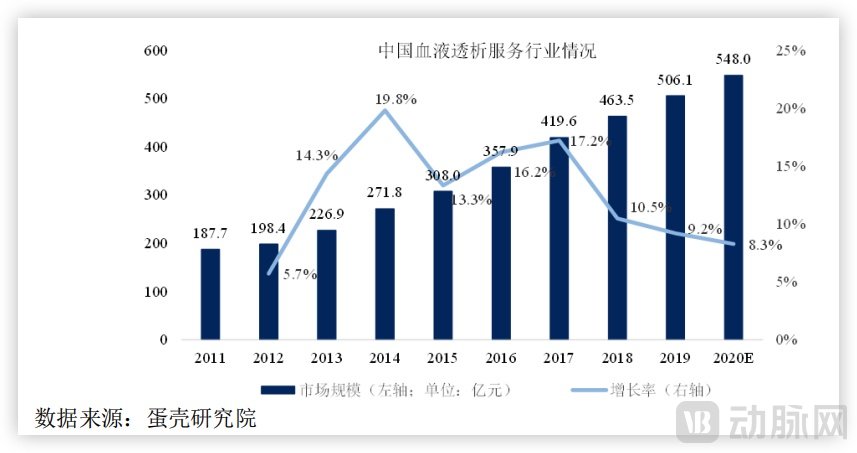
Scale of China’s Hemodialysis Services Industry, Source: Prospectus
According to statistics from VCBeat Research Institute, the annual dialysis cost per patient with uremia is approximately RMB 60,000–100,000. Based on this figure and the patient population data published by the Chinese National Renal Data System (CNRDS), the market size of hemodialysis services in China reached approximately RMB 54.8 billion in 2020 alone. Looking ahead, as healthcare policies continue to improve—including expanded medical insurance coverage, higher reimbursement rates for critical illnesses, and the implementation of tiered diagnosis and treatment—the market size of the hemodialysis service industry is expected to grow steadily, reaching nearly RMB 70 billion by 2025.
According to data from VCBeat, in 2020, the market sizes for dialysis machines, dialyzers, other consumables (such as powder/liquid concentrates and tubing), and pharmaceuticals in China were approximately RMB 3.8 billion, RMB 6.6 billion, RMB 5.3 billion, and RMB 6.4 billion, respectively. With the expansion of the hemodialysis center market, demand for dialysis equipment and consumables is expected to continue rising. By 2025, the combined market size for dialysis equipment, pharmaceuticals, and consumables within the upstream industry chain is projected to approach RMB 30 billion.
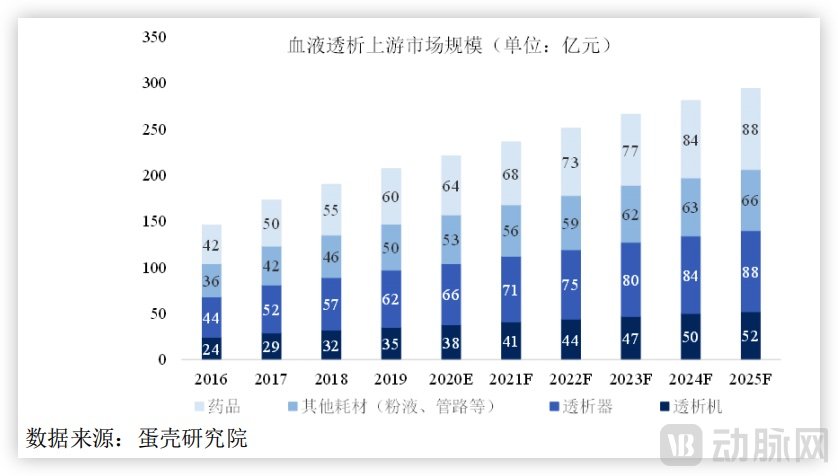
Market Size of the Upstream Hemodialysis Industry Chain, Source: Prospectus
Currently, the market share of hemodialysis machines in China is predominantly held by foreign brands. According to data compiled by VCBeat Research Institute, Fresenius topped the list of domestic hemodialysis machine sales in 2020 with a 30% market share. The four major foreign brands—Fresenius, B. Braun, Nikkiso, and Baxter—collectively accounted for approximately 80% of the domestic hemodialysis market. The market share of independently developed Chinese-branded hemodialysis machines was less than 20%. There is an urgent need to accelerate the pace of import substitution in the field of hemodialysis equipment. With the rise of domestic brands such as SWS MEDICAL, the market share of Chinese independent brands has achieved steady growth in recent years. According to market statistics on continuous blood purification equipment in 2020 by Yizhaocai, SWS MEDICAL’s sales volume share in the domestic market reached 12.38%, placing it among the top rankings in the market.
As a company that has been deeply engaged in the field of blood purification for over 20 years,SWS MEDICAL’s business now spans the entire industry chain, covering blood purification equipment, blood purification consumables, intelligent blood purification management systems, and chain hemodialysis centers.。
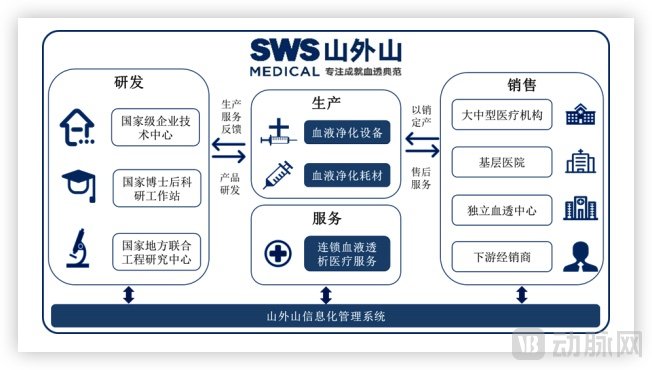
SWS MEDICAL’s Core Business Layout, Source: Prospectus
Blood Purification Equipment
Since its establishment in 2001, SWS MEDICAL has been dedicated to the research and development of key technologies for blood purification equipment and hemodialysis machines. The company has conducted in-depth research and technological innovation across various domains, including complete system integration, control software, core algorithms, equipment components, and specialized sensors, thereby forming a comprehensive suite of technical solutions for continuous blood purification equipment and hemodialysis machines.
After 20 years of development, leveraging its proprietary core technologies in blood purification equipment, SWS MEDICAL has established a portfolio featuring five representative continuous blood purification systems, including the SWS-3000 and SWS-5000 series; four representative hemodialysis machines, such as the SWS-4000 and SWS-6000 series; and hemoperfusion machines, including the SWS-2000 and SWS-2000A models. The company has also independently developed blood purification consumables, such as hemodialyzers, dialysate filters, concentrated hemodialysis solutions, and hemodialysis powder. These products are widely used in the treatment of various conditions, including acute and chronic renal failure, uremia, multiple organ failure, and poisoning.
Notably, the SWS-5000 device features a globally pioneering tri-integrated function of “Continuous Renal Replacement Therapy (CRRT) + Artificial Liver + Plasma Exchange.” Its patented “Artificial Liver-Kidney Support System” has been awarded the China Patent Silver Award.
Blood Purification Consumables
According to data from the Blue Book of China’s Medical Devices, China’s blood purification market is dominated by imported products. Imported brands hold over 70% of the market share, particularly in the segment of high-value medical consumables for blood purification. However, as domestic manufacturers continue to enhance their technological capabilities, import substitution with domestically produced alternatives has become an inevitable trend.
SWS MEDICAL has obtained National Class III Medical Device Registration Certificates for hemodialysis concentrate, hemodialysis powder, low-flux hemodialyzers, dialysate filters, and high-flux hemodialyzers. The company has also received Notification of Acceptance for Registration for single-use extracorporeal circulation tubing and single-use hemoperfusion devices, marking the imminent completion of its comprehensive layout for self-produced blood purification consumables. SWS MEDICAL’s self-produced consumables feature unique core technologies; for instance, its hemodialyzers utilize a globally advanced and domestically exclusive steam sterilization technology, offering superior biocompatibility compared to dialyzers currently on the market that are sterilized using gamma radiation or ethylene oxide.
Chain Hemodialysis Center Medical Services
The hemodialysis industry in developed countries in Europe and America has a long history, and the market for independent hemodialysis centers is well-established. As giants in the hemodialysis industry, Fresenius, Baxter, and DaVita hold the majority of the global market share in hemodialysis services.
In the domestic market, the market share of locally provided hemodialysis medical services is gradually increasing. Building on its existing portfolio of hemodialysis equipment and consumables, SWS MEDICAL is extending downstream into the hemodialysis medical services sector, creating an integrated full-industry chain encompassing “equipment + consumables + services + informatics.”
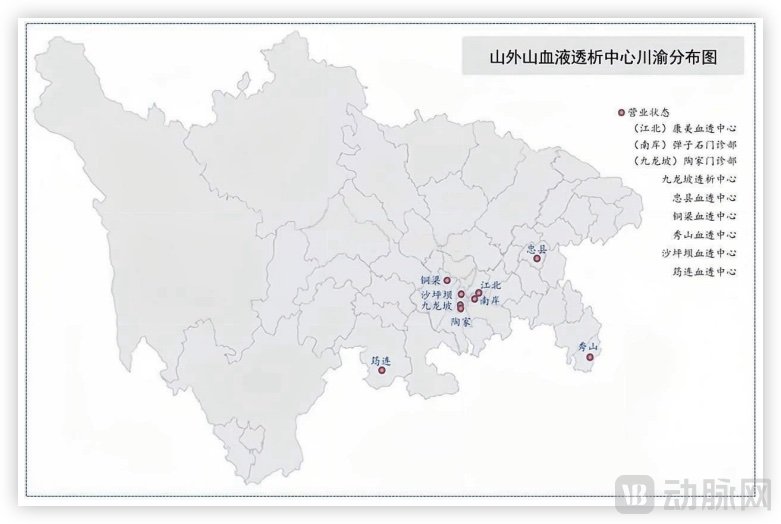
Distribution of Hemodialysis Centers, Source: Prospectus
In 2017, SWS MEDICAL established its first independent hemodialysis center (pilot), actively laying out autonomous community-based dialysis medical services and exploring a chain-operated hemodialysis service model. According to the prospectus, SWS MEDICAL has built and operates nine chain hemodialysis centers. Meanwhile, it has established construction and operational standards for chain hemodialysis centers, as well as a talent development system, laying a solid foundation for further expansion and replication of its chain hemodialysis centers.
Intelligent Management System for Blood Purification
SWS MEDICAL’s “Intelligent Management System for Hemodialysis Centers” has established a new “Internet+” service model for dialysis center management, integrating “equipment, patients, medical staff, and dialysis centers.” This system helps hemodialysis centers address challenges in patient management, staff and bed scheduling, equipment maintenance, and consumables management. It provides comprehensive process management, including patient self-service registration, intelligent triage, mobile nursing care, initiation of dialysis treatment, and pricing and billing. By focusing on improving work efficiency, reducing operational costs, enhancing service quality, and mitigating medical risks, the system achieves standardized, normalized, and intelligent management of dialysis centers. It offers a holistic solution for blood purification, empowering “Smart Hemodialysis.” Currently, SWS MEDICAL’s intelligent hemodialysis service project, based on big data in blood purification, has been listed by the Ministry of Industry and Information Technology of China as a “2022 Big Data Industry Development Pilot Demonstration Project.”
As the first Level-2 Industrial Internet Identity Resolution Node Platform (“MedDevice Connect”) for the medical device industry in Western China, SWS MEDICAL provides industry-wide application solutions such as the “Unique Device Identification (UDI) System,” “Intelligent Manufacturing,” “Remote Operations and Maintenance,” “Medical Device Custody,” and “Medical Big Data.” Leveraging the uniqueness of UDI and integrating next-generation information technologies, the platform connects with information management systems at hospitals (dialysis centers) and the SWS MEDICAL Remote Monitoring Center. This enables remote diagnosis and treatment for dialysis patients, real-time online monitoring of complete equipment, predictive repair and maintenance, and consumables inventory supervision, thereby helping to ensure patient safety during diagnosis and treatment.
Achieve precision medicine and enhance treatment capabilities and service quality.
Leveraging its years of deep expertise in the field of blood purification, SWS MEDICAL has gained recognition from both society and the industry. In February 2020, SWS MEDICAL was designated by the China Association of Medical Device Industry as a “leading domestic manufacturer of blood purification equipment,” and its SWS-5000 series products were included in the list of “emergency medical equipment for treating critically ill patients with novel coronavirus infection.” In March 2020, SWS MEDICAL was listed by the Ministry of Industry and Information Technology of China as a “key national producer of epidemic prevention and control materials.”
SWS MEDICAL’s primary revenue is derived from three major business lines: blood purification equipment, blood purification consumables, and medical services. From 2019 to the first half of 2022 (2022H1), the combined proportion of these three businesses was 98.17%, 99.15%, 99.22%, and 98.61%, respectively. Other businesses mainly include the sales of spare parts and water treatment systems for dialysis, as well as technical services and maintenance services, accounting for a relatively small share of total revenue.
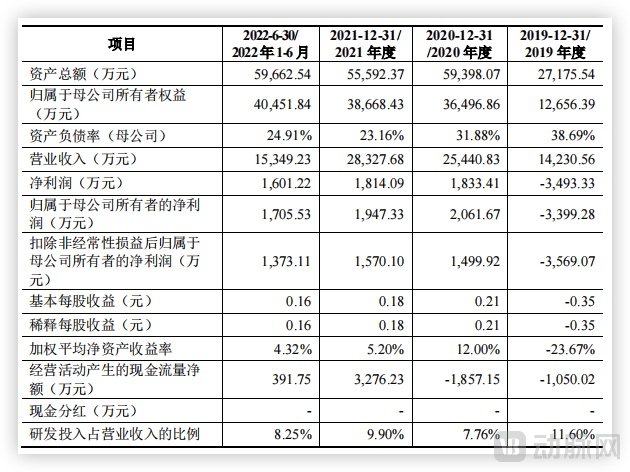
SWS MEDICAL’s Key Financial Data for the Past Three Years, Source: Prospectus
Breaking it down, blood purification equipment is the primary source of operating revenue for SWS MEDICAL, with its proportion of total operating revenue increasing year by year, reaching 60.20% in H1 2022. In addition, in H1 2022, blood purification consumables and medical services accounted for 20.57% and 17.84% of total operating revenue, respectively.
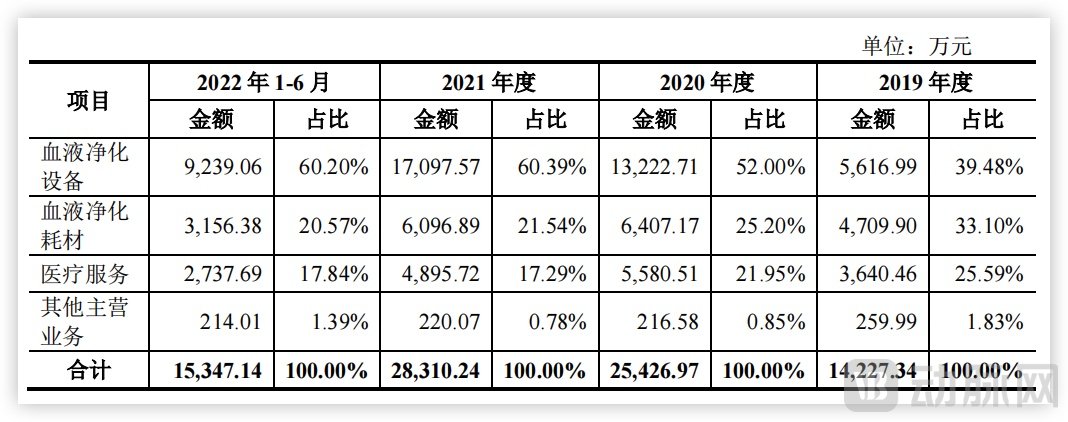
Revenue Share by Business Segment, Source: Prospectus
The gross profit from the company’s core business is primarily derived from the sales of blood purification equipment and consumables. From 2019 to the first half of 2022 (2022H1), the gross profit margins for the core business were 28.94%, 41.86%, 40.46%, and 41.85%, respectively, showing an overall upward trend.
Furthermore, SWS MEDICAL is also intensifying its efforts in the consumables sector. For this IPO, SWS MEDICAL plans to raise RMB 1.247 billion, of which RMB 863 million will be allocated to the industrialization project for blood purification equipment and high-value consumables.
Another major business segment is the chain of hemodialysis centers. Due to the substantial upfront investment and high proportion of fixed costs, coupled with the time required to establish brand awareness and customer acquisition channels in local markets during the initial operational phase, revenue scale was relatively small in the early stages. Prior to achieving a certain level of revenue, gross profit and gross margin remained low from 2019 to 2021, resulting in operating losses. In the first half of 2022 (2022H1), the gross margin of the dialysis centers improved due to increased bed occupancy rates driven by a rise in patient numbers and reduced operating costs from the disposal of certain dialysis centers. By the second half of 2022 (2022H2), the chain of hemodialysis centers had turned profitable.
It is evident that through independent research and development and deep engagement in the blood purification industry, SWS MEDICAL has initially established a full industrial chain layout encompassing “blood purification equipment + consumables + dialysis medical services + information management systems.” The funds raised from this IPO will be used to promote the R&D and industrialization of various blood purification devices and consumables, as well as the expansion of its chain of hemodialysis centers.
Specifically, with the proceeds from this fundraising, SWS MEDICAL will achieve full-scale production of its entire range of blood purification consumables, further diversifying its product portfolio to establish a sustainable, tiered, and serialized product mix, thereby making self-manufactured blood purification consumables a significant source of profitability for the company.
Meanwhile, SWS MEDICAL will also establish an R&D center to develop intelligent hemodialysis machines based on physiological feedback control technology, artificial intelligence and big data technology, and online dialysate preparation technology, building upon its existing blood purification equipment technologies; it will also conduct research and development of miniaturized portable intelligent hemoperfusion machines. In terms of blood purification consumables, the company will gradually improve and enrich its product portfolio, while accelerating the R&D and registration progress of multiple consumable projects.
Furthermore, another use of the funds raised is to expand marketing channels and build a remote operation and maintenance network. On one hand, it aims to improve existing channels and increase market share in China; on the other hand, through the construction of a remote operation and maintenance service network, it provides customers with remote online fault monitoring and maintenance for blood purification equipment, transforming "reactive" repairs into "predictive" maintenance. This enhances the reliability, safety, and stability of blood purification equipment, reduces operational and maintenance costs, alleviates the workload of medical staff, and addresses their concerns regarding product usage and operation/maintenance, while also offering new business models such as remote managed services.
Against the backdrop of a year-on-year increase in patient numbers and rising market penetration, the hemodialysis industry in which SWS MEDICAL operates boasts broad prospects. On December 21, SWS MEDICAL released its earnings forecast for the year, projecting operating revenue from January to December 2022 to range between RMB 305.95 million and RMB 458.93 million, representing a year-on-year growth of 8% to 62.01%. Net profit attributable to shareholders of the parent company is expected to reach RMB 42.39 million to RMB 63.58 million, marking a substantial year-on-year increase of 117% to 226.5%. SWS MEDICAL attributed this performance growth to the continuous improvement in product quality. Specifically, its hemodialysis machines have largely achieved parity with imported brands in terms of quality, while its continuous blood purification equipment for treating critical illnesses has attained industry-leading status in functionality and treatment modes. Additionally, policy support for domestic substitution and the sustained growth of the hemodialysis market were also cited as significant contributing factors.
Compared with foreign brands, domestic companies represented by SWS MEDICAL are still in their early stages and have not yet achieved significant market share. In recent years, domestic substitution has occurred across multiple niche sectors. Through continuous independent innovation, SWS MEDICAL has gradually attracted attention from top-tier capital firms: Hillhouse Capital, Xiangjiang Industry Guidance Fund, Xiangjiang Liyuan Investment, and Huagai Capital have all invested in SWS MEDICAL. In the future, SWS MEDICAL and other domestic manufacturers will drive a wave of domestic substitution in the blood purification sector.