

Triastek Advances Drug Development with Proprietary MED® 3D Printing Technology Through Collaborations with Eli Lilly and Merck
TRIASTEK
3D-Printed Drug R&D and Equipment Developer
Recently, TRIASTEK, a specialized company in 3D printing of pharmaceuticals, and Merck KGaA, Germany, jointly published an article titled “Advancing Extrusion-Based 3D Printing for Drug Production” in the U.S. pharmaceutical media outlet Pharma’s Almanac.
By providing an in-depth analysis of the principles of extrusion-based 3D printing technology, this article elucidates the applications and advantages of 3D printing in the development and manufacturing of pharmaceutical formulations. Furthermore, the article discloses for the first time the results of previous collaborative research between the two parties, through MED®By combining its technology with Merck excipients, successful solubilization of poorly soluble drugs was achieved, providing a technical solution to the formulation challenge of improving in vivo bioavailability.
"Melt Extrusion Deposition (MED®“The advantages of this technology in pharmaceutical formulation development and continuous manufacturing, particularly in enhancing the solubility and bioavailability of poorly soluble drugs, have facilitated the collaboration between TRIASTEK and Merck.” The article reveals the impetus for their partnership and future opportunities. Going forward, TRIASTEK and Merck will jointly explore the application of 3D printing technology in drug product development and the development of specialized pharmaceutical formulations, such as 3D-printed formulations for pediatric diseases, including but not limited to tablets and chewable tablets in various flavors.
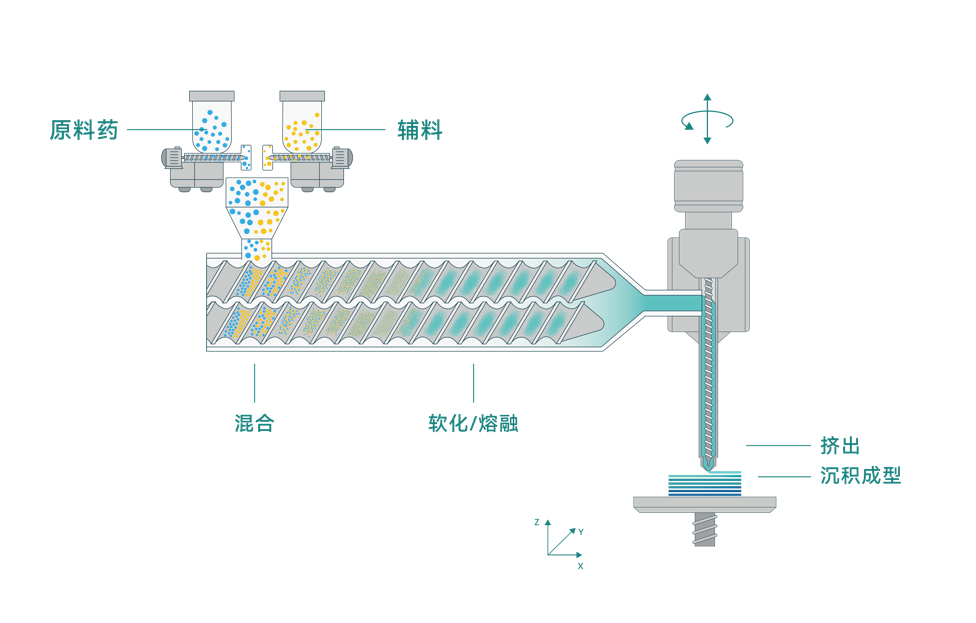
TRIASTEK MED®3D Printing Technology
TRIASTEK's Proprietary Melt Extrusion Deposition (MED®) technology enables the development of 3D-printed drug formulations under milder processing temperature conditions and allows for diverse drug release profiles through complex structural designs. Meanwhile, MED®The technology enables efficient continuous manufacturing through continuous high-throughput printing, holding broad application prospects in the pharmaceutical industry. Therefore, Merck KGaA, a German pharmaceutical giant with extensive investments in the field of 3D drug printing, has launched a collaborative research initiative with TRIASTEK focused on poorly soluble drugs, leveraging MED®Stable continuous 3D printing of mixtures of Merck’s SAFC® PVA and poorly soluble APIs successfully enhanced the solubility of poorly soluble drugs and enabled the development of sustained-release formulations.
In addition, the article also introduces MED®How technology leverages structural pharmaceutics to engineer sophisticated drug delivery architectures, such as core-shell, multi-compartment, and honeycomb/woven structures, thereby achieving more complex and challenging drug release profiles. Based on these features, MED®3D printing technology can provide technical solutions to existing formulation challenges, enabling more precise site-specific targeted release in the gastrointestinal tract, thereby enhancing the bioavailability of poorly soluble drugs, achieving gastric retention, and facilitating colon-targeted delivery.
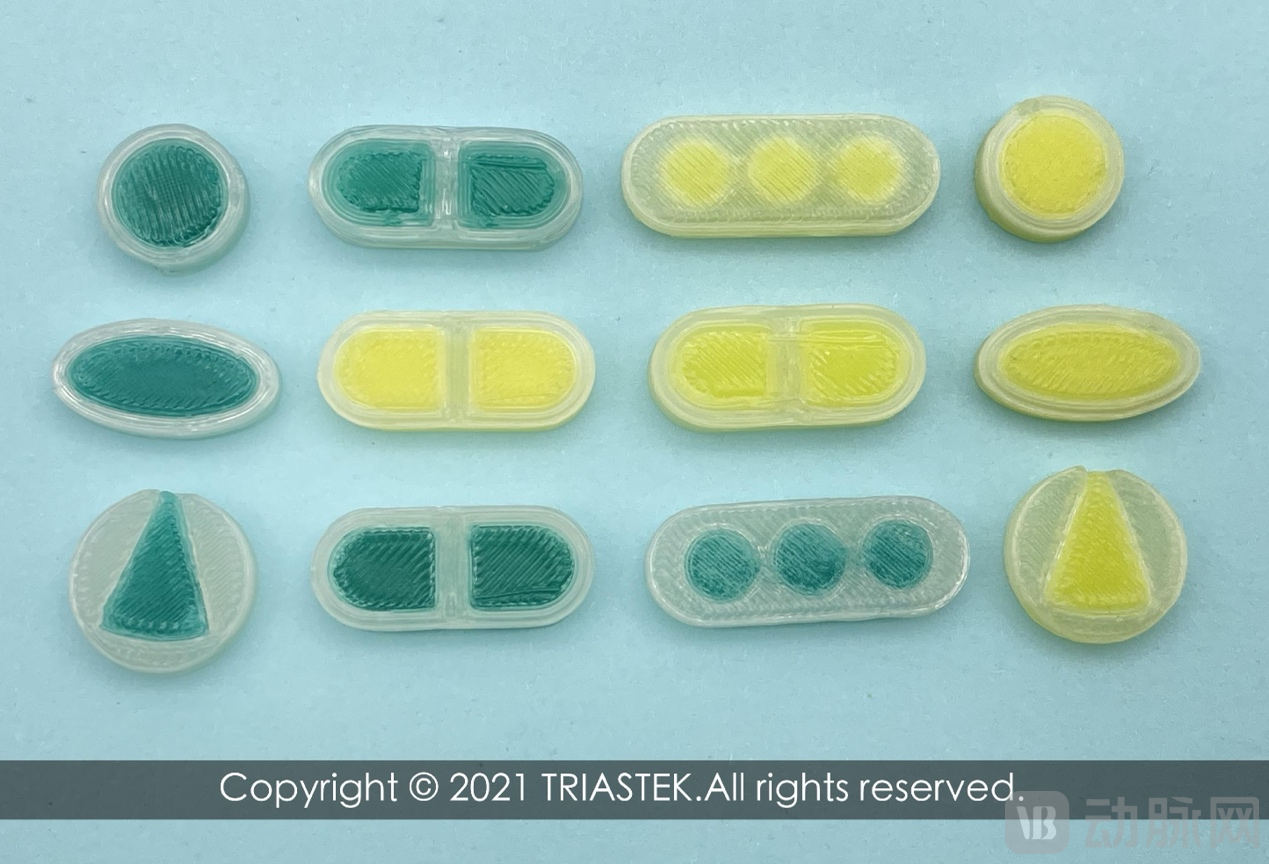
TRIASTEK Drug Structure Design - Multi-Chamber Design
“MED®“The principle of the technology is to continuously mix powdered active pharmaceutical ingredients (APIs) and excipients, softening or melting them into a flowable semi-solid, which is then precisely deposited layer by layer to fabricate more complex drug dosage forms,” said Professor Li Xiaoling, Co-founder and Chief Scientific Officer of TRIASTEK, in a recent interview with the U.S. pharmaceutical journal Pharmaceutical Technology.

Professor Li Xiaoling, Co-founder and Chief Scientific Officer of TRIASTEK
From the perspective of drug dosage form design, 3D printing enables better control over the timing and site of API release through structural pharmaceutics, effectively linking with pharmacokinetics to facilitate innovative and complex structural designs, thereby holding promise for addressing significant challenges in drug delivery and development.
MED®By flexibly adjusting formulation structures, the technology enables rapid prototyping, thereby shortening the timelines for clinical trials and commercial supply. Furthermore, it leverages continuous manufacturing and Process Analytical Technology (PAT) to perform real-time, in-line monitoring of the production process and quality of each tablet. The recorded data are uploaded, which not only enhances drug production efficiency but also improves drug safety and efficacy, while facilitating remote monitoring and management by partner pharmaceutical companies and regulatory authorities.
3D printing technology possesses digital and intelligent attributes, aligning closely with the concept of Pharma 4.0™. As an advanced digital manufacturing process, 3D printing of pharmaceutical formulations generates substantial amounts of data. Artificial intelligence and machine learning tools can be leveraged to analyze this data, enabling continuous optimization of the production process and ongoing improvement in product quality, thereby facilitating intelligent pharmaceutical manufacturing.
TRIASTEK has its own equipment R&D team and independently develops MED®3D printing equipment has undergone 12 iterations of R&D equipment technology and 8 iterations of high-throughput technology, breaking through the barriers of high precision and high throughput in 3D printing, thereby achieving full-chain equipment and technical support for 3D-printed drugs from research and development to production.
MED®The 3D printing continuous production line can operate at a rate of 132 kilograms every 72 hours, comparable to the production efficiency of coated tablets in 150-kilogram batches. TRIASTEK responded that this continuous pharmaceutical production line is undergoing process validation and commissioning for its first drug product, with the potential to become the world’s first continuous 3D printing production line for pharmaceuticals.
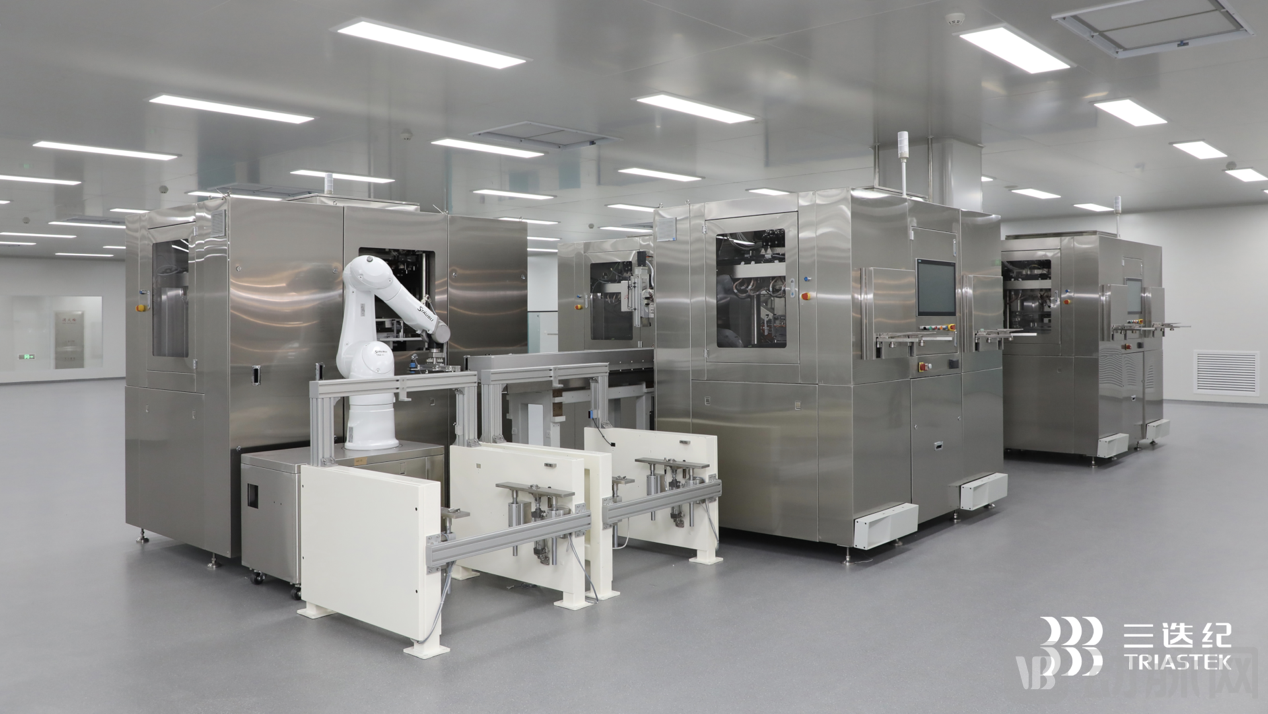
Triastek's Continuous 3D Printing Production Line for Pharmaceuticals
This production line will drive innovation in pharmaceutical manufacturing across three distinct dimensions: 3D printing will revolutionize pharmaceutical processes; continuous manufacturing will lead the transformation of production models; and digitalization and intelligence will bring about changes in drug production management and regulatory approaches.
The applications of 3D printing in the pharmaceutical industry are diverse, enabling not only clinical and commercial production but also meeting the demands for small-batch and personalized medicine. Specifically, given individual physiological variations among patients, personalized medication allows for the customization of patient-centric drugs based on factors such as age, body weight, and current health status. For specific disease conditions in targeted populations, prototype drug formulations can be rapidly and conveniently prepared, thereby reducing the side effects commonly associated with standard dosage forms.
“MED®“The design of the 3D printing production line is scalable, capable of expanding production capacity to meet the high-volume manufacturing demands of blockbuster drugs, while also allowing for downscaled operations to produce orphan drugs with lower demand,” added Professor Li Xiaoling.
The article argues that once this groundbreaking pharmaceutical technology achieves regulatory breakthroughs, such as product registration, a growing number of industry professionals will quickly recognize its advantages and convenience.
Currently, TRIASTEK has three in-house developed products (T19, T20, and T21) in its pipeline that have received Investigational New Drug (IND) approval for clinical trials in the United States, with T19 also having obtained clinical trial approval in China. In terms of collaborative development, TRIASTEK has established partnerships with multiple global pharmaceutical companies and several Chinese pharmaceutical enterprises. This July, TRIASTEK entered into a research collaboration with Eli Lilly leveraging MED®Advantages of 3D Printing Technology in Drug Delivery Systems: Achieving Programmed Release of Oral Drugs in the Gastrointestinal Tract