

Southern Medical University Shenzhen Hospital, Shenzhen Community Health Association, and Ping An Healthcare Jointly Establish Lifestyle Medicine Discipline to Advance Healthy China 2030 Strategy
“Diabetes is a disease that has plagued my physical and mental health, and I have long suffered from its torment. Since I joined the Blood Sugar Control Challenge Class and started logging my three daily meals, my diet has changed significantly, and my physical condition has greatly improved. By changing my lifestyle, my blood sugar levels have also stabilized.” Thus wrote Ms. Li from Guangdong Province in a letter addressed to the unseen health managers at Ping An Chronic Disease Management.
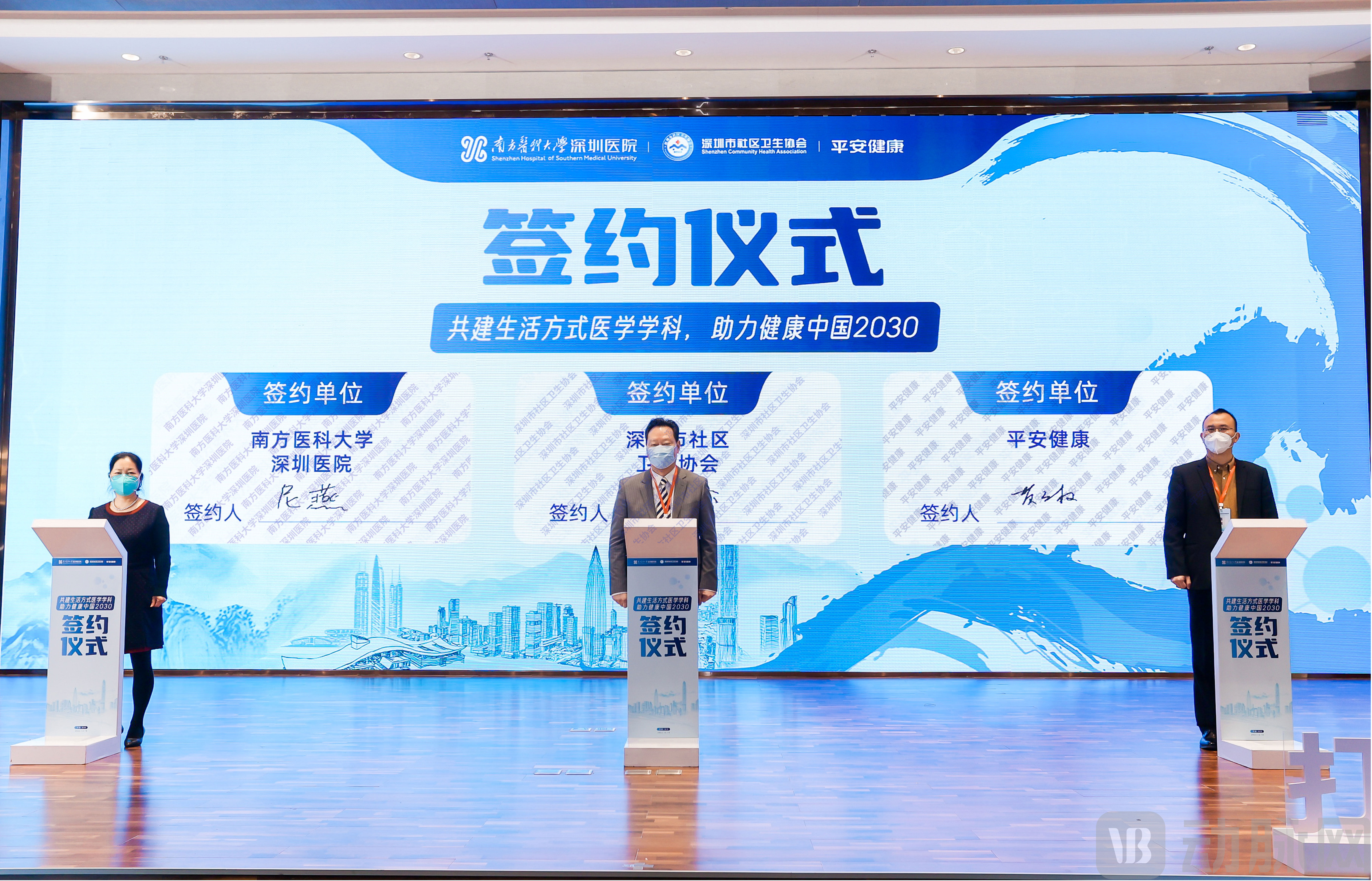
On December 18, at the 5th (International) Shenzhen High-End Forum on General Practice, hosted by the Shenzhen Municipal Health Commission, a signing ceremony was grandly held among three parties—Shenzhen Hospital of Southern Medical University, the Shenzhen Community Health Association, and Ping An Health Medical Technology Co., Ltd. (stock abbreviation: Ping An Good Doctor, 01833.HK; hereinafter referred to as “Ping An Health”)—to jointly establish a discipline in lifestyle medicine and support the Healthy China 2030 initiative. Zhou Zhiming, Executive President of the Shenzhen Community Health Association; Ni Yan, Chief Accountant of Shenzhen Hospital of Southern Medical University; and He Liquan, Senior Vice President and Chief Technology Officer of Ping An Health, signed the agreement on behalf of their respective organizations. He Liquan revealed to reporters that more than 600,000 clients, such as Ms. Li from Guangdong, have participated in Ping An’s online lifestyle medicine program for chronic disease management under its Ping An Chronic Disease Manager service.
At the “Inaugural Southern Forum on Lifestyle Medicine” held during this conference, Professor Zhou Maigeng, Deputy Director of the National Center for Chronic and Noncommunicable Disease Control and Prevention at the Chinese Center for Disease Control and Prevention, attended and shared the latest advances and cutting-edge technologies in chronic disease management across China. He emphasized that chronic disease prevention and control constitute a crucial component of the Healthy China initiative, with the threat posed by chronic diseases to public health being a primary focus of the Healthy China Action. Professor Zhou highlighted the current issues and challenges in chronic disease management in China and recommended innovating the institutional and mechanistic frameworks for chronic disease health management, promoting a shift toward service models centered on chronic disease health management, and strengthening the provision of chronic disease health management services.
In the United States, a healthy lifestyle known as “NEWSTART” has emerged, rapidly becoming a new trend in daily living and gradually evolving into an emerging medical discipline—“Lifestyle Medicine.” In 2019, the American Academy of Family Physicians, the American College of Preventive Medicine, the American College of Sports Medicine, and the Academy of Nutrition and Dietetics published the “Core Competencies for Clinical Practice and Clinical Training Guidelines in Lifestyle Medicine” in the Journal of the American Medical Association (JAMA) and launched board certification for lifestyle medicine specialists, marking the entry of lifestyle medicine into the ranks of recognized medical specialties. In August 2022, the National Cardiovascular Disease Expert Committee established the Professional Committee on Lifestyle Medicine, formally integrating lifestyle medicine into China’s national medical framework. Dr. Hu Zihui, Fellow of the American College of Lifestyle Medicine, stated at the “First Southern Forum on Lifestyle Medicine” held during this conference that the first International Lifestyle Medicine Certification Examination in mainland China will be conducted in Shanghai and Shenzhen next March. Dr. Hu believes that lifestyle medicine can help chronic disease patients achieve symptom relief, disease reversal, and even recovery.
Dr. Yue Hongwen, a postdoctoral fellow at Johns Hopkins University School of Medicine, and Dr. Ma Xin, a professor at Baylor College of Medicine, also shared their insights at the forum. They unanimously agreed that lifestyle medicine serves as a first-line treatment addressing the root causes of chronic diseases. By diagnosing and modifying lifestyle-related risk factors, prescribing personalized lifestyle management plans, and employing interventions such as cognitive behavioral therapy, motivational follow-up mechanisms, and self-efficacy techniques, lifestyle medicine helps patients reconstruct healthy lifestyles. This approach achieves fundamental treatment of chronic diseases, safely and effectively complements other clinical interventions, gradually reduces reliance on medications, and ultimately lowers healthcare costs while improving population health across the entire lifespan through comprehensive lifecycle treatment and health management—embodying true value-based care. Lifestyle medicine has demonstrated definitive clinical efficacy in the prevention and rehabilitation of common chronic conditions, including obesity, hypertension, type 2 diabetes, dyslipidemia, metabolic syndrome, atherosclerotic carotid plaques, coronary heart disease and other metabolic cardiovascular diseases, as well as in tumor prevention and rehabilitation, and anti-aging interventions.
Over the past three years, Dr. Ma Xin has leveraged self-media platforms to deliver public welfare science popularization on lifestyle medicine in Mandarin Chinese to a global audience, based at the Texas Medical Center in Houston, USA—the world’s largest medical center. Her efforts have yielded remarkable results, attracting 1.2 million followers on social media. The lifestyle medicine guidance provided has benefited millions, alleviating or even resolving the burdens of chronic conditions such as sleep disorders, obesity, cancer, diabetes, and hypertension. Particularly during the pandemic, her work offered psychological and spiritual support to patients suffering from anxiety and depression, helping them emerge from the shadow of illness and make significant contributions to public health.
He Liquan stated that Ping An Chronic Disease Manager is currently focused on developing technological solutions for the proactive lifestyle medicine intervention of 35 types of chronic diseases. Significant progress has been made in managing chronic metabolic disorders such as diabetes, hypertension, and obesity, with its out-of-hospital online management capabilities achieving industry-leading scale and efficacy. Taking diabetes management as an example, Ping An’s health managers conduct initial telephone interviews with enrolled patients to collect health data, including BMI, blood glucose, blood pressure, and smoking/alcohol consumption habits. Medical history, family history, and lifestyle habits are recorded into the physician-side system, where AI-driven customized online management plans are generated. These plans include blood glucose monitoring, patient education, dietary guidance, and exercise recommendations. Health lifestyle reshaping and reconstruction are facilitated through meal reviews, community check-ins, and educational milestone achievements. Based on Cognitive Behavioral Therapy (CBT), patients undergo stratified and classified management, including a 21-day intensive management program with immersive community engagement for diabetic patients, supplemented by follow-ups at one month and quarterly intervals. These follow-ups provide indicator alerts, abnormality interventions, and summary-based incentives. This approach establishes an effective closed-loop management system for online diabetes care: data collection for plan formulation, intensive management for behavior shaping, regular follow-ups for abnormality intervention, and periodic summaries for motivational reinforcement. This model has demonstrated positive outcomes in leveraging technology to empower lifestyle medicine and proactively intervene in the health management of chronic disease patients.
It is reported that in July this year, Ping An Group will unveil an upgraded brand identity centered on “Professionalism · Value.” The aforementioned achievements of Ping An Chronic Disease Manager, a subsidiary of Ping An Health, will also empower clinical practice. They will be applied across departments in hospitals at all levels, including General Practice, Health Management Centers, Clinical Nutrition Departments, and Endocrinology and Metabolism Centers, to jointly establish Lifestyle Medicine Centers for Health. By leveraging technological innovation in chronic disease management, these initiatives will enhance hospital capabilities through professional value, serve a broader population, and contribute to the goals of Healthy China 2030.