

National Health Informatization on the Horizon: Electronic Medical Records Poised as Core Infrastructure?
Recently, the National Health Commission, the National Administration of Traditional Chinese Medicine, and the National Bureau of Disease Control and Prevention jointly issued the "14th Five-Year Plan for National Health Informatization," aiming to initially establish a unified, authoritative, and interconnected support and guarantee system for the national health information platform by 2025, basically achieving full connectivity between public medical and health institutions and the national health information platform.
The policy states: "The 14th Five-Year Plan period is a crucial window of opportunity for leveraging innovations in national health informatization to drive the high-quality development of healthcare, as well as a key phase for promoting quality, efficiency, and momentum transformations in healthcare services through digital, networked, and intelligent transitions."
To achieve the ultimate goal of interconnectivity in national health information, the key lies in ensuring that provinces and cities establish robust systems for hosting and exchanging data, such as electronic medical records (EMR) and personal electronic health record (EHR) databases, with a particular emphasis on realizing the sharing of medical information across all healthcare institutions nationwide.
During the new three-year construction period, healthcare IT companies are once again thrust into the spotlight.
Reviewing the Historical Evolution of Healthcare Informatics Construction. Transitioning from the 1.0 era of business digitization to the 2.0 era characterized by vertical integration of business information, healthcare IT development has undergone a period of unregulated growth. This process has inevitably left hospitals with legacy issues such as data silos and application incompatibility, which have become successive barriers to achieving “nationwide medical information sharing among healthcare institutions.”
In 2018, the Bureau of Medical Administration and Hospital Management of the National Health Commission issued the “Notice on Further Promoting the Construction of Information Systems in Medical Institutions with Electronic Medical Records at the Core,” which required that “local health administrative departments at all levels and medical institutions of all types and tiers shall prioritize the construction of electronic medical record (EMR) information systems, leverage them as a key instrument for advancing the development of modern hospital management systems, reinforce the central role of EMRs in the informatization of medical institutions, establish and improve long-term working mechanisms, and continuously deepen related efforts.” The Notice also specified requirements for the application level of electronic medical records in tertiary hospitals.
In 2021, the "Notice on Issuing the Action Plan for Promoting High-Quality Development of Public Hospitals (2021-2025)" further incorporated the assessment of electronic medical record (EMR) systems in secondary hospitals, requiring that by 2022, the average EMR application maturity levels for public secondary and tertiary hospitals nationwide reach Level 3 and Level 4, respectively.
An analysis of the trends in medical informatization policies over the years reveals that, throughout the high-quality development of public hospitals, electronic medical records (EMR) serve not only as a core objective in the foundational infrastructure of medical informatization but also as a key lever for the construction of smart hospitals.
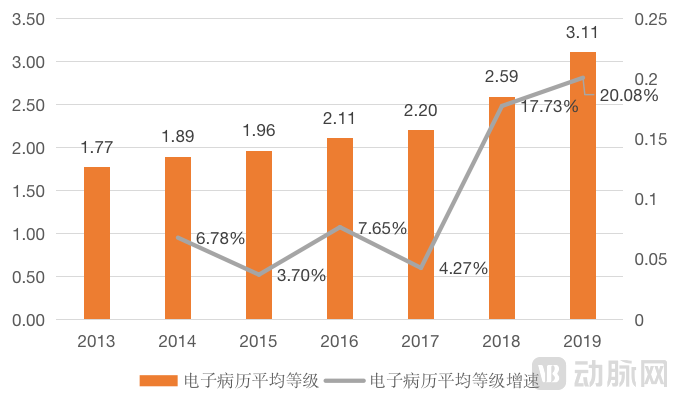
Acceleration of Electronic Medical Record (EMR) Grading in Tertiary Hospitals
Under continuous policy guidance and promotion, the application level of electronic medical records (EMRs) in hospitals at all levels has significantly improved in recent years. The integration of hospital information systems and business processes has become increasingly deep, thereby driving continuous improvements in medical service capabilities and hospital management standards. However, achieving the ambitious goal of nationwide EMR data resource sharing, as proposed by the National Health Commission in its response to suggestions from deputies to the National People’s Congress, requires more than just interconnectivity within individual hospitals; this is merely the beginning.
In simple terms, achieving the sharing of medical information among healthcare institutions across China requires a stepwise approach: expanding from individual hospitals to regional networks, and then from these regions to a national scale, thereby gradually constructing a shared network. As stated in the “Implementation Plan for the Construction of a High-Quality and Efficient Healthcare Service System during the 14th Five-Year Plan Period,” jointly issued in June 2021 by four ministries and commissions including the National Development and Reform Commission and the National Health Commission, it is essential to “accelerate the development of digital health infrastructure, promote the construction of big data systems for health and medical care, and expand the reach and coverage of high-quality medical resources.” As a key component of digital health infrastructure, electronic medical records (EMRs) are inevitably trending toward regional sharing.
As many health IT companies rush into regional healthcare informatization following the waves of cloud computing and big data, Jiangsu Mandala Software Co., Ltd., a pioneer in this field, has already accumulated over 10 years of experience. The company’s development journey—from building single-hospital electronic medical record (EMR) systems, to exploring regional EMR sharing platforms, and then to constructing municipal and provincial regional healthcare data centers—has continuously broken down data-sharing barriers, streamlined data-sharing channels, and promoted full lifecycle data management. It provides a typical case study of an industry-side player leveraging fundamental insights into the healthcare sector to make forward-looking strategic deployments, thereby gaining a first-mover advantage during the subsequent period of policy-driven opportunities.
In 2005, the newly established Mandala incorporated the concept of regional electronic medical records (EMR) into its product portfolio, striving to develop and promote a regional EMR system that transcends the information silos of individual hospitals. This system aims to achieve information sharing and operational collaboration among healthcare institutions within the region, thereby providing comprehensive, full-cycle healthcare services. The ultimate objective of this approach is to lay the foundation for nationwide interoperability of health information by realizing “information sharing across healthcare institutions at all levels throughout China.”
However, at that time, the focus of healthcare IT development was squarely on Hospital Information Systems (HIS) designed for managing personnel, finances, and materials, making Mandala’s vision somewhat ahead of its time. In 2006, Mandala seized the opportunity and successfully secured the contract from the Wuxi Hospital Management Center to uniformly build a regional electronic medical record (EMR) system. Two years later, Mandala achieved interoperability of EMRs among hospitals under the Wuxi municipal administration, and subsequently extended the EMR sharing network step by step to district-level hospitals and primary healthcare institutions in the area.
Across China, the foundational IT infrastructure for individual hospitals has been largely completed. The next step is to advance toward higher-level interoperability and connectivity. In December 2020, the National Health Commission issued the "Notice on Deepening the 'Internet + Healthcare' Five-One Service Initiative," requiring hospitals at Level II and above to accelerate the interconnection and sharing of internal medical service information and business collaboration. The policy aims to promote regional information sharing and mutual recognition, facilitate the access and sharing of healthcare data among medical institutions—including electronic medical records, laboratory and test results, and medical imaging—and gradually achieve province-wide mutual recognition of health information. Under this policy framework, the focus of IT development has shifted toward patient-centered services, making regional healthcare information interoperability and sharing the most urgent priority.
“We often say that healthcare informatization should be built from the perspectives of both medical providers and patients, but in the past, the industry rarely addressed patient needs in the realm of electronic medical records (EMRs),” said Ye Kai, General Manager of Mandala, in an interview with VCBeat. “To achieve comprehensive, full-cycle healthcare services for patients, it is essential to establish a complete disease data chain throughout the patient’s journey. However, patients do not receive care exclusively at a single hospital over their lifetime, and fragmented, discontinuous medical record data cannot support continuous, full-cycle health services. Our original intention in developing regional EMRs was to integrate scattered patient data within the region, thereby helping patients achieve lifelong health management, providing hospitals with tools for patient and disease management, and offering clinicians a foundation for clinical research.”
In practical applications, patients no longer need to re-enter their basic information every time they visit a new hospital, nor do they need to provide doctors with an exhaustive account of their medical history. Supported by regional electronic medical records (EMR), physicians can directly retrieve patient data from the regional EMR repository, thereby enabling more comprehensive data-driven diagnostic and treatment decisions.
On the other hand, the emergence of the COVID-19 pandemic has accelerated the development of national health information platforms. Both disease control centers and patients have benefited from the integration of identity information with electronic health records. Currently, strengthening the integration of medical care with disease prevention, as well as the coordination of routine and emergency responses, has become the direction for building a new public health system. In this context, the interoperability of electronic medical records will unlock greater value.
Specifically, for health commissions at all levels, Centers for Disease Control and Prevention (CDCs) can also leverage regional electronic medical records to enable critical applications such as regional healthcare quality supervision, disease surveillance, and regional scientific research and statistical analysis, thereby facilitating digitalized and intelligent management decision-making across the entire life cycle.
Today, Mandala’s regional electronic medical record (EMR) and regional healthcare data center solutions offer flexible deployment options tailored to customer needs. These products have been selected and implemented by health commissions in over 20 regions, including Jiangsu Province, Inner Mongolia Autonomous Region, Chongqing Municipality, as well as the cities of Hefei, Changsha, Kunming, Qingdao, and Shijiazhuang. Mandala has taken an early lead in seizing the new opportunities in medical IT brought about by the nationwide interoperability of health information.
Whether it is a regional electronic medical record system or a regional healthcare data center, the core ultimately remains the “digital application of medical records.”
Leveraging the clinical backgrounds of its founding team, Mandala pioneered the “post-structured electronic medical record (EMR)” technical route as early as 2006, attempting to apply natural language processing (NLP) techniques to address the challenges of semantic recognition and structure extraction from EMRs by computers. Today, Mandala’s EMR system has evolved from a standalone EMR framework into an integrated EMR/HIS architecture built on a common foundational platform; however, its research, development, and iterative improvements in post-structured EMR technology have never ceased.
The hallmark of post-structuring technology is that it does not alter the documentation habits of healthcare professionals. Instead, it establishes a standardized, structured electronic medical record (EMR) repository through meticulous and professional structuring of EMR elements and semantics. This approach significantly reduces learning, training, and implementation costs for healthcare staff while substantially improving data entry efficiency, thereby creating a breakthrough for the rapid adoption of outpatient, emergency, and inpatient EMRs. To date, Mandala’s EMR system has been deployed in nearly 1,000 hospitals, contributing to the advancement of healthcare informatization in China.
Mandala’s latest-generation electronic medical record (EMR) system incorporates machine learning technology, leveraging intelligent algorithms to extract valid information from medical records more efficiently and accurately for management purposes, thereby significantly enhancing the timeliness and precision of healthcare data applications.
Empowering medical IT with cutting-edge technologies, Mandala has developed a standardized, integrated, and regionally coordinated electronic medical record (EMR) system, laying the groundwork for the future development of a healthcare informatics ecosystem that spans departments, regions, systems, and business domains.
Given the unique nature of the healthcare industry, data security remains an indispensable topic. In its response to proposals from National People’s Congress deputies this year, the National Health Commission emphasized the need to strictly enforce regulations on information security and the confidentiality of health and medical data, while strengthening information security measures such as the protection of critical information infrastructure and data application services. This underscores the regulatory authorities’ strong commitment to the security of electronic medical records. Meanwhile, the “14th Five-Year” Plan for National Health Informatization has also incorporated the development of network and data security assurance systems into its key tasks, prioritizing the enhancement of data security capabilities.
Regarding the term “data security,” Mandala has always regarded it as the core foundation for building its system platform. After all, if medical IT systems cannot ensure data security, how can we dare to discuss the secure interconnectivity of national health information?
“In its response to a proposal from a National People’s Congress deputy, the National Health Commission highlighted the goal of achieving nationwide sharing of electronic medical record (EMR) resources. Regardless of the implementation pathway, multi-scenario and fragmented data sharing will inevitably pose security challenges,” said Ye Kai. “As critical infrastructure, EMRs require a robust security framework for protection. Particularly in the context of internet-based healthcare, healthcare IT companies must uphold a bottom-line mindset and a strong sense of mission. They need to increase investment and strengthen security designs that align with relevant laws and regulations at both the system architecture and underlying technology levels.”
Ye Kai stated, “The essence of healthcare informatization is to serve medical care; we must remain true to our original aspiration of creating value for users.” Healthcare informatization is a slow-moving industry that demands unwavering patience, a deep understanding of genuine clinical needs, and years of accumulated business expertise. It requires both innovation and reverence. Any entrepreneur in the healthcare sector, regardless of how abundant their resources or advanced their technology, must rely on time to consolidate and build their strength. Ye Kai concluded by affirming that Mandala will continue to uphold its relentless pursuit of technological innovation and its steadfast commitment to service quality, pressing forward vigorously on the path of healthcare informatization.