

DeepZhi Technology Files for IPO: Pioneering Breakthroughs in Miniaturized Medical Imaging and AI-Assisted Diagnosis for Grassroots Healthcare
Uneven medical development has been a challenging issue facing Chinese society in recent years. The Outline of the “Healthy China 2030” Planning emphasizes the development direction of “prioritizing rural and grassroots areas to promote the equalization of basic public health services.” However, in the process of advancing this equalization, many practitioners have found that low levels of informatization, outdated equipment, and shortages of funding and professional physicians are significant factors hindering the development of grassroots medical institutions.
Of particular concern is that initial imaging screening and simple image-guided therapies, as critical needs for primary healthcare institutions, commonly encounter practical challenges during implementation, such as “unaffordable equipment, unreadable images, and inability to perform treatments.” Due to cost and operational issues, existing diagnostic devices are rarely deployed at the primary care level.
The essence of this issue lies in the “impossible triangle” inherent in the research, development, and use of medical imaging equipment such as ultrasound, magnetic resonance imaging (MRI), and computed tomography (CT). Specifically, it is difficult to balance equipment cost, size, and resolution during product development. Given the current state of medical imaging technology, developing a device that is simultaneously low-cost, compact and portable, and high-resolution is essentially unfeasible.
Telemedicine, interoperability, and artificial intelligence serve as effective remedies to alleviate these challenges. Guided by national policies on tiered diagnosis and treatment and targeted poverty alleviation, Shanghai Shenzhi Information Technology Co., Ltd. has leveraged its technological advantages to develop a unique business model. By finding solutions that address the conflicting demands of the “impossible triangle,” the company has successfully extended its product coverage to nearly 10,000 primary healthcare institutions.
On the eve of its establishment, Shenzhi Technology had already set its sights on the ultrasound sector.
Based on extensive market research and the team’s expertise in ultrasound technology, Shanghai Shenzhi Information Technology Co., Ltd. (Shenzhi Tech) has identified that ultrasound is a high-volume sector with an annual examination volume reaching 2 billion procedures. However, because ultrasound interpretation requires physicians to acquire dynamic images from multiple planes for real-time diagnosis, the entire workflow—from image acquisition to diagnosis—is heavily dependent on clinical experience. Among the 50 million physicians worldwide, only 2% have mastered the skills required for ultrasound scanning. Consequently, this diagnostic tool, which should be widely accessible as an inclusive solution at the primary care level, remains out of reach for many grassroots physicians in China due to its high operational threshold, particularly those who lack adequate training, experience, and diagnostic proficiency.
To address this issue, Shenzhi Technology has adopted a dual approach focusing on artificial intelligence and application scenarios, developing “compact medical imaging devices with AI-assisted remote diagnosis and smart healthcare services.”
First, enterprises leverage artificial intelligence to enhance image quality. Assisted by deep learning on big data, low-resolution raw ultrasound images are processed to optimize imaging, enabling intelligent segmentation and precise measurement of lesions. By feeding image data into AI models, neural networks learn features from the images and compare them with physician-annotated ground truth labels, thereby deriving logic for inferring the size and shape of lesions. This logic is then applied to new images, allowing the system to automatically assess lesions and tissues. Ultimately, this enables primary care physicians to rapidly achieve accurate diagnoses with the assistance of ultrasound systems, effectively lowering the technical barrier to ultrasound use and transforming ultrasound systems into a powerful driving force.
Secondly, from the perspective of usage scenarios, enterprises have developed a standardized operational protocol for compact, portable ultrasound devices tailored to primary care physicians, enabling auxiliary diagnostic software to function in both Wi-Fi-connected and offline modes. This transforms the potential for portability and ease of use into reality, allowing “compact medical imaging + AI-assisted remote diagnostic devices” to be deployed across a wider range of scenarios. Furthermore, it enhances the operational fluency of ultrasound equipment, thereby ensuring that auxiliary diagnostic devices are effectively implemented at the grassroots level and empower primary healthcare providers.
Integrating these two components forms the complete workflow of Shenzhi Technology’s solution for empowering primary care providers—offering intelligent guidance to physicians without ultrasound experience and correcting their scanning techniques. Through real-time AI interpretation, diagnostic recommendations are provided. This approach not only enhances the accuracy of ultrasound screening and diagnosis but also shortens the learning curve for physicians, making ultrasound screening and diagnosis simpler.
Currently, the company has developed an integrated four-in-one solution comprising AI medical imaging equipment, an AI remote assisted diagnosis system, an AI screening and diagnosis workflow, and backend remote diagnostic services. Meanwhile, Shenzhi Technology aims to profoundly transform medical imaging equipment itself through an integrated hardware-software approach, thereby reshaping the entire imaging workflow and physicians’ examination workflows. This truly achieves mobility, high performance, and intelligence in equipment, enabling products to be more effectively deployed in their intended use scenarios.
Leveraging its in-depth understanding of ultrasound products and mastery of AI-assisted dynamic medical image analysis along with a comprehensive suite of foundational algorithms, Shenzhi Technology has, in just two years, built an imaging database comprising algorithm models for more than 10 categories and over 30 disease types, as well as an ultrasound imaging cloud center. This has enabled AI-assisted ultrasound diagnosis to cover more than 20 disease types. Furthermore, the company has obtained and applied for over 150 domestic and international patents in the fields of ultrasound hardware, artificial intelligence systems, chips, and cloud computing.
Nowadays, the company’s products have completed their 1.0 transformation and are rapidly evolving from in-house software development and deep hardware integration (2.0) toward an integrated software-hardware ecosystem model (3.0), while also launching the Kuaima Medical Imaging Smart Healthcare Service Platform. Most importantly, the continuous commitment to advancing intelligent software and hardware is driven by the goal of consistently reducing product costs and optimizing the operational efficiency of primary healthcare services through comprehensive solutions. Shenzhi Technology recognizes that only by lowering prices can its products be widely adopted in the highly fragmented primary care sector, thereby truly enhancing their economic viability.
“Equipment is portable, but human expertise and experience are difficult to replicate; therefore, empowering primary care should rely primarily on equipment. Equipping primary care physicians with simple, easy-to-use devices is a feasible approach to rapidly improving diagnostic and treatment efficiency and establishing a tiered diagnosis and treatment system,” Shanghai Shenzhi Information Technology Co., Ltd. once told VCBeat.
Guided by this understanding, at the end of last year, Shenzhi Technology ventured into Liuzhi Special District in Guizhou Province to launch the “Rural Healthcare Revitalization and Elderly Health Care—Public Welfare Stroke Screening Campaign,” marking the first practical application of its medical AI technology in Liupanshui City.
It is reported that many villages in Liupanshui are located deep within the mountains, where transportation is extremely inconvenient, and most elderly residents have never undergone screening in their lifetime. However, Shenzhi Technology has enabled physicians to perform neck imaging scans using a handheld “miniaturized medical imaging + AI-assisted remote diagnostic device.” The AI analysis results can be viewed directly on a smartphone, allowing each screening to be completed in under 10 minutes. This truly brings professional diagnostic services from medical institutions to the villagers’ doorsteps.
Shenzhi Technology conducted comprehensive screening coverage for four township health centers in Jiulong Subdistrict, Dayong Town, Luobie Township, and Mugang Town of Liuzhi Special District, as well as for ten village clinics. Behind these achievements lies Shenzhi Technology’s profound understanding and application of how to deploy mobile, high-performance, intelligent “miniaturized medical imaging + AI-assisted remote diagnostic devices” to serve grassroots populations. It also reflects the company’s success in striking a balance among cost, resolution, and size—the so-called “impossible triangle”—thereby simultaneously addressing all three factors while better meeting the demands of practical application scenarios.
In fact, primary healthcare institutions with little to no existing infrastructure have a particularly strong demand for screening and diagnostic equipment. However, these institutions typically handle low patient volumes, and the high cost of imaging equipment often deters them from making such investments. Fortunately, the accelerated implementation of Medical Consortia and Medical Alliances is helping to equip these primary care facilities. Against this backdrop, demand is growing for compact, portable devices that combine medical imaging with AI-assisted remote diagnosis—solutions that are affordable, lightweight, versatile in their applications, and capable of assisting physicians with routine examinations.
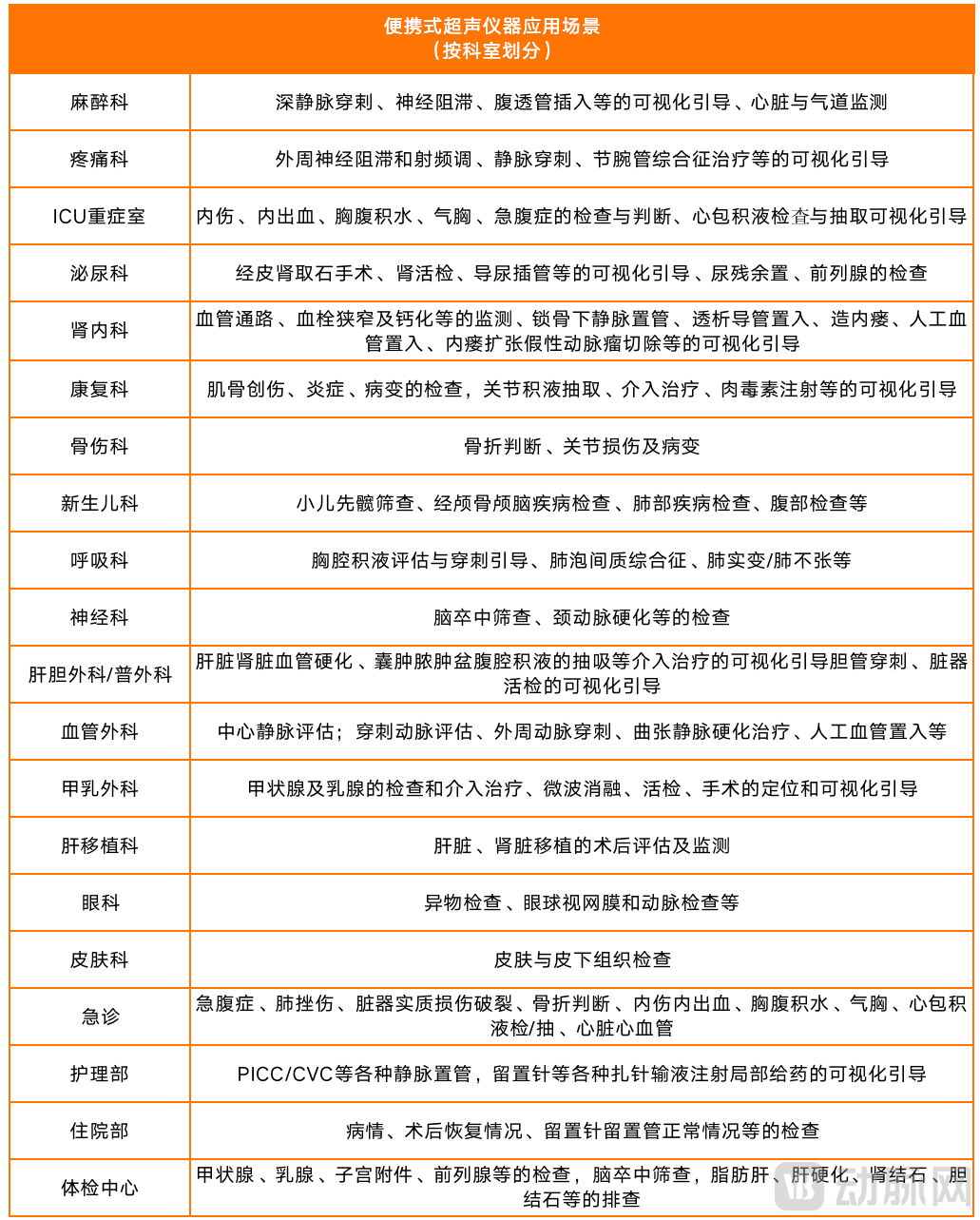
In the guidelines issued this year by the National Health Commission,“Notice on Issuing Three Service Capability Standards, Including the Service Capability Standards for Township Health Centers (2022 Edition)”It explicitly states that primary healthcare institutions, including township health centers, community health service centers, and village clinics, must be equipped with relevant devices corresponding to their approved diagnostic and treatment specialties and necessary for home visits. Both the sections on township health centers and community health service centers mention color Doppler ultrasound equipment. Furthermore, the section on community health service centers specifies that Class A centers must also be equipped with a certain number of information technology-based portable devices for home visits.
With the further implementation of policies such as tiered diagnosis and treatment, and this year“Guiding Principles for the Registration and Review of Artificial Intelligence Medical Devices”of its release. Ultrasound is highly likely to become the next key sector where AI companies will achieve new breakthroughs in regulatory approval and market access. Shanghai Shenzhi Information Technology Co., Ltd. has been strategically positioned in the ultrasound field for several years and has implemented numerous initiatives to promote ultrasound screening in primary healthcare settings, with potential for further breakthroughs in the future.
In recent years, the development of new materials, algorithms, and data, along with their integration into miniaturized medical imaging screening and diagnostic equipment, has accelerated the overall advancement of portable ultrasound technology, making the miniaturization of medical devices increasingly prevalent. This widespread adoption inevitably leads to the accumulation of diagnostic data and the optimization of artificial intelligence models. In the future, more valuable application scenarios will certainly be explored around “miniaturized medical imaging + AI-assisted remote diagnostic devices.” This solution may even extend into households, enabling users to conduct early self-screening and ensuring early disease detection.
Beyond clinical settings, “miniaturized medical imaging + AI-assisted remote diagnostic devices” are now widely used in everyday scenarios, including fieldwork, disaster relief, vehicle-mounted applications, and home use. The home ultrasound market is growing rapidly and holds substantial potential. This year, not only has GE Healthcare, one of the three major players in the medical industry, entered the home miniaturized ultrasound segment—further validating the value of this sector—but data from U.S. venture capital and private equity firm Insight Partners also shows that the global market for home medical devices reached $33.635 billion in 2020 and is projected to reach $57.103 billion by 2028, underscoring the significant growth potential of this sector.
Furthermore, numerous low- and middle-income countries worldwide face the same challenges as China’s primary healthcare institutions. The emergence of compact ultrasound systems will undoubtedly expand access to imaging examinations for patients in more regions while reducing equipment training and maintenance costs. Currently, Shanghai Shenzhi Information Technology Co., Ltd. has established in-depth collaborations with primary healthcare institutions across various regions and will continue to explore the application value of “compact medical imaging + AI-assisted remote diagnostic devices” in a broader range of scenarios.
“Meanwhile, this small device is also highly valuable in terms of the equity and accessibility of healthcare services.” At the end of the conversation, Shenzhi Technology stated.