

Wanxin Psychology Files IPO Prospectus: Serving Over 3,000 Enterprises and 2.6 Million Users in China's B2B Mental Health Market
How Hot Is the Mental Health Sector? The Data Offers a Glimpse.
According to the “2021 Global Healthcare Industry Capital Report” by VCBeat and VBInsight, the digital health sector abroad remained highly active throughout 2021. Compared with 2020, financing in the mental health segment saw further growth in 2021. In 2021, investment and financing activity in overseas digital mental health surged comprehensively, with a total of 115 financing deals completed and cumulative financing amounting to over USD 3.4 billion (approximately RMB 21.9 billion).
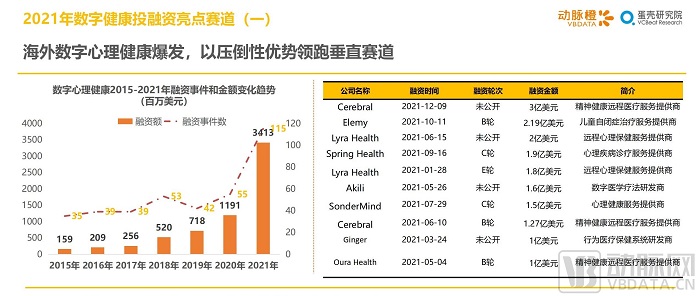
Image source: VCBeat & VBInsight, "2021 Global Healthcare Industry Capital Report"
Meanwhile, investment in China’s mental health sector has also heated up. Since 2020, companies such as Wanling Pangu, Jiandan Xinli (Simple Psychology), Yidianling, Westlake Xinchen, and Pause Lab have successively attracted investor interest, securing financing rounds in the tens of millions or even exceeding RMB 100 million.
The surge in investment and financing in the mental health sector is closely linked to the robust growth of global digital mental health since 2015. Amid the pandemic, factors such as the rise of remote work and increased uncertainty surrounding offline medical services have further driven up demand for mental health services. Bolstered by digital technologies, the global digital mental health market has continued to expand.
While the mental health services sector has garnered significant attention, we have also observed a gradual segmentation within this field, which can be broadly categorized into traditional psychological counseling agencies, online psychological counseling platforms, and Employee Assistance Program (EAP) service providers. Amidst the struggles of numerous companies facing challenges in delivering psychological counseling services to individual consumers (B2C), those catering to enterprise clients (B2B) present a markedly different landscape. What accounts for this disparity? Shanghai Wanxin Network Technology Co., Ltd. (“Wanxin Psychology”), which has focused on B2B EAP services since its establishment in 2017, is certainly well-positioned to offer insights.
Seizing the Development Opportunities in Corporate EAP to Enter the B2B Mental Health Services Market
The company targeted the B2B psychological services market from its inception, a strategic decision linked to Hu Miaomiao, founder of Wanxin Psychology, and her professional experience and insights into industry development.
Hu Miaomiao, who has a medical background, graduated from the Second Military Medical University. After graduation, he worked in a hospital. Recognizing the promising prospects of the mental health sector, Hu subsequently embarked on an entrepreneurial venture in this field. From initial training for psychological counselors to subsequent provision of online psychological services, and later to offering Employee Assistance Program (EAP) services to businesses (B-side), his career trajectory has accurately aligned with every key milestone in the development of China’s psychological industry.
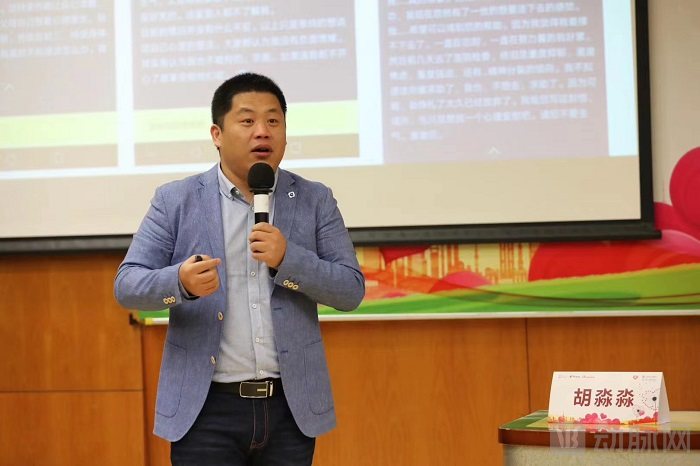
2017 marked a milestone year for Hu Miaomiao. During this period, they consolidated team resources and began integrating brands such as Huilan Psychology, Zhongmeng EAP, and Wanxin Technology under the “Wanxin Psychology” umbrella, officially launching comprehensive mental health services for B-side enterprise clients.
The decision-making process is partly influenced by Hu Miaomiao’s assessment of the development trends in the mental health sector—
On the one hand, the expansion of the consumer-facing psychological services market continues to face challenges such as low public awareness and acceptance.
At that time, the prevalence of psychological counseling and its public acceptance were both low. However, the rapid growth of online products is strongly correlated with user density and frequency of use. Unlike other internet apps that can achieve rapid expansion through capital investment, users in the mental health sector lack established consumption habits, making it difficult for platforms to rely on capital subsidies or similar strategies to rapidly acquire users. Consequently, online psychological counseling platforms clearly struggle to achieve profitability by serving individual consumers (C-end users).
On the other hand, the B2B psychological services market is rapidly emerging, leaving substantial room for growth for domestic enterprises.
Corporate EAPs play a crucial role in this context. The term EAP (Employee Assistance Program) refers to an “Employee and Family Assistance Program,” commonly known as “corporate psychological services” or an “employee assistance program.” It is a systematic, long-term welfare and support initiative established by enterprises for their employees. Through guidance, training, and counseling provided by professionals, it aims to address various psychological and behavioral issues faced by employees and their family members, thereby enhancing employees’ job performance within the organization.
Undoubtedly, there are significant opportunities in the field of Employee Assistance Program (EAP) services. Hu Miaomiao pointed out that domestic EAP services have roughly undergone the following development trajectory: First, multinational corporations entering China introduced EAP services to their expatriate and local employees. During this period, EAP services were primarily provided by overseas firms. Notably, 90% of Fortune Global 500 companies have made EAP services a standard offering. For instance, the entry of multinational enterprises such as Google into China also spurred the rise of the Chinese EAP service market. Second, large central state-owned enterprises and other state-owned enterprises in China began consciously adopting practices from overseas companies by providing EAP services to their employees. Recognizing the opportunity, some local enterprises entered this sector, further advancing the localization of EAP service provision. Meanwhile, international EAP service providers, lacking localized advantages, have gradually withdrawn from the Chinese market.
Recognizing the challenges in expanding within the consumer (C-end) market and the rising demand for Employee Assistance Program (EAP) services in the corporate (B-end) sector, Wanxin Psychology has leveraged its years of experience and professional service foundation in the mental health field to enter the EAP market, despite the immaturity of the EAP service supply side.
For Hu Miaomiao, the focus is on a more long-term objective: On one hand, as domestic medium and large-sized enterprises further expand their global operations, Chinese EAP services will increasingly enter overseas markets; on the other hand, beyond these larger corporations, the EAP market for small and medium-sized enterprises (SMEs) also holds significant potential, driven by the adoption of innovative technologies, declining service prices, and improving service quality.
Since its integration in 2017, Wanxin Psychology has achieved rapid growth with annual revenue increases of nearly 50% to 80%.To date, Wanxin Psychological Services has served over 3,000 enterprises, covering more than 2.6 million employees.Among them are many large state-owned enterprises and central state-owned enterprises, with numerous multinational corporations also included in the client roster of Wanxin Psychology.
Taking the collaboration between Wanxin Psychology and a major automotive enterprise as an example, Wanxin Psychology assisted the company in establishing a psychological counseling center named “Mind Station.” Leveraging its proprietary Physical and Mental Health Cloud Platform, Wanxin Psychology enabled the enterprise to provide enhanced psychological counseling services to its employees. Additionally, it helped the enterprise manage the service workflows related to employees and counselors. With thousands of corporate cooperation cases accumulated, Wanxin Psychology can promptly grasp client needs and deliver superior services to enterprises.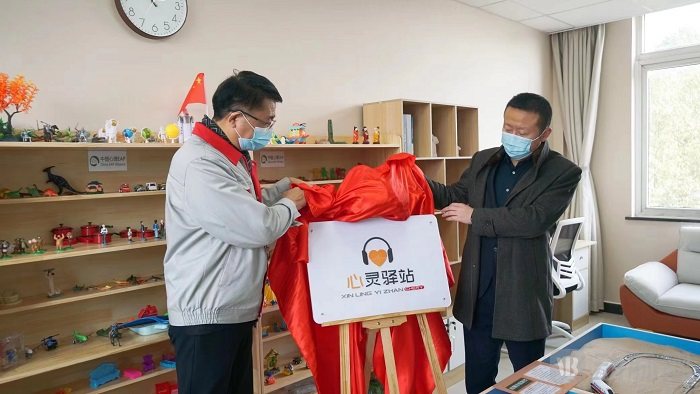
Rather than seeking high-quality psychological counselors, the more critical focus is on building systemic service capabilities.
While Wanxin Psychology anchors its services to B-side enterprise clients, it has further expanded its brand to address the needs of diverse groups, driven by its own business development—
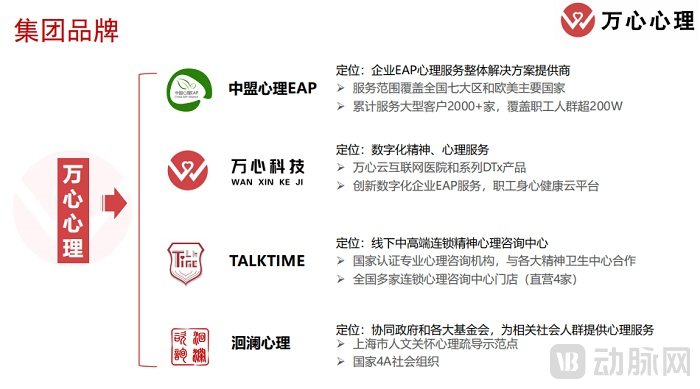
These include Zhongmeng Psychology EAP, positioned as a provider of corporate EAP psychological service solutions; Wanxin Technology, which offers internet hospital and digital therapeutics products; TALKTIME (established in late 2020), positioned as a chain of offline mid-to-high-end psychological counseling centers; and Huilan Psychology, which collaborates with the government and major foundations to provide psychological services to relevant social groups.
Wanxin Psychology’s four major brands cover nearly all key user segments, including B2B enterprises, insurance companies, government entities, and individual consumers.
After establishing distinct brands for different user segments, Wanxin Psychology has gradually developed eight core product lines tailored to the needs of these diverse groups: psychological assessments, psychological counseling, training courses, brand promotion, event salons, organizational surveys, internet-based digital products (such as a physical and mental health cloud platform for B-end clients and an internet hospital for C-end consumers), and hardware infrastructure planning (including psychological assessment rooms and sandplay therapy rooms). These products can be combined into specific modules to support the four major brands under Wanxin Psychology.
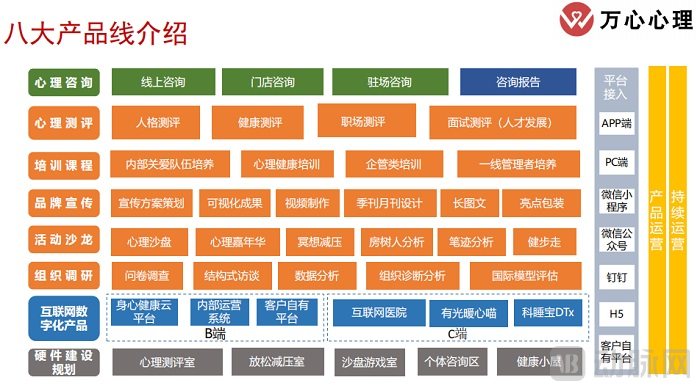
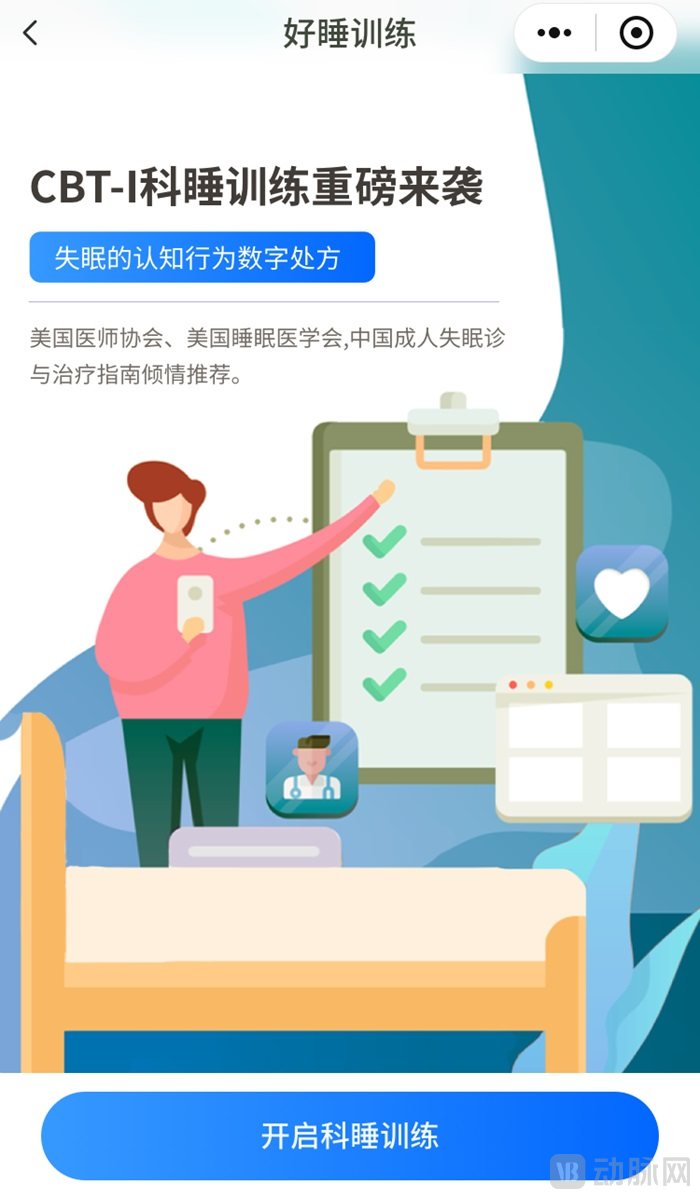
It is worth noting that, amid the current surge in digital therapeutics, Wanxin Psychology’s internet-based digital products also include a range of digital therapeutic (DTx) offerings. Examples include “Ke Shui Bao,” a DTx product designed for individuals with insomnia, and the “PCA Happiness Action Camp,” a DTx product targeting emotional well-being.By developing a range of innovative internet-based digital products, Wanxin Psychology is further enhancing its ability to meet user needs.
For companies operating in the mental health sector, these products may be familiar. Hu Miaomiao also pointed out that what sets Wanxin Psychology apart from other enterprises in the mental health field is perhaps not the products offered, but rather the development of a comprehensive digital system service capability behind them.
On the one hand, in the provision of online psychological counseling services, the extreme scarcity of high-quality counselors on the supply side is regarded as a major pain point restricting industry development. Most internet-based psychological counseling platforms have made attracting top-tier counselors to join their platforms a key strategic objective. However, Hu Miaomiao points out that this issue can actually be resolved by building robust digital system service capabilities.
In fact, Wanxin Psychology currently has more than 3,000 licensed psychological counselors on its platform, with its full-time counseling team numbering nearly 100. In recent years, the proportion of counselors recruited from universities has continued to rise. Addressing the shortage of high-quality counselors, Hu Miaomiao pointed out that this is not merely a domestic issue but a global challenge; data shows that even in the United States, there is only one psychological counselor for every 3,000 people.
To address the shortage of high-quality psychological counselors, the key lies in building a standardized service system. By leveraging this standardized framework alongside digital management systems, service quality can be gradually enhanced, while continuous empowerment of counselors further elevates their professional capabilities. Wanxin Psychology has established a comprehensive and relatively mature system covering counselor screening, training, case assignment, consultation processes, user assessments, and supervision. This approach creates a distinct differentiation from platforms that lack effective management mechanisms for onboarded counselors.
For example, when a client requires services from a counselor at Wanxin Psychology, the system automatically ranks available counselors in real time and assigns the case to the one most precisely matched by the algorithm. This ranking is typically based on the capture and analysis of each counselor’s historical practice data, such as cumulative consultation hours in their areas of expertise, supervision records, client evaluations, and timeliness of consultation report submissions. This mechanism effectively imposes a degree of oversight on counselors, motivating them to proactively participate in relevant training and supervision, thereby encouraging continuous improvement and refinement of their professional skills.
“Whether there is a comprehensive psychological counseling management system is undoubtedly quite important. If one can have a system capable of managing counselors and clients, and even supervising the entire counseling process, it will gain a competitive advantage,” emphasized Hu Miaomiao.
On the other hand, comprehensive system service capabilities also include the provision of both online and offline services, as well as the rational and effective management and operation of offline chain institutions.
Since opening its first offline store in late 2020, TALKTIME, a mid-to-high-end chain psychological counseling brand under Wanxin Psychology, has strategically established four chain stores. Targeting mid-to-high-end clientele, TALKTIME has designated Beijing, Shanghai, Guangzhou, and Shenzhen as its key strategic cities. It is reported that the brand plans to expand further into second- and third-tier cities after consolidating its presence in first-tier cities.

The establishment of offline stores has, to some extent, perfected Wanxin’s psychological service ecosystem, enabling further provision of accessible offline services for employees of B-side corporate clients. Wanxin Psychology also recognizes the importance of operational management for its chain of offline stores. By drawing on mature methodologies from the education and training sector, it has implemented systematic management measures across store operations, business management, and supply chain logistics, thereby further mitigating the impact on clients caused by the turnover of high-quality psychological counselors.
The construction of a digital system combined with professional service capabilities has also enabled Wanxin Psychology to build stronger barriers to cope with the competition brought about by the current industry shift.
In the past two years, not only have domestic mental health companies recognized the limitations of the consumer (C-end) market, but many foreign enterprises have also been actively expanding into the business (B-end) market. For instance, LifeStance Health, a publicly listed company overseas, leverages its foundation of offline psychological clinics to integrate online and offline services, providing mental health solutions to B-end health insurance providers. Meanwhile, Talk Space, which went public via a SPAC merger, initially offered online psychological counseling services directly to consumers via the internet. After 2019, it expanded its offerings to provide employee assistance programs and psychological counseling services to businesses. This strategic shift has contributed significantly to its business growth.
These shifts undoubtedly highlight the growth potential of the B2B psychological services market. Regarding the trend of domestic online counseling platforms shifting their focus from the consumer (C-end) to the business (B-end) market, Wanxin Psychology appears unconcerned. “Companies serving individual consumers that pivot to the B2B sector often risk being easily replicated and surpassed if they focus solely on the product itself without building robust systemic service capabilities.” Furthermore, the relatively high entry barriers in the B2B market will exclude some players. With its long-term accumulation in the B2B sector and well-established systemic service capabilities, Wanxin Psychology clearly holds a competitive advantage.
Strengthen B-side services, expand C-side conversion, and return to the essential value of psychological services
Wanxin Psychology is fairly confident in the current competitive landscape.
On one hand, compared with other enterprises that also provide mental health services to B-end clients, Wanxin Psychology possesses substantial accumulated expertise and a strong, systematic service capability.This has also established Wanxin Psychology’s corporate image as a clear leader in the EAP (Employee Assistance Program) service sector. A Wanxin Psychology employee noted that Hu Miaomiao has consistently emphasized internally: “We should not simply view our peers as competitors; instead, we must aim to emulate more outstanding domestic and international health enterprises. Only in this way can we recognize the substantial work that remains for us to refine.” One example effectively illustrates Wanxin Psychology’s competitive advantages. Previously, a client evaluated products from multiple companies before ultimately entering into a long-term cooperation agreement with Wanxin Psychology. A significant factor in this decision was the assessment of crisis intervention capabilities. Wanxin Psychology boasts a robust data tracking system, providing comprehensive contingency plans beforehand and ensuring full-process, multi-dimensional handling procedures and data management thereafter, thereby delivering a secure and reliable service experience to clients.
On the other hand, in tapping into the consumer market, Wanxin Psychology—leveraging its coverage of over 2.6 million employees across more than 3,000 enterprises and their families—has effectively overcome customer acquisition challenges, unlike companies solely focused on consumer-oriented psychological counseling or physical and mental wellness.This is precisely the urgent issue that online psychological counseling platforms need to address. Furthermore, given the higher entry barriers on the B2B side and the greater range of challenges faced by enterprise employees, companies with long-term engagement in the B2B sector are, to some extent, better positioned to achieve a transition from B2B to B2C. From a product perspective, the development of digital offerings, such as the “Ke Shui Bao” digital therapeutic, aligns more closely with the current consumption habits of internet users and is more likely to gain acceptance and recognition among younger audiences. Moreover, the efficacy of digital products based on Cognitive Behavioral Therapy (CBT) is inherently assured.
Even,Relative to Foreign Competitors, Hu Miaomiao pointed out that although domestic enterprises face the problem of inflexible payment methods—with B-side enterprises accounting for 80%-90% of payments. Domestic insurance payments refer to critical illness insurance products to a certain extent, and the payment conditions are relatively harsh, which leads to insufficient willingness to purchase—but,The advantage of the domestic market lies in the rapid adoption of more affordable innovative digital service products, further reducing the burden on users.
These advantages have also enabled Wanxin Psychology to achieve rapid growth in recent years. In recognition of Wanxin Psychology’s capabilities, the organization undertook numerous psychological assistance projects for local governments during the pandemic.
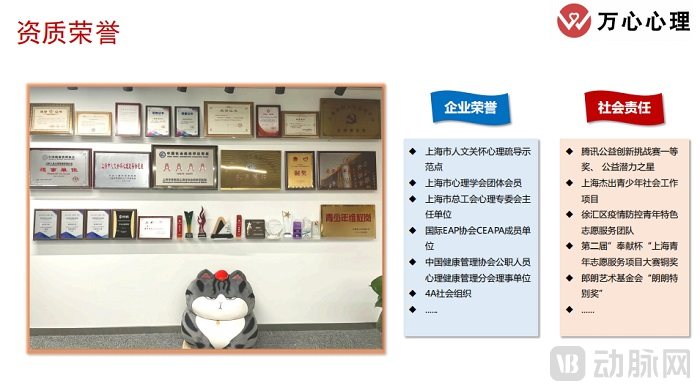
Furthermore, Wanxin Psychology has been supporting advancements in related academic research. Over the three years of the pandemic, Wanxin Psychology continuously collaborated with government agencies and universities to conduct surveys on key populations in industries heavily impacted by the epidemic, such as catering, tourism, and express delivery, providing targeted recommendations and policy suggestions. Meanwhile, through its mental health app for adolescents, “Nuanxin Miao,” Wanxin Psychology partnered with Tencent AI and pharmaceutical companies to launch the “Hundred Cities, Thousand Schools” public welfare psychological support campaign for primary, secondary, and university students during the pandemic. This initiative received widespread social acclaim and won numerous public welfare awards.
Amid its rapid early-stage growth, Wanxin Psychology is also planning its next steps: it intends to further develop its internet hospital and expand its offline chain of psychological counseling centers through financing, while integrating with EAP-enabled physical and mental health platforms to create a more comprehensive closed-loop ecosystem.
For Hu Miaomiao, the core development focus of Wanxin Psychology in the future will be to strengthen its B-side business while integrating the B-to-C segment, thereby establishing competitive barriers and sustaining user stickiness. In the medium to long term, it will further consolidate its physical and mental health cloud platform business sector, enhance the integration of related medical insurance, health check-ups, and healthcare services, and expand its overseas operations.
“The mental health sector boasts a promising outlook, with genuine user needs becoming increasingly apparent. However, policy uncertainty remains a significant hurdle for industry development. Amidst the overall positive trajectory, enterprises face both opportunities and risks, necessitating constant vigilance regarding shifts in policy guidance,” noted Hu Miaomiao. He suggested that, driven by policy direction, a likely future trend is the “universalization of psychological counseling,” which implies greater market demand for more affordable mental health service products. Consequently, some high-end counseling firms and institutions incapable of handling large-scale counseling services may encounter certain challenges. “In contrast, Wanxin Psychology, with its robust digital and systematic service capabilities, is poised to seize new development opportunities in this process.”