

Proya and Shiseido Enter as VCs: Is Recombinant Collagen the Next Hyaluronic Acid?

Giant Biogene
Skin Care Product R&D Developer
As the darling of the fashion industry, the beauty sector has recently begun to frequently discuss “biotechnology.”
Since 2022, Chinese beauty giant Proya has first invested in Synbio Tech through its affiliated fund, and then signed a strategic cooperation agreement with Zhejiang Paiptide Biotechnology. The common ground between these two companies lies in their attempts to leverage “synthetic biology” to reconstruct the upstream raw materials for the medical aesthetics industry.
Coincidentally, after establishing the Shiseido Yue Fund in May, Shiseido’s first investment was in Trautec Medical, a startup specializing in self-developed recombinant collagen biomaterials.
The entry of two industry leaders is quietly reshaping the application and development landscape of synthetic biology in the medical aesthetics sector. Over the past decade, investors seeking risk premiums were the constant companions of pioneers such as Giant Biogene and Jinbo Bio. However, as startups have now validated their in-house R&D pathways and market education has begun to yield results, more beauty giants are entering the fray in the role of venture capitalists, progressively securing their foothold in the market.
Ideally, they hope to create a blockbuster product akin to hyaluronic acid in the next decade. But will reality prove as straightforward as their plans suggest?
As early as 1981, the U.S. FDA issued its first approval for a collagen-based product to Inamed’s bovine collagen implant Zyderm, pioneering new avenues for superficial and mid-dermal aesthetic restoration.
However, over the subsequent 30 years, collagen failed to outperform hyaluronic acid, which emerged as a dominant force. Backed by an efficient supply chain and successful market education, hyaluronic acid has flourished across multiple sectors—including medical aesthetics, pharmaceuticals, and food—gradually forming a massive market valued at hundreds of billions of dollars, with annual sales in China exceeding 600 tons.
In terms of product efficacy, hyaluronic acid demonstrates superior hydrating properties, with a water-locking capacity 500–1,000 times its weight, far exceeding the 30-fold efficacy of collagen. However, collagen holds greater advantages in anti-aging, repair, and skin brightening, as it can induce endogenous collagen regeneration and promote basal cell division. In particular, its repair and anti-aging benefits align well with current consumer preferences.
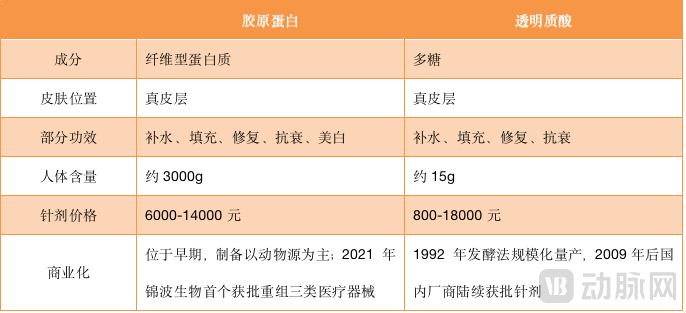
Comparison of the Development Trends of Collagen and Hyaluronic Acid (Data Source: VCBeat, Guosen Securities)
In the past, despite its numerous advantages, collagen gradually declined due to deficiencies in its technological foundation and source materials, as well as associated risks and technical limitations.
First, safety and standardization. Traditional collagen is predominantly animal-derived, extracted from animal connective tissues (such as pig skin, bovine hide, donkey hide, and fish) using acid or enzymatic hydrolysis methods. This approach carries certain risks of immunogenicity, and industry standards for medical-grade applications remain relatively lagging.
Next are production volume and price. According to data from Grand View Research, global animal-derived collagen production amounted to only 32,000 metric tons in 2019. The primary constraint on animal-derived collagen is the limited supply of animal sources. High costs associated with raising animals, coupled with stringent regulatory and traceability requirements—particularly for medical-grade collagen raw materials—make it difficult to meet large-scale production demands. Consequently, collagen products remain relatively expensive, hindering product development by midstream enterprises. Prices often exceeding tens of thousands of yuan are also unaffordable for ordinary consumers.
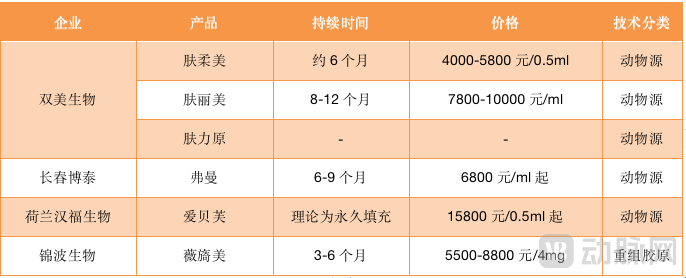
Currently Approved Collagen Filler Injection Products by the National Medical Products Administration (Data Source: Guosen Securities)
Today, collagen is regaining momentum, primarily due to the rapid advancement of gene editing and synthetic biology technologies. These innovations enable recombinant collagen to theoretically overcome many challenges associated with the production and distribution of animal-derived collagen. For instance, by designing human-like collagen sequences, it is possible to completely avoid the immunogenicity of animal-derived collagen and mitigate the risk of transmitting pathogenic viruses. As a result, recombinant collagen offers superior biocompatibility and safety.
In terms of standardization, the National Medical Products Administration (NMPA) has continuously clarified management specifications for collagen products, as well as standards for raw materials and quality control in recent years. These efforts facilitate standardized industry development and further promote the healthy commercial application of these products. In January 2022, the NMPA issued the industry standard YY/T 1849-2022 “Recombinant Collagen,” which specifies quality control requirements, testing indicators and methods, and biological evaluation criteria for recombinant collagen. In December 2022, the NMPA released the Technical Review Points for Recombinant Humanized Collagen Injection Materials for Plastic and Aesthetic Surgery (Trial), which classified such injection materials as Class III medical devices. It also required the submission of information on raw material selection, formulation determination, and studies on the degradation metabolism mechanisms and characteristics of humanized collagen, thereby further clarifying the review process.
More importantly, production capacity is key. Leading enterprises are continuously breaking through constraints. For instance, Giant Biogene has developed and applied high-density fermentation and highly efficient separation and purification technologies, enabling a 90% recovery rate of target proteins from recombinant E. coli after a single processing cycle, while achieving a purity level of up to 99.9% for recombinant collagen. According to its prospectus, Giant Biogene’s production capacity reached approximately 10.9 tons in 2021, more than three times the global output of animal-derived collagen in the same year (estimated at 33,300 tons in 2021).
After breaking through numerous technical bottlenecks in collagen over the past three decades, the recombinant collagen sector has witnessed explosive growth in enterprises over the last two years. On one hand, leading companies such as Jinbo Bio and Giant Biogene have rapidly entered the secondary market, leveraging their first-mover advantage to accelerate market education and swiftly capture market share. On the other hand, medically rooted enterprises like Trautec Medical and Tichuang Biology have seen their production technologies mature, focusing primarily on the B2B market.
This landscape has provided companies such as Proya and Shiseido with the foundational basis to enter the collagen sector. In the past, when technology was less mature, exploiting the value of hyaluronic acid clearly offered a comparative advantage. Today, however, most of the core technological challenges in collagen have been overcome. Beauty giants no longer need to spend vast sums acquiring listed companies to establish their presence; instead, by securing sufficiently effective technologies and leveraging their extensive consumer bases, they are well-positioned to gain a competitive edge in the forthcoming market reshuffling.
Although numerous venture capital firms and corporations flocked into the sector, driving collagen to popularity throughout 2022, it would be premature to regard this as the definitive rise of the track. Just as Giant Biogene has written one miracle after another in the research, development, and production of recombinant collagen, its sales performance at the downstream end remains clouded by uncertainty.
According to the prospectus, from 2019 to May 2022, the revenue of Giant Biogene’s flagship product, Comfy (Ke Fu Mei), was RMB 290 million, RMB 421 million, RMB 898 million, and RMB 428 million, respectively, while the revenue of Collgene (Ke Li Jin) was RMB 481 million, RMB 559 million, RMB 526 million, and RMB 238 million, respectively. The combined revenue of these two products accounted for 80.6%, 82.4%, 91.7%, and 92.2% of the company’s total annual revenue, respectively.
Although the 2022 data has not yet been disclosed, it is all but certain that Giant Biogene’s increasing reliance on its core products has coincided with stagnating growth. After all, declining consumer demand for the Recombinant Collagen Brightening Ampoule Essence (Collgene’s flagship product) directly impacted sales volumes of Giant Biogene’s largest distributor, Xi’an Maker Village, thereby affecting Giant Biogene’s financial statements.
In the first half of 2022, Giant Biogene optimized its distributor network by adding 35 new distributors and terminating contracts with 56, resulting in a net decrease of 32 distributors. Consequently, Giant Biogene appears to be prioritizing a direct-to-consumer (DTC) model to turn the tide. From 2019 to May 2022, the proportion of revenue from direct sales accounted for 20.1%, 27.8%, 45.4%, and 46.5% of total revenue, respectively. In just the first five months of 2022, Giant Biogene spent RMB 200 million on sales and marketing expenses to drive traffic on Tmall and JD.com.
It is difficult to assess the merits and drawbacks of Giant Biogene’s heavy bet on a direct-sales strategy in the short term. However, one thing is certain: for ordinary startups in this sector, the vast majority lack the financial capacity to cover sales costs and bear sales risks when attempting to move upstream to midstream operations and shift from B2B to B2C models.
At the current stage, synthetic biology companies engaged in R&D for medical aesthetics are generally focused on the development of raw materials, at most customizing specific products for midstream enterprises, and lack the resources and economic capacity for sales and operations. However, upstream enterprises must accurately grasp market trends and identify shifts in demand, which likewise requires deep engagement at the frontline to obtain real-time, precise market intelligence.
The entry of beauty giants can clearly fill the information gaps faced by startups. Their deep familiarity with the consumer market enables them to serve as lighthouses, guiding the primary R&D direction for startups, which in turn can focus wholeheartedly on research and development to build competitive advantages at the product level.
Take Trautec Medical, which received investment from Shiseido, as an example. Without interfering with Trautec Medical’s operational autonomy, Shiseido has integrated it into its ecosystem. This serves two purposes: first, it endorses the quality of Trautec Medical’s products, thereby enhancing the brand’s credibility; second, it enables Shiseido to share the latest developments in the field of “functional skincare,” allowing Trautec Medical to conduct more targeted research and development.
However, although startups have benefited significantly from this wave of investment, the involvement of many beauty companies has remained superficial, with none clearly disclosing their development strategies in the recombinant collagen sector.
Thus, investment is more akin to a strategy of patient observation. Without the ability to accurately predict future trends, one should prepare a high-quality seed in advance, enabling it to take root swiftly when the timing is right.
After all, collagen has experienced ups and downs for 40 years. To challenge the established market share of hyaluronic acid, in addition to technological breakthroughs, what is still lacking is an opportunity to capture consumers’ mindshare.
Consistent with the stance of beauty companies, although collagen is currently a hot trend and many institutions and enterprises are entering the market, startups—the absolute main players in this wave of iteration—have not chosen to go all-in. Unable to sway sales dynamics, they have instead secured an early exit strategy by positioning technology as their core competitive advantage for investment.
Under this logic, the leading players in the recombinant collagen sector recently share two key characteristics: first, they emphasize their platform-based synthetic biology strategies; second, they highlight their inherent medical attributes.
Taichuang Biologics, which secured over $100 million in financing in 2022, has developed recombinant humanized type III collagen that has reached the pilot-scale stage. However, its core competency lies in establishing an integrated technological pathway spanning upstream component and strain libraries, midstream mutation and screening platforms, and downstream scale-up processes. Leveraging this platform system, Taichuang Biologics can rapidly transition from synthesizable compounds to mass-producible substances, thereby enhancing the yield and efficiency of synthetic materials.
A Further Look at Trautec Medical, Invested in by ShiseidoThe company currently operates two core platforms: synthetic biology innovation and the commercialization of medical products. The former’s pipeline includes recombinant collagens (Types I, II, III, and XVII), 5 kDa low-molecular-weight proteins, lactoferrin, and other candidates. Notably, the 5 kDa low-molecular-weight protein, used as a cosmetic ingredient, is reshaping the pricing landscape for raw materials, potentially driving down overall costs by 30%–50%. The latter platform focuses on deploying medical devices in areas such as dermal fillers for medical aesthetics, skin anti-aging, skin tissue engineering, prevention of intrauterine adhesions, corneal repair, and bladder repair.
Trajectory of NEO-HEALTH Offers Lessons for Most Synthetic Biology Companies. When asked about the development logic of NEO-HEALTH, its CEO Qian Song did not provide a direct explanation but instead discussed the evolution of Amyris, the pioneer of synthetic biology.
He stated, “Amyris initially approached the field from a medical perspective, developing artemisinic acid, the precursor to artemisinin, before pivoting to the medical aesthetics sector. NEO-HEALTH has similarly targeted the medical field, but has allocated part of its efforts to medical aesthetics, providing certain companies with ‘turnkey’ comprehensive product solutions. The fundamental advantage of NEO-HEALTH still lies in its understanding of medicine itself, rooted in its medical heritage.”
“We spent some time in the Department of Endocrinology at Sir Run Run Shaw Hospital. At that time, the department head mentioned that the products used for treating diabetic foot were all imported from abroad. However, these products could only serve as dressings. In our treatment of diabetic foot, we sometimes needed to fill wounds to promote tissue growth in the affected areas, so we had to scrape off the collagen layer from the imported products and use it to fill and repair wound defects in patients.”
The solution to this issue clearly falls within the capabilities of NEO-HEALTH. After understanding the clinical needs, NEO-HEALTH developed a collagen-based tissue-engineered product for injectable regenerative repair. “Some patients previously required dressing changes at the hospital three times a year, whereas with the new product, we can promote wound healing within two months.”
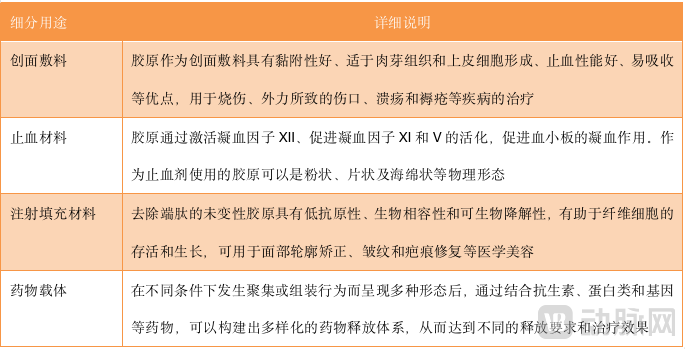
Primary Application Scenarios of Collagen in the Medical Field
There are many other companies, such as Tycell Biotech and NEO-HEALTH, that have strategically positioned themselves in the field of synthetic biology. It is difficult to predict exactly when the “tipping point” for collagen will arrive as expected. However, under the overarching theme of “returning aesthetic medicine to its medical roots,” companies that leverage synthetic biology to establish a solid foundation in medical technology need not be overly anxious about shifting market trends.
After all, in any era, the “water sellers” who master core technologies can always justify their existence by adapting to changing circumstances with unwavering strategies.