

Sequoia China's 2026 Medical Investments: Backing World-Class Scientists and Cutting-Edge Therapeutics
In recent years, as the wave of medical innovation has surged, an increasing number of investors have entered the early-stage healthcare investment sector, among which Sequoia Capital has drawn particular attention.
According to incomplete statistics from VBInsight, as of the time of publication (December 30, 2022), a total of 188 early-stage (seed and angel round) financing transactions were completed in China’s healthcare sector this year. Sequoia Capital participated in 11 of these deals, making it the most active investor among all investment firms.
As a bellwether for healthcare venture capital, which scientists has Sequoia Capital prioritized this year? And what do these angel investment cases reveal about the evolution of Sequoia’s early-stage healthcare investment logic? To address these questions, VCBeat Orange Bureau analyzed the 11 startups Sequoia invested in this year, aiming to uncover the answers.
Targeting Top PIs in Hot Sectors
Adhering to the core philosophy of investing early, investing in small businesses, and investing in technology has always been central to Sequoia’s strategy, particularly in the healthcare sector. According to incomplete statistics from the VCBeat Orange Database, as of the time of publication (December 30, 2022), Sequoia had completed 49 financing deals in the healthcare field this year, with 32 deals occurring at pre-Series A stages, accounting for 67% of the total.
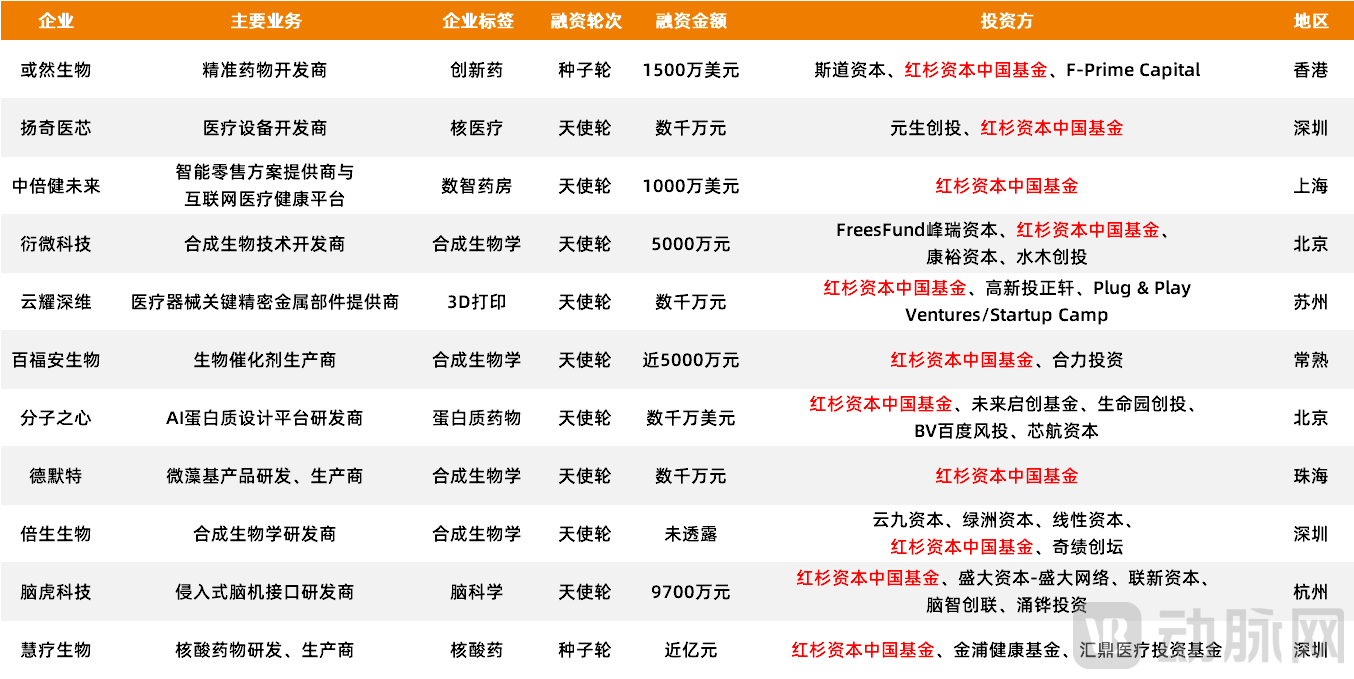
Among these, there were a total of 11 seed and angel-round investments, indicating that Sequoia has identified 11 new innovative targets as it continues to extend its reach into earlier stages of the healthcare sector. So, what do these startups look like? VCBeat’s Orange Fruit Bureau focuses its analysis on two key aspects: the founders and their respective niche sectors.
According to statistics, among 11 startups, all founders are scientists. These include those from Chinese universities, such as Yanwei Technology, whose founder and chief scientist, Dr. Yu Huimin, is a professor in the Department of Chemical Engineering at Tsinghua University; another example is Baifuan Biology, whose founder, Dr. Xu Jianhe, is a professor of biochemical engineering at East China University of Science and Technology.
Beyond its focus on the domestic market, Sequoia has also set its sights on overseas opportunities. For instance, Yunyao Shenwei’s core technology was incubated by the Fraunhofer Institute for Laser Technology (Fraunhofer ILT) in Germany, and its founder, Dr. Shen Liyaowei, has long been affiliated with the institute. Another example is Huoran Biology, whose co-founder Dr. Yang Shi is a Professor of Epigenetics at the University of Oxford and the Ludwig Institute for Cancer Research, as well as a Fellow of the American Academy of Arts and Sciences and a Member of the U.S. National Academy of Medicine. The other co-founder, Dr. Or Gozani, is the Morris Herzstein Professor of Biology at Stanford University.
In fact, it is no longer novel for scientists to launch startups; however, not all scientists are suited for transitioning into industry. While most scientists may achieve technological breakthroughs, successfully commercializing their achievements requires a broad range of interdisciplinary competencies.
Therefore, in its early-stage investment process, Sequoia Capital looks not only at the technology itself but also at the scientists’ ability to translate their research into commercial applications. For instance, as previously mentioned, the three founders of Huoran Biology were deeply involved in the establishment and development of biotechnology companies. Notably, Professor Shi Yang and Professor Lan Fei were part of the founding team of Constellation Pharmaceuticals, a clinical-stage company specializing in epigenetics, which was acquired for $1.7 billion in 2021. Additionally, Beisheng Biology’s two founders, Dr. Chen Yu and Dr. Kang Kang, previously worked at BGI Genomics and possess considerable experience in industrial translation.
Yang Yunxia, a partner at Sequoia China, has stated that Sequoia is essentially a “technology-driven firm,” which is why it makes significant early-stage investments in sectors with strong technological leadership. For instance, in the highly watched field of nucleic acid therapeutics, Sequoia completed an angel investment in Huiliao Bio this year—a rising star in the nucleic acid drug space betting on non-LNP delivery technologies. Another example is brain science, a field favored by Elon Musk; this year, Sequoia led both the angel and Series A financing rounds for NeuroXess, a global pioneer in invasive brain-computer interface solutions.
Among these cutting-edge sectors, Sequoia Capital has shown a particular fascination with synthetic biology. Statistics show that four of the 11 startups are from the synthetic biology sector, namely Yanwei Technology, Baifu’an Biotechnology, Demote, and Beisheng Biotechnology. In addition, Sequoia’s investment portfolio over the past year or two includes other players in the synthetic biology space, such as Ketaiya Biotechnology, Microfactories, and Insilico Medicine.
Beyond focusing on frontier technologies such as synthetic biology, Sequoia is also exploring more possibilities for integrating cutting-edge technologies with healthcare scenarios.
Take Beijian Future, a portfolio company, as an example. It leverages cutting-edge technologies such as the Internet of Things (IoT), 5G, Internet Plus, behavior recognition, facial recognition, and artificial intelligence algorithms to further enhance the user experience in medication purchasing and optimize the tiered allocation of existing medical resources. Additionally, Molecule Mind employs world-class AI capabilities to deeply explore the myriad possibilities of protein-based drugs and related products in disease treatment.
Early-Stage Investment Logic: Early Positioning + Long-Term Partnership
In 2018, Sequoia Capital announced the spin-off of its seed fund to establish Sequoia China Seed Fund, making a comprehensive push into early-stage investments. Although this move attracted significant attention within the industry, many remained skeptical, as China’s venture capital sector was in a downturn at that time.
So, four years on, what has Sequoia’s seed fund actually achieved?
The answer may lie in a set of data. To date, Sequoia has connected with 15,000 early-stage entrepreneurs and invested in nearly 300 seed-stage companies. Many of these have progressed to the growth stage, while numerous others have become unicorns valued at over $1 billion. Among them is Metagenomi, an angel investment made by Sequoia in 2020. Within less than three years of its establishment, the company has completed five rounds of financing, including two consecutive rounds in April this year, bringing its total funding to $150 million.
It is well known that early-stage investing is no easy task, particularly in the healthcare sector, which is characterized by numerous variables and exceptionally high risks. Even top-tier firms may suffer significant setbacks if they are not extremely cautious. So, what exactly has Sequoia Capital done right in early-stage healthcare investment?
First, proactively position and advance in depth. Investing early means investing in the future, so selecting the right track is critical. As previously mentioned, Sequoia’s core strategy for early-stage healthcare investment primarily targets cutting-edge medical technologies and the integration of such technologies with clinical scenarios. The underlying logic follows changes in the disease spectrum of the Chinese population, with a focus on major diseases while also accounting for the development of new technological approaches in the field of rare diseases.
However, merely targeting the right sector is insufficient; deep strategic positioning is also essential. Take the currently booming field of nucleic acid therapeutics as an example. As early as 2016, Sequoia Capital had already taken notice of this sector. At that time, however, nucleic acid drugs in China were largely overlooked, resulting in a scarcity of viable investment targets. Consequently, Sequoia turned its attention overseas and invested in Moderna, a quintessential company in this field. This investment not only deepened Sequoia’s understanding of nucleic acid therapeutics but also revealed the vast potential of this sector in the Chinese market.
Consequently, Sequoia Capital initiated comprehensive industry research on nucleic acid therapeutics. As the sector gradually matured, Sequoia conducted a systematic scan of the nucleic acid therapeutics landscape, identifying core value chains from a global perspective and completing a series of investments in companies including Zhaowei Biotechnology and Ruiji Biotechnology. Yang Yunxia, Partner at Sequoia China, previously stated that unlike many funds that have recently made catch-up investments in nucleic acid therapeutics over the past one to two years, Sequoia’s strategic positioning was at least one to one-and-a-half years ahead.
Beyond early positioning, the second hallmark of Sequoia’s early-stage healthcare investment strategy is providing end-to-end support and increasing stakes across multiple funding rounds. In early-stage healthcare investing, selecting the right targets is merely the first step; the most challenging, yet potentially most valuable, aspect of this venture lies in transforming these targets into industry benchmarks.
At this juncture, Sequoia Capital has prioritized strengthening its team’s comprehensive ability to communicate and engage with scientists. Scientists are key stakeholders in early-stage healthcare ventures; having been nurtured primarily within academic research ecosystems, they may not be fully versed in the language of industry. Therefore, for investment firms, establishing effective communication with them is a critical challenge. In response, Sequoia Capital emphasizes that beyond professional expertise, sincerity is essential—upholding rigorous technical professionalism while standing in solidarity with scientists.
So, how does Sequoia stand with scientists? The answer is continuous companionship and sustained investment.
A distinct feature of Sequoia Capital’s early-stage healthcare investments is its consistent follow-on funding for startups. For instance, among the 11 startups invested in this year, Yangqi Medical Chip, Demote, and BrainCo Technology each completed two rounds of financing led by Sequoia within a single year.
In this regard, Zheng Qingsheng, a partner at Sequoia Capital China, has stated that Sequoia has consistently adhered to a “semi-commercial, semi-philanthropic” philosophy in its early-stage investments. Therefore, even if other funds take over subsequent financing rounds, Sequoia does not exit or cash out. Instead, Sequoia aims to genuinely help early-stage entrepreneurs secure more time and space for development, thereby practicing long-term investment principles.
Beyond capital, Sequoia has established a comprehensive post-investment value-added service system for early-stage entrepreneurs. This system comprises six major modules—including startup enablement, brand, marketing and event support, human capital empowerment, and technology enablement—covering all stages of corporate development. According to Yang Yunxia, a partner at Sequoia China, more than 200 of the firm’s nearly 300 team members are dedicated to serving its portfolio companies to ensure the effectiveness of these services.
Take a specific case as an example. This year, Sequoia Capital engaged with a brain science project, but the founder was reluctant to leave his current position to embark on entrepreneurship full-time. In response, Sequoia took two actions: First, it convened a meeting involving various departments, including business development, legal, and human resources, to discuss how to assist the scientist in building the project from the ground up. Second, it helped the scientist identify a suitable CEO candidate to better facilitate the project’s implementation.
In addition, to help scientist-entrepreneurs grow rapidly, Sequoia has actively organized numerous industry events and sharing sessions, such as the “Yale–Sequoia Leadership Center” courses. These initiatives primarily invite opinion leaders and renowned entrepreneurs from various industries both domestically and internationally to deliver lectures, thereby providing portfolio companies with greater knowledge, experience, and a broader perspective. Furthermore, Sequoia launched the “YUE” startup accelerator in August this year. Positioned as “the first lesson for Chinese entrepreneurs,” YUE aims to offer systematic entrepreneurship curricula and resource services exclusively developed by Sequoia to Chinese founders at the angel to Series A stages.
Neil Shen, Founding and Managing Partner of Sequoia China, has stated that for early-stage investments, 50% of success hinges on post-investment support. Sequoia does more than just invest; it aims to provide genuine assistance to early-stage entrepreneurs at critical junctures.
How Much Room for Growth Does Sequoia Still Have in Early-Stage Healthcare?
Currently, the landscape of entrepreneurship in China is undergoing profound changes. A technology-driven era of startups has arrived, particularly in the healthcare sector, where substantial industrial demand is fueling a new wave of innovation.
This wave of medical innovation has drawn in not only scientists but also venture capital firms. Although they occupy different roles, their circumstances are identical: they currently possess unprecedented opportunities for translating innovations into practical applications, yet simultaneously face the challenge of stepping out of their comfort zones.
How to mitigate the risks posed by these challenges is likely the same for both scientists and venture capital firms: relentlessly pursue original innovative technologies, focus on harder-core, smarter, and more interdisciplinary tech entrepreneurship sectors, and adhere to long-termism by adopting a longer-term perspective when evaluating the development of individual scientists, technologies, startups, and emerging industries. Currently, Sequoia Capital and the scientists it has invested in are all striving toward this goal.
In 2006, Sequoia Capital invested in ChinaGtel at the angel round, marking its entry into the healthcare and medical sector. At that time, few were optimistic about Sequoia’s ability to make breakthroughs in this niche area, which was often perceived as a “pitfall.” In that year, the total financing raised by the biotechnology industry in mainland China’s capital markets amounted to less than RMB 500 million, with very few institutions actively participating in such investments. Therefore, in the realm of healthcare and medical investment, Sequoia can be regarded as a “pioneer.”
Eleven years later, in 2018, Sequoia Capital established a seed fund, once again positioning itself as a “pioneer” in early-stage healthcare investment. However, much like before, Sequoia faced skepticism, as 2018 was widely regarded as a downturn for China’s venture capital industry, with healthcare innovation investment essentially in a “windless” state.
However, Sequoia disagreed, arguing that its seed fund should have been established two years earlier, as it had clearly observed the rise of U.S. SaaS companies during that period, when the era’s technological opportunities emerged. Now, with a new wave of medical innovation sweeping across China, Sequoia’s Seed Fund is once again preparing for a new long-distance race.