

Renibus Therapeutics Files IPO Prospectus: Founders Behind $5B in Prior Exits Target Cardiac Surgery Complications with Lead Drug RBT-1

Renibus Therapeutics
Developer of Kidney Disease Prevention and Treatment Products
The heart is one of the most important organs in the human body.
Cardiac drug development has long been highly competitive, with major pharmaceutical companies striving to be the first to discover next-generation breakthrough therapies. However, postoperative complications following cardiac surgery have remained a blind spot in cardiac drug research and development. In 2015, Renibus Therapeutics (“Renibus”) became the first pharmaceutical company to enter this field.
Renibus Therapeutics is a clinical-stage biopharmaceutical company headquartered in Texas, USA, dedicated to developing breakthrough therapies for cardiorenal diseases. The company currently has four drug candidates in its pipeline. Its lead program, RBT-1 (SnPP/FeS), an effective inducer of Nrf2, IL-10, and ferritin, is in Phase 2 clinical trials for reducing the risk of complications associated with cardiothoracic surgery.
Recently, Renibus announced the completion of a $33 million bridge financing, which included a $23 million issuance of SAFE (Simple Agreement for Future Equity) and an initial $10 million tranche drawn from a $30 million term loan facility established with Oxford Finance LLC (“Oxford”).
Speaking ofD.Jeff KeyserandAlvaro Guillema bond spanning more than 20 years.
In 1998, the two sequentially joined Adams Respiratory Therapeutics in Texas. Keyser and Guillem both served as Vice Presidents, where they formulated and executed R&D and regulatory strategies, leading their team to successfully invent Mucinex, an over-the-counter (OTC) cold medication. In the following years, they and their team successfully brought Mucinex to market.
In 2008, the giantsReckitt Benckiser Announces $2.3 Billion Acquisition of Adams Respiratory Therapeutics, in the same year,Its Mucinex brand ranks first in sales within the U.S. cold medication market.
After the first project was acquired, the two of them opened the door to entrepreneurship.In 2008, they co-founded ZS Pharma, a pharmaceutical company specializing in the production of drugs for kidney diseases, and developed ZS-9 (sodium zirconium cyclosilicate, Lokelma), a medication for the treatment of hyperkalemia (HK). Hyperkalemia is a common condition among patients with chronic kidney disease (CKD) and heart failure (HF), affecting 24% to 48% of those with moderate-to-severe CKD or HF.
In 2015, AstraZeneca acquired ZS Pharma at a premium of $2.7 billion., and acquired the drug development rights to ZS-9. Three years later, the drug received CE marking and FDA approval for the treatment of hyperkalemia in adult patients. It was approved in China in 2020, filling a 60-year gap in the pharmacological treatment of hyperkalemia.
Also in 2015,Keyser and Guillem continued their journey by founding Renibus Therapeutics, a cardiorenal drug development company, in Texas, USA. Keyser served as President and Chief Operating Officer, while Guillem assumed the roles of CEO and Chairman. Within just a few years, Renibus had built a pipeline of four drug candidates and secured a total of $78 million in financing.
Beyond their ongoing entrepreneurial endeavors, Keyser and Guillem have continued to take on challenges in other fields. Currently, Keyser holds positions at Encysive Pharmaceuticals, Medeva Americas, Marion Merrell Dow, and Abbott Laboratories. Since 2019, Keyser has served as Chairman of Lantern Pharma, a publicly listed AI-driven pharmaceutical company.
Guillem, who holds a Ph.D. in Chemistry from Virginia Commonwealth University, has held positions at Genzyme/Bone Care, Wyeth, Boehringer Ingelheim, and Medeva Americas. In mid-2022, Guillem announced that he would no longer serve as CEO and Chairman of Renibus Therapeutics, with Frank Stonebanks succeeding him.
Frank Stonebanks has over 20 years of industry experience. He founded Triphase LP and Zosano Pharma, and has served as a senior financial advisor and product manager at multiple Fortune 500 companies, including Sanofi. Currently, Frank also serves as a Special Health Advisor to Wavemaker 360 Health.
Cardiac surgical procedures include coronary artery bypass grafting, congenital heart disease surgery, and valve replacement. Cardiac surgery is among the most commonly performed surgical interventions. According to the China Extracorporeal Circulation Forum, the volume of major cardiac and vascular surgeries and extracorporeal circulation-supported surgeries in China reached record highs in 2021, totaling 278,056 and 176,496 cases, respectively, representing a 25% increase from 2020.
The high risk associated with cardiac surgery has become a widely recognized consensus. It poses risks such as prolonged ICU stays, ventilator dependence, and increased 30-day readmission rates. Surgical complications include acute kidney injury, infection, heart failure, and postoperative bleeding. As a relatively young discipline within the field of surgery, despite numerous technological advancements, postoperative complications from cardiac surgery continue to pose a serious threat to patient health.
Postoperative ICU care for cardiac surgery is primarily supportive in nature, making it difficult to improve surgical recovery outcomes. This may lead to poor long-term prognosis, prolonged hospital stays, and consequently, increased medical costs and expenses.
In response to this condition, Renibus has developed a novel drug, RBT-1.
RBT-1 is the first-in-class drug for postoperative complications of cardiac surgery, by inducing antioxidants involved in organ damage (Nrf2), anti-inflammatory cytokines (IL-10) and iron metabolism markers (ferritin, hepcidin) play a role in reducing postoperative complications and lowering the risk of 30-day readmission.
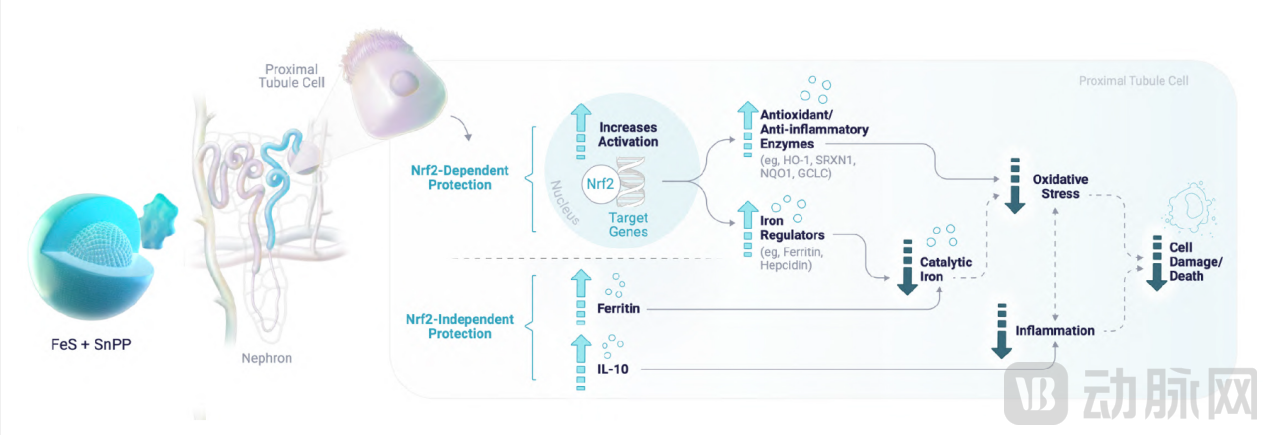
RBT-1Mechanism of Action Model
In November 2022, RenibusResults of the Phase II Clinical Trial Presented at the American Heart Association (AHA) 2022 Scientific Sessions.The Phase 2 study is a randomized, multicenter, placebo-controlled trial designed to evaluate the effects of RBT-1 in patients undergoing coronary artery bypass grafting (CABG) or cardiac valve surgery.
The results show that,RBT-1 demonstrates the potential for multi-organ preconditioning, effectively reducing the number of days on ventilators and in the ICU, with a more than 90% reduction in 30-day readmission rates (P < 0.0027).. Currently,RBT-1 has been granted FDA Fast Track designation, with Phase 3 studies scheduled to commence in early 2023.。
RBT-3 (FeS) is a novel low-molecular-weight iron nanoparticle and a component of RBT-1, designed to reduce the risk of cisplatin-induced nephrotoxicity.
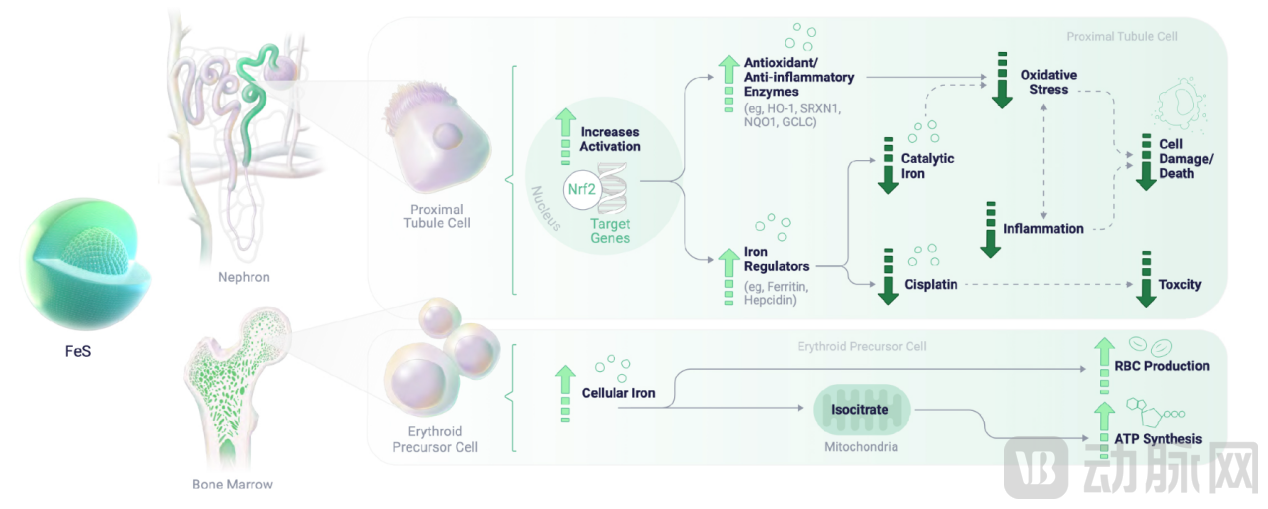
RTB-3 Mechanism of Action Model
2021A peer-reviewed article by Renibus Therapeutics in *Science* noted that preclinical animal model studies of RBT-3 demonstrated its potential to reduce cisplatin-induced nephrotoxicity by 50%. Cisplatin, a platinum-based chemotherapy agent, can cause nephrotoxicity in up to 30% of patients undergoing cancer treatment. RBT-3 is scheduled to enter clinical development in 2023.
RBT-9 (SnPP) is a potent anti-inflammatory and antioxidant drug with antiviral properties, and it is also one of the components of RBT-1. A Phase 2 clinical trial involving 42 patients studied its use as monotherapy in hospitalized patients, reducing hospital stays by approximately 70%.
In addition to drugs targeting heart disease, Renibus has also developed RBT-2, a drug designed to slow the progression of chronic kidney disease (CKD).
RBT-2 is an active metabolite of a natural antioxidant product that slows the progression of chronic kidney disease (CKD) by restoring cellular homeostasis and reducing inflammation and fibrosis. Preclinical studies have shown that RBT-2 also has cardioprotective effects. Currently, an Investigational New Drug (IND) application for RBT-2 is underway, with clinical trials expected to commence in the third quarter of 2023.
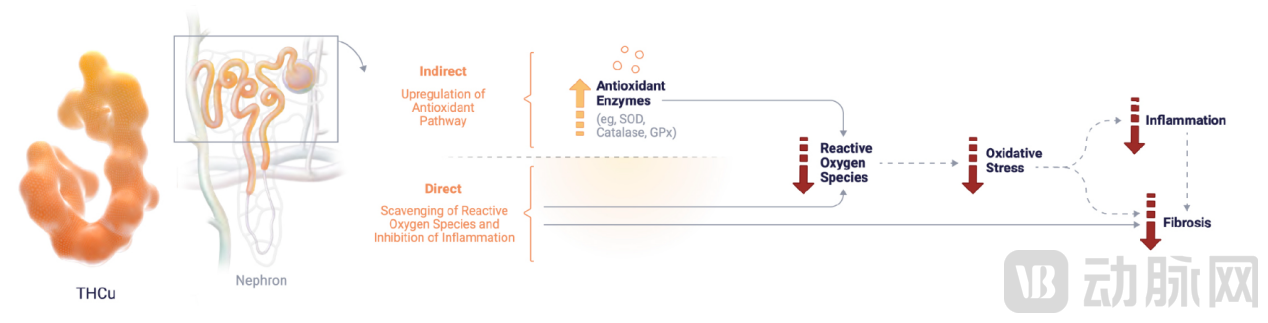 RBT-2 Mechanism of Action Model
In recent years, the association between cardiac and renal diseases has attracted widespread attention. At the 2001 American Heart Association (AHA) scientific sessions, a summary of the cardiorenal connection concluded that chronic kidney disease (CKD) is a risk factor for cardiac death and adverse cardiovascular events in patients with acute coronary syndrome. Compared with other risk factors (such as a history of coronary heart disease, stroke, heart failure, and myocardial infarction), CKD exhibits a stronger independent association.
The 2003 K/DOQI Clinical Practice Guidelines also state that all patients with chronic kidney disease (CKD) should be considered at high risk for cardiovascular disease (CVD). Cardiovascular risk factor assessment should be performed in all CKD patients, and the presence of CKD should be taken into account when preventing, treating, or correcting various risk factors.
Multiple domestic studies have also highlighted the correlation between hypertensive cardio-renal damage, coronary heart disease, and chronic kidney disease. Traditional Chinese Medicine has long proposed that renal diseases influence the pathogenesis of cardiac lesions.
In the past, cardiovascular and cerebrovascular diseases were often referred to collectively, and pharmaceutical companies frequently developed combination drugs for these conditions. Today, exploration of the correlation between cardiac and renal diseases is continuously advancing, and the joint development of cardio-renal therapies may become one of the future trends in drug development.