

Wuhan University Professor's 16-Year Biotech Venture: Heyuan Bio Files for STAR Market IPO with World-First Plant-Derived Recombinant Human Serum Albumin
Healthgen Biotech
Research and Product Developer of Plant-derived Recombinant Protein Expression Technology

Efung Capital
Biomedical Professional Investment Institutions
The highly lucrative synthetic biology sector is set to welcome another public listing, as Healthgen Biotech recently filed its prospectus with the Shanghai Stock Exchange for an IPO on the STAR Market.
Founded in 2006, Healthgen Biotech is a company specializing in the research and product development of plant-derived recombinant protein expression technology. The company plans to raise RMB 3.502 billion, with the proceeds allocated to projects such as the industrialization base for plant-derived recombinant human serum albumin and new drug research and development.
Three months ago, Healthgen Biotech completed a RMB 556 million Pre-IPO financing round, led by Betta Pharmaceuticals Co., Ltd., a company listed on the ChiNext board, and its affiliates. According to public information, Healthgen Biotech had previously completed multiple rounds of equity financing and private placements, with key shareholders including the Optics Valley Talent Fund and Efung Capital.
Human serum albumin in China has long faced a supply shortage, with over 60% reliant on imports. Clinically used human serum albumin is still primarily derived from human blood extraction, posing contamination risks. The blood bank crisis during the COVID-19 pandemic has further highlighted the domestic shortage of human serum albumin, making the search for blood substitutes urgent.
Healthgen Biotech’s plant-derived recombinant human serum albumin injection is currently the only product worldwide that utilizes a plant expression system to achieve pharmaceutical-grade injectable quality for recombinant human serum albumin, thereby addressing the supply gap for this therapeutic protein. Its independently developed plant-derived recombinant human serum albumin injection (OsrHSA) has completed dual Investigational New Drug (IND) filings in both China and the United States and is undergoing Phase II clinical trials in subjects with hypoalbuminemia associated with liver cirrhosis ascites.
Healthgen Biotech possesses undeniable innovative attributes. Although the company is currently operating at a loss, its value and growth potential will be substantial once the commercial viability of its recombinant human serum albumin injection technology is validated.
Agricultural Roots, Global Vision: A Wuhan University Professor’s 16-Year Entrepreneurial Journey
Healthgen Biotech’s approach to developing recombinant human serum albumin using a plant-based expression system is closely tied to the agricultural background of its founder and chairman, Yang Daichang. A graduate of Wuhan University, Mr. Yang was the first master’s and doctoral student supervised by Academician Zhu Yingguo, a renowned Chinese geneticist and rice biologist who pioneered hybrid rice research.
From 1997 to 2005, Yang Daichang successively led research projects at the Genetics and Plant Breeding Division of the International Rice Research Institute (IRRI) and at Ventria Bioscience in the United States. In 2005, he returned to Wuhan University as a professor in the Department of Genetics, School of Life Sciences, and the following year founded Healthgen Biotech to advance the industrial application of his research achievements.
In an interview with Pharmaceutical Economic News several years ago, Yang Daichang stated that rice endosperm cells possess a complete eukaryotic protein processing system, and that the translation, folding, and modification of recombinant proteins are highly similar to those in mammalian cells. Meanwhile, the choice of rice endosperm cells as bioreactors is based on the hypothesis that the human body has a high tolerance for rice proteins.
However, due to questions regarding its purification standards and research direction, the company initially wavered between focusing on excipients or injectable-grade products. Ultimately, it decided to generate revenue through excipient products while targeting the more challenging pharmaceutical injectable grade.
To secure additional financing for R&D, Healthgen Biotech listed on the National Equities Exchange and Quotations (NEEQ) in 2015 and subsequently delisted in 2018. During this period, the company achieved significant milestones: in 2017, Healthgen Biotech obtained the world’s first clinical trial approval for a plant-derived recombinant human serum albumin injection.
However, since 2020, Healthgen Biotech has been embroiled in a patent dispute with Ventria Bioscience, the former employer of Yang Daichang. Ventria Bioscience achieves the expression of recombinant human serum albumin in rice endosperm cells by genetically modifying rice, and its reagent products have already entered the industrial market. Ventria Bioscience considers Healthgen Biotech’s technological approach to be similar, which is likely the primary reason for its lawsuit.
After two years, the U.S. International Trade Commission (ITC) issued its final determination in the Section 337 investigation last September, ruling that Healthgen Biotech’s plant-derived recombinant human serum albumin products with polymer content exceeding 2% do not constitute infringement. The company has optimized the technical standards for its plant-derived recombinant human serum albumin products, confirming that the polymer content of its products is no less than 2%, to resume overseas sales.
Healthgen Biotech has consistently focused on the international market. Except for the period from January to June 2022, when its overseas revenue fell below domestic revenue due to the Section 337 investigation, the company’s overseas revenue accounted for 77.63%, 65.51%, and 62.23% of total revenue in 2019, 2020, and 2021, respectively.
Healthgen Biotech’s pipeline under development also demonstrates ambitions to cover overseas markets. Among the three drug candidates that have entered clinical trials, HY1001, a plant-derived recombinant human serum albumin injection (OsrHSA), is being filed for regulatory approval in both China and the United States; HY1003, a plant-derived recombinant human alpha-1 antitrypsin, has received orphan drug designation from the U.S. FDA and is currently undergoing Phase I clinical trials in the United States.
After a long and arduous 16-year entrepreneurial journey, Healthgen Biotech now stands once again at the threshold of an initial public offering, armed with interim achievements.
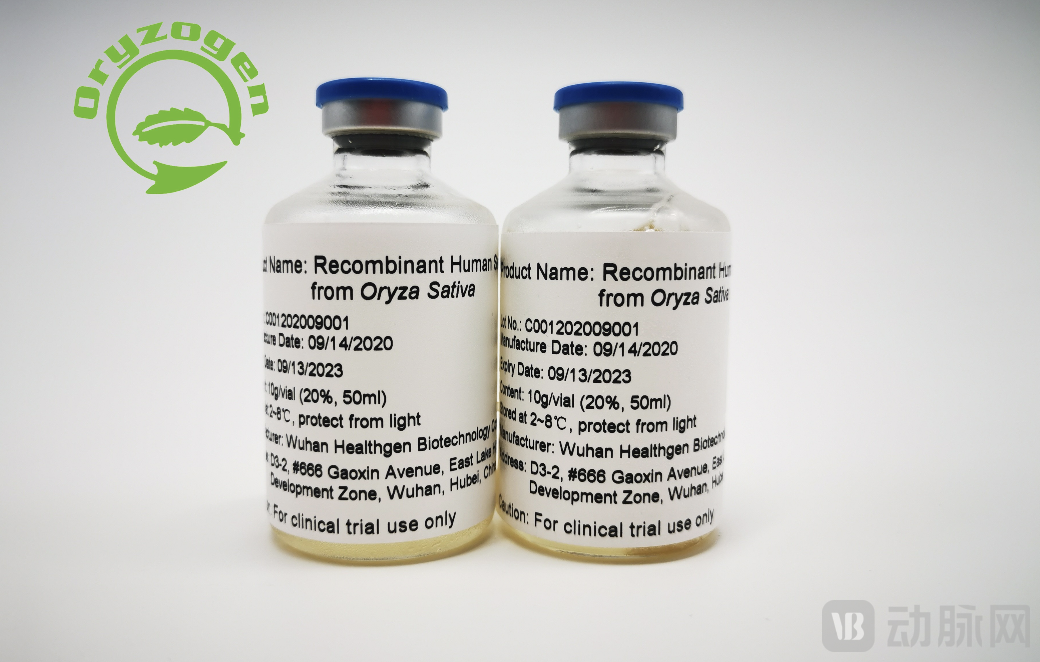
Healthgen Biotech’s Plant-Derived Recombinant Human Serum Albumin Injection (Image source: company official website)
Healthgen Biotech Has No Domestic Competitors Using the Same Platform
Human Serum Albumin (HSA), widely used in clinical practice for hypoalbuminemia caused by various etiologies and its complications, such as ascites due to liver cirrhosis, and as an emergency substitute for whole blood or plasma in the treatment of shock or trauma, is known as the “golden life-saving drug.” Furthermore, during epidemics, when specific antiviral drugs are often scarce, blood products such as human serum albumin have become important options for emergency treatment due to their multiple functions, including antibacterial and anti-inflammatory effects, immune defense, and thermoregulation.
To date, human serum albumin used in clinical settings is still derived from blood extraction. However, human blood may contain infectious agents such as those causing chronic hepatitis B and HIV/AIDS, and even with purification processes, it is difficult to guarantee that viruses are not introduced into the final product. Furthermore, blood supply is limited; particularly in recent years, with the rapid development of the biopharmaceutical industry, the demand for human serum albumin as an industrial raw material and excipient has been increasing, exacerbating the shortage.
Over the past four decades, numerous global pharmaceutical companies and research institutions have attempted to develop recombinant human serum albumin for clinical use through genetic engineering. Although various production methods have been established—including prokaryotic expression systems, yeast expression systems, transgenic animal expression systems, and transgenic plant expression systems—no breakthrough progress has been achieved to date.
In 2008, Medway, a recombinant human serum albumin (rHSA) product developed by Mitsubishi Tanabe Pharma Corporation in Japan, was launched as an injectable drug but was subsequently ordered to cease production after allegations of data tampering in clinical trials emerged. The rHSA produced by Novozymes Biopharma UK, used as a pharmaceutical excipient and stabilizer in Merck’s measles-mumps-rubella (MMR) vaccine in the United States, differs significantly in purity from that required for injectable-grade products; failure to meet injectable-grade purity standards can cause fatal damage to the human immune system.
Albumin possesses extensive binding capabilities. For recombinant human albumin, it is necessary not only to remove relevant impurities from the fermentation broth but also to eliminate impurities bound to or aggregated with albumin. However, relying solely on continuous purification makes it difficult to control the cost of recombinant human albumin. Consequently, the production of recombinant human serum albumin injection has long been constrained by limitations in large-scale manufacturing and quality control technologies.
As a country with a large population, China’s human serum albumin (HSA) market has long been characterized by supply falling short of demand. For many consecutive years, HSA has remained the top-selling single product in hospitals. Statistics indicate that annual clinical demand for HSA in China exceeds 700 metric tons, with over 60% reliant on imports. Data from the first three quarters of 2022 show that the total number of approved batches of HSA in China amounted to 3,037, among which imported HSA accounted for 1,878 batches, representing a share of 62%.
Domestic substitution and industrial-scale production are imminent, yet only a handful of companies in China have advanced recombinant human serum albumin (rHSA) into clinical trials. North China Pharmaceutical Group has obtained clinical trial approval for its excipient-grade rHSA, while Tonghua Anruite Biotechnology’s injectable rHSA has entered Phase II clinical trials. Additionally, Healthgen Biotech has independently developed plant-derived recombinant human serum albumin (OsrHSA), the world’s first human serum albumin produced using plant bioreactors. The OsrHSA injection has completed dual regulatory filings in China and the United States and is currently undergoing Phase II clinical trials in patients with hypoalbuminemia associated with liver cirrhosis and ascites.
According to the company’s prospectus, Healthgen Biotech possesses a globally leading plant-based bioreactor technology platform and has established an efficient recombinant protein expression platform based on rice endosperm cells with independent intellectual property rights (OryzHiExp), as well as a recombinant protein purification technology platform (OryzPur).
In China, Healthgen Biotech has no competitors using the same production system; most manufacturers of recombinant human serum albumin, including North China Pharmaceutical Group and Tonghua Anruite Biotechnology, utilize yeast-based systems.
In contrast, Healthgen Biotech’s rice-based transgenic plant expression system offers greater advantages in terms of production capacity, scalability, and safety. By replacing fermentation processes with agricultural production methods, the purification process is simplified, and production costs are significantly reduced compared to bacterial and animal systems. For instance, achieving ton-scale production using a yeast system requires an investment of RMB 430 million, whereas the rice expression platform requires only tens of millions of RMB, reducing fixed capital investment by 21–29 times compared to the yeast system. Furthermore, pharmaceutical protein products produced in plant seeds are free from pathogenic contamination, ensuring higher safety.
Innovative Attributes Are Undeniable, Yet Commercialization Challenges Remain Significant
Despite the vast market and substantial demand, there are currently no commercially available recombinant human serum albumin injections worldwide, indicating that the technological approach has yet to be commercially validated.
Healthgen Biotech has also been in a state of continuous losses. In 2019, 2020, 2021, and the first half of 2022, Healthgen Biotech’s operating revenues were RMB 10.25 million, RMB 21.5659 million, RMB 25.5181 million, and RMB 6.0496 million, respectively; its net losses were RMB 49.9357 million, RMB 53.3516 million, RMB 134 million, and RMB -58.2987 million, respectively; and its net losses after deducting non-recurring gains and losses were RMB 54.8549 million, RMB 62.4975 million, RMB 13 billion, and RMB 60.2326 million, respectively.
This is due to the substantial allocation of funds to research and development activities, including preclinical and clinical studies of its product pipeline. According to the prospectus, Healthgen Biotech’s R&D expenses amounted to RMB 34.8016 million, RMB 45.0519 million, RMB 75.2102 million, and RMB 47.9620 million in 2019, 2020, 2021, and the first half of 2022, respectively.
The company’s primary revenue is derived from the sales of raw and auxiliary materials for life sciences, with its main products being recombinant human serum albumin and Proteinase K. Its biopharmaceutical products have not yet been commercialized; there are seven products in development, three of which have entered clinical trials, while four remain in preclinical research.
The prospectus indicates that the company’s most advanced product, HY1001 plant-derived recombinant human serum albumin injection (OsrHSA), is expected to receive marketing approval in 2025. Phase II study results demonstrated that OsrHSA injection met the non-inferiority endpoint compared with the positive control, human serum albumin (pHSA), and exhibited favorable safety, tolerability, and therapeutic efficacy in subjects. During the pre-Phase III meeting (End-of-Phase II Clinical Trial Meeting) with the Center for Drug Evaluation (CDE) of the National Medical Products Administration, the CDE, based on its review of the Phase II clinical data of OsrHSA, agreed to proceed with Phase III clinical studies and provided guidance on the study protocol design.
However, significant uncertainties remain in the journey of recombinant human serum albumin injection from Phase II clinical trials to market approval. It will take at least 3–5 years or even longer to enter the industrialization stage. Post-launch market acceptance will also pose a major challenge. In its prospectus, Healthgen Biotech specifically highlighted that due to factors such as physicians’ prescribing habits and patient awareness, plant-derived recombinant human serum albumin may fail to gain recognition among doctors and patients, thereby posing a risk that commercial sales could fall short of expectations.
Healthgen Biotech stated that the company has currently achieved the world’s highest yield level, producing approximately 10 grams of serum albumin per kilogram of rice. If recombinant human serum albumin injection successfully reaches the market, it will undoubtedly become a blockbuster product in the biopharmaceutical industry.Navigating uncharted territory without benchmarks is no easy feat, but companies that are the first to validate their commercial viability are more likely to maximize value realization. Healthgen Biotech’s development warrants continued attention.