

Leroy Hood, Who Turned Down Bill Gates, Sparks a Genomics Revolution and Files IPO
In the early 1990s, Bill Gates decided toDepartment of Systems Biology, University of WashingtonHe donated to the establishment of the institute, but with one condition: that Dr. Leroy Hood serve as its founding chair. Hood clearly did not refuse; he devoted himself to working in the Department of Systems Biology at the University of Washington for nearly a decade, until at the age of 61, he voluntarily resigned and decided to strike out on his own.
What was originally a routine personal career choice has instead set off a major stir in the industry, prompting widespread speculation: Will this scientist, now over sixty years of age, retire as a result?But Hood did not think so; amidst widespread suspicion, he embarked on a new adventure.
After leaving the University of Washington, Hood used his personal savings to establish the world’s first Institute for Systems Biology, successfully integrating systems biology into the realm of medicine and earning him global acclaim as the “Father of Systems Biology.” Looking back on Hood’s journey, he has been associated with many labels:“Revolutionary in Genomics,” “Pioneer in Systems Biology,” “Advocate of P4 Medicine”...What Kind of Legendary Life Did He Lead?
Leading the Genomics Revolution
In 1938, Hood was born into an ordinary family in Missoula, Montana, USA. His father was a telephone engineer with considerable expertise in mechanical design. Influenced by his father, Hood developed a strong interest in mechanical design and aspired to become an outstanding engineer.
However, life did not go as planned. Hood’s younger brother was diagnosed with congenital Down syndrome at birth, which led him to change his original career aspirations.
After enrolling at the California Institute of Technology, while most of his peers opted for “glamorous” majors such as finance or law, Hood chose the abstruse and tediousGeneticsas a research direction. For Hu De, his younger brother’s ordeal had long planted a seed in his heart: if our genetic research could advance further, perhaps more children around the world could be spared from congenital diseases.
During his undergraduate and doctoral studies, Hu De studied under a “Nobel Laureate in Physics.”Richard Feynmanand "Nobel Laureate in Chemistry"Linus Pauling, producing numerous research findings. Subsequently, to further his studies in genetics, he earned a Doctor of Medicine degree from Johns Hopkins University.
After earning his Ph.D., Hood returned to the California Institute of Technology as an assistant professor, focusing on molecular immunology and biotechnology. For the first 20 years in his laboratory, he devoted himself to studying just one question—How Does the Immune System Actually Work?
Finally, in 1987, 49-year-old Hood published his genetic study on “Antibody Production by the Immune System.” He discovered that the two chains of human antibodies are encoded by different genes and can be classified into light chains and heavy chains. These chains can combine and pair with each other, generating more than 10^6 variations under different combinations. Rational arrangement of antibody chains can help humans resist various disease threats.
Based on this, Hood proposed the “two genes, one polypeptide chain” hypothesis, clearly elucidating the mechanism underlying the diversification of antibody variable region genes. Overnight, Hood rose to prominence and captured the award known as the “American Nobel Prize.”Lasker Medical Award.
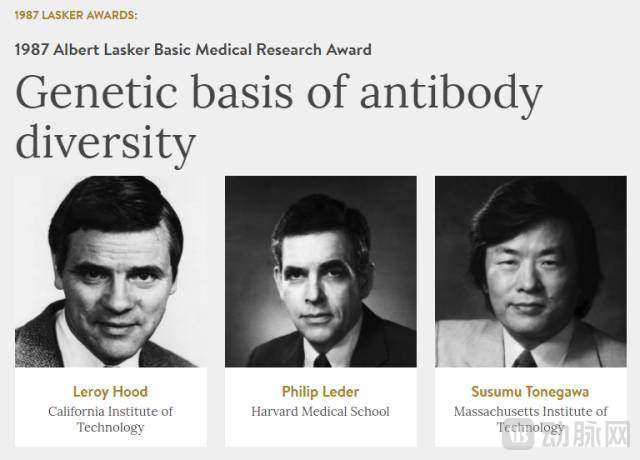
▲ Hood received the Lasker Award for Medical Research in 1987
The Lasker Medical Research Award gave his research the highest praise: “Hood employed molecular biology techniques to demonstrate how limited genetic information can give rise to an immense diversity of antibodies. He revealed how the immune system elegantly rearranges existing DNA sequences to synthesize new genes and generate novel antibodies.”
And this was not the full extent of Hood’s achievements over those two decades. As an “engineer’s child,” Hood also possessed considerable expertise in instrument design.
In genetic research, DNA sequencing is an indispensable step in experiments. At that time, “Sanger sequencing” was the only method available for completing DNA sequencing. However, this method required the use of many toxic compounds to attach radioactive labels to each DNA fragment. The process was heavily reliant on manual operations and involved complex procedures, which not only made it time-consuming but also prone to errors.
To conduct genetic research efficiently, it is necessary to change the sequencing method. Inspired by colleagues in the laboratory, Hood conceived of using fluorescent labeling to enable sequencing machines to recognize DNA signals, thereby designingAutomatic DNA Sequencer。
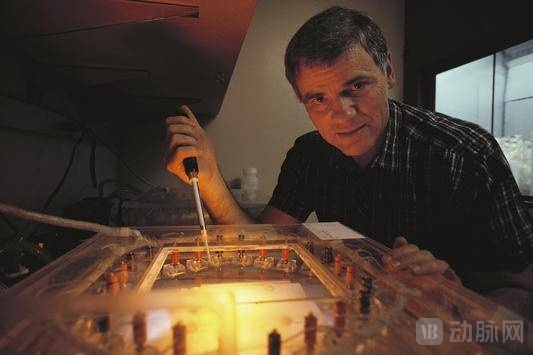
▲ Hood's Research on Automated DNA Sequencers
In the automated DNA sequencer designed by Hood, bases are no longer labeled with isotopes but instead with fluorescent dyes free of radioactive contamination. This design not only prevents operators from exposure to radiation but also enables simultaneous labeling of multiple bases, greatly simplifying the reaction process.
In addition, automated DNA sequencers integrate laser and computer technologies to achieve automation of final data processing. When detecting different bases, the laser beam excites fluorescent labels to emit light, which is then captured by a lens and an optical amplifier. The signal is ultimately converted into digital information for computer processing to obtain the final results. This innovation eliminates tedious and cumbersome manual data collection, significantly accelerating the sequencing process.
Following Hood’s publication of this study, it attracted the attention of several biotechnology companies. In 1986,Applied BiosystemsAnnounced a collaboration with Hood, and through the joint efforts of both parties, automated DNA sequencers were successfully commercialized, thereby launching the industrialization of DNA sequencing.
Building on the successful experience with automated DNA sequencers, Hood went on to design, over the next decade,Protein Sequencer, Protein Synthesizer, and DNA Synthesizer. This not only paved the way for the subsequent “Human Genome Project,” but also accelerated the progress of human “genomics” research.
Becoming the "Father of Systems Biology"
Following Leroy Hood’s invention of the automated DNA sequencer, Nature devoted an entire article to its introduction, remarking: “This is not merely an instrument that makes molecular biology research faster and more efficient, but a vital tool for exploring new frontiers in biology.”
This report also caught the attention of Bill Gates, who developed a strong interest in this bold and innovative scientist and even attended all of Hood’s lectures in Seattle.
Meanwhile, the University of Washington in Seattle was making every effort to develop its biology program—a trend of the times, as all universities sought to leverage the expansion of biology to break into the ranks of the world’s top institutions.
As a benefactor of the University of Washington, Bill Gates personally extended an olive branch to Hood—He was invited to become the founding chair of the Department of Systems Biology at the University of Washington.Systems biology is a multidimensional discipline that integrates biology, mathematics, physics, and computer science. Leroy Hood, known for “doing mechanics in the biology department,” seems to have been born for this field.
With ample room to flex his intellectual muscles, Hood was no longer content with merely exploring genes and biological species; instead, he set a more ambitious goal—to establish a comprehensive, unified theory of biology by integrating research across the levels of atoms, molecules, cells, organisms, and ecosystems.
Hood proposed that “integration is the soul of systems biology and represents its most significant distinction from genomics, proteomics, and other ‘-omics’ disciplines.” He divided systems biology research into four stages: preliminary modeling, observational experimentation, analytical revision, and ideal modeling, thereby laying the foundation for systems biology research.
In addition, Hood proposed a research methodology for systems biology that involves selecting a relatively simple system and analyzing as many of its components as possible to elucidate the behavior of the entire system. Although Gilman, a Nobel laureate in Physiology or Medicine, also proposed the “Signal Transduction Consortium” approach, the “Hoodian analysis” remains mainstream in systems biology to this day.
During his ten-year tenure as department chair, Hu De led students in analyzing human and murine immune receptors using DNA sequencing technology, initiated research on prostate cancer, autoimmunity, and hematopoietic stem cell development, deciphered numerous complex biological mechanisms, and elevated systems biology to unprecedented heights, establishing it as one of the pillars at the forefront of cutting-edge biological sciences.
Disappointed by the bureaucratic red tape at the university and the slow pace of translating research into practical applications, Hood ultimately submitted his resignation to Bill Gates and decided to strike out on his own to continue advancing systems biology.
Proposing P4 Medicine in the 21st Century
In 2000, 62-year-old Hood used $5 million from his personal savings to establish the world’s first Institute for Systems Biology—Institute for Systems Biology, Seattle, USA, thus systems biology was officially included in the field of medicine.
Looking back on the history of medical development, it is also a history of continuous multidisciplinary integration. People once integrated chemistry and physics into medicine, giving rise to classic disciplines such as biochemistry and molecular biology. In recent years, emerging fields such as chemical biology and chemical proteomics have emerged. Overall, the integration of multidisciplinary technologies has become an irreplaceable research paradigm in medical development.
The 21st century is known as the era of information technology. At this time, Hu De was already in his sixties, but he still stood at the forefront of the times—he combined medicine with information technology and proposed ““P4 Medicine”concept.
The so-called “P4 Medicine” is characterized by being predictive, preventive, personalized, and participatory. In his previous research, Hood discovered that human life systems and diseases are interconnected. He boldly hypothesized that focusing on unilateral factors in the study of human life systems and diseases is akin to blind men touching an elephant; only by adopting systematic technical methods and research strategies can we achieve a better understanding of human life systems.
To verify this hypothesis, Hood conducted an observational study in 2014 involving 108 researchers, collecting datasets on personal health indicators such as genomics, proteomics, metabolomics, and gut microbiota, while also assessing their lifestyle habits and environmental exposures.
Research findings indicate that genes exert a significant influence on humans, but they are not the sole determinant. Individuals need to adjust various aspects such as diet, exercise, and nutritional supplementation based on their genetic profiles, and adopt more precise disease prevention strategies, in order to effectively enhance their self-health management capabilities—this aligns perfectly with his hypothesis.
Following the initial success of the “108-Person Study,” Hu De announced the launch of the “100,000-Person Health Project,” aiming to build a personalized, intensive dynamic cloud of health and medical data. He boldly predicted: “In the next decade, physicians diagnosing and treating patients will face a ‘virtual cloud’ composed of billions of data points.”
Established 15 Biotechnology Companies
Throughout the long history of scientific research, we have witnessed many scientists dedicate their entire lives to their work. However, Hood believes that the laboratory is by no means the endpoint of scientific achievement. He has always firmly believed that scientific results can only realize their true value when they enter the market. This perspective is inextricably linked to his past experiences: he personally witnessed the transformative impact of the Bayh-Dole Act on scientific research and participated in the commercialization of automated DNA sequencers.
He recognized that the commercialization of automated DNA sequencers laid a solid technical foundation for the advancement of molecular biology. Consequently, Hood wrote in his memoirs, “I realized this invention was important, but I never imagined it would be historic.”
Following the success of automated DNA sequencers, multiple scientific achievements invented by Hood, including protein sequencers and DNA synthesizers, were successfully commercialized. Yet Hood did not rest on these laurels; he devoted the latter half of his life to founding biotechnology companies.
Since the 1990s,He has co-founded and established 15 biotechnology companies,Most of these companies focus on genetic diagnostics and medical device manufacturing. Hood has brought cutting-edge biological research findings to these companies, laying a scientific foundation for their product development. Additionally, he has actively facilitated collaborations between the Institute for Systems Biology and these companies, providing financial support to foster their growth.
As time passed, the focus of Hood’s attention also shifted. In 2006, Hood hadCNSIServing as a director, he led the company to ring the opening bell at NASDAQ. Unlike other companies in which Hood has been involved, CNSI is not focused on biomedical research or the production of genetic testing instruments; instead, it leverages IT technology to provide healthcare solutions for patients. This inevitably brings to mind Hood’s concept of “P4 Medicine.” Indeed, “P4 Medicine” laid a solid academic foundation for the establishment of CNSI, while real-world clinical data from CNSI, in turn, feeds back into and enriches the “P4 Medicine” framework. This may well be one of Hood’s approaches to balancing scientific research with market-oriented operations.
To date, most of these 15 companies have achieved robust growth, with some even emerging as leading enterprises in the healthcare sector. For instance,Amgenas an example, it was named one of the “100 Most Sustainable Companies” by Barron’s in 2021 and is currently a global leader in the field of biologic drug development. Leveraging genetic technologies, it has developed several blockbuster drugs with worldwide impact, such as AMG510, hailed by the industry as a “revolution in anticancer therapy,” which sent shockwaves through the sector upon its launch. Additionally, the investigational drug bemarituzumab received Breakthrough Therapy designation from the U.S. Food and Drug Administration (FDA) during its development.
Overall, Hood has demonstrated remarkable boldness in both scientific research and the translation of findings into practical applications. It is no wonder that Science hailed him as “a versatile, multifaceted, and prolific scientific titan.” Now at 85, Hood remains active on the front lines of research, currently focusing on Alzheimer’s disease. While many scientists of his age have slowed their pace, Hood continues to run at an astonishing speed. Perhaps, as one of Hood’s old friends remarked:“There is only one reason that can stop him from continuing his adventures, and that is his death.”