

Evozyne Files IPO Prospectus Highlighting NVIDIA-Powered Generative AI for Protein Design
NVIDIA
Artificial Intelligence Computing Service Provider
Startup Evozyne uses NVIDIA-providedPre-trained AI Model, creating two proteins with significant potential in the fields of healthcare and clean energy.
A joint paper released today describes this process and the resulting amino acid sequences of the proteins. One of the proteins is used to treat a congenital disorder, while the other can be employed to consume carbon dioxide, thereby mitigating global warming.
Preliminary research results demonstrate a new approach to accelerating drug development.
Andrew Ferguson, co-founder of Evozyne and co-author of the paper, stated, “It is gratifying that the synthetic proteins generated by this AI model in the first round are akin to naturally occurring proteins. This indicates that the model has learned the design rules of nature.”
Evozyne uses NVIDIA's ProtT5. ProtT5 is aTransformer Model, a software framework and service for creating medical AI models—NVIDIA BioNeMoa part of.
Molecular engineer Ferguson, whose research spans chemistry and machine learning, stated, “BioNeMo is extremely powerful. It enables us to train models and then deploy them for work tasks at very low cost—generating millions of sequences within seconds.”
This model is the core of the Evovyne ProT-VAE pipeline. ProT-VAE is a workflow that integrates BioNeMo with a variational autoencoder (VAE) serving as a filter.
He stated, “A few years ago, no one had yet recognized the potential of combining large language models with variational autoencoders for protein design.”
Just as humans read thousands of books, NVIDIA’s Transformer model processes amino acid sequences from millions of proteins. By leveraging neural network techniques originally developed for text understanding, the model has learned how nature constructs protein amino acid sequences.
The model then predicted how to assemble new proteins that would meet Evozyne’s requirements.
He stated, “This technology is empowering our work to realize dreams that were unattainable a decade ago.”
Machine learning facilitates the exploration of vast numbers of potential amino acid combinations, thereby enabling the efficient identification of the most promising sequences.
Traditional protein engineering design methods, namely directed evolution, employ a slow, unplanned approach that typically alters only a few amino acids in the sequence at a time.
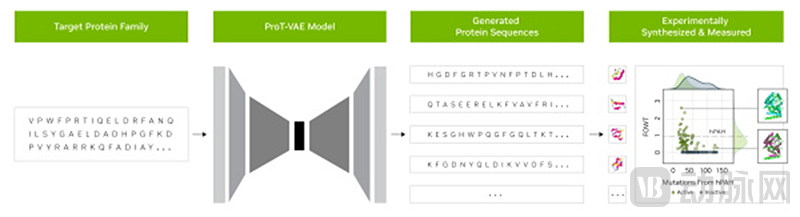
Evozyne’s ProT-VAE pipeline leverages the powerful Transformer models within NVIDIA BioNeMo to generate functional proteins, thereby advancing drug discovery and promoting sustainability in the energy sector.
In contrast, Evozyne’s approach can alter half or more of the amino acids in a protein in just one round, equivalent to introducing hundreds of mutations.
He stated, “We are achieving a technological leap that enables us to explore proteins with useful new functions that have never been seen before.”
Evozyne plans to use new processes to engineer a variety of proteins capable of combating diseases and climate change.
Ferguson stated, “NVIDIA is an excellent partner in this regard.”
Joshua Moller, a data scientist at Evozyne, stated, “They accelerate training by scaling their workloads across multiple GPUs.”
This reduces the time required to train large AI models from several months to just one week. Ferguson stated, “Thus, we are able to train models that would otherwise be untrainable, such as those with billions of trainable parameters.”
The Prospects for Using AI to Accelerate Protein Engineering Are Very Broad.
Ferguson noted the recent advancements in diffusion models: “The pace of development in this field is incredibly fast, and I am truly looking forward to further progress in the future.”
“No one knows how far we will be able to go in five years.”
As AI applications in healthcare become increasingly widespread and mature, NVIDIA is providing the industry with a growing number of use cases. Particularly in new drug research areas such as protein discovery, NVIDIA’s solutions are laying the foundation for rapid industry development, far exceeding expectations. Undoubtedly, NVIDIA will soon establish its position in the healthcare sector, much like its GeForce brand did in the gaming industry, thereby contributing to the future growth of the industry.