

Reva Medical, Once Peer to Abbott, Emerges from Bankruptcy with $45M Financing to Advance Bioresorbable MOTIV Peripheral Scaffold

REVA Medical
Vascular Device Development and Manufacturing

BioStar Capital
Healthcare Technology Value-Added Investor
Fifteen years ago, REVA Medical raised $42 million in its final pre-IPO round of private venture capital and, with its bioresorbable coronary stent Fantom Encore, became a major player in the stent industry on par with Abbott. On January 15, 2020, however, REVA Medical filed for bankruptcy reorganization.
15 years later, Reva Medical made a strong comeback by raising $45 million (approximately RMB 300 million) in its latest Series B financing round.
This funding round was led by an anonymous global medical device investor, with participation from BioStar Capital. The proceeds will be used to support the company’s ongoing operations, clinical activities, and capital requirements, including the clinical program for its MOTIV peripheral bioresorbable stent.
Next, VCBeat will walk you through the rise and fall of medical device company REVA Medical, as well as its arduous comeback following bankruptcy restructuring.
Among cardiovascular diseases, coronary artery disease (CAD) is the leading cause of death and disability worldwide.
The formation of coronary artery plaques impedes blood flow to the heart muscle. Percutaneous Coronary Intervention (PCI) is one of the most effective and rapid treatments for coronary artery disease and peripheral artery disease.
PCI refers to a series of minimally invasive procedures used to open blocked coronary arteries (the arteries that supply blood to the heart). By restoring blood flow, the treatment can alleviate symptoms associated with arterial blockage. As part of PCI treatment, physicians place a stent (a tiny mesh tube) in the patient’s affected area to keep the artery open.
Stents used in the treatment of coronary heart disease are typically less than 4 centimeters in length, yet they have undergone four major transformations over the past 40 years, sparking competition among numerous companies.
REVA Medical, a pioneer in the field, was founded in 1998, with Robert Stockman as one of its co-founders. Headquartered in San Diego, California, USA, the company is dedicated to developing bioabsorbable polymers and bioabsorbable stents for blood vessels. Its mission is to restore patients’ lifelong health by developing biomaterials required for implantable medical devices.
Over its 20-year history since its establishment, REVA Medical has developed 19 polymer series. In its early years, the company had three flagship products: TyroSphere microspheres, Tyrocore proprietary polymers, and the Fantom Encore bioresorbable coronary stent.
TyroSphere microspheres are bioabsorbable embolic microspheres used for the treatment of hypervascular tumors. During treatment, the embolic material occludes the tumor’s feeding vessels, thereby inducing ischemic necrosis of the tumor tissue. TyroSphere microspheres degrade safely and are visible under standard X-ray imaging, which facilitates precise delivery of the microspheres to the target tumor during the procedure.
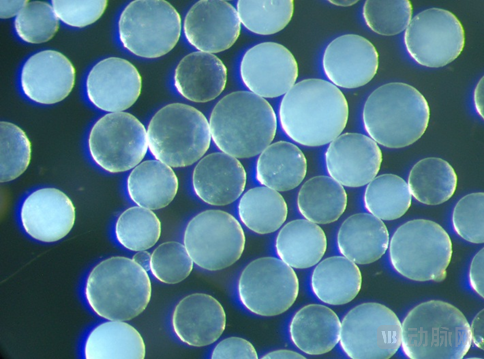
TyroSphere Microspheres
REVA Medical’s first commercial polymer, Tyrocore, is specifically designed for implantable bioresorbable medical devices. As a bioresorbable polymer, it provides a physical structure that serves as a delivery mechanism for therapy and can fully dissolve once its therapeutic purpose has been fulfilled.
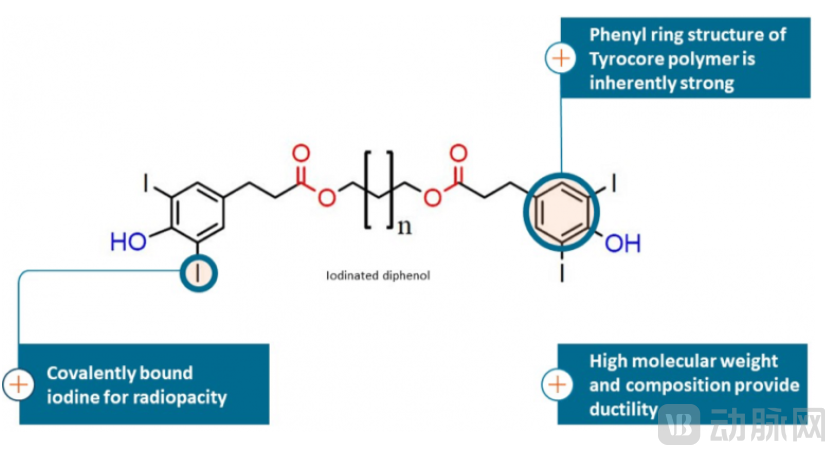
The strength of Tyrocore comes from its molecular structure.
As REVA Medical’s primary competitor, Fantom Encore has undergone three generations of upgrades. It is a bioresorbable scaffold used for the treatment of coronary artery disease. Once arterial patency is restored and healing is complete, Fantom Encore is gradually absorbed by the body and eventually disappears. In 2017, the Fantom Encore bioresorbable coronary scaffold received CE marking (the mandatory safety certification for the European Union).
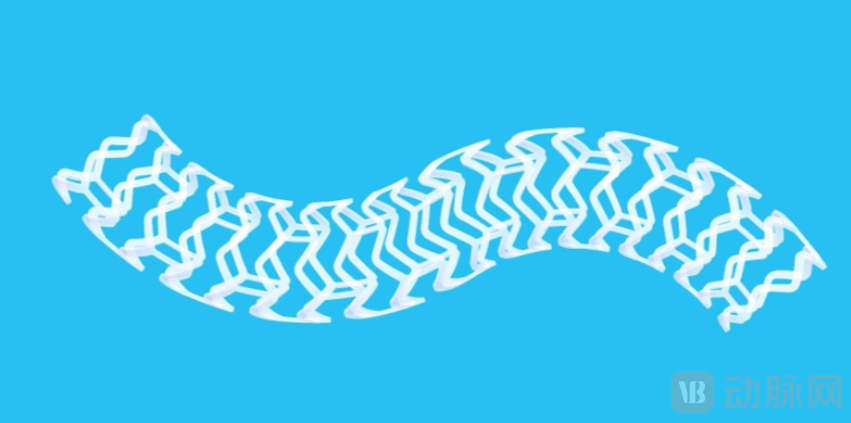
Fantom Encore Bioresorbable Coronary Stent
REVA Medical entered the bioresorbable stent arena with these three flagship products.
In 1977, the success of percutaneous transluminal coronary angioplasty ushered in a new era of coronary artery treatment.
In 1986, the first bare-metal stent (BMS) was implanted in a patient, marking the advent of coronary stent technology and widely regarded as the second revolution in interventional cardiology. Made of stainless steel or cobalt-chromium alloy, BMSs are permanent implants; even after patient recovery, these metallic stents remain in the target arterial vessels and may lead to various complications, such as subacute thrombosis.
Drug-Eluting Stents (DES), also known as drug-releasing stents, are used in percutaneous coronary intervention. The metallic foreign body of traditional bare-metal stents (BMS) may stimulate neointimal hyperplasia, leading to vascular stenosis or occlusion, with restenosis rates as high as 20%–30%. In contrast, DES feature an antiproliferative drug coating on the metal stent surface, successfully reducing the rate of in-stent restenosis to below 10%. DES is regarded as the third revolution in interventional cardiology. Although DES has successfully reduced the rate of in-stent restenosis, it does not address all limitations associated with BMS, such as late lumen enlargement and neoatherosclerosis.
To overcome these limitations, bioresorbable scaffolds (BRS) have been developed. Primarily composed of biodegradable polymers or metallic materials, BRS provide mechanical support to blood vessels and deliver antiproliferative drugs only when necessary, earning them recognition as the fourth revolution in interventional cardiology.
Successive Retreats of Market Entrants
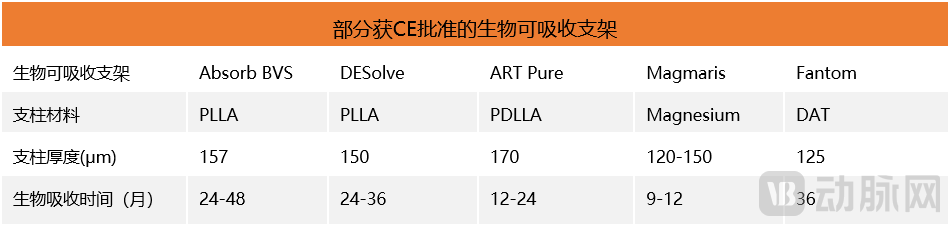
Abbott developed the world’s first bioresorbable scaffold, Absorb BVS, which is primarily made from PLLA polymer (poly-L-lactic acid). The product received CE marking in 2011 and FDA approval in 2016. To provide sufficient radial strength without a metallic backbone, the struts of Absorb BVS are thicker than 150 micrometers. Due to this strut thickness, complete vascular absorption of Absorb BVS may take up to four years.
Biotronik AG’s Magmaris AMS1 bioresorbable scaffold is made from magnesium. This scaffold is bulky, with a thickness of 150 micrometers. Magmaris received CE marking in 2016. Studies on Magmaris have shown that the rates of target lesion revascularization (TLR) and major adverse cardiovascular events were 45% and 26.7%, respectively.
The first-generation Fantom Encore is a stent developed by REVA Medical based on DAT (deaminotyrosine). REVA Medical also incorporates iodine into the stent to enhance visualization during the procedure. Eighty percent of the Fantom Encore stent is completely absorbed by the blood vessel within 36 months.
In 2017, the three-year data from the ABSORB III trial and the 30-day data from the ABSORB IV trial heightened market concerns regarding bioresorbable scaffolds. In the ABSORB III trial, the target lesion failure rate for BVS was 13.4%. The ABSORB IV trial demonstrated that BVS was associated with a higher rate of target vessel myocardial infarction compared with drug-eluting stents (DES). In September, Abbott discontinued sales of Absorb BVS in the United States due to safety concerns.
InAbbottFollowing the market withdrawal of the Absorb BVS stent, REVA MedicalOne of the few developers in this field。
At the time, REVA remained confident in its competitive position. CEO Groves stated at a healthcare conference, “I fundamentally believe that metal stents are a great solution, but bioresorbable stents are an even better one. We need more clinical evidence to offset the damage caused by Abbott’s clinical data.”
Bankruptcy Looms
However, before REVA could present new clinical evidence, the crisis of confidence triggered by the results of the Absorb study swept through the entire bioresorbable stent market, delivering a severe blow.
Although the results of the FANTOM II study demonstrated the safety and efficacy of the Fantom Encore stent, with a target lesion failure (TLF) rate of only 4.2% and just one case of stent thrombosis, marking an initial success, REVA has continued to face financial difficulties. In February 2019, REVA announced a plan to lay off 44% of its workforce, at which time the company had 22 employees.
In January 2020, REVA filed a voluntary bankruptcy petition with the U.S. Bankruptcy Court for the District of Delaware, listing $5.9 million in assets and $104.5 million in liabilities.
Previously, REVA reached a restructuring support agreement with minority shareholders, aiming to address the company’s outstanding debt issues. REVA filed a prepackaged reorganization plan that, subject to court approval, would ensure uninterrupted payment of wages and benefits to employees while continuing to pay suppliers and vendors as usual. The company also plans to maintain normal operations and intends to invoke provisions under bankruptcy law that require suppliers to adhere to the terms of existing contracts.
In the interview, REVA expressed its hope to exit bankruptcy protection proceedings as soon as possible.
In March 2019, Jeffrey Anderson was appointed President of REVA. He served as Vice President of Clinical and Regulatory Affairs at REVA from 2004 to 2008, and was promoted to Senior Vice President in February 2011.
At a critical juncture for REVA Medical, he assumed significant responsibility and made two key decisions: first, to expand market reach and transform sales strategies; second, to pivot the company’s existing development strategy through new technologies and products.
At a press conference, Jeffrey Anderson stated, “Although the clinical outcome data for the company’s Fantom and Fantom Encore bioresorbable coronary stents (BRS) remain strong, adoption of BRS has been significantly hampered by clinical data from inferior competing devices. Consequently, we are focusing on opportunities in the peripheral intervention and embolization markets.”
Transforming Sales Strategies
In 2021, B. Braun and REVA announced a strategic partnership to help REVA sell the Fantom Encore stent.
B. Braun, with more than 64,000 employees across 64 countries and regions, is one of the world’s leading manufacturers of medical devices, pharmaceutical products, and related services. In November 2021, the company began actively marketing the Fantom Encore stent in Germany and Switzerland.
The establishment of the strategic partnership between the two parties is precisely based on the robust clinical evidence supporting the efficacy of the Fantom Encore stent.
“REVA’s third-generation Fantom Encore bioresorbable coronary stent has achieved several technological advancements in materials and design, overcoming many of the issues associated with other bioresorbable stent systems,” said Jeffrey Anderson, President and Chief Executive Officer of REVA Medical. “Compared with current state-of-the-art drug-eluting stents (DES), Fantom Encore offers long-term clinical efficacy.”
Compared with the Absorb BVS, Magmaris AMS1, and DESolve, which have previously obtained CE certification, REVA Medical’s latest third-generation Fantom Encore stent has a thickness of only 95 microns, approaching the 83-micron dimension of Abbott’s Xience drug-eluting metallic stent.
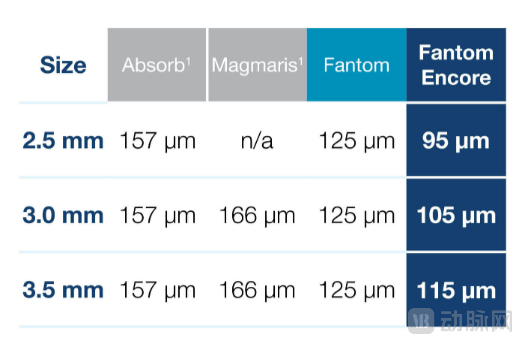
Reduced Strut Thickness
Strategic Transformation
Following the announcement of its bankruptcy restructuring, REVA decided to discontinue further development of the Fantom Encore for the U.S. market, shifting its focus to the MOTIV stent and TyroSphere embolization microspheres.
The MOTIV bioresorbable stent is specifically designed for the treatment of peripheral artery disease below the knee and is made from Tyrocore patented polymer. Its purpose is to spare the artery from a permanent implant; as the MOTIV stent dissolves over time, it allows the artery to regain its natural movement or vasomotion.
As early as 2018, the MOTIV stent was approved for use in Europe, becoming the first bioresorbable stent to receive CE mark approval for the treatment of below-the-knee disease.
On August 10, 2022, after 937 days under the shadow of bankruptcy, REVA Medical brought the MOTIV bioresorbable stent back to the U.S. market and announced its return.
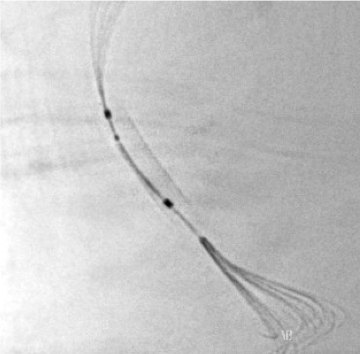
MOTIV Stent
On September 27, 2022, REVA announced that clinical centers in the United States and Europe had begun enrolling patients for the MOTIV pivotal trial. This study will evaluate the use of the MOTIV bioresorbable vascular scaffold in the treatment of patients with chronic limb-threatening ischemia (CLTI). CLTI is an advanced stage of peripheral artery disease (PAD) that typically affects the infrapopliteal arterial bed and impairs quality of life due to a high risk of serious health outcomes, including amputation, major adverse cardiovascular events, and mortality.
MOTIV Bioresorbable Scaffold Undoubtedly Brings a New Direction to REVA; REVA Is No Longer Fixated on Bioresorbable Scaffolds for Coronary Arteries, but Will MOTIV Be REVA’s New Hope? We Remain Uncertain.