

Radiopharmaceuticals Breakthrough: How the Sector Continued to Gain Momentum in 2023 After a Landmark Year

Full-Life Technologies
Radiopharmaceutical Developer
On September 3, 2022, in Suzhou, the Nuclear Medicine Sub-forum of the “SAPA-China 2022 International Summit on Frontier Technological Innovation and Collaboration in Medical Devices” was held, with nearly the entire Chinese nuclear medicine community in attendance.
Previously, radiopharmaceutical conferences were mostly sidelines of nuclear medicine meetings and rarely held alongside mainstream industry forums. At the event, a senior radiopharmaceutical expert remarked, “This is a worthwhile initiative; it is time for radiopharmaceuticals to break out of their niche.”
The scenario we report here may represent the most intuitive perception of industry professionals in the nuclear medicine sector regarding changes in the broader environment in 2022.
After observing the radiopharmaceutical sector for a year, we have gained some intuitive insights. In 2022, we hosted three online and offline radiopharmaceutical salon events. The offline salon held in Shanghai in February attracted the highest-caliber investors among all our biomedical salon events, with many attendees being partners at their respective institutions. This underscores the significant attention the capital market has paid to radiopharmaceuticals.
Amid such high levels of attention, radiopharmaceutical companies have not felt the chill of a capital winter.
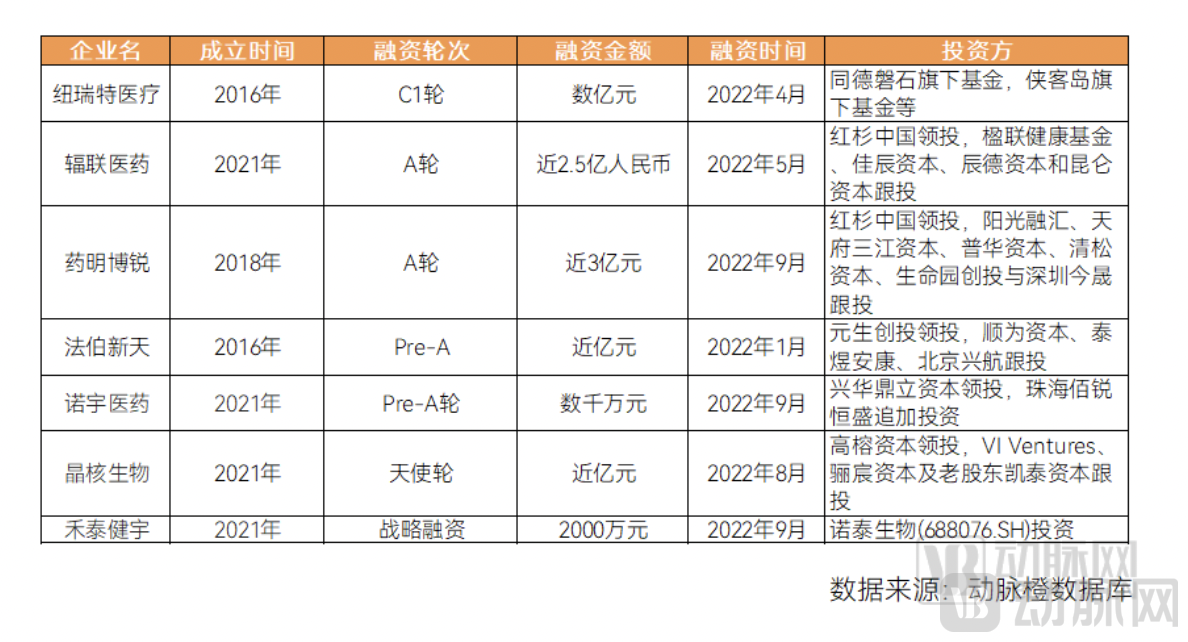
2022 Financing Landscape for Nuclear Medicine in China
Although most financing rounds are currently at the pre-Series A stage, we have seen renowned institutions such as Gaorong Capital, VI Ventures, Sequoia China, and Yisheng Venture Partners among the investors in these companies. Notably, Sequoia China led the Series A financing rounds for two radiopharmaceutical companies, Full-Life Technologies and WuXi Biologics (WuXi Bioray), with funding amounts reaching nearly RMB 250 million and RMB 300 million, respectively.
Innovative pharmaceutical companies laying out their presence in the domestic radiopharmaceutical sector continue to emerge. Hexin Pharmaceuticals, dedicated to the research and development of dual-target integrated radiodiagnostic and radiotherapeutic agents, was established in Taicang in 2020. Although it has maintained a low profile, it has already garnered significant attention from the industry.
The radiopharmaceutical sector is also experiencing unprecedented activity. Within an industry exchange group of 500 members, we have observed a vibrant atmosphere of sharing and discussion. What regulatory framework and broader upstream-downstream ecosystem will developers of diagnostic and therapeutic radiopharmaceuticals in China face? This is the most pressing practical concern for the industry.
Grand Pharma’s introduction of Sirtex’s core product, Yttrium [90Y] Microspheres for Injection, achieved the transition from regulatory approval to clinical application within three months. This marks the formal launch of therapeutic radiopharmaceuticals in China, sending a positive signal to the industry. It is worth noting that when Yttrium [90Y] Microspheres for Injection was approved in China in February 2022, it had already been on the market overseas for 20 years. Prior to this, no innovative radiopharmaceuticals had been approved for marketing in China for over a decade.
This year, we engaged with and interviewed nearly all domestic radiopharmaceutical companies, witnessing their numerous new developments over the past year. NeuraTech’s yttrium-90 (⁹⁰Y) carbon microsphere injection, independently developed over four years, received approval for clinical trials. SNA002, a radioactive imaging agent independently developed by Zhihe Biology, a company based in BioBAY, became the first radionuclide imaging drug in China to receive Investigational New Drug (IND) approval from both China and the United States. Meanwhile, Xiantong Pharma initiated Phase III clinical trials for its lutetium-177 (¹⁷⁷Lu) oxodotreotide injection, the first targeted therapeutic radiopharmaceutical of its kind in China.
In 2020 and 2021, Xiantong Medicine raised a record-breaking nearly RMB 1 billion in financing. The team has grown to nearly 300 members and continues to expand rapidly. Among the company’s current pipeline of more than ten product candidates, two are at the New Drug Application (NDA) stage, four are in clinical trials, and five to six are in the pre-Investigational New Drug (pre-IND) stage.
It is foreseeable that in the near future, well-capitalized domestic radiopharmaceutical companies will intensify product development and advance their pipelines. From R&D to clinical application and regulatory breakthroughs, the radiopharmaceutical industry is undoubtedly gathering momentum and stands on the verge of an explosion.
In a year when radiopharmaceuticals gained widespread attention and momentum, we also felt the challenges faced by industry professionals when confronting practical issues.
In essence, due to the unique regulatory and logistical challenges associated with radiopharmaceuticals, the “nuclear medicine” sector remains an industry that is difficult to fully commercialize. Particularly at this stage, as market-driven enterprises enter the field, they encounter unforeseen and formidable obstacles.
In February 2022, VBInsight held its first offline salon on radiopharmaceuticals in Shanghai. Ge Qiang, Deputy General Manager of NewRay Pharmaceuticals, shared the company’s entrepreneurial journey, noting that “out of five years in business, three were spent obtaining qualifications.” Due to the high barriers to entry in the radiopharmaceutical sector, NewRay Pharmaceuticals focused on infrastructure development during its first three years (2016–2018), securing the Class A Radiation Safety License required for the research and production of radiopharmaceuticals. In developing therapeutic radiopharmaceuticals, the company has encountered nearly every conceivable challenge.In particular, the weakness at both ends of the radiopharmaceutical industry chain is genuinely affecting clinical progress.
First is the issue of upstream radionuclide production and supply. Ge Qiang remarked that even a heavy rainstorm in Beijing could affect the supply of short-half-life radionuclides. Although radionuclide production and supply is a global challenge, the situation is somewhat better in Europe and the United States. Currently, the vast majority of radionuclides in China rely on imports, with therapeutic radionuclides being almost entirely imported.
Second, downstream hospitals. Over the past year, domestic radiopharmaceutical companies have been engaging in discussions and collaborations with hospitals to advance clinical development. Beijing Xiantong International Technology Co., Ltd., in particular, has already established partnerships with more than 30 hospitals. Many enterprises have provided feedback to us, emphasizing an urgent need to address hardware-related challenges in nuclear medicine departments, including bed availability and the radiation safety limits for radionuclides approved by national authorities for each hospital.
If a hospital previously lacked the appropriate facilities or qualifications, it would face objective clinical challenges. For instance, only a few hospitals in Nanjing, Wuhan, and Hangzhou across China had obtained the qualification to use Yttrium-90 (Y-90) microspheres in their interventional radiology departments. Neurat has been assisting hospitals in securing the necessary qualifications for the use of Y-90 microspheres, thereby experiencing firsthand the difficulties faced by a fourth-party entity in coordinating the certification process among the other three parties involved.
A clinical principal investigator (PI) from the Department of Medical Oncology at a top-tier tertiary hospital in Beijing remarked to us that, beyond clinical practice, if this issue remains unresolved, it will strictly speaking cause significant challenges for hospitals in the future promotion and adoption of treatments.
The same holds true for Xiantong Pharma, an industry pioneer. Recognizing that the domestic nuclear medicine sector remained severely underdeveloped in its early years, Xiantong Pharma was compelled to extend its value chain, covering both upstream and downstream segments.
We have observed that enterprises are taking initiatives to independently address challenges. NeurayTech has developed Yttrium-90 (Y-90) microspheres and established its own strontium-yttrium separation production line. Throughout 2022, the company consistently worked toward achieving commercial supply of Y-90 in China, aiming not only to serve the entire Chinese market but also to export Chinese-made Y-90 to the broader Asia-Pacific region. Meanwhile, Beijing Xiantong International Technology Co., Ltd. (Xiantong Pharma) has built two Class B qualification production bases focused on radiopharmaceutical diagnostics, located in Guangdong and Jiangsu provinces. Notably, its Jiangsu base has entered into a strategic partnership with Joinn Laboratories to jointly establish a nuclear medicine CRO/CDMO platform.
We have also observed a gap between clinical needs and regulatory oversight. More than one industry insider told us that while regulatory authorities have made significant progress, they still lag behind the development demands of the industry, and the regulation of radiopharmaceuticals could be more scientific.
An industry veteran stated that regulatory complexities are currently posing significant hurdles to clinical trials. For instance, regarding the use of radionuclides, the approval process for expanding the scope and volume of services in nuclear medicine departments during clinical trials is protracted. Furthermore, institutions are required to finalize their usage plans for the following year by the end of the current year. If adjustments to increase usage are needed mid-year, the administrative procedure for such changes is also excessively lengthy.
It is understood that the Center for Drug Evaluation (CDE) has established a specialized team for the review of radiopharmaceuticals. However, as most reviewers lack a background in radiopharmaceutical-related fields, additional time is required to gain an in-depth understanding of the specific characteristics of these agents. With an increasing number of radiopharmaceuticals entering preclinical and clinical research stages, the volume of products under CDE review has gradually risen, leading to continuous accumulation and enhancement of regulatory experience.
In late June, the Center for Drug Evaluation (CDE) released the “Technical Guidelines for Clinical Evaluation of Radiopharmaceuticals for Internal Radiotherapy (Draft for Comment),” seeking industry feedback. These guidelines primarily address areas not covered by general drug development guidance, such as dose exploration, dosimetry, and radiation protection. It is understood that the CDE may also be discussing the issuance of guidelines on the chemistry, manufacturing, and controls (CMC) of radiopharmaceuticals.
More importantly, the radiopharmaceutical industry has experienced rapid development over the past two years, leading to an increasingly pronounced mismatch between the supply and demand of R&D talent. It can even be said that China is currently at a peak point where this imbalance is most severe. Wang Guanglin, an associate professor at Soochow University, stated that the School of Radiation Medicine and Protection under the Medical College of Soochow University enrolls approximately 100 undergraduate students, 80 graduate students, and 20 doctoral candidates each year. However, only about 1–2 undergraduates and 3–5 graduate students choose to pursue research in radiopharmaceuticals annually.
This has made talent acquisition extremely difficult for enterprises. Since its establishment in 2015, a well-known domestic radiopharmaceutical company has managed to recruit only one candidate with a pure radiochemistry background from a German research institute and one candidate with a background in radiation medicine from Chinese universities. The difficulty in recruiting is not limited to China; the global radiopharmaceutical market is also grappling with a severe talent shortage.
Regulatory breakthroughs and advancements at both ends of the nuclear medicine industry chain, coupled with the talent shortage facing innovative enterprises, have brought deeper-seated issues to the forefront of discussion, confirming that the industry’s development has entered a new cycle.
Looking back on this year, we must remember that radiopharmaceuticals are not a brand-new field, but rather a resurgent one.
The direct driver of the renaissance in radiopharmaceuticals is the substantial investment by major pharmaceutical companies in this field, along with their clinical and commercial successes, which have demonstrated the significant promise of therapeutic radiopharmaceuticals.
Novartis’ $6 billion investment in its radiopharmaceutical portfolio has already paid off with just two products: Lutathera is a core product with annual sales of $400 million; in March 2022, Pluvicto (177Lu-PSMA-617) received FDA approval for marketing. Given its excellent clinical results and the indication for metastatic castration-resistant prostate cancer (mCRPC), its commercial value is self-evident.
However,The long-term development and prospects of radiopharmaceuticals cannot rely solely on the success of individual cases such as Lutathera and Pluvicto.
Moreover, the radiopharmaceutical drug conjugate (RDC) sector, exemplified by products such as Lutathera and 177Lu-PSMA-617, has gained significant momentum. Undoubtedly, nuclear medicine is increasingly shifting its focus toward therapeutic applications.
It is crucial to clearly identify the future direction. Ge Qiang points out that there are currently limited radiopharmaceuticals for systemic radiotherapy approved abroad,The industry must innovate, including the development of new ligands (small molecules, peptides, antibodies), target selection, and approaches to discovering new drugs.。
Wang Peng, Vice President of Xiantong Pharma, also emphasized multiple times during our online panel discussion that, apart from local administration and the treatment of hematologic malignancies, there are currently only two successful cases of therapeutic radiopharmaceuticals for solid tumors.How to Replicate These Two Success Stories Across Other Products, such as expanding to other tumors, other molecules, and other indications, presents a significant challenge. "For therapeutic radiopharmaceuticals, particularly in early-stage research and development, can we identify consistent patterns for druggability? Which tumors may be suitable for treatment with radiopharmaceuticals? Which molecular types might be more advantageous—peptides, antibodies, or small molecules?"
We understand that radiopharmaceutical companies excel at conjugating radionuclides with drugs, but molecular development is not a strength for many of them.
In particular, the barriers to peptide design are exceptionally high, and individuals and companies with extensive experience in peptide R&D are scarce globally. We have reported on innovative companies such as Hetai Jianyu, which have discovered novel peptide molecular structures and explored innovative conjugation strategies between peptides and other molecular types, drawing attention from innovators in the radiopharmaceutical industry.
In recent years, companies specializing in the development of antibody-drug conjugates (ADCs) or peptide-drug conjugates (PDCs) have also entered the radiopharmaceutical sector, leveraging their profound expertise in molecular development, particularly in antibodies and peptides. The increasing collaborations or joint development initiatives between many ADC companies and radiopharmaceutical firms represent a highly positive trend.
Related transactions have also entered a period of intense activity. In November, NewRay Therapeutics and Nanjing Anji Biotechnology jointly signed the "Strategic Cooperation Agreement for the Development of Peptide-Radionuclide Conjugate (PRC) Innovative Drugs," establishing a collaborative development project valued at over RMB 100 million. Shortly thereafter, Full-Life Technologies Limited acquired the U.S.-based company Focus-X for $245 million, completing a cross-border deal in the field of radiopharmaceuticals and peptides, thereby bolstering Full-Life’s technological platform and product pipeline in the peptide sector.
It is safe to assert that 2023 was a pivotal year for radiopharmaceuticals, marking a further consolidation of momentum within the industry. We anticipate that domestic R&D enterprises will disclose more impressive clinical data and accelerate clinical development and product commercialization. This will further validate the value of radiopharmaceuticals and pave the way for the launch and promotion of additional products.
We should also bear in mind the remarks made by Tang Yanmin, CEO of Xiantong Pharma, in a previous interview with us: “Although the domestic radiopharmaceutical sector has gained increasing momentum in recent years, the fundamental landscape of the industry has not undergone significant change.”
In 2023, we believe that once the industry’s momentum truly gains traction, it will naturally attract greater resource allocation across all fronts. Regulatory challenges, upstream and downstream supply chain issues, and talent shortages may all be resolved accordingly, leading to a significant improvement in the industry’s fundamentals.
Welcome to the live stream dedicated to radiopharmaceuticals, where we will join entrepreneurs and investors in capturing industry signals from 2022 and looking ahead to key highlights for 2023.
Time: February 7, 20:00
Live Streaming Platform: VCBeat New Medicine WeChat Channel. Long-press the image to scan the QR code and reserve your spot.
VCBeat’s 2022 “Radiopharmaceuticals Special” Industry Insights and Interview Reports
1. A “Nuclear” Entrepreneur’s Account: Industry Rules Apply, and Entry Is Not Easy
18. Annual Revenue Exceeds $300 Million: Lantheus’s Nuclear Medicine Business Strategy