

Digital Healthcare Sees Major New Opportunities as WeDoctor Accelerates 'Digital Health Maintenance Organization' Rollout and Files IPO Prospectus
“The WeDoctor platform, which connects 32 internet hospitals, handled over 800,000 consultations and patient visits in a single day at its peak.”
Recently, a set of figures shared by Liao Jieyuan, founder of WeDoctor, on an interview program has drawn industry attention to the role and responsibilities of digital health platforms in China’s new phase of pandemic response.
Since December 2022, China’s COVID-19 prevention and control policies have shifted. With epidemics peaking in many regions and infection rates continuing to rise, offline medical institutions have come under significant pressure, prompting a large influx of patients to online platforms for medical consultations and prescriptions. At this critical juncture, internet hospitals, as a key pillar of the healthcare service system, have joined forces with large tertiary hospitals and primary care institutions to form an “iron triangle” in the fight against the pandemic.
It is no coincidence that digital healthcare has moved to the “foreground.” In recent years, driven by improved national regulatory policies, advances in digital technologies, and the growing habit of seeking medical care online among residents, China’s digital healthcare industry has experienced rapid growth, with platforms such as WeDoctor attracting significant market attention. Unlike pharmaceutical e-commerce and online platforms for minor consultations, digital healthcare platforms like WeDoctor, which focus on serious medical services, have established digital healthcare infrastructure and fostered new business models across the upstream and downstream industrial chains. They have successfully implemented innovative models such as the “Digital Health Community,” thereby supporting scalable medical and health management services for hundreds of millions of users.
The acceleration of the digital health sector has long been foreseeable.
In the early stages of the COVID-19 pandemic in 2020, China vigorously promoted the role of internet-based healthcare. Platforms such as WeDoctor launched online platforms for COVID-19 prevention, control, and relief efforts, thereby opening up an “aerial battlefield” against the epidemic and accelerating the development of the new business model of “Internet + Healthcare.”
Recently, with the release of the “Twenty Measures” and the “New Ten Measures,” COVID-19 has been reclassified as a Category B infectious disease under Category B management. In response to the surge in COVID-19 infections, leveraging the role of “Internet + Healthcare” has once again become a key policy directive at the national level.
On December 12, 2022, the Joint Prevention and Control Mechanism of the State Council issued the Notice on Doing a Good Job in Internet Medical Services for COVID-19, allowing internet hospitals to prescribe online for COVID-19, thereby breaking the ice on initial online consultations.
On December 15, 2022, the National Development and Reform Commission issued the “Implementation Plan for Expanding Domestic Demand During the 14th Five-Year Plan Period,” which proposed to actively develop “Internet + Healthcare” services and include eligible internet-based medical services in the scope of medical insurance coverage through established procedures.
Supported by favorable policies and expanding user demand, internet healthcare platforms have seized the opportunity to launch. WeDoctor, Ali Health, JD Health, and others have rolled out COVID-19 service platforms. Among them, WeDoctor was the first to launch the “National Home Healthcare Protection Platform” and assisted multiple regions, including Tianjin, Shandong, Shanghai, Zhejiang, and Fujian, in deploying regional platforms. These initiatives enabled online services such as “COVID-19 outpatient clinics” via internet hospitals and follow-up consultations and medication purchases for chronic diseases.
A recent report on COVID-19 infections released by the National School of Development at Peking University shows that 55% of infected individuals utilized one or more forms of medical services, such as online consultations and telephone consultations. In contrast, the proportions of infected individuals who used outpatient/emergency services and inpatient services at medical institutions were 17% and 5.5%, respectively. This highlights the significant role played by internet-based diagnostic and treatment services, including online consultations, in the fight against the pandemic.
However, the industry has also recognized the limitations of relying solely on online consultation services. On one hand, internet healthcare has a low penetration rate among the elderly population, who suffer from multiple chronic conditions and are a key demographic for epidemic prevention and control. On the other hand, purely online services struggle to cover the entire patient journey, making it difficult to establish a closed-loop service model.
Documents issued by the State Council’s Joint Prevention and Control Mechanism propose accelerating the implementation of initial consultations in internet hospitals and building a “trinity” epidemic prevention and control system that integrates primary care hospitals, large tertiary hospitals, and platform-based internet hospitals. The Work Plan for Tiered Diagnosis and Treatment of COVID-19 Using Medical Consortia as Carriers requires leveraging the grid-based layout of medical consortia to improve referral mechanisms among sub-designated hospitals, designated hospitals, medical consortia, and tertiary general hospitals collaborating externally with these consortia, while also proposing the use of information platforms and technological tools such as internet hospitals.
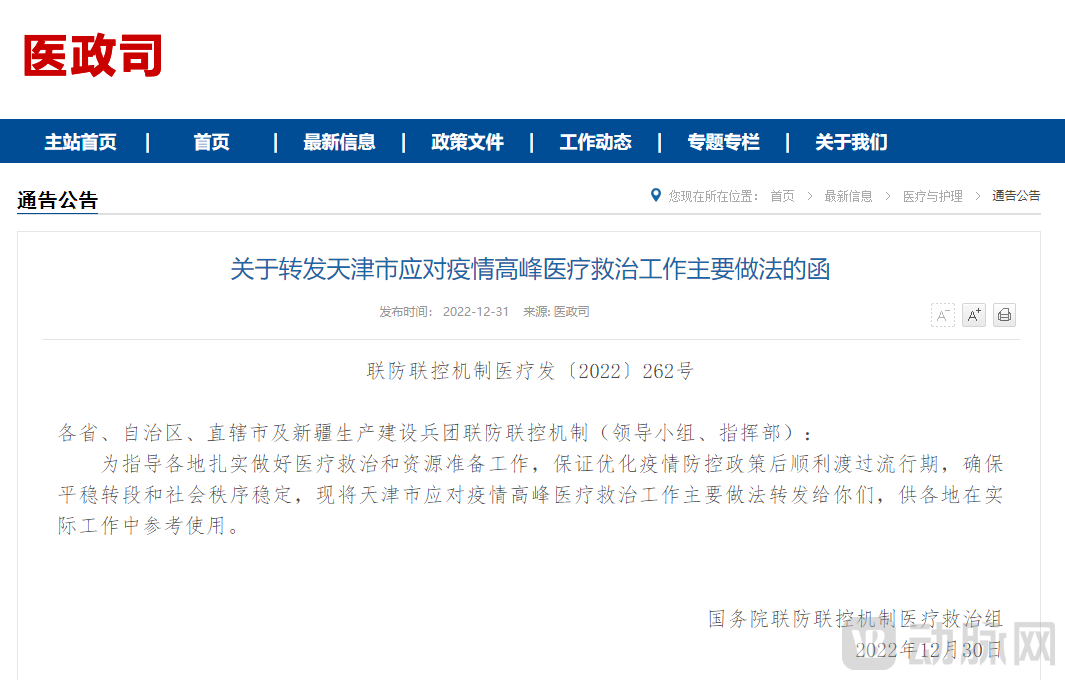
To promote typical practices, on December 31, 2022, the Joint Prevention and Control Mechanism of the State Council circulated Tianjin’s main approaches to medical treatment and response during the peak of the epidemic.
Tianjin Municipality, with Tianjin WeDoctor Internet Hospital as the lead entity, collaborated with 266 primary healthcare institutions across the city to establish the Tianjin Primary Care Digital Health Community. Leveraging digital empowerment through this health community, the initiative enhanced the service capabilities of primary healthcare institutions, enrolled 2.06 million key populations—including seniors aged 65 and above—into family doctor contracted services, and achieved grid-based management and treatment. Additionally, it developed home-based medical security services, offering online follow-up consultations, telephone consultations, and medication delivery to patients’ homes.
Heilongjiang’s practices have also drawn significant attention recently. The province launched the “Healthy Longjiang COVID-19 Medical Services” platform, with WeDoctor providing the primary technical support and service assurance. By comprehensively integrating online and offline medical and pharmaceutical resources, the platform has onboarded more than 16,000 primary care physicians to deliver grid-based healthcare services to tens of millions of residents across the province.
It can be said that the prevention and control of the epidemic in the new stage has, on the one hand, exposed the long-standing challenges in the healthcare system regarding coordination between different levels of care and the integration of medical services, health insurance, and pharmaceuticals, while also highlighting the urgency of advancing the upgrade of the healthcare service system through digitalization.
In the post-pandemic era, the general public will inevitably coexist with SARS-CoV-2 for the long term. The routine prevention and control of COVID-19, particularly the service management of high-risk groups prone to severe illness—such as the elderly, pregnant women, children, and patients with chronic underlying conditions—will constitute a long-term challenge for China’s healthcare service system.
In the practice of epidemic prevention and control, the establishment of a “trinity” medical service system has provided a framework for addressing the aforementioned challenges. This achievement stems from the healthcare industry’s sustained implementation and practical accumulation in accordance with key national healthcare reform policies, including the Implementation Opinions on Deepening the Promotion of Sanming City’s Experience in Fujian Province and Furthering Healthcare System Reform.
Building a Digitally Driven, Tightly Integrated Medical Consortium—The Digital Health Community—Based on a Health Accountability System to Provide Patients with Lifecycle-Wide Health Maintenance Services for Each Disease Type.
This is exemplified by WeDoctor’s practice in Tianjin. Relying on a digital platform, the Tianjin Primary Care Digital Health Consortium has implemented a unified “Four Clouds” platform—comprising cloud management, cloud services, cloud pharmacy, and cloud diagnostics—at primary healthcare institutions, alongside offline standardized chronic disease management centers. This initiative has achieved standardized, disease-specific diagnosis and treatment, centralized cloud pharmacy services, and centralized cloud diagnostic services, while implementing “pay-for-performance” measures. As a result, it has become the vanguard in Tianjin’s comprehensive rollout of the health stewardship responsibility system for outpatient special care coverage for diabetes.
As of December 2022, the healthcare consortium had collaborated with 133 primary care institutions and five secondary hospitals to establish chronic disease management centers, creating health records for over 1.68 million patients, including 630,000 individuals with diabetes. Among them, more than 100,000 diabetic patients had been enrolled under signed contracts and incorporated into the specialized outpatient health stewardship model for diabetes. In terms of outcomes, the standardized management rate for diabetic patients in pilot primary care institutions reached 76.68%; the blood glucose control rate among patients managed for more than three months improved by over 21%; and medical insurance surplus rates at institutions implementing capitation payment models ranged from 16% to 31%.
Shandong is also one of the early regions where WeDoctor explored the Digital Health Community. In Shandong, WeDoctor has extensively integrated resources from large medical institutions by implementing the Digital Health Community, facilitated health insurance payments, and established more than 40 chronic disease management service centers in cities such as Jinan, Tai’an, and Weifang. These centers provide patients with an integrated online-offline “Three-Physician Co-Management” service. Public reports indicate that WeDoctor’s Digital Health Community-centric operations now cover all 16 prefecture-level cities in Shandong Province, having served insured individuals over 23 million times and provided care to nearly 3 million patients with chronic diseases.
The Reshaping of the Healthcare System by Digital Health Communities Generates Significant Social Benefits. In April this year, five ministries and commissions, including the Ministry of Agriculture and Rural Affairs and the National Development and Reform Commission, jointly issued a document proposing to guide localities in exploring the development of grassroots digital health communities.
Meanwhile, the commercial pathway of the Digital Health Community, characterized by “strengthening infrastructure and prioritizing operations,” has begun to prove viable. Taking Tianjin’s Primary Care Digital Health Community as an example, this initiative was fully launched in April 2020. It currently handles over 10,000 outpatient visits per day, with monthly revenue exceeding RMB 100 million, demonstrating its high growth potential compared to traditional hospitals.
According to media reports, WeDoctor has launched its Digital Health Community operations in Shandong, Fujian, Tianjin, and other provinces (municipalities), achieving normalized operations. In multiple cities within these regions, the scale of business operations and revenue generated by the Digital Health Communities rivals that of large tertiary hospitals. Additionally, among WeDoctor’s more than 30 internet hospitals, approximately 20 have integrated with medical insurance payment systems, laying the foundational conditions for establishing Digital Health Communities in additional regions.
Digital healthcare is a crucial component of China’s digital economy, with a market size that cannot be underestimated. According to data from Future Market Insights, the global digital healthcare market was valued at USD 224.24 billion in 2022 and is projected to grow at a compound annual growth rate (CAGR) of 27.7% from 2022 to 2032. China is one of the most promising digital healthcare markets, with external estimates generally placing its scale at the hundred-billion-yuan level.
Earlier, the spillover effects of intensified antitrust regulation in China and the “Double Reduction” policy in the education and training sector impacted the internet industry. Coupled with multiple headwinds, including global pandemic disruptions and a sluggish capital market, the internet industry faced a severe downturn.
Since 2022, regulatory authorities have accelerated the completion of rectification efforts for relevant internet platforms, sending a clear signal of support for their development. At the Political Bureau of the Communist Party of China Central Committee meeting held in December 2022, the status and role of the platform economy and platform enterprises were affirmed. The meeting pointed out that “we should vigorously develop the digital economy, improve the level of normalized regulation, and support platform enterprises in playing a prominent role in leading development, creating jobs, and competing internationally.”
Particularly in the recent period, as China’s epidemic prevention and control efforts have entered a new phase and socioeconomic activities have resumed, market expectations for both primary and secondary capital markets are also recovering. The valuations of Chinese internet healthcare platforms listed on U.S. stock exchanges and the Hong Kong Stock Exchange are entering a recovery trajectory, injecting new momentum into industry development.
Chasing Fortune Securities recently pointed out that, considering the waning constraining effects of the pandemic and the real estate sector on the domestic economy, the marginal easing of expectations for Federal Reserve rate hikes, and the de-escalation of global tensions, the three major headwinds that had previously weighed on market performance—namely corporate earnings, valuations, and risk appetite—have all shown a clear reversal. Coupled with the continuous release of policy benefits from the Central Economic Work Conference, it is expected that opportunities in the A-share and Hong Kong stock markets will outweigh risks next year.
Soochow Securities released a report stating that there is still significant room for growth in the penetration rate of internet healthcare. With strong national support for “Internet + Healthcare” and the arrival of the post-pandemic era, sectors such as online diagnosis and treatment are expected to experience growth.
Certainly, in terms of the most critical industry fundamentals, platforms such as WeDoctor have demonstrated strong growth momentum by establishing closed-loop business and commercial models, thereby accelerating the release of their social and market potential. Furthermore, against the backdrop of China’s new healthcare reforms driven by changes in medical insurance payment methods, the trillion-yuan medical insurance fund is shifting towards a health accountability system based on value-based payments, such as capitation and diagnosis-related groups (DRGs). Platforms like WeDoctor, with digital healthcare communities as their core business, are expected to continue benefiting from this trend.
Overall, driven by multiple favorable factors, China’s digital healthcare sector is poised to enter a golden period of growth, with leading digital health platforms seizing the opportunity to accelerate development and consolidate their market positions. In the long run, industry practitioners must leverage the advantages of digitalization, align with policy guidelines and pressing market demands, and continuously enhance the quality and substance of medical and health services to truly achieve a substantive upgrade of the traditional healthcare service system.