

Ultima Genomics: Revolutionizing Genomic Accessibility with $100 Whole Genome Sequencing

Ultima Genomics
Gene Sequencing Platform Developer
After years of market education, the clinical value of gene sequencing has become clearly defined, leading to a rapid surge in demand. However, high-throughput sequencing has long remained constrained by high costs.
Cost reductions and technological breakthroughs by sequencer manufacturers have played a pivotal role in the development of the entire industry. In 2022, gene sequencing company Ultima Genomics emerged on the scene, reducing the cost of whole-genome sequencing from $1,000 to $100.
On May 31, 2022, Ultima Genomics launched the UG 100, a new high-throughput, low-cost gene sequencing platform capable of delivering whole-genome sequencing for $100. The company also announced the completion of a $600 million financing round, with investors including General Atlantic, Andreessen Horowitz, D1 Capital, Khosla Ventures, Lightspeed, Marius Nacht, aMoon, Playground Global, and Founders Fund.
Clearly, Ultima Genomics is emerging as the new dark horse in the upstream sequencer race following Illumina, with the potential to fundamentally reshape the industry’s upstream and downstream landscape.
The cost of gene sequencing continues to decline at a pace exceeding Moore’s Law. According to data from the National Human Genome Research Institute, the cost of sequencing the human genome was as high as $95.263 million in 2001. In recent years, the cost has stabilized at around $1,000.
However, the cost of gene sequencing has hovered around the $1,000 mark for many years, failing to achieve a breakthrough.
How Important Is Low-Cost Gene Sequencing? Depth, quality, and cost are the three core pillars of gene sequencing. Historically, these factors formed an “impossible triangle”: achieving greater depth and higher quality inevitably incurred prohibitive costs, forcing researchers to make cautious trade-offs due to budgetary constraints, which significantly hindered both scientific research and clinical diagnostics.
In the clinical sector, the decline in sequencing costs holds significant importance for early cancer screening and diagnosis, precision diagnostics, new drug development, and personalized medicine. For instance, in the early cancer screening market, many industry insiders consider “a price drop to the hundreds-of-yuan range” a critical condition for the large-scale adoption of early screening products.
Only through systematic innovation can the “impossible trinity” be broken; Ultima Genomics has developed a completely new sequencing architecture, reducing the cost of human whole-genome sequencing from $1,000 to $100.
How is this achieved? First, Ultima Genomics’ sequencing system featuresOpen Fluidic and Optical DesignBy directly using a 200-mm silicon wafer as the reaction carrier, reagents are dispensed onto the rotating wafer through a nozzle at its center. Centrifugal force ensures rapid and uniform distribution of the reagents, thereby reducing reagent consumption. The use of an open substrate creates a large reaction surface while eliminating the need for expensive flow cells and complex fluidic systems, enabling zero crosstalk and ultra-high-speed scanning over a large area.
Secondly,Chemical SystemUltima Genomics combines the advantages of traditional reversible-terminator SBS and label-free natural nucleotide incorporation sequencing by using a four-color single-base mixture (natural nucleotides + labeled nucleotides) in each sequencing cycle. This mixture contains a small fraction (<20%) of fluorescently labeled, non-terminated nucleotides and a majority of unlabeled, non-terminated (natural) nucleotides. Ultima Genomics refers to this approach as “Mostly Natural Sequencing-by-Synthesis (maSBS).”
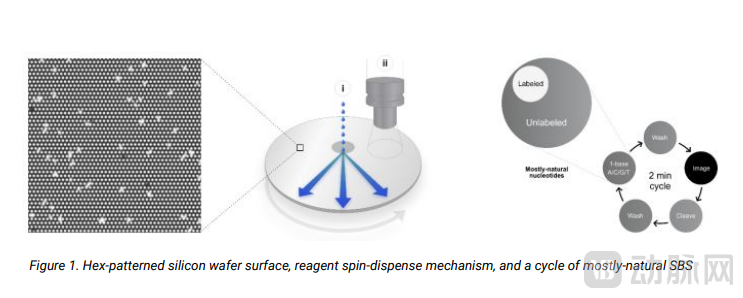
AlgorithmIn this regard, Ultima Genomics employed a neural network approach, training the algorithm with extensive known data and validating and refining it using real-world data.
Based on this, Ultima Genomics has launched the UG 100, a new high-throughput, low-cost gene sequencing platform. Research published in collaboration with the Broad Institute shows that the UG 100 canSequencing billions of reads at a low cost of $1/Gb, with longer read lengths (~300 bp), short run times (<20 hours), and high base accuracy (Q30 > 85%).
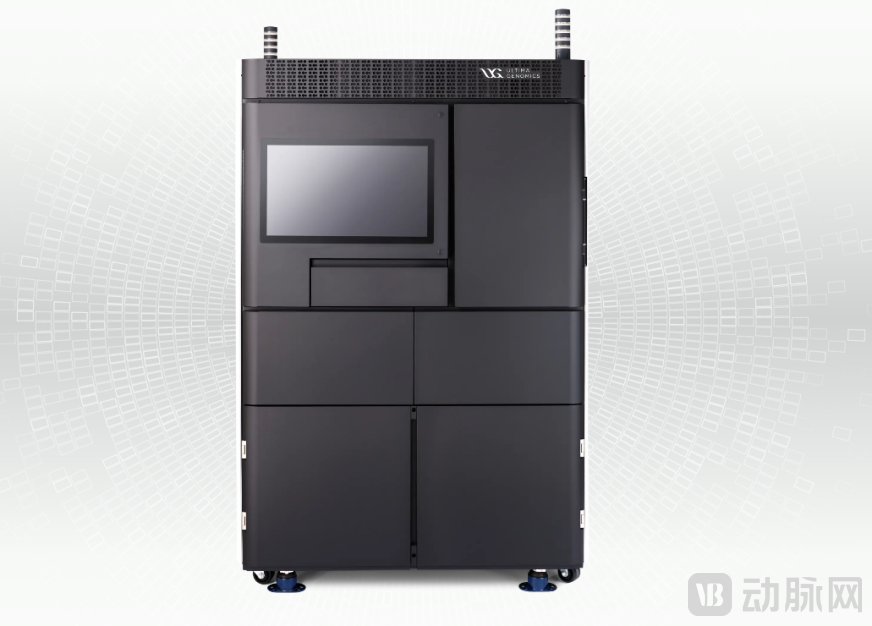
UG 100
Currently, Ultima Genomics has collaborated with multiple leading research institutions to demonstrate the performance of the UG 100 in applications such as single-cell sequencing and whole-genome methylation.
In this collaboration, Ultima Genomics partnered with Jonathan Weissman’s team at the Whitehead Institute to perform CRISPR interference (CRISPRi) on millions of human cells, followed by single-cell RNA sequencing, thereby constructing a comprehensive genotype-phenotype map. This work demonstrated the utility of Ultima’s system in large-scale single-cell studies, enabling extensive experiments that were previously infeasible.
In collaboration with Michael Snyder’s team at Stanford University, the company performed whole-genome bisulfite sequencing on samples from colorectal cancer patients, mapping DNA methylation changes associated with the transition from healthy colon tissue to malignant colorectal cancer. In partnership with Joshua Levin’s and Aviv Regev’s teams at the Broad Institute of MIT and Harvard, the company conducted single-cell RNA sequencing, demonstrating that the sequencing results obtained from its platform are consistent with those from existing platforms.
Downstream companies in the industry have shown great interest in Ultima Genomics’ low-cost gene sequencing system.Since the launch of the UG 100, the company has announced a collaboration with Olink to develop high-throughput proteomics solutions; partnered with Exact Sciences to reduce the cost of cancer genetic testing; and signed an agreement with Regeneron Pharmaceuticals to accelerate drug development. Furthermore, the company will receive investments from Regeneron and Exact Sciences.
Numerous pharmaceutical companies and leading precision diagnostics firms have extended cooperation offers to Ultima Genomics, underscoring the industry’s strong demand for low-cost gene sequencing systems and affirming the superior performance and promising prospects of the UG 100.
Ultima Genomics’ rapid and impressive progress in the low-cost sequencer market is closely tied to its team composition.
Gilad Almogy, the company’s CEO, holds a Ph.D. in Applied Physics from the California Institute of Technology and a B.S. in Mathematics and Physics from the Hebrew University of Jerusalem. With many years of experience in the semiconductor industry, he previously founded the solar energy company Cogenra Solar. Doron Lipson, the CSO, is an alumnus of the same institutions as the CEO and brings 20 years of expertise in high-throughput sequencing. Mark Pratt, the CTO, formerly led engineering R&D for Illumina’s MiSeq, HiSeq X, and other sequencing platforms. This team composition provides strong support for the company’s development of low-cost sequencing systems, underpinned by solid technical foundations and innovative thinking.
Ultima Genomics confidently states on its official website that $100 genome sequencing is just the beginning. In the future, the company will continue to reduce the cost of genomic sequencing, promoting gene sequencing as a routine medical practice.
It is an indisputable fact that the sequencer sector is becoming increasingly heated.The overseas sequencer market is becoming increasingly competitive.Startups such as Element Biosciences and Omniome have launched sequencing instruments. In the field of low-cost gene sequencing, companies like Illumina and Element are making significant efforts. On January 11, 2023, Element announced that “even desktop sequencers can offer low-cost sequencing solutions at $200 per genome.” On September 29, 2022, Illumina released the NovaSeq X, which can sequence the entire human genome for just $200. The NovaSeq X has shipped more than 300 units.
The wave of independent innovation in sequencers has also spread to China.
For a long time, China relied on imported gene sequencers, until MGI Tech successfully broke the import monopoly. In the past two years, China’s voice in this high-barrier sector has grown increasingly prominent, with the localization of upstream sequencer components accelerating significantly. In 2022, multiple Chinese companies launched domestically produced gene sequencing systems.
For instance, Smoove’s GenoCare 1600 received approval from the National Medical Products Administration (NMPA) in July 2022, becoming the world’s first clinically approved single-molecule gene sequencer. On November 28, Smoove launched its independently developed new gene sequencing system, FASTASeq 300. Salus Medical released the high-throughput sequencer Salus Pro, and Mingyi Intelligent Manufacturing unveiled the high-throughput gene sequencer UniSeq2000. In addition, companies such as Anxuyuan and Qitan Technology are already making strategic moves in third- and fourth-generation sequencing instruments.
The localization of upstream sequencing systems has long been a focal point for the industry. The emergence and growth of domestic brands benefit players across the upstream, midstream, and downstream segments of the supply chain. In 2022, a series of innovations in gene sequencing systems by multiple Chinese enterprises signaled that the sequencer market had entered a phase of vibrant diversification. Against the backdrop of ongoing import substitution and expanding demand in downstream application areas, the prospects for the domestic sequencer market are promising.
Next, sequencing instrument manufacturers need to engage in deep collaboration with downstream enterprises to build an ecosystem, and plan appropriate development pathways for different application scenarios and types of testing projects, thereby enabling the instruments to operate effectively in both research and clinical markets.