

Billions in Funding and Over $30 Billion in Revenue Across Three Quarters Still Not Enough to Sustain This Health Insurance Tech Giant

Bright Health
Healthcare Platform Provider
A review of the global insurtech investment and financing market reveals that “insurance + healthcare” has undoubtedly been one of the hottest sectors in recent years. Driven by factors such as an aging population and the pandemic, health insurance-related technology companies have garnered significant attention, continuously securing substantial funding rounds. Bright Health is a prime example.
Bright Health was founded in 2015 and completed its U.S. stock market listing in June 2021. A review of the company’s financing history is truly astonishing. Since its inception, Bright Health has repeatedly secured substantial funding rounds, with total capital raised to date exceeding $1.5 billion (approximately RMB 10.1 billion). Notably, it closed a $500 million financing round in September 2020 and raised $635 million in December 2019. Its initial public offering on the New York Stock Exchange in June 2021 raised a total of $924 million, setting a new record for fundraising by insurance companies in recent years.
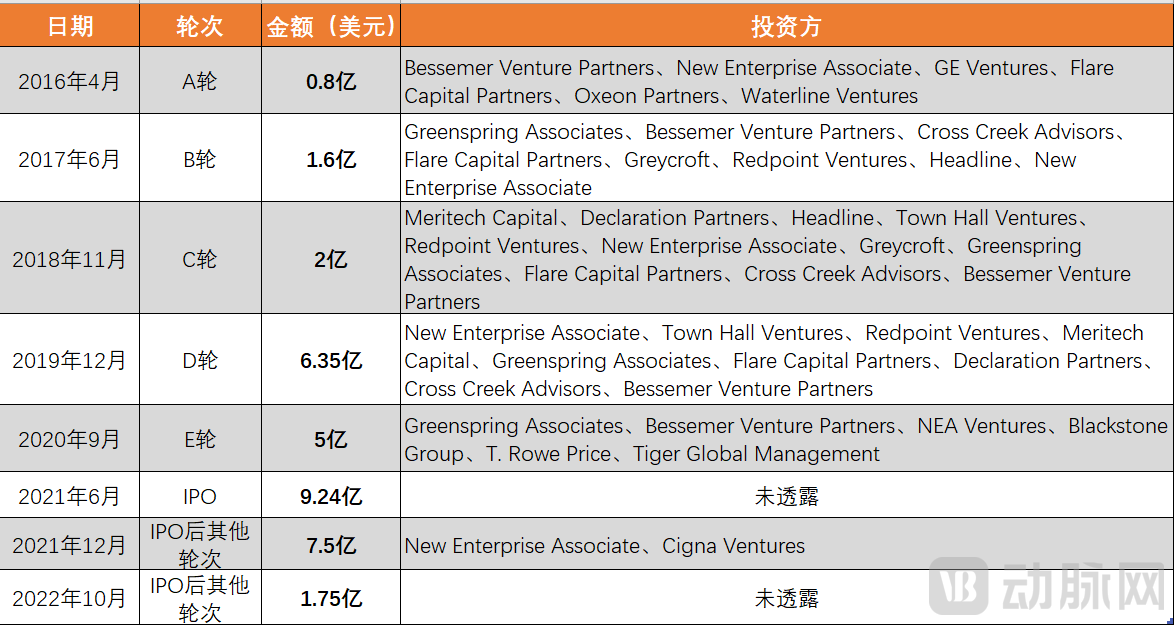
Bright Health Financing Information | Data Source: VCBeat Orange Database
Behind the Frequent Large-Scale Capital Injections: What Makes Bright Health So Attractive? How Has Bright Health Performed in the Market Since Its IPO One and a Half Years Ago?
Former UnitedHealth Executive Launches Startup, Pursuing Model Innovation in Health Insurance Technology
Bright Health, founded in November 2015 and headquartered in Minnesota, USA, is a consumer-centric healthcare insurance and technology company. The company collaborates with leading providers within the healthcare system to foster better connections between healthcare consumers and service providers, aiming to make healthcare simpler, more affordable, and personalized, thereby achieving improved health outcomes.
The company’s founding team has accumulated extensive experience in the healthcare sector. The three founders were formerly colleagues at UnitedHealth Group and hold a strong positive outlook on the health insurance market. Bright Health was established with the mission of providing users with affordable health insurance plans, leveraging advanced technology to deliver high-quality, efficient healthcare services.
Bob Sheehy, Co-founder and CEO of Bright Health, graduated from the University of Michigan in the United States. He has provided healthcare consulting services to numerous private equity firms and venture capital companies. Prior to founding Bright Health, Bob Sheehy served as a former CEO at UnitedHealth Group, where he worked for over 20 years, accumulating extensive experience in the health insurance industry.
Kyle Rolfing, Co-founder of Bright Health, is the former CEO and Co-founder of health management companies Definity Health and RedBrick Health. Under Kyle’s leadership, Definity Health’s revenue grew from zero to $100 million in just four years. Definity Health was later acquired by UnitedHealth, and Kyle became a member of UnitedHealth’s leadership team.
Dr. Tom Valdivia, Chief Medical Officer, is the former Chief Health Consumer Officer at Definity Health and previously served as Co-founder and CEO of Luminate, with over 20 years of experience working for healthcare technology vendors.
Since its founding more than seven years ago, Bright Health has remained at the forefront of innovation, achieving remarkable growth. In its second year, the company launched an innovative Medical Partner health plan model, leveraging exclusive Care Partner health plans offered within local communities to help consumers and healthcare providers access simpler, more affordable, and personalized healthcare services.
That same year, Bright Health completed an $80 million Series A financing round. Subsequently, it grew rapidly by securing large funding rounds annually, propelling itself into the top ranks of health insurance companies nationwide.
Insurance Services + Health Management: A Mutually Empowering Medical Insurance Ecosystem
Bright Health comprises two business units: Bright Healthcare and NeueHealth. Among them, Bright Healthcare sells health insurance products to consumers, primarily including Individual and Family Plans (IFP), Medicare Advantage (MA) plans for seniors, and other supplemental health plans.
In IFP product design, Bright Health primarily offers Bronze, Silver, and Gold-tier plans, with monthly premiums and reimbursement limits increasing sequentially. Taking the Bronze-tier plan as an example, its coverage includes outpatient services, prescription drugs, health screenings, hospitalization insurance, and maternity insurance. Additionally, the product provides reimbursement for emergency care expenses, including emergency room fees, urgent care facility charges, and emergency medical service costs.
Medicare Advantage (MA) represents the portion of the U.S. Medicare program for seniors that has been transferred to commercial insurance companies. Insurers bid annually with the Centers for Medicare & Medicaid Services (CMS) and, upon contracting, receive capitated payments from CMS. Currently, Bright HealthCare offers Medicare Advantage products in 17 U.S. states, typically focusing on high-risk populations with special needs.
NeueHealth serves as a healthcare provider, delivering comprehensive care to patients through its proprietary medical service platform, collaborating with external healthcare vendors to provide corresponding health management services, and engaging individual healthcare practitioners. According to the company’s official website, NeueHealth currently operates more than 3,000 owned and affiliated clinics, providing healthcare services to over 530,000 value-based care patients at various stages of their health journeys.
Through the division of labor and collaboration between its two divisions, Bright Health connects insurance products, healthcare services, and consumers, creating mutual empowerment to drive overall business growth. On one hand, for consumers, Bright Health provides insurance products, while its upstream network of physicians offers personalized health management services. This enables consumers to accurately predict out-of-pocket costs and process claims more quickly. On the other hand, NeueHealth helps healthcare providers attract consumers by offering innovative tools and solutions that support their health management initiatives and the development of value-based care businesses.
Patient-Centric, Building "Personalized" Intelligent Health Management
To achieve greater efficiency, Bright Health has developed an intelligent operating system, “BiOS,” an end-to-end smart technology platform comprising consumer, care delivery, and administrative solutions, designed to create an integrated, consumer-centric healthcare ecosystem.
BiOS leverages the Care Partner model to generate data and enable healthcare system integration, encompassing the intelligent data hub Consumer 360 and DocSquad, a solution suite for both consumers and providers. Consumer 360 aggregates clinical and administrative data, consumer information, and data related to health determinants to create personalized digital care plans.
DocSquad encompasses virtual care, personalized care teams, intelligent alerts, and other healthcare services, connecting consumers with care-delivering organizations and providing providers with a 360-degree view of the consumer to better manage their healthcare needs.
Furthermore, to deliver an optimal experience for both patients and providers, Bright Health has also designed high-performance information technology systems that provide digital services to both customers and healthcare providers.
On the medical service platform, Bright Health launched the MOIS EMR electronic medical record system, aiming to improve overall patient care and enhance provider efficiency. Highly customizable, MOIS helps healthcare institutions manage everything from daily clinic operations to patient management.
On the user side, myhealthkey is a web-based electronic Personal Health Record (PHR) application. With myhealthkey, patients can view their personal health information, monitor their health status at any time, and engage in every stage of their healthcare journey.
By leveraging big data models to integrate healthcare and insurance, Bright Health provides users with high-quality medical services while offering the most suitable insurance plans based on their health status and other factors, thereby achieving a "personalized experience for each individual." These initiatives have significantly addressed the long-standing pain point of ineffective intervention in health management.
2022: Losses Outweighed Profits, Value-Based Unified Nursing Model Becomes Business Focus
According to Bright Health's financial report, the company's total revenue for the first three quarters of 2022 was $5.044 billion (approximately RMB 33.7 billion), representing a year-on-year increase of 64.47% from $3.067 billion in the same period last year.
Among them, NeueHealth reported revenue of $1.545 billion, a year-on-year increase of 300%. Bright Healthcare generated revenue of $3.098 billion, up 60.2% year on year, with Medicare Advantage revenue reaching $1.259 billion, a 35.6% year-on-year increase.
While the company’s revenue has seen substantial growth, its losses have continued to widen. According to the company’s financial reports, its net losses amounted to USD 62.64 million, USD 125 million, and USD 248 million in 2018, 2019, and 2020, respectively, before further expanding to USD 1.178 billion in 2021. In the third quarter of 2022, the company reported a net loss of USD 691 million, representing an 89.41% increase compared to the same period in the previous year.
The losses stem from the continuously rising medical loss ratio and high operating costs. From 2018 to 2021, the company’s medical loss ratios were 75.8%, 82.4%, 88.7%, and 101.3%, respectively; operating costs amounted to $95.83 million, $180 million, $410 million, and $1.238 billion, with growth rates of 88% and 127%, respectively. Given the substantial medical expense outlays coupled with escalating operating costs, the company still has a long way to go before achieving profitability.
Nevertheless, the “member–payer–provider” ecological value chain constructed by Bright Health remains competitively core. As noted above, NeueHealth’s threefold revenue growth in the first three quarters of 2022 stemmed precisely from its innovation in a value-based, consumer-driven model.
Bright Health has chosen to leverage its robust healthcare resources and partner with external payers and care providers to implement a differentiated end-to-end care model, thereby reducing risk, improving capital efficiency, and achieving profitability more rapidly.
Meanwhile, in terms of building and integrating its technology platform, Bright Health’s intelligent platform connects users, payers, and providers, centralizing all user and claims data to enable the exchange of data value and mutual empowerment.
Based on this, the company’s user base, particularly its value-based care consumers, has also seen substantial growth. As of the end of the third quarter of 2022, Bright HealthCare’s commercial members exceeded 1 million, representing a 70.8% year-over-year increase, including 125,000 Medicare Advantage enrollees. Among these, the number of patients under value-based care arrangements increased by 20,000 to reach 520,000, comprising 405,000 from Bright HealthCare, 46,000 through direct contracts, and 69,000 from other external value-based payers.
At the 41st J.P. Morgan Healthcare Conference, Mike Mikan, CEO and President of Bright Health, stated that in 2023, the company would focus its business on a unified care model and cease offering Bright HealthCare’s Individual Family Plan (IFP) and Medicare Advantage (MA) products outside of California and Florida. Going forward, the company will prioritize scale and differentiation as its primary transformation directions, driving a shift toward a value-based, consumer-driven model.
In October 2022, Bright Health announced the closing of its previously offered Series B convertible perpetual preferred stock, with a total of 175,000 shares sold. The company raised $175 million from this offering, reaffirming support for Bright Health’s core businesses and unified care model.
Mike Mikan stated that Bright Health’s strategy for 2023 is to focus on EBITDA and ensure profitability, rather than pursuing revenue maximization. “We have demonstrated the effectiveness of our end-to-end care model in serving the elderly population and those with unmet clinical needs, while driving a market shift from a broad-based approach to value-based consumer segments. This represents another strategic step by the company in building a large-scale, differentiated, and profitable business, which will deliver greater stability and lower risk, thereby supporting profit growth in 2023,” said Mike Mikan.
In the new year, Bright Health stands at a critical juncture. Whether its differentiated solutions prove effective is vital not only to Bright Health itself but also offers significant lessons for China’s health insurance technology enterprises.
China’s Trillion-Yuan Blue Ocean Market: Greater Focus Needed on Technological Innovation and Profit Models
In recent years, China’s health insurance industry, driven by demographic shifts and changes in the healthcare structure, has gradually entered a period of robust growth. According to data from the China Banking and Insurance Regulatory Commission (CBIRC), the original premium income from health insurance business reached RMB 817.3 billion in 2020, representing a year-on-year increase of 15.7%, a growth rate significantly higher than that of other insurance categories. Over the past five years, the compound annual growth rate (CAGR) of health insurance has reached 31.4%, with the market size doubling. It is estimated that the market surpassed the RMB 1 trillion mark in 2021.
With original premium income exceeding one trillion yuan and an annualized growth rate of over 30%, the market’s overall potential is highly attractive. Behind this expansion in market size has come a wave of new health insurance technology enterprises in China, along with accelerating financing activities.
However, compared with global health insurance technology giants, the development of this sector in China faces multiple challenges. Current issues plaguing domestic health insurtech companies include superficial technological integration, insufficient business model innovation, a mere transposition of traditional offline strategies to online platforms, and a failure to adequately fulfill their roles as payers and providers.
First, health insurance products suffer from severe homogenization and lack differentiation. Second, their health management capabilities are weak, with a primary focus on medical payment functions; furthermore, the coverage responsibilities and eligible insured populations of currently available products are highly similar. Third, the technological integration in health insurance remains superficial, with insufficient innovation in business models, failing to fully demonstrate the attributes of technology.
Currently, the core competitiveness of health insurance technology enterprises lies in customer acquisition capabilities and the construction of medical service networks. Drawing on Bright Health’s development trajectory and leveraging the inherent correlation between the insurance industry and healthcare, shifting from mere claims payment to proactive life and health management, and actively providing health management services to reduce morbidity and mortality rates can effectively enhance the operational efficiency of health insurance businesses.
Bright Health’s development is built upon the unique healthcare security system in the United States. The U.S. private health insurance market is highly developed, offering a wide variety of products and extensive choices for consumers. In contrast, China’s universal health coverage system and the dominance of public hospitals have resulted significant differences between China’s health insurance market and regulatory framework and those of the U.S., necessitating that technological innovations be adapted to local realities.
However, overall, customer acquisition capabilities, the construction of medical service networks, and profitability models are all questions that health insurance companies must address. Also based on Bright Health’s experience, precisely targeting user needs to achieve low loss ratios, actively pursuing technological innovation, and improving overall health management and claims efficiency through a full-process management model are key strategies. Furthermore, breaking free from the “cash-burning” cycle, avoiding blind pursuit of revenue, and instead focusing on sustainable profitability models deserve particular attention.
References:
Bright Health, a Star in Medical Insurance, Suffers Huge Losses Year After Year: What Are Its Advantages and Prospects? - Dr. Max
Where Should the Health Insurance Industry Go After Raising Tens of Billions in Funding Only to Face Major Challenges? - VCBeat