

Twist Bioscience Challenges DNA Data Storage After Revolutionizing DNA Synthesis Scale, Throughput, and Cost
Twist Bioscience
DNA Synthesis Biotechnology Developer
In 1975, British biochemist Frederick Sanger invented the chain-termination method for DNA sequencing, opening the door to deciphering the book of life. This breakthrough gave rise to a series of technological revolutions, including automated sequencing, high-throughput sequencing, RNA sequencing, and methylation sequencing. The subsequent advent of DNA synthesis technology has further provided humanity with the tools to rewrite the code of life.
As a key foundational enabling technology driving the advancement of life sciences and related fields, DNA synthesis has become an indispensable tool in molecular biology research, playing a critical role in various domains such as genetic engineering, clinical diagnostics and therapeutics, antibody discovery, and DNA data storage.
According to a BCC Research report, the global oligonucleotide synthesis market size is projected to grow from $6.1 billion in 2021 to $10.2 billion in 2026, at a compound annual growth rate (CAGR) of 10.7%. According to Grand View Research, the gene synthesis market was valued at approximately $1.77 billion in 2021 and is expected to reach $5.58 billion by 2028, with a CAGR of 18.1%.
Founded in 2013 and headquartered in San Francisco, Twist Bioscience is an innovative DNA synthesis company. Its silicon-based DNA synthesis platform has broken through the bottlenecks of existing DNA synthesis processes and successfully achieved commercialization.
In 2018, Twist Bioscience successfully listed on the Nasdaq. Twist Bioscience is leveraging its unique technology platform to manufacture a wide range of synthetic DNA-based products, including synthetic genes, next-generation sequencing (NGS) tools, antibody libraries for drug discovery and development, and the development of DNA data storage systems.
Experts from Industry and Academia Launch Startup, Significantly Reducing Sequencing Costs
Twist Bioscience, headquartered in San Francisco, is a rapidly growing synthetic biology and genomics company. Its unique semiconductor silicon chip-based DNA synthesis platform enables high-throughput, high-fidelity, and cost-effective synthesis of DNA and genes for customers, further advancing the industrialization of bioengineering.
Dr. Emily Leproust, CEO and Co-Founder of Twist Bioscience, is a pioneer in high-throughput DNA synthesis and sequencing. As a researcher spanning both industry and academia, Dr. Leproust has published more than 30 academic papers, primarily on the applications of synthetic DNA, and has developed oligonucleotide library synthesis technology.
Foreign Policy magazine named her one of the 100 leading global thinkers, while Fast Company magazine ranked her among the most creative people in business.
Emily Leproust earned her Ph.D. in Organic Chemistry from the University of Houston and her Master’s degree in Industrial Chemistry from the French National Graduate School of Chemical Engineering (ENSIC) in Lyon, France. During her time at the University of Houston, she was a distinguished student under the supervision of renowned scientist Professor Gao Xiaolian. Together, they developed a parallel synthesis process for DNA and RNA on solid supports, which later became a commercial development project for Xeotron Biosystems.
After leaving Professor Gao Xiaolian’s team, Emily Leproust was hired by Hewlett-Packard’s Analytical Instruments Division as the Technical Director of its Life Sciences Department. In 1999, HP spun off its highly profitable Analytical Instruments Division into an independent company, which later became the renowned Agilent Technologies. Emily Leproust joined Agilent as Chief Technology Officer (CTO), where she helped develop the SureSelect product line, significantly reducing sequencing costs.
In 2013, Emily Leproust founded Twist Bioscience, enabling high-throughput DNA synthesis. Since its inception, the company has achieved rapid progress and gradually become a formidable force in the field of synthetic biology.
In April 2016, the company launched its first application for synthetic genes and oligonucleotide pools, disrupting the gene synthesis market and rendering traditional DNA synthesis methods obsolete. Since then, the company has experienced rapid growth, with annual revenue steadily increasing. In November 2018, Twist Bioscience officially listed on the Nasdaq, offering 5 million new shares at $14 per share, completing an IPO valued at $70 million.
Increase throughput by 9,600-fold to enable large-scale, low-cost DNA synthesis
It is understood that traditional DNA synthesis methods are generally conducted in 96-well plastic microplates and are limited to synthesizing a single gene. For the industrial demand for large-scale production of gene fragments, this approach is not only inefficient but also prohibitively expensive.
Twist Bioscience’s high-throughput silicon-chip DNA synthesis platform features wells that each correspond to a single well of a 96-well plate, with each well containing 100 honeycomb-shaped nano-wells. Leveraging this honeycomb nano-well design and Twist’s proprietary processing system, oligonucleotide fragments synthesized in each micro-well can be assembled directly in situ without the need for transfer.
This DNA synthesis system not only reduces the reaction volume required for DNA synthesis by a factor of one million, but also increases sample throughput by 9,600-fold. Because silicon chips are more sensitive to temperature changes than traditional plastics, the accuracy of synthesis is higher.
Furthermore, this method significantly reduces reagent consumption, and the synthesized products achieve near-zero waste during subsequent assembly processes, thereby reducing pollution and enhancing environmental sustainability. Currently, Twist Bioscience can synthesize DNA fragments up to 1.8 kb in length, with yields ranging from 100 to 1,000 ng.
In addition to DNA synthesis, the platform’s underlying synthesis principles can also be applied to other synthetic fields, such as protein synthesis. Twist Bioscience is leveraging its proprietary technology to manufacture a broad portfolio of synthetic DNA-based products, including synthetic genes, next-generation sequencing (NGS) library preparation tools, and antibody libraries for drug discovery. Meanwhile, Twist Bioscience is pursuing longer-term opportunities in digital data storage using DNA and the development of biological products. The company’s products are widely used across numerous industries, including healthcare, industrial chemicals, agriculture, and academic research.
Currently, Twist Bioscience’s product portfolio is primarily divided into two major segments: synthetic biology tools and NGS tools, encompassing synthetic biology products, IgG proteins, NGS tools, synthetic viral controls and infectious disease research tools, as well as drug and target discovery solutions.
In terms of synthetic biology tools, Twist Bioscience offers two types of synthetic genes. The first is cloned genes, also known as DNA-carrying vectors. These cloned genes are 5,000 base pairs in length, enabling customers to directly apply them in their research, with a standard pricing of $0.09 per base. The second is non-cloned genes, which can be inserted into vectors and are no longer than 1,800 base pairs, meeting the majority of needs, priced at $0.07 per base pair.
Twist Bioscience offers diverse, customizable oligonucleotide pools (or primer pools), ranging from hundreds to over one million oligonucleotides, with lengths of up to 300 nucleotides and an error rate of only 1 in 2,000 nucleotides. This flagship service can be applied to high-throughput targeted sequencing, CRISPR gene editing, mutagenesis experiments, DNA computing and data storage, as well as high-throughput gene assays for studying cell signaling pathways, gene regulation, and the structure of cellular regulatory elements.
In terms of NGS tools, the company’s NGS products are primarily used for diagnostic testing across various indications, such as liquid biopsies for SARS-CoV-2 and cancer, population genetics and biomarker research, translational research, microbiology, and applied markets. Its customer base mainly comprises diagnostic companies and hospitals, research institutions, agricultural biotechnology firms, and consumer genetics companies conducting diagnostic tests for a wide range of applications.
In addition, the company offers a comprehensive suite of NGS tools, including library preparation kits, human exome kits, integrated and customized panels, Twist’s high-quality target enrichment Alliance Panel portfolio, methylation detection kits for cancer, rare disease, and genetic disorder research, as well as rapid hybridization buffers.
Antibody Services + License-Out + In-House Development: Antibody Development Emerges as a New Growth Driver
Currently, synthetic biology products and NGS products are the company’s core growth drivers, while drug discovery and DNA data storage will usher in new growth curves for Twist Bioscience.
In 2017, Twist Bioscience launched its Biopharma division, providing end-to-end solutions for the discovery and early development of therapeutic biologics. Its disease areas cover cancer, neuroscience, immuno-oncology, infectious diseases, and canine/feline diseases, with product offerings including monoclonal antibodies, bispecific antibodies, nanobodies, antibody-drug conjugates (ADCs), and engineered proteins.
The division generates revenue by establishing antibody discovery programs with partners through various channels, during which Twist Bioscience Biopharma rapidly develops high-affinity antibodies against specific targets as needed.
Currently, Twist Bioscience has identified multiple promising targets and selected corresponding antibodies, with plans to license out these compounds in the late stages of preclinical development to optimize upfront payments and secure higher milestone payments and royalties.
Furthermore, the company also sells candidate antibodies to experts in biotechnology product development and commercialization, while focusing on refining and upgrading its proprietary technology platforms.
In November 2021, Twist Bioscience announced the acquisition of Abveris, an antibody discovery company, for $190 million. Leveraging its proprietary DiversimAb hyperimmunized mouse model, Twist Bioscience provides comprehensive antibody discovery and characterization services, combined with antibody optimization solutions, to develop high-quality biologics and accelerate clinical development. To date, Twist Bioscience has developed antibodies targeting Adora2a, GLP1R (agonists and antagonists), SARS-CoV-2, TIGIT, PD-L1, CXCR4, CD3, and several undisclosed targets.
Through the acquisition of Abveris, the Biopharma division’s operations have been further integrated. By adopting a model combining services, license-out agreements, and internal development, Twist Bioscience will secure more partners and collaborative projects, as well as milestone payments and royalties.
Currently, Twist Bioscience’s Biopharma division has established relationships with 42 partners, advancing 52 active projects and completing 39 projects, among which 50 include milestone payments or royalties. Partners include Boehringer Ingelheim, Takeda Pharmaceutical, Adicet Bio, Kyowa Kirin, Invetx, and Neogene Therapeutics. Additionally, Twist Bioscience’s Biopharma division has formed collaborations with companies offering complementary technologies to expand the division’s opportunities and scope.
DNA Data Storage Can Last for Centuries: Developing GB-Scale “Century Archives”
With the advent of the big data era, global data volume is growing exponentially, and the demand for data storage is continuously rising. In 2016, Nature Materials predicted that the total amount of global information data could reach 163 ZB by 2025, equivalent to 163 × 1024 × 1024 × 1024 TB, requiring 35 billion 5-TB hard drives to store. However, storing this same amount of data in DNA would require only 1 kilogram of DNA material.
DNA not only stores information but also exhibits nearly zero information decay and loss. Relying on the varied arrangements of biological bases, this information can be stored for up to one million years in an environment at -18°C.
In 2003, scientists “encoded” a piece of music from a Disney animated film into bacteria. By 2010, when the first synthetic cell was created, American geneticist J. Craig Venter, who led the effort, “encoded” the names of all scientists involved in the project into the DNA of the synthetic cell.
DNA data storage, as a promising solution for high-density, sustainable, and cost-effective long-term archival of massive datasets, is poised to address the potential “data crisis” of the future.
In May 2021, Twist Bioscience announced that it had successfully synthesized 200-base-pair oligonucleotides on its DNA chips developed for data storage. These silicon-based chips measure only 1 µm in size. Dr. Emily Leproust stated that this represents a significant achievement—the longest DNA ever synthesized on the smallest-scale silicon-based chips to date. However, the company believes that chip dimensions need to be reduced to 150 nm to achieve true commercialization, indicating that many key technological breakthroughs are still required.
Twist Bioscience’s DNA data storage technology has advanced from the megabyte (MB) level to the gigabyte (GB) level, utilizing integrated DNA data storage chips as small as 1 µm for proof-of-concept demonstrations. The company is currently designing an alpha-generation integrated chip capable of terabyte (TB)-scale storage.
It was revealed that Twist Bioscience also plans to launch an early access program for a DNA-based data storage product for long-term archiving by the end of 2023. This is the company’s first commercializable DNA data storage solution, which will serve as a “century archive” capable of storing data for up to 100 years.
Emily Leproust stated that the market for archival storage is valued at approximately $35 million, with 40% of potential customers seeking to archive data for 100 years or longer. DNA offers a lower-cost solution compared to magnetic tapes or digital hard disk drives.
In the future, the company will develop terabyte-level storage solutions and explore lower-cost enterprise-grade storage chips.
Revenue Surges Despite Slight Loss; Returning Customer Repurchase Rate Hits 98%
On November 28, 2022, Twist Bioscience released its annual report for fiscal year 2022 (covering the period from October 2021 to September 2022). The company’s revenue for fiscal year 2022 amounted to $204 million, representing a year-over-year increase of 53.83%; total orders reached $226 million, up 42% year over year; and the gross margin stood at 41.4%.
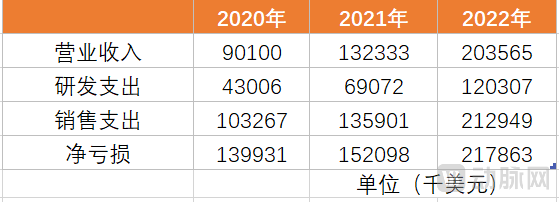
2023 Fiscal Year Revenue Data Source: Twist Bioscience 2022 Annual Report
The net loss for fiscal year 2022 was $220 million, a 44.7% increase from the $152 million net loss in 2021. This was primarily due to the fact that the growth rates of R&D expenses and sales expenses in fiscal year 2022 both exceeded the revenue growth rate, leading to an expanded net loss.
Correspondingly, from the perspective of the balance sheet, the company currently holds $379 million in cash and cash equivalents, indicating a relatively robust cash reserve.
In terms of customer base, the number of clients grew from 2,200 in fiscal year 2020 to 3,300 in fiscal year 2022. The proportion of repeat customers remained exceptionally high at 97%, 98%, and 98% respectively, indicating stable product quality and strong customer stickiness. However, this also suggests that the company’s efforts in acquiring new customers have been insufficient.

Customer Data Source: Twist Bioscience 2022 Annual Report
In terms of product composition, the gene synthesis and NGS tools product lines account for the largest share, representing approximately 80% of total revenue. As the company continues to expand its new businesses, their share decreased from 88% to 85% in fiscal years 2020 and 2021, and further declined to 79% of total revenue in fiscal year 2022.
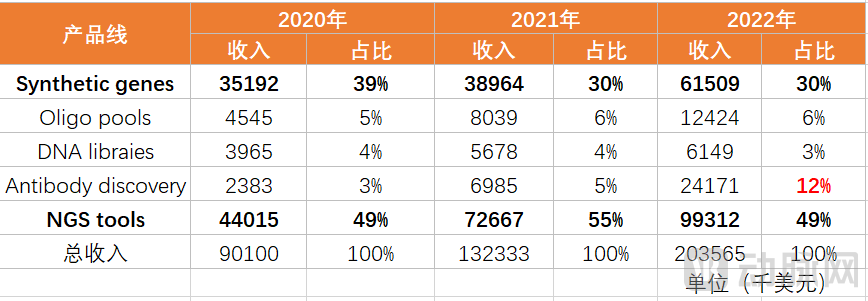
Product Revenue Data Source: Twist Bioscience 2022 Annual Report
In contrast, the antibody discovery product line saw significant revenue growth in fiscal year 2022, with its share rising from 5% in the previous year to 12%. This was driven by Twist Bioscience’s acquisition of Abveris, an antibody discovery services company, in 2021, which boosted revenue from antibody discovery and strengthened the company’s capabilities in biopharmaceuticals.
Abveris leverages its proprietary DiversimAb series of high-immunity mouse models to provide comprehensive antibody discovery and characterization services. The resulting outputs can be humanized using Twist’s antibody optimization solutions to develop high-quality biologics, thereby accelerating clinical development. This acquisition complements and expands Twist Bioscience’s biopharmaceutical antibody capabilities, enabling entry into mouse-based discovery and screening.
At the 2023 J.P. Morgan Healthcare Conference, Twist Bioscience announced a research collaboration with Astellas Pharma to discover antibodies against multiple targets. Under the agreement, Twist Bioscience will identify antibodies for multiple targets selected by Astellas. In addition to an upfront payment and research funding for specific projects, Twist Bioscience is eligible to receive up to $11 million per product upon achievement of specified clinical and commercial milestones. Twist Bioscience will also receive royalties on product sales. Astellas will be responsible for the development, manufacturing, and commercialization of any related products.
Emily Leproust, CEO and Co-Founder of Twist Bioscience, stated that the company will launch its “Fast Genes” product later in 2023. With a faster turnaround time than existing offerings, the product is expected to unlock a $1.4 billion market opportunity.
For fiscal year 2023, Twist Bioscience projects revenue in the range of $261–269 million, broken down as follows: synthetic biology revenue is expected to be $104–106 million, NGS revenue is projected at $120–123 million, and biopharma revenue is anticipated to reach $37–40 million. The company expects its net loss for fiscal year 2023 to widen further to $260 million.
References:
US Stock Unicorn: DNA Synthetic Biology Pioneer, Twist Bioscience - PharmaCircle
Innovation and Development: The Right Time for DNA Synthesis to Set Sail - Asymchem
Twist Bioscience Official Website Financial Report