

Precision Brain Science Founder Bao Huanhuan: A Former Cold Spring Harbor Scientist and Investment Veteran Embarks on a New Journey in the Challenging CNS Field
The Time for Startups in China’s Central Nervous System (CNS) Disease Industry Has Arrived.
Statistics show that over 50 CNS and brain science companies have been established in China in recent years, with more than 20 enterprises in this sector securing financing in 2021 alone. After a decade of waiting, Bao Yanghuan says he has finally found the optimal moment to realize his dream.
Prior to embarking on his entrepreneurial journey full-time, Bao Yanghuan served as an Investment Partner at Mint Angel Fund. The fund’s focus on angel investing and its DNA of fostering original innovation endowed Bao with the ability to remain highly attuned to frontier trends and technological advancements across various fields, enabling him to swiftly identify the golden era in the CNS (Central Nervous System) sector. In early 2023, Bao officially founded Pubaisi Bio (Precision Brain Science), a platform empowering CNS diagnosis and treatment driven by precise brain science data.
From a scientist at Cold Spring Harbor Laboratory, to an early-stage investor in biopharma, and now to launching a second startup tackling the high-risk CNS field—what ups and downs lie behind Bao Yanghuan’s journey? Recently, VCBeat sat down for a conversation with Bao Yanghuan.
In early spring 2009, snow still piled up and biting winds swept across Long Island, New York.
At midnight, along the shore of Long Island Sound, the Cold Spring Harbor Laboratory (CSHL) is scattered across the hillside. Individual buildings are dotted with lights, and through the windows, figures can be faintly seen working.
This is a “Shangri-La” for life sciences, having produced eight Nobel laureates. Among them, James Watson, one of the discoverers of the DNA double helix structure, worked here for many years. According to Bao Yanghuan, young scientists at the institute can live and eat on campus, devoting themselves entirely to exploring the mysteries of life sciences while remaining detached from worldly affairs.
In 2009, Yanghuan Bao joined Cold Spring Harbor Laboratory as the first researcher in the laboratory of Pavel Osten, a professor in the Department of Neurobiology, where he conducted molecular genetic and genomic studies on central nervous system (CNS) diseases, particularly autism and schizophrenia. However, upon entering the lab, he immediately encountered a thorny challenge: the central dogma of molecular biology (from DNA to RNA to protein), co-discovered by James Watson, struggled to explain the pathogenesis of many CNS diseases, thereby hindering progress in related research.
“Each specific external neural stimulus inevitably activates neuronal networks to produce a specific ‘signature pattern.’” Pavel Osten and his fellow scientists decided to adopt a different approach, focusing on the connectivity network of neurons in the brain.
Action speaks louder than words. The most challenging problems often inspire the greatest wisdom and motivation in the brightest minds. Bao Yanghuan participated in developing a fluorescent mouse model that represents neural activity, while his colleagues built a fully automated, high-throughput, high-resolution imaging platform—described as a “traffic light monitoring system” within neuronal networks.
After the solution was implemented, a massive influx of test data poured in continuously. The storage and computational demands quickly saturated the nearly twenty top-of-the-line Mac workstations that Bao Yanghuan had procured. Consequently, he was compelled to adopt a cloud-based model for data storage and computing to monitor and analyze the data.
“If ‘signature patterns’ of efficacy and side effects for various CNS drugs can be identified within neuronal networks, then the efficacy and side effects of these drugs could be predicted before human clinical trials.” This group of “bright minds” continued their brainstorming session. However, as they had never actually developed drugs themselves, they lacked the profound understanding possessed by pharmaceutical scientists regarding the formidable challenges inherent in CNS drug development.
In 1990, the number of CNS drugs and oncology drugs entering Phase I and Phase III clinical trials was comparable. However, due to a lack of new scientific discoveries in the CNS field and high failure rates in clinical trials, many pharmaceutical companies withdrew from the CNS sector. By 2012, the number of CNS drugs entering Phase I clinical trials was only one-third that of oncology drugs, and the disparity was even greater for those entering Phase III (Reference -1).
In 2011, Pavel Osten co-founded Certerra with Seung, a Korean-American professor at Princeton University and a pioneer in brain “connectome” research, to identify “signature patterns” associated with the efficacy and side effects of CNS drugs within neuronal connectivity networks. As one of the three founding employees, Yanghuan Bao participated in the establishment and early operations of Certerra, where he was responsible for biology, while the other two founders oversaw medicine and data analysis, respectively.
This endeavor was akin to “finding a needle in a haystack,” yet Certerra’s scientists gradually uncovered subtle clues linking the efficacy and side effects of CNS drugs within the brain’s neuronal connectivity network, validating the reliability of their predictive models with real-world clinical data. Certerra also enjoyed the good fortune of securing its first major client—Otsuka Pharmaceutical of Japan—for which it provided highly valuable preclinical data support for Brexpiprazole, a drug used to treat schizophrenia and depression (Note: Brexpiprazole was approved for market launch in autumn 2015) (Reference 2).
As of today, Certerra has provided services to numerous CNS drug R&D companies worldwide. Meanwhile, it has begun leveraging its proprietary database and predictive models to screen for new drug candidates. Around the year 2000, the company established a new drug development subsidiary to advance its own CNS pipeline, which is currently approaching the Investigational New Drug (IND) stage.
“A good timing, a great idea, a group of smart people, and a research grant may be enough to solve a major problem,” said Bao Yanghuan.
Certerra’s initial success emboldened Bao Yanghuan, prompting him to further unravel the “puzzles” in this field. At that time, the U.S. and European “Brain Science Initiatives” were on the verge of launch. Policymakers recognized that sustained investment in basic cancer research since the 1970s had yielded a continuous stream of scientific discoveries and technological breakthroughs, helping identify more potential drug mechanisms and targets. Therefore, achieving breakthroughs in brain science and CNS drug development would likewise require increased investment in basic scientific research.
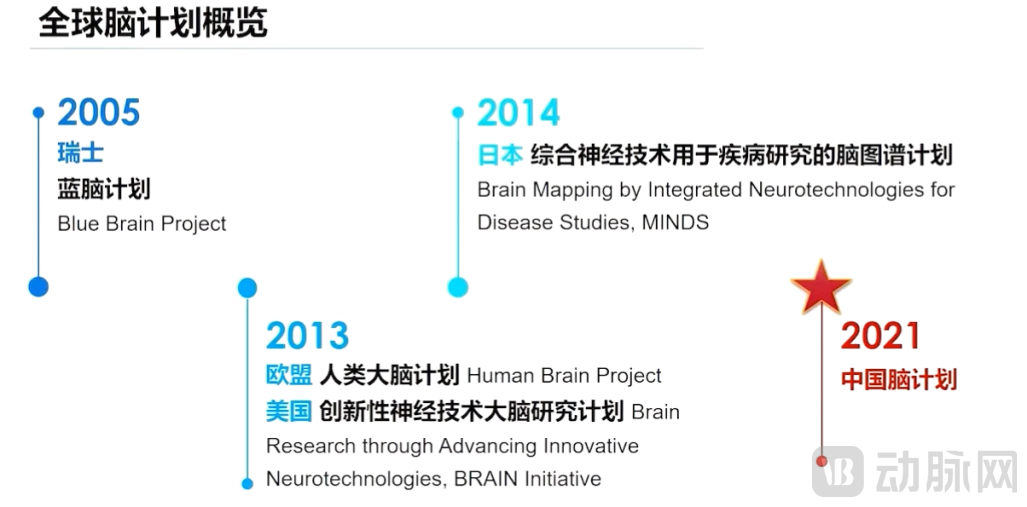
Current Status and Development Trends of Domestic and International Brain Science Initiatives
Image source: Academician Lu Lin (Citation-3)
Bao Yanghuan firmly believes that China will not lag behind in the “Brain Science Project.” In 2012, he returned to China without hesitation to seek such opportunities.
Upon returning to China, Bao Yanghuan was quickly doused with a dose of cold reality. At that time, the domestic market was in the golden age of “me-too,” “me-better,” and fast-follow strategies. From 2013 to 2019, CNS (Central Nervous System) therapeutics attracted little interest within China’s biopharmaceutical startup and investment circles; discussing technological innovation in CNS was seen as largely out of place.
After completing his MBA at Cheung Kong Graduate School of Business, Bao Yanghuan entered the biopharmaceutical venture capital industry. Over the past decade, he has participated in investments in more than 30 biopharmaceutical and healthcare companies, including star projects identified as early as the angel round or first institutional funding round, as well as “unicorns” that delivered substantial returns upon exit through IPOs. Prior to embarking on his full-time entrepreneurial venture, Bao Yanghuan served as an Investment Partner at Mint Angel Fund.
The Bao Yanghuan known to most is a steady biopharmaceutical investor with the demeanor of a scientist, making it difficult to associate him with the “young man from days gone by” who returned from Cold Spring Harbor Laboratory ten years ago, harboring dreams of publishing in CNS journals. Time flies; what exactly happened in between?
In 2019, Bao Yanghuan finally saw the long-awaited rise of interest in CNS disorders. At that time, China’s biomedical startup and investment communities began to focus on CNS disorders and brain science.
The substantial unmet clinical needs and market demand have attracted venture capital (VC) investment in the central nervous system (CNS) field. Both the total investment amount and the number of VC deals in the CNS sector have continued to rise, now second only to oncology. This increased capital influx will inevitably accelerate the research and development of innovative drugs. Since 2019, clinical progress and new drug approvals for CNS therapeutics have entered a turning point.
Big Pharma has also renewed its interest in the CNS field, forming collaborations with biotech companies at early stages of development. Over the past two years, the number of CNS-related transactions has reached half that of oncology deals, including several landmark cases. For instance, in May 2022, Pfizer announced it would acquire Biohaven Pharmaceutical for $11.6 billion in cash, thereby gaining access to the blockbuster marketed migraine therapy Rimegepant (a CGRP-targeting drug) and its pipeline of investigational assets.
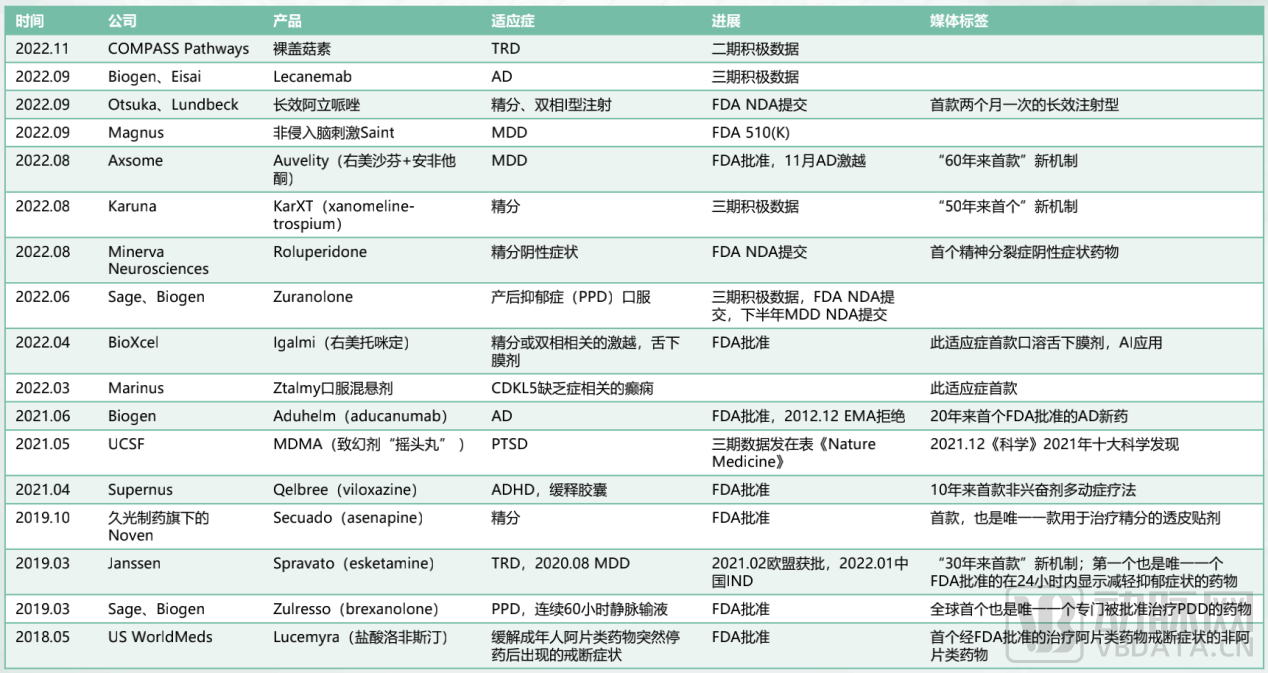
Source: Compiled by Pubai Si Biotech and VCBeat
“The wind is blowing, but it still requires profound technological accumulation and deep industry understanding. On the track of clinical trials, those who reach the finish line are the ‘lone warriors’ who started from the starting line ten years ago. Because this path is not easy, companies must learn to face external ridicule and sarcasm, while maintaining unyielding belief and possessing hard-core technology. Most people fall halfway,” said Bao Yanghuan.
CNS has always been a focal point for Yang Huan, who has been actively seeking investment opportunities in CNS startups. In recent years, Mint Angel Fund has invested in outstanding brain science and CNS companies such as Younao Galaxy. However, he has also noted a severe shortage in China of CNS companies and teams capable of developing innovative products with global competitiveness.
“Why not build a pure and beautiful CNS company based on your own vision?” The long-dormant “spark” in Bao Yanghuan’s heart could no longer be contained.
Fortunately, ten years of investment and post-investment management experience with more than thirty biopharmaceutical and healthcare companies have enabled Bao Yanghuan to develop his own framework for early-stage investment and startup operations, encompassing timing of venture creation, strategic direction and pipeline selection, team building, and financing arrangements.
Therefore, when considering the company’s strategic direction, Bao Yanghuan decided to address the two greatest challenges in CNS drug development. First, preclinical efficacy assessment relies on animal behavioral studies, but data from animal models have poor translatability and fail to accurately reflect the complex physiological data in humans. Second, efficacy evaluation in clinical trials and clinical practice depends on rating scales, which are highly subjective and susceptible to strong placebo effects.
“Take the failure of Relmada Therapeutics as an example. In August and October 2022, Relmada announced that its Phase III trials of REL-1017, a drug for treating major depressive disorder (MDD), had failed both as monotherapy and in combination with standard therapy. The reason was that REL-1017 did not demonstrate statistically significant improvement over placebo on rating scales used to assess depressive symptoms,” Bao Yanghuan told VCBeat.
The experiences at Cold Spring Harbor Laboratory and Certerra, along with the insights from Mint Angel Fund during the establishment of the Suzhou Bohe IT-BT Convergence Innovation Incubation Center, provided Bao Yanghuan with significant inspiration. He decided to start with brain science data and precision medicine to build a “signature pattern” prediction model for the efficacy and side effects of CNS drugs, similar to Certerra’s approach.
Ten years ago, when Certerra was founded, data in the fields of brain science and precision medicine were extremely limited, forcing the company to first establish its own animal models and imaging platforms to generate data. AndOver the past decade, the accelerated accumulation of neuroscience data in the era of precision medicine has significantly expedited the development of predictive databases and models.If drug efficacy and side effects can be effectively predicted in both preclinical and clinical settings, reliance on animal behavioral studies for preclinical efficacy evaluation will be reduced. This aligns precisely with the recent FDA trend of “no longer requiring animal testing before clinical trials” and “reducing unnecessary animal testing.” The current clinical practice of evaluating efficacy through rating scales will also be improved, potentially even enabling the exploration of “virtual clinical trials.”
Pubaisi Biotech was born in response to this demand.For CNS disorders with high incidence rates and significant unmet medical needs, such as depression, schizophrenia, addiction, and Alzheimer’s disease, the company has developed a precision brain science database and models. By integrating data from biomarkers, omics, and imaging, and leveraging precision medicine models and tools, it predicts drug efficacy, stratifies patients, and identifies novel targets and therapeutics to enhance the probability of clinical success.
Globally, precision medicine data-driven CNS drug development companies such as Neumora Therapeutics, Alto Neuroscience, and Verge Genomics are leading the future development trends in the CNS field to a certain extent.
In January 2023, the Phase IIa clinical trial results for the antidepressant ALTO-100, released by Alto Neuroscience (which demonstrated significant differences in efficacy between patient subgroups stratified with and without biomarkers), provided the first evidence that data-driven metrics can be used to prospectively identify subjects likely to respond to new drugs in clinical trials for central nervous system (CNS) disorders.
Theoretically, no matter how advanced a technological platform is, its value is difficult to assess without clinical validation.Pubaisi Biologics is building a global pipeline of innovative therapeutic and diagnostic products, empowered by its proprietary database and predictive models of “signature patterns” for the efficacy and side effects of CNS drugs.
“At present, the CNS small-molecule drug pipeline that our company is building will feature GPCR targets and inflammatory mechanisms as its key differentiators and entry points. We warmly welcome other companies with CNS pipelines to engage in deep collaboration with Pubio,” said Bao Yanghuan at the end of the interview.
Citation:
1.Kesselheim AS, Hwang TJ, Franklin JM. Two decades of new drug development for central nervous system disorders. Nat Rev Drug Discov. 2015;14(12):815-816. doi:10.1038/nrd4793
2.Novel brain-mapping technology could revolutionise pre-clinical drug screening. Retrieved January 16, 2023
3. Academician Lu Lin: Current Status and Development Trends of Brain Science Initiatives in China and Abroad.