

FDA Signals Shift in Regulatory Priorities with Four New Drug Approvals at Start of 2023

In January 2023, four new drugs received FDA marketing approval.
On January 7, Leqembi (lecanemab), a new drug for the treatment of Alzheimer’s disease (AD) jointly developed by Eisai and Biogen, received FDA approval for marketing, becoming the second new AD therapy approved in nearly two decades. On January 24, the FDA approved Brenzavvy, an oral SGLT2 inhibitor, for the treatment of type 2 diabetes. On January 27, two new drugs were approved: Jaypirca, a non-covalent BTK inhibitor, received accelerated FDA approval for the treatment of relapsed or refractory mantle cell lymphoma (MCL); and Orserdu was approved for the treatment of HER2-negative, ESR1-mutated advanced or metastatic breast cancer, becoming the first oral SERD agent approved by the FDA.
Meanwhile, on January 19, the New Drug Application (NDA) for obeticholic acid in the treatment of non-alcoholic steatohepatitis (NASH) was accepted by the FDA. In this therapeutic area, which has lacked approved treatments for decades, obeticholic acid is poised to become the first approved therapy later this year.
These new developments announced earlier this year reflect, to some extent, the FDA’s increasingly clear direction in new drug approvals: a growing number of first- and second-in-class therapies for various diseases are being approved. In addition to conditions that pose serious life-threatening risks or significantly impair quality of life, non-life-threatening age-related diseases, chronic conditions, and neurological disorders have also become key focus areas for the FDA’s new drug approval process.
This article systematically reviews and summarizes the new drugs approved by the FDA in the past two years.
Over the past two years, the FDA has approved nine first-in-class drugs, representing a multiple-fold increase in number.
A review of new drugs approved over the past two years reveals a growing number of first-in-class approvals for new indications or innovative therapies, many of which carry landmark significance.
In June 2022, baricitinib, an oral JAK inhibitor co-developed by Eli Lilly and Incyte, was approved for the treatment of adult patients with severe alopecia areata, marking the first systemic therapy approved by the FDA for this condition. In September, Boehringer Ingelheim’s therapy for rare psoriasis received marketing approval, becoming the first FDA-approved treatment for generalized pustular psoriasis (GPP) flares in adults. In October, Relyvrio, a drug for amyotrophic lateral sclerosis (ALS) developed by Amylyx Pharmaceuticals, was approved as the first therapy to both significantly slow disease progression and functional decline and extend patient survival. In November, the first fecal microbiota therapy received FDA approval.
Looking further back, drugs such as Aimovig for migraine treatment, Vuity for presbyopia, and Clascoterone for acne were successively approved and launched, all being the first of their kind globally.
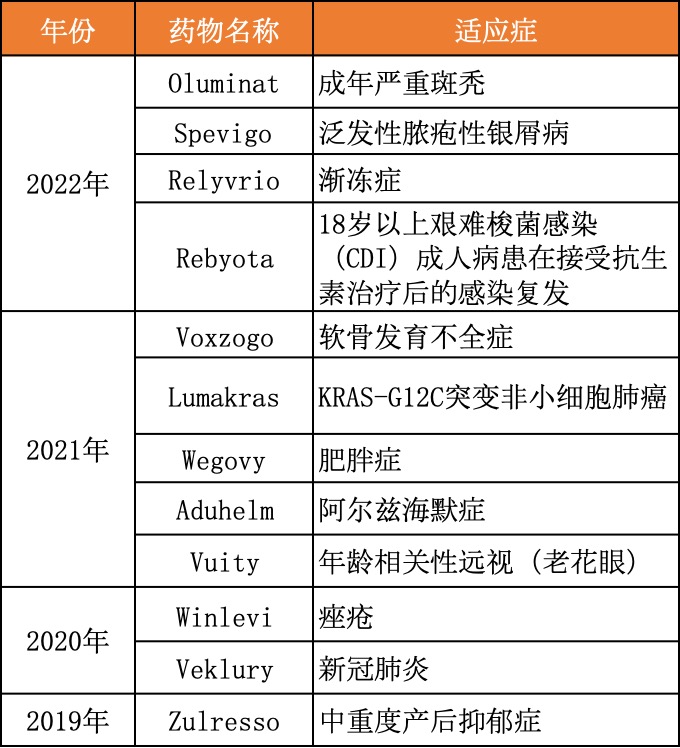
First New Drugs and Innovative Therapies Approved by the FDA for New Indications in the Past Four Years
VBInsight has compiled statistics on the first new drugs approved by the FDA for new indications over the years, revealing that the number of such approvals in the past two years is already three times the combined total for 2019 and 2020. This underscores the FDA’s heightened attention to persistent and emerging unmet clinical needs, demonstrating its commitment to supporting pharmaceutical companies in intensifying drug development efforts to address these gaps.
Of course, the approval of a first-in-class drug is often accompanied by controversy. It is precisely within these debates that the FDA’s clear stance and position become more evident.
Taking Alzheimer’s disease (AD) drugs as an example, in 2021 the FDA approved Aduhelm, a new AD medication developed by Biogen. This was the first new therapy approved for Alzheimer’s disease since 2003 and the first treatment targeting the underlying pathophysiology of the condition. However, the drug faced immediate skepticism from industry experts, casting doubt on the FDA’s credibility as a regulatory agency and overshadowing the dominant “beta-amyloid (Aβ) deposition” hypothesis that underpins such drug development efforts.
Nevertheless, the approval of Alzheimer’s disease (AD) therapies has not stalled; the first drug approved in 2023 was a novel AD treatment. The approvals of the first two new drugs reflect the nearly two-decade-long therapeutic void faced by tens of millions of Alzheimer’s patients worldwide, as well as the setbacks encountered by numerous pharmaceutical companies in this field. In light of this substantial unmet clinical need, the FDA must take action to encourage pharmaceutical companies to pursue the research and development of such therapies.
This principle is also clearly reflected in the NASH field, which boasts a market potential worth tens of billions of dollars. Currently, the FDA has not approved any medications for NASH. Previously, obeticholic acid was required by the FDA to carry a black box warning in its labeling due to safety concerns. Recently, there has been considerable positive news in this area, with the most notable development being the FDA’s acceptance of the New Drug Application (NDA) for obeticholic acid in the treatment of NASH.
Non-Life-Threatening Indications Are the New Focus of Regulatory Approval
In 2022, the FDA approved new drugs for market launch in areas such as chronic diseases, dermatological conditions, and neurological disorders, with a focus on non-life-threatening conditions including diabetes, atopic dermatitis, and insomnia.
VBInsight compiled statistics on FDA-approved drugs for non-life-threatening conditions in 2021 and 2022. In 2022, 12 such drugs were approved, accounting for 32% of the total, compared with 9 drugs (18%) in 2021.
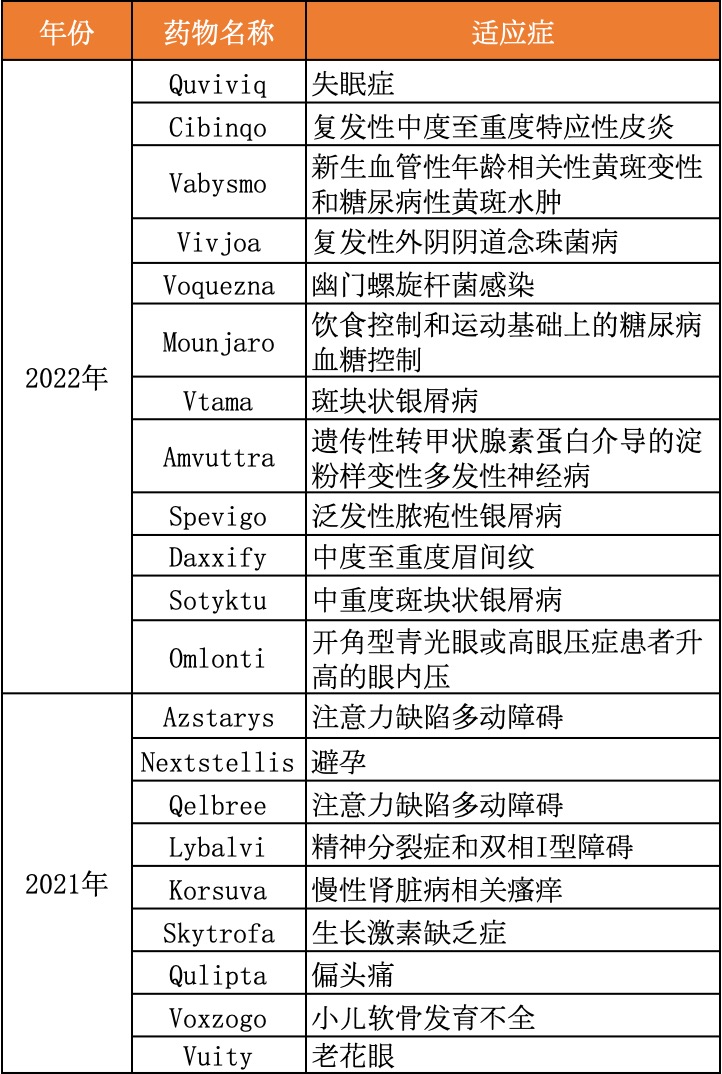
Non-Fatal Disease Therapeutics Approved by the FDA in 2021 and 2022
From the new presbyopia drug approved in late 2021 to the novel therapies for alopecia areata and other conditions approved in 2022, these developments demonstrate that as the population ages, society becomes increasingly aged, lifestyles change, and modern scientific understanding deepens, treatments are gradually emerging for diseases previously considered untreatable or not requiring treatment. New clinical needs continue to arise.
Among the 37 new drugs approved by the FDA last year, 10 were oncology drugs, accounting for 27%. Although oncology remained the therapeutic area with the highest proportion of new drug approvals, the number of approvals has shown a downward trend compared to 18 in 2020 and 13 in 2021.
A former senior FDA reviewer, who served at the agency for seven years and continues to closely monitor its new drug approval trends, has confirmed this trend to VCBeat New Medicine. According to his statistics,The number of FDA-approved oncology drugs has shown a year-on-year decline over the past decade.The reason is that with an increasing number of oncology drugs currently approved, the development of new oncology therapeutics has become progressively more challenging. Meanwhile, emerging expectations suggest that certain cancers will trend toward becoming chronic conditions over the next 10 to 15 years, which will further elevate the difficulty of oncology drug development. Among foreign pharmaceutical companies, the number of new drug projects targeting oncological diseases has already begun to decline.
In contrast, in China, oncology remains the primary focus for pharmaceutical companies, while R&D for other drugs with unmet clinical needs appears to be only just emerging.The former FDA reviewer also revealed that among the pharmaceutical companies that have launched drugs in China in recent years, more than half are oncology-focused. Among new drugs submitted for approval in both China and the United States by Chinese pharmaceutical companies, oncology drugs still account for the highest proportion.
In VCBeat’s interviews with startup pharmaceutical companies over the past year, “unmet clinical needs” has become a phrase emphasized by nearly every enterprise, marking a shift from the previous years’ focus on validating “new modalities.” However, there is still a long way to go for the industry to fully implement a clinical-need-driven approach.
As a regulatory authority, the FDA’s approvals serve as an industry bellwether. While continuously encouraging innovation within the sector, its core focus remains steadfastly guided by unmet clinical needs.
A former FDA reviewer with approximately a decade of experience at the agency explained to VCBeat that the FDA has established the Emerging Technology Program in recent years. This initiative aims to coordinate interdepartmental consensus on the acceptance of new technologies and therapeutic modalities, thereby facilitating the rapid approval of these novel therapies. The program seeks to prevent innovative technologies from being hindered from clinical application due to excessive regulation.
Whether implementing new regulatory measures or approving the market launch of innovative drugs, the FDA’s innovation-friendly and open-minded approval stance has created opportunities for the clinical application of novel therapies and provided genuine room for corporate growth. Meanwhile, this has also highlighted to China’s biopharmaceutical industry the greater potential and feasibility of developing new therapies for novel indications, which not only helps domestic pharmaceutical companies broaden their R&D perspectives but also plays a crucial role in stimulating the industry’s enthusiasm and confidence in pursuing innovation.