

Reachfun Launches Digital Therapeutics for Cognitive Disorders Amid China's Aging Crisis
“Li Juan, a researcher and doctoral supervisor at the Institute of Psychology, Chinese Academy of Sciences, has noted that by the age of 85, one in three people may have dementia. If we are fortunate enough to live to 95, the figure rises to one in two.”
Data from the Seventh National Population Census show that China’s population aged 60 and above has reached 264 million. As population aging intensifies, elderly care issues have become increasingly prominent. China primarily implements the “9073” elderly care model, under which 90% of older adults are cared for by their families, 7% receive community-based home care services, and 3% reside in institutional care facilities. However, high costs of institutional care and insufficient medical and nursing resources for home-based health and eldercare have led to the gradual social “neglect” of older adults, particularly those with cognitive impairments.
As of early 2022, there were more than 53 million individuals aged 60 and above in China with cognitive impairment, including 15.07 million patients with dementia and 38.77 million patients with mild cognitive impairment (MCI). In the current context of limited effective medical interventions, digital therapeutics make it possible to deliver treatment anytime and anywhere.
Beijing Ruifan Technology Co., Ltd. (hereinafter referred to as “Ruifan Technology”) focuses on cognitive impairment, entering the tracks of digital therapeutics and digital rehabilitation. By leveraging digital technologies and gamified products, it provides personalized treatment anytime and anywhere, thereby enhancing users’ cognitive abilities.True to its name, Ruifan (Reachfun) adds joy to users’ lives and gives the remaining years of the elderly more “depth.”
“Fighting monsters and leveling up” is how Jiang Hai, founder of Ruifan Technology, summarizes his past academic and professional journey.
He comes from a family with a strong background in computer science. He majored in communication software and, upon graduation, successfully joined a top-tier telecommunications company. Starting as an assistant engineer, he advanced to chief engineer before transitioning into management, where he led a team of over 1,000 people. Over the course of 20 years, he dedicated ten years to mastering technology and another ten to honing his management skills.
In 2018, he resolved to change his way of life, resigning from his job to start a business and step out of his comfort zone. Determining the company’s positioning and strategic direction posed a significant challenge. At its inception, Ruifan Technology initially followed the conventional path by developing new technologies and creating products related to cloud-network convergence. At that time, the healthcare industry was undergoing digital transformation, with innovative digital technologies holding great promise for addressing issues such as the unequal distribution of doctor-patient resources and talent shortages. Meanwhile, as his parents aged, he became increasingly aware of the severity of China’s elderly care challenges. Why not leverage his own advantages to undertake initiatives that would bring greater benefit to society?
Ultimately, Ruifan Technology, founded by a group of tech enthusiasts, chose to enter the elderly care sector, where there is market demand and a product gap. “We combine knowledge, technologies, and methods from different fields to achieve cross-disciplinary innovation. If a problem can be resolved with a single surgery or a medication, then digital therapeutics are not necessary,”We aim to leverage digital technologies such as XR, 5G, and artificial intelligence, building upon clinically validated medical theories, to alleviate the shortage of healthcare resources.。”
Ruifan Technology'sCore members have extensive experience in virtual reality, cloud computing networks, and artificial intelligence.. Meanwhile, the company places great emphasis on medical-engineering collaboration,Collaborations established with renowned hospitals such as Beijing Xuanwu Hospital and Peking University Sixth Hospital, closely collaborating across all stages from early product development and testing to clinical trials, ensuring that digital health products remain true to their medical essence.
Cognitive impairment is the first major hurdle that Ruifan Technology must overcome. Cognitive impairment is a chronic condition that severely affects patients' quality of life. Mild cognitive impairment (MCI) does not yet meet the diagnostic criteria for Alzheimer's disease; early diagnosis and intervention hold promise for alleviating symptoms and reducing the rate of progression to dementia.
Within hospital settings, interventions such as memory training, cognitive training, and activities of daily living (ADL) skills training are conducted based on the theory of neuroplasticity; however, their accessibility remains limited due to costs associated with expenses and manpower. Digital therapeutics for non-pharmacological intervention offers a superior solution, essentially representing a novel therapeutic and rehabilitative approach grounded in evidence-based medicine. Similarly, leveraging the theory of neuroplasticity, Ruifan Technology organizes existing training methods into effective information streams delivered to patients to achieve cognitive stimulation.
The company’s “XinYiTong” series of digital therapeutics products adopts an integrated hardware-software approach, delivering cognitive training through gamified designs that target multiple dimensions, including memory, thinking, language, mathematics, and sensory perception.
The product is algorithm-centric, intelligently delivering targeted training programs tailored to each user’s preferences, status, and capabilities at different stages, while simultaneously formulating personalized treatment plans based on training outcomes.Difficulty can be dynamically adjusted in real time during single-task training, with assessment data provided for each session; historical training data can also be stored in the cloud to establish a closed loop of assessment–treatment–reassessment.Furthermore, the third-party care provider can monitor and manually adjust the user’s treatment regimen, thereby integrating the user’s therapeutic process both within and outside the hospital.
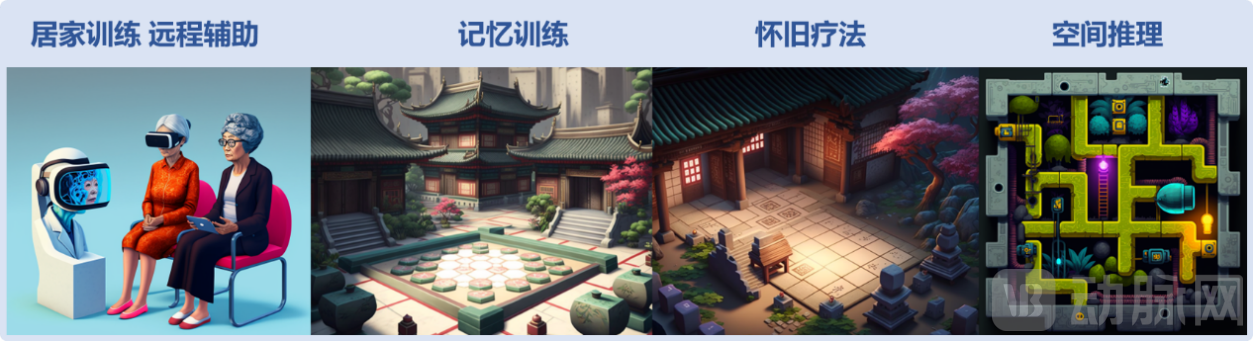
“Xin Yi Tong” leverages advanced technologies such as virtual reality (VR), 5G, image recognition, and edge computing. VR stimulates users’ visual and auditory senses, providing patients with an immersive experience and a sense of human-computer interaction, while 5G technology ensures efficient, real-time connectivity. Ruifan Technology has established a flexible architecture that allows product functions and forms to be adapted to different scenarios both inside and outside hospitals, with a current emphasis on portable applications for home-based care.
Currently,The “Xinyitong” series of products is still in the user testing phase.. As an emerging therapeutic approach, digital healthcare requires continuous enhancement of user experience through gamified design to ensure treatment efficacy.“User Experience Is Paramount”, Ruifan hopes to first ensure its effectiveness, optimize user experience, and simultaneously validate it in medical scenarios. “We will carefully refine the product before launching it to the market.”
Ruifan Technology believes that, unlike traditional medical devices and pharmaceutical products, digital therapeutics should ensure user stickiness by providing high-quality services. For instance, in weight loss through exercise, although weight reduction can be achieved via reasonable workouts and controlled caloric intake, more than half of individuals ultimately fail to reach their goals. Without external intervention, outcomes vary significantly depending solely on patients’ own initiative and persistence. Ruifan Technology focuses on how to help users maintain adherence, designing its products with a service-oriented approach.
In the future,Ruifan Technology will leverage the advantages of digital technologies while staying grounded in the essence of healthcare, continuously introducing cutting-edge technologies such as facial expression recognition and olfactory recognition to expand its product portfolio, including digital therapeutics for cognitive rehabilitation and companion robots. Meanwhile, the company plans to broaden its target user base by extending its focus beyond the elderly to address cognitive issues in children.
“Ruifan Technology remains optimistic about the application of innovative digital technologies in the healthcare sector. Digital health has developed rapidly in developed regions such as the United States, whereas it is still in its early stages in China. Physicians at primary-care hospitals often lack awareness of digital therapeutics, yet patients in extensive grassroots areas have a greater need for home-based rehabilitation services. The integration of medical care and elderly care requires collaborative efforts among the government, hospitals, and enterprises.”
In the digital therapeutics sector, Jiang Hai evaluates Ruifan Technology with the saying, “No effort is too great to overcome, no collective wisdom too vast to succeed.” Starting from the user perspective and leveraging digital technologies, the company adheres to evidence-based medicine to enhance the accessibility of medical resources. Along its journey, the company aims to bring together partners across the upstream and downstream industry chain and seek more like-minded collaborators.