

Tsinghua University Tops China's University Tech Transfer Rankings with Comprehensive Innovation Ecosystem

Tsinghua Innovation Ventures
Professional Investment Institutions for Industrialization of Scientific and Technological Achievements
If one is to examine the commercialization of scientific and technological achievements in China, Tsinghua University is an unavoidable focal point.
In the 2022 rankings of the “2021 Annual Report on the Transformation of Scientific and Technological Achievements in China,” jointly compiled by institutions including the National Center for Science and Technology Evaluation, Tsinghua University ranked first among all Chinese universities in terms of the total monetary value of transformed scientific and technological achievements.
Public data shows that from 2015 to 2020, Tsinghua University transferred 2,889 patents, signed 516 technology transfer contracts, and achieved a total transfer value of RMB 2.998 billion (with RMB 848 million actually received), while spinning off 218 enterprises. A number of key scientific and technological achievements in disciplines and industrial fields such as electronic information, life and health, high-end equipment, and new materials have been successfully commercialized. To some extent, Tsinghua University has become synonymous with innovation, openness, and exploration in the commercialization of scientific and technological achievements.
Why Has Tsinghua University Become the Benchmark for Commercializing Academic Research Achievements Among Chinese Universities? In addition to its robust research capabilities, the university’s emphasis on and encouragement of research outcomes, along with its comprehensive policies, platform development, and operational systems, are indispensable.
As early as 2009, Tsinghua University issued the “Several Provisions of Tsinghua University on Promoting the Transformation of Scientific and Technological Achievements,” which clearly stipulated that individuals and teams contributing to scientific and technological achievements would share in the benefits derived from their commercialization. At that time, the regulations allocated 40% of the proceeds or equity from such commercialization to the concerned individuals and teams. Although implementation proved challenging at the operational level, this document marked the first step in establishing Tsinghua University’s policy framework for the transformation of scientific and technological achievements.
By 2015, the construction of Tsinghua University’s technology transfer system had reached a new milestone.
First, the revised "Law on Promoting the Transformation of Scientific and Technological Achievements" was promulgated at the national level. This legislation clarified the rights and obligations of innovation entities regarding the transformation of scientific and technological achievements at the institutional level, reformed the management systems for the use, disposal, and income distribution of such achievements, and increased the reward ratio for scientific and technical personnel involved in their transformation. This law has driven a series of breakthroughs in policies and regulations, marking the initial formation of a system for transforming scientific and technological achievements adapted to China's current stage of development.
In the same year, Tsinghua University issued the “Measures for the Evaluation, Disposition, and Distribution of Benefits from Scientific and Technological Achievements at Tsinghua University” (hereinafter referred to as the “Measures”), which clarified decision-making processes, incentive mechanisms, and procedural requirements for the commercialization of scientific and technological achievements. The Measures specified procedures for the commercialization of achievements based on different transaction amounts and established a benefit distribution mechanism that allocates the majority of rewards from commercialization to the creators of the achievements or individuals who have contributed to them.
Certainly, within the overall allocation framework, Tsinghua University also encourages its various departments and schools to formulate distribution policies tailored to their specific characteristics and local conditions. For instance, some departments emphasize organized scientific research; in such cases, the share of revenue from technology transfer achievements allocated to the department is increased accordingly. These funds are used to reward faculty members who have made outstanding contributions to scientific and technological achievements and to support strategic planning for future development.
The following year, the “Tsinghua University Intellectual Property Management Regulations” (hereinafter referred to as the “Regulations”) were promulgated, clarifying the centralized administration of intellectual property (IP) management for university achievements, addressing ownership issues related to IP and copyright, and standardizing the ownership and use of Tsinghua University’s relevant trademarks. Conceptually, the document aims to prioritize the protection, management, and commercialization of intellectual property, advocating for standardized practices and protection throughout the creation process. It constitutes an important component of Tsinghua University’s policy framework for the commercialization of scientific and technological achievements.
In 2018, the “Detailed Rules for the Record-filing of Evaluation of Tsinghua University’s Scientific and Technological Achievements” (hereinafter referred to as the “Rules”) were reviewed and approved at a meeting of Tsinghua University’s Intellectual Property Management Leadership Group. In addition to strengthening the management of the university’s state-owned assets, the Rules standardize and clarify the process management for evaluating the value of technological achievement transformation, as well as the centralized administration and procedures for such evaluations. Furthermore, for technological achievement transformation projects involving transfer or equity contribution through valuation, the Rules emphasize the requirements for price evaluation and record-filing. Specifically, these projects must engage qualified asset appraisal institutions to conduct asset valuations of the scientific and technological achievements and complete the requisite record-filing procedures for such appraisals.
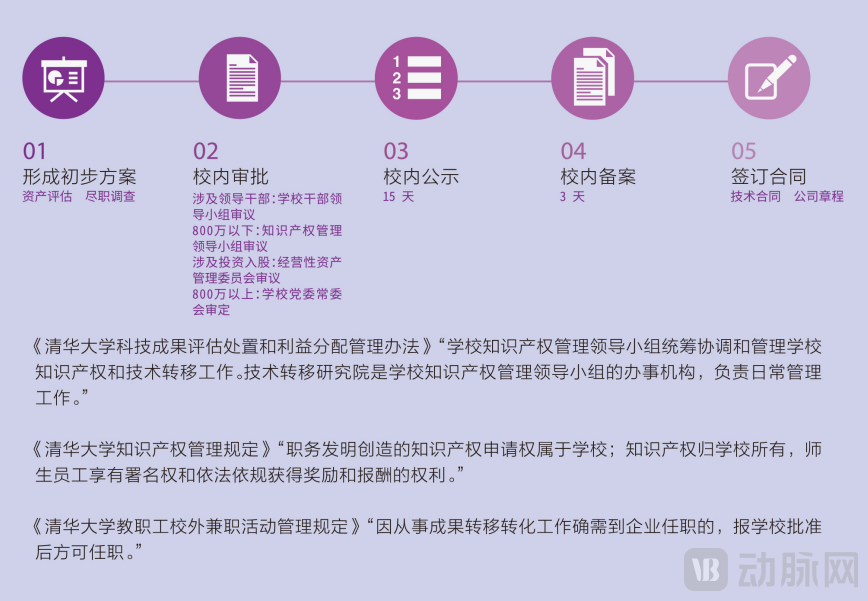
▲ Approval Process for Technology Transfer Proposals. Image source: Tsinghua University Handbook on Scientific and Technological Achievement Transformation Services
To strengthen and standardize the management of state-owned assets, Tsinghua University issued the "Regulations on the Management of State-Owned Assets of Tsinghua University" in 2021. The document stipulates requirements for the allocation, management, and reporting of changes in state-owned assets. It also clarifies that the Office of Domestic Cooperation is responsible for coordinating the management of state-owned assets for local research institutes and dispatched research institutes, under the professional guidance and supervision of the university’s centralized department for state-owned asset management.
Moreover, Tsinghua University has promulgated a series of regulations concerning the approval of technology transfer and assignment, faculty members’ external part-time activities, and the implementation measures for equity participation based on the valuation of scientific and technological achievements. For instance, the Due Diligence Measures for the Disposal of Scientific and Technological Achievements at Tsinghua University standardizes the responsibilities and procedures for due diligence, establishing a code of conduct for investigations into the status of target technologies, the profile of technology transferees, the analysis of transaction proposals, and the compliance of approval processes. Additionally, the Administrative Provisions on External Part-Time Activities for Faculty and Staff at Tsinghua University regulates the classification and approval of external part-time work, time allocation and compensation for such activities, the management of leave-of-absence entrepreneurship and innovation related to the commercialization of scientific and technological achievements, and associated liabilities...
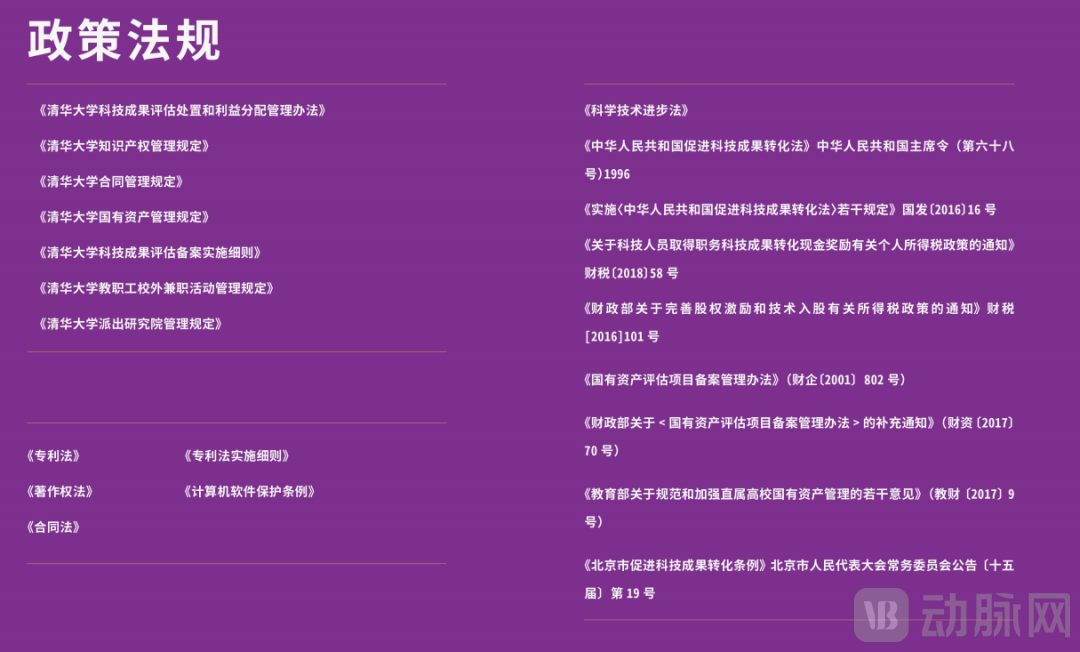
▲ Policy and regulatory framework. Image source: Tsinghua University Technology Transfer Service Handbook
The policy framework serves as the operational structure for the commercialization of research outcomes; the promulgation of these laws and regulations provides guidance and a legal basis for universities’ technology transfer activities. On the other hand, universities’ efforts to build their technology transfer systems represent proactive exploration.
Tsinghua University was among the first domestic universities to establish a comprehensive technology transfer system. Since 2015, it has set up specialized entities to promote the commercialization of scientific and technological achievements, including the Leading Group for Intellectual Property Management, the Office for Achievement and Intellectual Property Management, the Institute for Technology Transfer, and the Office for University-Local Government Cooperation. In addition to building these functional departments, the university has collaborated with local governments in multiple regions to establish various local entities and dispatched research institutes, further advancing the commercialization of its achievements through secondary development and enterprise incubation.
In terms of management systems, the university has incorporated institutional development into its overall strategic plan for institutional advancement, strengthening unified coordination. The Intellectual Property Management Leadership Group is responsible for providing unified leadership over the university’s technology transfer and intellectual property (IP) activities. This group comprises university leaders in charge of scientific research, industry engagement, and university–local government cooperation, as well as heads of multiple departments including the Technology Transfer Institute, the Assets Management Office, and the Scientific Research Academy. It coordinates the management of university departments involved in IP and technology transfer and oversees their operations.
■ 1. Office of Achievement and Intellectual Property Management
In 2015, by studying and drawing on the operational models of technology licensing offices at renowned foreign universities, Tsinghua University established the Office of Technology Licensing (hereinafter referred to as “OTL”). As the daily administrative body of the University’s Intellectual Property Management Leadership Group, OTL performs functions in four areas: scientific and technological awards, patent management, technology transfer, and policy and legal affairs. Its responsibilities have shifted intellectual property management from a focus on “achievement management and quantity” to an emphasis on “quality and value realization.” Within the workflow for achieving the commercialization of scientific and technological achievements, OTL serves as an intermediary bridge. Leveraging its authority as an internal department, it effectively connects faculty members’ research outputs with corporate needs on one end, while managing the disposition and licensing of patent achievements on the other.
■ 2. Institute of Technology Transfer
If the establishment of the Office of Technology Licensing (OTL) is aimed at shifting the focus of achievement transformation from “quantity” to “quality,” then the establishment of the Institute for Technology Transfer is intended to promote the industrialization of major innovative achievements. Founded in 2014, Tsinghua University’s Institute for Technology Transfer is responsible for the university’s achievement transformation and the management of related intellectual property rights, including patents, copyrights, and technical secrets. As a supporting unit of Tsinghua University, the Institute operates under the direct leadership of the Intellectual Property Management Leadership Group. It comprises several divisions, including the Intellectual Property Office, the Technology Transfer Office, the External Cooperation Office, and the General Administration Office, which are specifically tasked with intellectual property management, patent examination, international patent applications, patent quality control, publication management, and technology transfer.
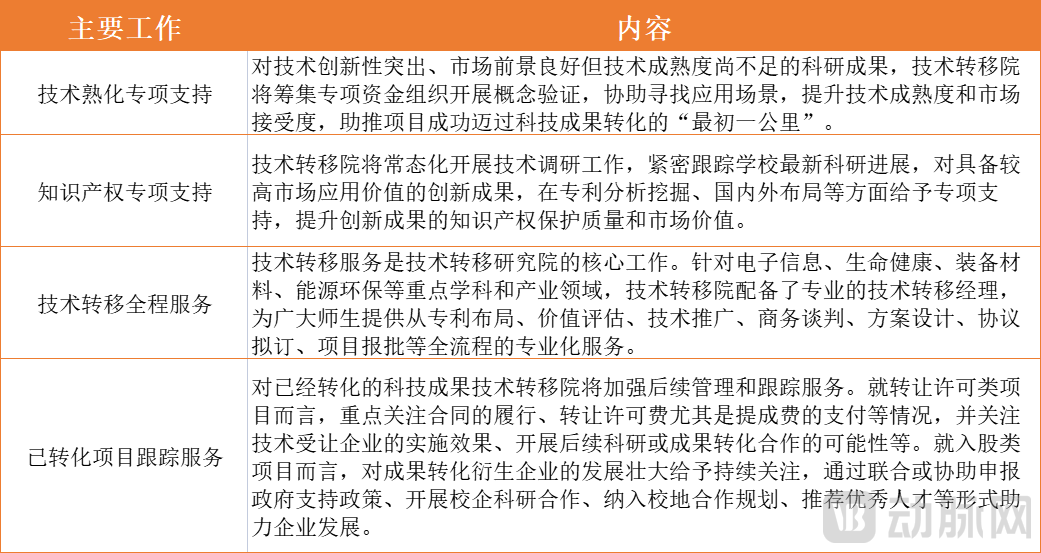
▲ Main Responsibilities of OTT, Source: Tsinghua University Technology Transfer Service Handbook
It is worth noting that, in addition to the division of labor within technical transfer work categories, the Technology Transfer Office has established senior executive positions corresponding to key areas where Tsinghua University’s technology transfer activities are particularly intensive. These areas include big health, materials and high-end equipment, electronic information, semiconductors, and intelligent connected vehicles. A Tsinghua University researcher-turned-entrepreneur once told VCBeat that, beyond researchers proactively seeking assistance from the Institute of Technical Transfer, the institute also takes the initiative to identify researchers whose achievements show potential for commercialization. It then assigns dedicated personnel to manage the commercialization of their outcomes and handle related intellectual property matters.
■ 3. Academy of Sciences
Tsinghua University Research & Development Affairs Office is an administrative functional department of the university, responsible for the centralized management of scientific research and related activities. Its primary functions include formulating and implementing research-related plans, advancing strategic layout initiatives for scientific research, and organizing, managing, and providing services for research projects, research institutions, technological collaborations, and science and technology awards.
In addition to overseeing the planning of National Key R&D Programs, Major Special Projects, ministerial and commission-level projects, and university-funded research initiatives, as well as managing the recognition and allocation of research funds, the Research Institutes are also responsible for the recognition and allocation of horizontal technology contracts, certification of technology contracts, and university-local government scientific and technological cooperation. For overseas projects, they handle international science and technology exchanges and collaborative expansion involving university-enterprise, university-local government, and inter-university partnerships, along with related fund recognition, allocation, and technology contract certification.
Moreover, the management of government-approved research institutions, independently established research entities, jointly built research platforms, interdisciplinary research organizations, and applications by faculty members for open projects in off-campus laboratories, as well as the submission of nominations for national, Ministry of Education, and local science and technology awards, are primarily overseen by the Research Institute. Compared to the two departments mentioned earlier, the core function of the Research Institute is actually to generate and facilitate the generation of research outcomes, which can be vividly likened to the upstream counterpart of OTL (Office of Technology Licensing) and OTT (Office of Technology Transfer).
■ 4. University-Local Government Joint Research Institute
University-local government collaboration is also a crucial pathway for promoting the translation of scientific and technological achievements. Tsinghua University’s university-local government science and technology cooperation began in the early 1980s. In recent years, with the national implementation of strategies such as the Western Development Program, the Revitalization of Northeast China’s Old Industrial Bases, and the Rise of Central China, the University has intensified its in-depth cooperation with regions aligned with national strategic development. As a result, university-local government science and technology cooperation has further expanded, covering areas such as regional economic and social development strategies, joint training of innovative talent, development of local characteristic and pillar industries, construction of innovation platforms, joint key scientific and technological breakthroughs, and promotion of international cooperation.
Currently, this work is primarily undertaken by the Office of Domestic Cooperation, which operates under the auspices of the President’s Office. This office coordinates and oversees comprehensive collaborations between the university and domestic partners, including central government ministries and commissions, local governments, enterprises, other universities, and public institutions. It is responsible for the execution and management of comprehensive cooperation agreements with these partners, oversees the signing of letters of intent (memoranda) for domestic cooperation by secondary units of the university, and carries out activities related to the planning, liaison, and research of domestic cooperation initiatives.
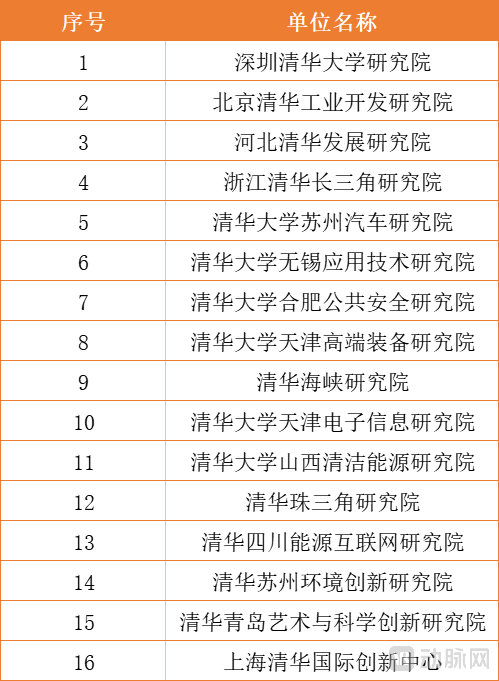
University-Local Government Cooperation Research Institutes serve as a key platform for collaboration between universities and local governments, a vital channel for the transformation and application of scientific and technological achievements, and an important support for discipline construction and development. Aligned with major regional strategies—including the coordinated development of the Beijing-Tianjin-Hebei region, the development of the Guangdong-Hong Kong-Macao Greater Bay Area, the integrated development of the Yangtze River Delta, ecological protection and high-quality development in the Yellow River Basin, and the construction of the Chengdu-Chongqing Twin City Economic Circle—Tsinghua University has established a total of 16 University-Local Government Cooperation Research Institutes. These entities are all secondary units under Tsinghua University.
■ 5. Tsinghua Holdings
Tsinghua Holdings is a state-owned wholly-owned enterprise and an authorized operator of state-owned assets, established with capital contribution upon approval by the State Council on the basis of integrating various enterprises founded by Tsinghua University. Its predecessor was Tsinghua University Enterprise Group.
As a key component of the university’s efforts to promote the commercialization of scientific and technological achievements, Tsinghua Holdings plays a leading role in formulating Tsinghua University’s industrial development strategy, integrating and restructuring resources, and coordinating interests. It serves as the decision-making and management center for major business activities, including industrial investment and financing, technology development, achievement commercialization, incubation of high-tech enterprises, foreign trade, and economic and technical cooperation. Through years of exploration and practice, Tsinghua Holdings has initiated a series of strategic transformations, combining high technology with modern finance. By leveraging self-accumulation, mergers and acquisitions, incubation, and other approaches, it has achieved historic leapfrog development, accelerating the industrialization of scientific and technological achievements through the establishment of financial platforms and investment companies.
Institutions such as the Office of Technology Licensing (OTL), the Office of Technology Transfer (OTT), the Academy of Sciences and Technology, the University-Local Government Cooperation Office, the Institute for Technology Transfer, and Tsinghua Holdings have jointly established a working system for the transfer and commercialization of technological achievements. Wang Yan, Dean of the Institute for Technology Transfer at Tsinghua University, once stated, “If we compare Tsinghua University’s technology transfer and commercialization system to a solar system, then Tsinghua University is the sun. Departments such as local institutes and dispatched institutes revolve around the university’s development goals to promote the overall transformation of academic achievements, while also carrying out innovation services tailored to the regional economic and industrial development of their respective locations. Thus, they engage in both ‘orbital revolution’ and ‘axial rotation.’”
Certainly, beyond policy frameworks and technology transfer systems, what is even more critical is Tsinghua University’s research strength. The pursuit and exploration by researchers have led to a continuous stream of landmark achievements, while their passion for translating these achievements into products has enabled high-quality results to be consistently transformed into hallmark innovations that support industrial development. It is the synergy among policies, transfer systems, and scientific innovation that constitutes the “Tsinghua Model.”
Appendix: Selected Enterprises Commercializing Tsinghua University’s Scientific and Technological Achievements
PINS Medical
PINS Medical, founded in 2008 and headquartered in the Changping Park of Zhongguancun Science Park in Beijing, is a high-tech enterprise specializing in the research, development, production, and sales of a series of neuromodulation products, including deep brain stimulators, vagus nerve stimulators, spinal cord stimulators, and sacral nerve stimulators. The company is committed to providing advanced therapeutic solutions for patients with functional neurological disorders such as Parkinson’s disease, epilepsy, chronic pain, and urinary incontinence.
Tinavi
Beijing Tinavi Medical Technologies Co., Ltd. is a high-tech enterprise dedicated to the independent innovation, large-scale production, specialized marketing, and high-quality clinical application of orthopedic surgical robots and related technologies. It is the first company in China and the fifth globally to obtain a medical robot registration license. In 2020, Tinavi successfully completed its initial public offering (IPO) on the STAR Market of the Shanghai Stock Exchange.
Tinavi’s flagship product, the Tiangji Orthopedic Surgical Robot, assists surgeons in precisely positioning implants or surgical instruments. It is widely applicable in spinal and trauma orthopedic surgeries, achieving a clinical accuracy of within 1 mm, significantly reducing intraoperative radiation exposure, and improving surgical efficiency. As of September 30, 2022, the Tiangji series of orthopedic robots had been clinically deployed in more than 150 medical institutions across nearly 30 provinces, autonomous regions, and municipalities directly under the Central Government, with the number of procedures performed exceeding 30,000.
LargeV Instrument
LargeV Instrument’s product portfolio encompasses dental cone-beam CT (dental CBCT) systems, dental medical imaging processing software, orthodontic devices and software, and cloud-based imaging storage services, catering to diverse clinical needs. The company’s core team originates from Tsinghua University and boasts extensive expertise in high-precision CBCT imaging, dose optimization, high-precision electromechanical system design, artifact correction, and image processing, resulting in a substantial portfolio of independent intellectual property rights. LargeV’s customers are present across all provinces, municipalities, and autonomous regions in China, with exports to numerous countries and regions in Europe, Africa, Southeast Asia, and the Middle East.
Qingying Huakang
Beijing Qingying Huakang Technology Co., Ltd. was jointly established in 2016 by Tsinghua University and industry experts. Dedicated to translating the scientific achievements of the Medical Imaging Research Center at Tsinghua University School of Medicine into clinical applications, the company adheres to the philosophy of providing advanced medical solutions for clinicians and precise imaging diagnostic methods for patients. Leveraging the research outcomes of Tsinghua University’s senior magnetic resonance imaging (MRI) research team, it has launched a high-resolution MRI vessel wall imaging solution.
Since its establishment, Qingying Huakang has been certified as a High-Tech Enterprise in Beijing and a Zhongguancun High-Tech Enterprise, and has obtained multiple invention and utility model patents.
Huawei Hengyuan
Huaweihengyuan was registered and established in Beijing in 2018, with its core technology and team originating from Tsinghua University. Leveraging its internationally pioneering, fully independent intellectual property rights in human immune-privileged cell technology, the company focuses on the research and development of innovative cell-based therapies and diagnostic technologies in the fields of autoimmune diseases, regenerative medicine, and assisted reproduction. Its current projects include a cellular injection for rheumatoid arthritis, an immune-privileged artificial pancreas, and an assisted reproduction testing system; related products have entered the preclinical animal trial stage and have been filed for human clinical trials.
Tupai Medical
Tupai Medical was established in October 2017, with its core technologies derived from the commercialization of scientific and technological achievements at Tsinghua University. Headquartered in the Life Science Park in Changping District, Beijing, the company operates R&D centers in Beijing, Shanghai, and Nantong, as well as production bases in Beijing and Suzhou. It currently maintains multiple product lines, including ophthalmic swept-source OCT systems, swept-source optical biometers, ophthalmic fiber-optic OCT endoscopes, surgical microscopes, ultra-widefield fundus cameras, and combined phacoemulsification and vitrectomy machines.
As a pioneering innovator in China’s ophthalmic medical device industry, the company adheres to the philosophy of long-term value and upholds a democratic corporate management model centered on the spirit of scientific inquiry. Dedicated to the research, development, and manufacturing of high-end ophthalmic medical devices, the company takes clinical needs as its fundamental guide. It is committed to collaborating with ophthalmologists to advance diagnostic and therapeutic technologies in ophthalmology, thereby bringing greater benefits to patients with eye diseases.
Daqing Bio
Beijing Daqing Biotechnology Co., Ltd. was established in 2001. Founded by overseas-returning scholars, it is a national key high-tech enterprise headquartered in the core area of Beijing’s Zhongguancun Science Park. As one of the earliest enterprises engaged in biomedical materials research, the company specializes in wound management, minimally invasive surgery, dentistry, and regenerative medicine. It is an integrated biomedical company encompassing product research and development, manufacturing, sales, and services.
Saiqiao Bio
Saikyo Bio was established in March 2020, co-founded by several outstanding PhD graduates from the Department of Precision Instruments at Tsinghua University and Professor Zhang Youming, an academician of the German National Academy of Science and Engineering (acatech) and the Academia Europaea. The core team members possess over a decade of research and product development experience in cutting-edge core technologies such as digital biochips and ultra-high-precision biological signal detection.
The company is dedicated to achieving closed, automated, flexible, digital, and intelligent industrial-grade core equipment for the cell and gene therapy (CGT) industry, accelerating the promotion of domestic substitution. It has established a platform for equipment and consumables capabilities and completed the development of a full suite of process modules, including fully enclosed automated blood cell separation, magnetic bead activation and sorting, electroporation, cell expansion, washing and concentration, and formulation filling equipment, along with a series of supporting GMP single-use closed consumables. Saiqiao Biotech strives to break the import monopoly and provide industry customers with a fully domestically developed, autonomous, and controllable CGT digital process equipment platform, promoting the widest possible benefit of the most advanced biomedical technologies to patients.
Shenji Changhua
Shenji Changhua is located in the Zhongguancun Life Science Park in Changping District, Beijing. Its founding team members are all from Tsinghua University, and Jia Yichang, the Chairman of the Scientific Committee, is a researcher at the School of Medicine, Tsinghua University. The company is committed to leveraging gene therapy technologies, including AAV-mediated gene editing and expression, as well as small nucleic acid drugs designed to intervene in target genes. It focuses primarily on neurological disorders, particularly neurodegenerative diseases, such as amyotrophic lateral sclerosis (ALS), stroke, Parkinson’s disease (PD), and Alzheimer’s disease (AD), with the ultimate aim of addressing these major healthcare challenges for humanity.