

Bridging a 4-Million Talent Gap: How China's Special Dietary Food Industry Is Poised for Takeoff
Authors: Shen Yuting, Shi Yi
By the end of 2022, vitamin C, protein powder, electrolyte drinks, and even fruits such as oranges became overnight bestsellers, selling out repeatedly. In the post-pandemic era,"How to Boost Immunity"It has become a focal point of widespread public discussion, with most people focusing on what to eat to boost immunity.
A rational diet is inextricably linked to human health; this holds true for the general population and is even more critical for special populations. Beyond providing essential daily nutrients, dietary intake serves as a vital adjunctive therapeutic tool. For instance, in surgical settings, foods for special medical purposes (FSMP) are utilized for preoperative physiological optimization and postoperative rehabilitation. Similarly, for patients with metabolic diseases, a well-structured diet facilitates more effective and less burdensome disease management...
It is becoming a consensus in nutritional and clinical research to utilize the properties of food by adjusting the body's metabolism under pathological conditions.So, how exactly has nutrition science transformed “eating” into a discipline? What sets special dietary foods apart? Focusing on the value, development, and current status of special dietary foods, VCBeat has compiled the following overview.
What Are Foods for Special Dietary Uses?
Since ancient times, the concept of “medicine and food sharing the same origin” has been widely circulated in China. Today, nutrition has evolved from its early beginnings as “empirical wisdom” into a scientific discipline. Meanwhile, the traditional practice of “dietary supplementation” has been standardized into “foods for special dietary uses.” So, what exactly are foods for special dietary uses?
Special Dietary Foods, short for Special Dietary Edible Products(hereinafter referred to as “special dietary foods”). In the General Standard for the Labeling of Prepackaged Special Dietary Foods, special dietary foods refer to foods that are specially processed or formulated to meet the specific dietary needs arising from particular physical or physiological conditions and/or diseases, disorders, or other health states, mainly includingInfant formula, infant complementary foods, formula foods for special medical purposes, and other foods for special dietary uses.
It is worth noting that foods for special dietary purposes must simultaneously meet two criteria. One isFor consumption by specific populations, such as infants and young children, individuals with diabetes, and those with severe deficiencies in certain nutrients. This is because the dietary structure required by these groups differs significantly from that of the general population, necessitating a more comprehensive intake of nutrients through “customized” approaches. The other aspect isThe Nutritional Composition of Special Dietary Foods Is More Targeted Than That of Ordinary Foods, such as infant formula required by infants who are not breastfed, which has significantly higher nutritional content and levels than milk powder consumed by adults.
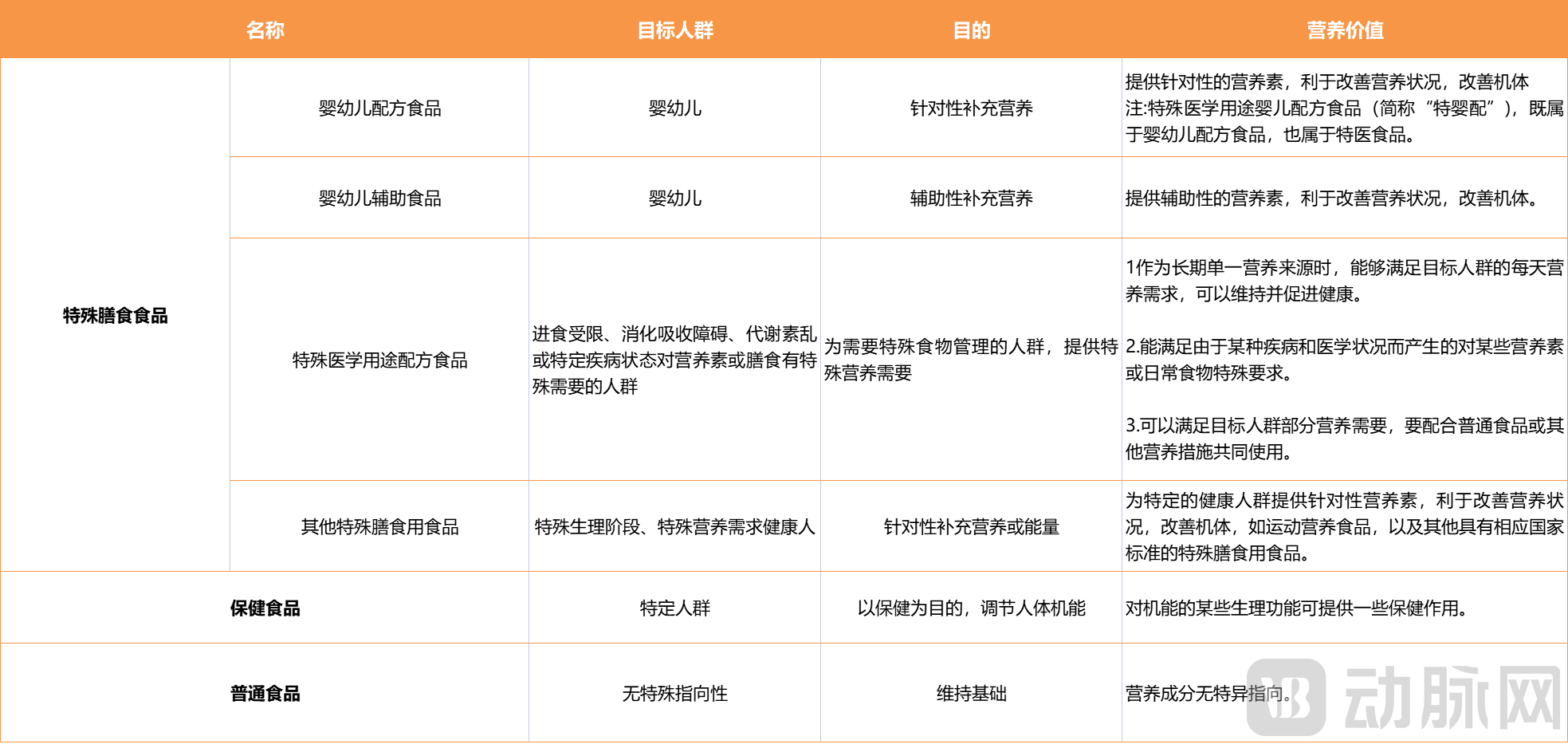
Differences Between Special Dietary Foods, Health Supplements, and General Foods
"Foods for Special Dietary Uses have an auxiliary therapeutic effect."
As an adjunctive nutritional intervention for patients with chronic diseases and other conditions undergoing surgery, foods for special dietary uses play a significant role in the course of disease treatment.
In terms of hospital utilization, FSMPs aim to improve patients' physical condition.In the ICU, foods for special medical purposes (FSMPs) are used to provide continuous nutritional support to comatose patients or those with difficulty eating. Furthermore, in surgical care, FSMPs help optimize patients’ preoperative physical condition, enhance postoperative recovery, shorten hospital stays, and facilitate earlier discharge. For instance, carbohydrate modules administered prior to enhanced recovery after surgery (ERAS) protocols can reduce postoperative insulin resistance and accelerate recovery.
Nowadays, population aging and the prevalence of chronic diseases have become indisputable facts. Chronic diseases require long-term, even lifelong, dietary interventions. Taking diabetes treatment as an example, while patients may achieve normal blood glucose levels through medication and monitoring, related complications often do not improve. However, regulation through specialized medical foods can not only meet the specific nutritional needs of diabetic patients but also address the drawbacks of indiscriminate dietary restrictions and reliance on medication alone. This approach helps control blood glucose levels to a certain extent and reduces the risk of complications.
Meanwhile,As public awareness of health management grows, some individuals have recognized the inadequacies of their dietary patterns and consciously opt to replace meals with foods for special medical purposes (FSMP) on a daily or alternate-day basis.Thereby controlling the overall composition of dietary intake. With long-term adherence and combined with exercise, the body will achieve a distinct level of physical fitness.
It is precisely its positive role in adjuvant disease treatment that has spurred the enormous market size of the special dietary food industry. According to the report “Analysis of the Development Background and Current Status of China’s Formula Foods for Special Medical Purposes Industry in 2021” released by iiMedia Research, just one niche segment within the special dietary food industry—The market size of FSMP increased from RMB 2.59 billion in 2016 to RMB 7.72 billion in 2020, representing a threefold expansion, and further grew to RMB 10.01 billion in 2021.
Difficult to Implement? Five Major Clinical Challenges in Nutrition Science
In China, the population of patients with chronic diseases is vast. According to statistics from the National Health Commission, the number of people with chronic diseases in China has approached 300 million, with an annual increase of approximately 10 million. China has entered a period of high prevalence of chronic diseases and is home to the largest population of chronic disease patients globally.
Regarding chronic disease management, pharmacotherapy is indispensable. However, nutritional therapy through specialized diets can also enhance the efficacy of various clinical treatments, reduce complications such as infections, and accelerate patient recovery.Currently, in many developed countries, the use of specialized dietary foods for the adjunctive treatment of chronic diseases has become a significant trend in medical development.
However, China’s specialized dietary food industry has lagged significantly behind. As of December 31, 2022, only 94 foods for special medical purposes (FSMP) had been approved in China, failing to meet the needs of large special populations such as patients with chronic diseases, infants and young children, and pregnant women.So, what exactly has influenced the development of China's special dietary food industry?Through market analysis and consultations with industry experts, Chengguo Bureau has identified the following five reasons.
1. Low consumer awareness, with a market penetration rate of only 1.6%
Overseas, most people have a habit of regularly purchasing dietary supplements, leading to a higher acceptance of foods for special dietary uses. In contrast, due to the late development of the health supplement industry and issues such as a "trust crisis," consumers in China have not yet formed a habit of consuming dietary supplements, resulting in lower awareness of foods for special dietary uses.
Taking foods for special medical purposes (FSMP) as an example, statistics show that the global annual consumption of FSMP totals RMB 56 billion to RMB 64 billion, with the market size growing at an annual rate of 6%.In the United States, 65% of malnourished patients use foods for special medical purposes (FSMPs), whereas in mainland China, only 1.6% of patients use FSMPs, with consumption accounting for merely 1% of the global market.
The internal factors contributing to this gap are mainly twofold. On the one hand, domestic consumers’ awareness of their own nutritional needs and foods for special dietary usesLack of Sufficient Understanding; on the other hand, it stems from domestic media’s coverage of foods for special dietary usesInsufficient Public Health Education, many patients with chronic diseases or individuals in special populations are unaware that their health status can be improved and treatment supported through foods for special dietary uses (FSDU), let alone proactively seek consultation at hospital nutrition departments to select such products.
It is understood that in China, the rates of nutritional diagnosis and nutritional therapy for both inpatients and outpatients are very low. Among the nearly 100 million inpatient visits annually, the rate of nutritional diagnosis is less than one in ten thousand. Public awareness of foods for special dietary uses (FSDU) is significantly lower than that of health supplements, which influences consumers when they select health-oriented food products. Meanwhile, as China’s food nutrition industry started relatively late overall, most consumers tend to prefer imported products.
2. Difficulty in obtaining approval makes filing as a health supplement the preferred choice for many
In the review process,The review process for special dietary foods is also more complex than that for health supplements.
Specifically, the registration of foods for special dietary uses falls into two categories. One category comprises foods for special medical purposes (FSMPs), which require multiple clinical trials, similar to pharmaceuticals, to obtain FSMP registration certificates; subsequently, manufacturers must secure additional permits, such as food production licenses, before production and market launch. The other category includes other types of foods for special dietary uses, which do not require clinical trials but are prohibited from claiming efficacy on outer packaging, placing them in an ambiguous regulatory position.
In comparison, health supplements face lower regulatory thresholds, both in terms of the review process and the duration of clinical trials. Consequently, researchers are more inclined to commercialize their findings as health supplement products during the productization phase.
3. Lack of Standards: The Development and Implementation of Industry Standards Are Relatively Lagging
 Compilation of Relevant Laws and Regulations
Although, in terms of quantity and prescribed content, the development of regulations and standards in China is gradually becoming more detailed, from the perspective of the issuing authorities,China’s special dietary food industry has yet to achieve unified rulemaking.. When multiple departments formulate legislation for the same field, it can easily lead to issues such as complex content, overlapping and redundant provisions, and a high likelihood of misunderstandings during the regulatory process.
Moreover, as China’s FSMP (Foods for Special Medical Purpose) industry has emerged only recently, many regulators have not undergone systematic training in nutrition science, which often leads to divergent interpretations of standards between enterprises and regulatory authorities. Consequently, the practical enforcement and implementation of these standards remain relatively lagging.
The lack of a robust management system, coupled with chaotic market regulation, has influenced consumer choices and led to confusion, resulting in the special dietary food industry receiving little attention.
4. Scarcity of Talent: Significant Shortage of Nutrition Professionals
The scale of market development and talent cultivation in higher education institutions remain mutually constraining. Although the concept of “food as medicine” has long existed in China, nutrition was not formally established as an academic discipline in the country until the 1980s.
Since the 1980s, several prestigious medical schools in China, such as Zhejiang Medical University, Bethune Medical University, Sun Yat-sen University of Medical Sciences, and Shanghai Second Medical University, have successively established nutrition majors to train professionals in the field. However, due to the uneven development of clinical nutrition disciplines across medical institutions nationwide, advanced experiences in discipline construction failed to effectively provide leadership and drive progress on a national scale. As a result, by 1995, there were only 1,500 nutrition-related professionals in China.
To date,China still faces a shortage of nearly 4 million nutrition professionals.Overall, the shortage of professionals in nutrition is primarily attributed to two factors.
On the one hand,The disciplinary positioning of nutrition science is relatively ambiguous., with some institutions classifying it under the sciences and others under medicine, resulting in a limited pool of nutrition professionals qualified to work in hospitals or research institutes.
According to publicly available curricula at universities, most institutions categorize nutrition under the broader discipline of public health and preventive medicine, with graduates receiving a Bachelor of Science degree. This classification prevents students from obtaining the Public Health Practicing Physician Qualification Certificate and renders them ineligible for the Clinical Practicing Physician Qualification.
Only a small number of schools offer five-year medical degree programs, whose graduates are eligible to take the examination for the Clinical Practicing Physician Qualification Certificate. Failure to obtain this certification makes it difficult to secure employment in either hospitals or centers for disease control and prevention.
Meanwhile, China’s discontinuation of the issuance of nutritionist certification in 2016 also dampened the enthusiasm of a cohort of medical professionals to pursue advanced studies in nutrition.
On the other hand,Society’s Attention to Nutrition Is Insufficient. Currently, many secondary hospitals have not established nutrition departments, and while some tertiary hospitals have set up such departments, their work remains limited to traditional dietary guidance without any substantive activities. This working environment means that hospitals do not require a large number of nutrition professionals. Furthermore, there is a significant disparity in compensation between hospitals and other social institutions, leading many nutrition experts to reject suboptimal employment opportunities. Over time, this has resulted in a declining number of medical students choosing to specialize in nutrition.
The shortage of talent has fundamentally led to slow progress in scientific research within China’s special dietary food sector, and the market has naturally not yet entered a phase of rapid development.
5. Continued Strengthening of Intellectual Property Protection
For the translation of scientific and technological achievements, intellectual property protection is a crucial step. This is because patent information and scientific research information support each other; this not only serves as a means to protect the intellectual property rights of researchers but also reserves space for the iterative updating of their own scientific research.
However, in the field of foods for special dietary uses (FSDU),It is extremely difficult to obtain a patent for a formula.. Since external factors such as the origin of raw materials, harvesting time, and preparation methods can affect the efficacy of foods for special dietary uses, it is difficult to secure patent protection solely for the formulation.
Based on currently patented foods for special dietary uses, the majority of patents are obtained through claims related to manufacturing processes. However, the formula is the core of such products, placing scientists in a dilemma: while disclosure of the formula is required for patent application, seeking patent protection based solely on the formula is not feasible.
Thus, it appears that the inadequate protection of intellectual property rights for researchers may also constitute a major obstacle to the development of foods for special dietary uses.
Opportunities and Trends
Although the development of China's special dietary food market currently faces numerous pain points, an overview of overseas industry trends reveals the significant growth potential inherent in this sector.
During the pandemic, to facilitate purchases by special populations, foods for special dietary uses fortunately gained access to online purchasing channels.Expanded Sales ChannelsFor enterprises, online sales translate to reduced marketing costs, enabling them to reach a broader consumer base anytime and anywhere, thereby enhancing the influence of specialized dietary food brands. For consumers, corporate digital marketing campaigns provide access to more comprehensive educational content on specialized dietary foods, helping them improve their understanding and select products that meet their individual needs. The promising prospects and advantages of online development are driving brands to establish an online presence and deepen their digital marketing efforts.
The expansion of sales channels has not only deepened public understanding of foods for special dietary uses but also enhanced purchasing power.
Moreover, China is placing increasing emphasis on the development of clinical nutrition departments, andIntroduce policies favoring the special dietary food industryOn March 25, 2022, the National Health Commission issued the Guidelines for the Construction and Management of Clinical Nutrition Departments (Trial). The document clarified that clinical nutrition departments are independent clinical units within medical institutions responsible for delivering clinical nutrition diagnosis and treatment services. It further stipulated that among the seven core functions to be carried out by these departments is “providing medical diets, enteral nutrition, and parenteral nutrition recommendations or prescriptions on an as-needed basis.” This document has been widely regarded by many practitioners as a hallmark of the impending recognition of clinical nutrition departments’ clinical status, as well as a precursor to special dietary foods emerging as a significant market opportunity.
Not only that, but the rise of the earliest batch of enterprises has also given the industry a glimpse of hope. As the market demand for foods for special dietary uses (FSDUs) continues to expand, an increasing number of companies are choosing to enter this sector. A group of domestic FSDU enterprises, represented by Kelubao, has developed rapidly and secured a foothold in the Chinese market. Meanwhile, driven by shifts in public health awareness, more nutrition researchers and enterprises have become active, guiding greater public understanding and attention toward FSDUs. The booming market is inevitably drawing significant attention from the government and relevant professionals.It is highly likely that industry standards will be established for it in the future, thereby regulating the market and facilitating industry development.
Despite persistent challenges such as ambiguous industry perceptions and a talent shortage, policy guidance, market expansion, and the growing recognition and emphasis on the value of nutritional metabolism in clinical research have illuminated the path forward through the fog. The road ahead is long and arduous, but steady progress will ultimately lead to success.