

Precision Neuroscience, Co-Founded by Elon Musk's Neuralink Partner, Files for IPO After Raising $430M in Two Years

Precision
Brain-Computer Interface Developer

Draper Associates
Seed-Stage Venture Capital Firms

Forepont Capital Partners
A Venture Capital Firm

re.Mind Capital
Mental Health Investment Firms

Mubadala Capital
Asset Management Institution

Alumni Ventures
Venture Capital Firms
The 100 billion cells in the human brain connect with thousands of other cells, creating over 10 trillion connections. This intricate network makes neuroscience the final frontier of science.
In 1973, computer scientist Jacques Vidal proposed that electroencephalography (EEG) is a technique for tracking brainwave patterns, enabling humans to control devices using only their thoughts. This gave rise to the concept of the brain-computer interface (BCI). Over the subsequent half-century, BCI technology advanced rapidly through scientific exploration. In 2021, Neuralink, the BCI company founded by Elon Musk, released a video showing a monkey playing a video game using its mind, thrusting BCI technology into the spotlight.
As a communication technology, brain-computer interfaces (BCIs) do not rely on any muscle or neuromuscular pathways, enabling electrical signals to be transmitted directly from neurons to external devices or systems (such as computers or robotic arms) to facilitate collaboration between the brain and the device. Therefore, in the medical field, BCIs enable paralyzed individuals to regain control of their limbs, allowing them to perform various daily activities such as moving objects, opening doors, and typing, thereby improving patients' motor capabilities and freedom of interaction with their environment.
Currently, numerous companies worldwide have identified the potential of this sector and are striving to develop their own systems that enable patients with neurological disorders to control computers using their brains.
Precision Neuroscience is one of the many emerging companies in the brain-computer interface industry, founded in New York in 2021 by a team of scientists and engineers.
On January 25, 2023, Precision announced the completion of a $41 million Series B financing round, led by Forepont Capital Partners, with participation from Mubadala Capital, Draper Associates, Alumni Ventures, and re.Mind Capital.
In 2021, the company secured $12 million in Series A funding from Forepont Capital Partners and six other investors, including Steadview Capital and B Capital Group.
It is reported that the new round of financing will accelerate Precision’s product refinement, enable the hiring of additional staff, and expedite the FDA regulatory review process.
The human cerebral cortex consists of six cellular layers, but Precision Neuroscience is striving to build a device that evokes the brain’s “seventh layer.”
This device is known as the Layer 7 Cortical Interface. As a brain implant, it is designed to help paralyzed patients operate digital devices using neural signals. This means that patients suffering from severe degenerative diseases such as ALS will regain the ability to communicate with friends and family by moving cursors, typing, and even accessing social media through thought alone.
Layer 7 is a flexible, tape-like film approximately one-fifth the thickness of a human hair. Surgeons need only create a 1-millimeter slit in the skull—so small that patients do not even need to shave their heads for the procedure—and then implant the device onto the brain’s surface, much like sliding a letter into a mailbox.Therefore, it can conform to the brain surface without damaging any tissue.
Compared to Neuralink’s brain-computer interface devices, which still involve craniotomy and penetrating electrodes, Layer 7 relies on a surgical technique that reduces invasiveness.
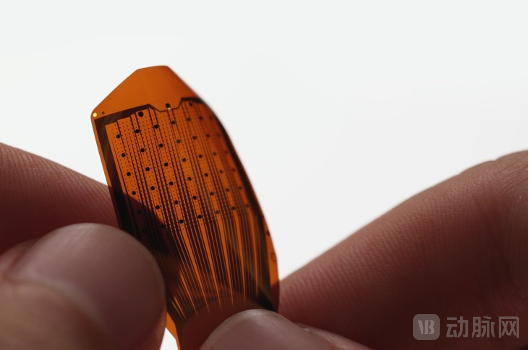
Layer 7. Image source: Precision Neuroscience
Layer 7 consists of more than 1,000 electrodes, with an electrode density 600 times that of standard cortical arrays,Basically laid flat over a region of the brain, each array will rapidly and precisely provide images of the cortical areas it covers. Therefore, unlike other minimally invasive methods, it can process large volumes of data.
These electrodes can not only collect brain signals, transmit them to a computer, and convert them into code via machine learning algorithms, but also deliver pulses to stimulate specific brain regions for the treatment of neurological disorders such as epilepsy and stroke.
If a patient decides that the implant is no longer needed or wishes to upgrade to a newer device version, the procedure is also reversible.Because Layer 7 is currently the only brain-computer interface implant that can be safely removed.
“When you start considering its expansion to a larger patient population, the risk–benefit profile of any procedure should become a fundamental consideration,” said founder Mager.
Since Layer 7 does not penetrate directly into brain tissue, its resolution of neural signals is not as high as that of some other brain-computer interface devices; however, it remains significantly superior to the resolution obtained from outside the skull—providing ample room for practical applications.
Currently, Precision has successfully used its Layer 7 to decode neural signals in animals. Mager stated that he hopes to obtain FDA approval within the next few months to test this technology in humans.
Benjamin Rapoport co-founded Neuralink with Elon Musk. After leaving Neuralink in 2018, Rapoport founded Precision Neuroscience with private equity investor Michael Mager.
Rapoport possesses a multidisciplinary academic background. He earned a Master’s degree in Physics from Harvard University and a Master’s degree in Mathematics from the University of Oxford, followed by a Ph.D. in Electrical Engineering and Computer Science from the Massachusetts Institute of Technology (MIT) and a Medical Degree from Harvard Medical School. Additionally, he completed his neurosurgery residency, served as chief resident, and pursued fellowship training in endovascular neurosurgery and endoscopic skull base surgery at NewYork-Presbyterian Hospital and Weill Cornell Medical Center.
As a neurosurgeon at the Skull Base Surgery Center, Dr. Rapoport specializes in minimally invasive, technology-assisted procedures involving the skull base and ventricular system, including endoscopic surgery for pituitary tumors and comprehensive management of adult hydrocephalus.
Dr. Rapoport also serves as the Scientific Director of Mount Sinai BioDesign, a medical device incubator. The center aims to help physicians and researchers at Mount Sinai translate their research findings into commercial products and practical healthcare solutions, while fostering structured collaborations with the health technology industry.
He also has a track record of technology translation in the field of digital health. In addition to Precision and Neuralink, he is the co-founder of Simbionics. The company has now been acquired by Apple.

Benjamin Rapoport Image source: WebMD Doctor
Michael Mager has extensive experience in corporate finance and investment. He also serves as a board member of the fintech platform Supply Finance, a partner at the investment holding company Ridge Road Partners, and co-chairman of Assembly Software, a provider of legal practice and case management tools. Additionally, Mager previously served as Managing Director at the investment firm Ward Ferry Management.
“BCI is not just about arrays; it is also inextricably linked to software—the complexity of machine learning is a prerequisite for driving truly powerful BCIs.”This is a full-stack product that requires an interdisciplinary team for development.“Mager said.
In March 2022, Craig Mermel, Ph.D. in Cancer Genomics, and Dan Trietsch, a software component expert, joined Precision as President and Chief Product Officer and Chief Software Architect, respectively, filling the company’s technology leadership roles. Previously, both had developed health and fitness features for Apple.
Mermel is an expert in machine learning applications within the healthcare sector. He previously led a team at Google exploring the use of artificial intelligence for diagnosing and treating various cancers, and developed machine learning tools to identify key cancer genes at the Broad Institute. Mermel met Rapoport during their MD program at Harvard Medical School. While in graduate school, they co-founded Simbionics, a company that developed health software for wearable technology. Trietsch was the first software engineer they hired.
According to World Health Organization data, hundreds of millions of people worldwide are affected by neurological disorders.
The global prevalence of migraine exceeds 10%. Each year, more than 6 million people die from stroke, and there are over 50 million individuals with epilepsy and 47.5 million with dementia, 60–70% of whom have Alzheimer’s disease. All these conditions lead to structural brain damage and functional decline, thereby resulting in impaired cognitive and memory functions.
Brain-computer interfaces represent a new paradigm at the intersection of neuroscience and information technology, with the potential to help these patients—and indeed all of humanity—transcend biological limitations.
According to a market research report released by Contrive Datum Insights, the global brain-computer interface (BCI) market was valued at USD 2.79 billion in 2022 and is projected to reach USD 9.31 billion by 2030, registering a compound annual growth rate (CAGR) of 16.26% from 2023 to 2030. Meanwhile, the medical application segment accounts for 62% of the total market size.
Mager stated that the brain-computer interface sector has seen significant positive momentum in investment and financing, and he believes this year will be a “watershed year” for neurotechnology.
According to PitchBook data, the brain-computer interface sector raised $274 million in 2022.
Neuralink, founded by Elon Musk, has raised a total of $373 million since its establishment in 2016, with its latest funding round completed on July 14, 2022.
Neuralink is currently developing a coin-sized chip that will be implanted into patients’ brains, with ultra-fine wires extending further into the brain tissue. Due to the minuscule size of the chip and wires, Neuralink is also developing a robot to implant the device into patients’ brains in a manner akin to a sewing machine.
In February 2022, Max Hodak, co-founder and former president of Neuralink, announced that he had joined Synchron as an advisor and invested in the company.
Synchron, founded in 2016, has developed a brain implant that enables paralyzed patients to control digital devices using their thoughts. Unlike Neuralink’s product, this implant does not require craniotomy; instead, it is delivered to the brain via the blood vessels.
In December 2022, Synchron announced the completion of a $75 million Series C financing round led by ARCH Venture Partners. According to VC News Daily, Synchron’s total funds raised to date have reached $145 million.
Interestingly, Elon Musk himself is reportedly considering investing in Synchron. In 2022, reports emerged that he had met with Dr. Thomas Oxley, CEO of Synchron, to discuss a potential deal. However, neither company has confirmed or denied these speculations.
In contrast, China's brain-computer interface industry is still in its nascent stage.
According to data from VCBeat, the number of financing events in China’s domestic industry surged in 2022, with companies at Series A and earlier stages accounting for 81% of the total.
In February 2022, NeuroEchos completed a Series A financing round of nearly RMB 100 million, and Zhongke Huayi completed a seed financing round of tens of millions of yuan.
In May 2022, Hangzhou Shudan Medical Technology Co., Ltd. completed a financing round amounting to tens of millions of yuan.
In December 2022, BrainCo and Jieti Medical successively completed Series A financing rounds amounting to hundreds of millions of RMB.
Although starting later, China's brain-computer interface technology has developed rapidly and achieved remarkable results.
As one of the earliest established companies in China’s brain-computer interface (BCI) industry, NeuroXess has achieved global leadership in electroencephalogram (EEG) signal acquisition, breaking the monopoly held by imported products. In December 2022, NeuroXess secured hundreds of millions of yuan in Series C financing, which will accelerate the research and development and commercialization of its minimally invasive implantable BCI technology.