

Looking to the Stars, Grounded in Reality: Phenovision Delivers an Integrated Spatial Multi-Omics Solution to Decode the 'Morse Code' of Precision Medicine
In 2022, Nature published seven “disruptive” technologies, one of which isSpatial Multi-omicsHailed as the “next big wave” set to ignite the life sciences sector.
Since the concept of spatial multi-omics was proposed in 2016, its development has been progressing at a breakneck pace. As of 2022, more than 10,000 papers with “spatial multi-omics” as a keyword have been published internationally. A search for the term “spatial multi-omics” in bioRxiv, a preprint server in the life sciences, yielded over 1,500 results, with more than 600 submitted in 2022 alone. Meanwhile, various technological platforms have emerged in the field of spatial multi-omics research.
With the emergence of this boom, spatial omics has advanced in both life sciences research and clinical applications. However, due to their distinct analytical perspectives, spatial omics, while promising for clinical translation, still faces numerous challenges that require urgent resolution.
“Spatial multi-omics is currently experiencing rapid development, with relatively mature underlying technologies and significant improvements in detection methods and data quality.”Tumor diagnosis was initially performed using H&E-stained sections. In the 1990s, with the continuous enrichment of disease classifications and treatment modalities, immunohistochemistry gradually became a critical tool in tumor diagnosis. Currently, emerging therapies such as targeted therapy, immunotherapy, and tissue-agnostic therapies have greatly expanded the therapeutic arsenal for cancer, while also imposing higher demands on precise tumor diagnosis. As an advancement over traditional immunohistochemistry and in situ hybridization techniques, spatial omics technology“Empowering the increased throughput of biomarker detection and bioinformatics analysis,” said Li Yang, founder of Fenuoweikang.
Prior to founding Fenuoweikang, Li Yang established the Chinese subsidiary of Advanced Cell Diagnostics (ACD), a leading technology company in the field of spatial biology. During his tenure at Akoya Biosciences, another prominent player in spatial biology, he came to appreciate that spatial biology represents a blend of romance and reality—spanning from macroscopic astronomical exploration to microscopic cytological analysis, and now even enabling the observation of vast realms of microscopic life.
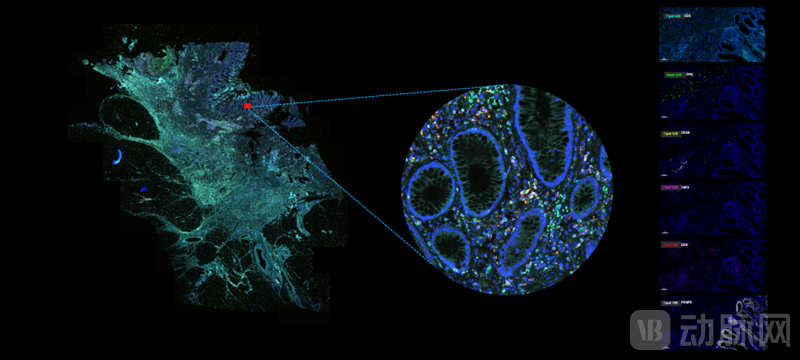
Assessment of Tumor Immune Microenvironment Status – Colorectal Cancer Case Study | Provided by Fenuoweikang
“The underlying algorithms for spatial biology applications involve visual analysis of captured signals, including distribution patterns such as signal intensity, positivity rate, density, and spatial distance. This provides a new perspective for further research into disease mechanisms and the stratification of patient diagnosis and treatment,” said Li Yang.
Li Yang has been dedicated to the field of clinical diagnostics for over 20 years. Since obtaining his master’s degree in pathology from Peking Union Medical College in 2006, he has been engaged in work related to in vitro diagnostics, personally participating in and witnessing the development of automated and standardized tissue diagnosis in China. In 2011, while accompanying Dr. Thomas Grogan, founder of Roche Ventana Medical Systems and a pathologist, on a visit to China to promote collaboration aimed at improving cancer patient management, he realized thatWith the advent of the era of personalized precision medicine, pathology is poised for rapid development as the gold standard for clinical diagnosis.。
The breakthroughs and maturation of spatial proteomics, spatial transcriptomics, and single-cell sequencing technologies have ushered in the opportunity to apply these techniques in clinical settings.. In 2022, Fenuoweikang was established in Beijing, positioning itself asProviding One-Stop Spatial Multi-Omics Solutions for Clinical Translational Medicine and Precision Medicine“This is not my first venture, but this time we not only aim for the stars, but also stay grounded to address real-world clinical challenges,” said Li Yang.
Spatial multi-omics technologies primarily involve labeling nucleic acids or proteins of different cell types within the tissue microenvironment to characterize complex cellular phenotypes, functional states, and spatial relationships between cells and the tissue microenvironment, thereby enabling visualization of biomarkers and establishing corresponding data analysis models. Spatial multi-omics is of paramount importance for the research and clinical application in complex diseases such as neurological disorders, cancer, and developmental abnormalities.
A comprehensive analysis of tissue microenvironment interactions necessitates an ever-increasing number of biomarkers, thereby making the accurate identification of multiple targets and the precision of data analysis significant challenges to overcome. In light of these considerations, Beijing Fenuoweikang Biotechnology Co., Ltd. has introduced two internationally advanced technological platforms to complement its one-stop solution.
The first system is Akoya Biosciences’ PhenoImager HT platform, which is characterized by its powerful spectral unmixing capabilities. By providing more fluorescence analysis channels, it resolves fluorescence crosstalk issues, enabling the analysis of complex data metrics and significantly enhancing the data richness and accuracy of spatial multi-omics analyses.
The second solution is the Oncotopix Discovery software analysis platform developed by Visiopharm, an image intelligence analysis company. Leveraging AI deep learning algorithms, this software enables standardized analysis tailored to diverse clinical application scenarios, fully unlocking the potential of in situ spatial omics and effectivelyAdvance research in clinical translational medicine and the practical implementation of precision medicine applications.
In addition to introducing advanced international technologies, Fenuoweikang actively pursues independent technological innovation and the development of applications. In Beijing, Fenuoweikang has established a Clinical Translation Center Laboratory, built a rigorous management system, and leverages its innovative technology platform and application expansion philosophy.Won multiple awards in domestic innovation and entrepreneurship competitions。
“We hopeBy adopting a dual-mode strategy that combines introduced collaborations with independent R&D, we have developed China’s first multi-omics spatial information solution on a single platform—namely, a one-stop spatial biology solution.“, including reagents for spatial multi-omics, automated equipment, and software capable of interpreting DNA, RNA, and protein bioinformation, with the ultimate goal of providing clinically accessible application products,” said founder Li Yang.
When discussing the greatest difference between life science research and clinical applications, Li Yang said, “For scientific research, greater emphasis is placed on the innovativeness of technical platforms and cutting-edge performance parameters, to provide solutions for areas of interest to researchers; whereas for clinical applications, more attention is paid toTechnical platform work efficiency, accuracy of result data, clinical application value, and clinical accessibility.
“The application of spatial omics technologies is extensive, but in clinical practice, it must focus on addressing specific real-world problems. Behind every sample is a patient awaiting diagnostic and therapeutic information; obtaining more precise data is a shared goal among healthcare professionals,” said Li Yang.
Based on an understanding of the clinical applications and their importance, Fenuoweikang has established a quality control system encompassing sample preparation, staining, imaging, slide review, and data analysis, ensuring stable and accurate results in clinical practice.
“Given the complexity of the entire experimental workflow, we need to ensure rigorous quality control at every stage of the analysis. Our team members possess extensive experience in developing bioassay technologies, enabling us to better understand the future clinical demands for new technologies and their practical implementation pathways.” Li Yang expressed strong confidence in his team and the advancement of clinical applications for spatial multi-omics in China.