

Culina Health Files for IPO After Delivering Nearly 20,000 Personalized Nutrition Plans with a Team of 34 Registered Dietitians
In addition to daily fitness, people have long been in the habit of supplementing their daily nutrition through diet and health products. In recent years, a wave of “Personalized Nutrition” trend.
Personalized nutrition, also known as “precision nutrition,” tailors nutritional interventions to individual characteristics to prevent and control chronic diseases. In this field, a personalized nutrition platform service provider based in New York State, USACulina HealthAttracting Capital Attention.
In May 2022, Culina Health announced the completion of$4.75 millionseed funding round. Culina Health helps clients improve their health by overcoming physical, psychological, environmental, and behavioral challenges through personalized coaching programs. It is reported that the company has currently provided18,000 copiesPersonalized Clinical Nutrition Plan.
A Company Founded by a Registered Dietitian
Nutrition is a primary intervention for preventing and reversing chronic diseases, but much of this field is rife with misinformation and conflicting advice, which can easily trigger a crisis of consumer trust.
On the one hand, many physicians have not undergone systematic training in nutrition, making it difficult for them to provide scientifically grounded dietary advice; meanwhile, influencers promoting trendy weight-loss products do not necessarily possess professional expertise in nutrition or exercise science. On the other hand, some nutritional products on the market are of substandard quality and may not genuinely improve consumers’ health through dietary intake.
To Provide Consumers with Scientific Nutritional Care, Registered DietitiansTamar SamuelsandVanessa RissettoCo-founded Culina Health. Vanessa Rissetto brings over a decade of experience in nutrition product development and serves as the Director of Dietetic Internships at New York University, while Tamar Samuels is an R&D specialist and a National Board-Certified Health and Wellness Coach who leverages integrative functional medicine, positive psychology, and behavioral science to transform the nutrition industry.

Culina Health founders Vanessa Rissetto and Tamar Samuels, image from the company’s official website
Vanessa Rissetto stated in an interview, “We aim to build a company that helps people achieve their goals and understand the true meaning of health and healthy eating.”
Registered DietitianThey are the only healthcare professionals in the United States qualified to provide evidence-based nutritional care. They not only offer daily nutritional guidance but also perform medical tasks, such as prescribing nutritional supplements and providing meal plans for hospitals or communities. Apart from the founders, Culina Health’s entire consulting team consists of registered dietitians, totaling34 cases.
Consumer-Facing: Providing Personalized Nutrition Plans
Nutritional management is highly individualized, influenced by a variety of personalized factors such as age, sex, internal physiological status, medical history, lifestyle habits, and environmental conditions. For the same health issue, different individuals require distinct nutritional and dietary management plans; a one-size-fits-all approach often yields suboptimal results.
Therefore, Culina Health offers services to individuals, with consumers paying$99/monthmembership fees to become platform members, while nutritionists will develop more targeted and effective personalized nutrition plans based on members' physical conditions, lifestyles, dietary habits, and taste preferences.
Consumers’ needs vary, and Culina Health tailors its offerings based on different service scenarios,Home Meal Planning, Fitness Management, Chronic Disease/Rehabilitation Management, and Maternal & Infant NutritionIt has established a presence in major niche subsectors with a healthcare focus.
 Culina Health Service Scenarios
Meanwhile, by leveraging technologies such as the Internet, big data, and artificial intelligence, Culina Health hasvia phone, video, etc., to provide consumers with remote nutritional counseling services, nutritional management plans, and dietary advice at a lower cost and with greater efficiency. The specific process for formulating personalized nutrition plans is as follows:
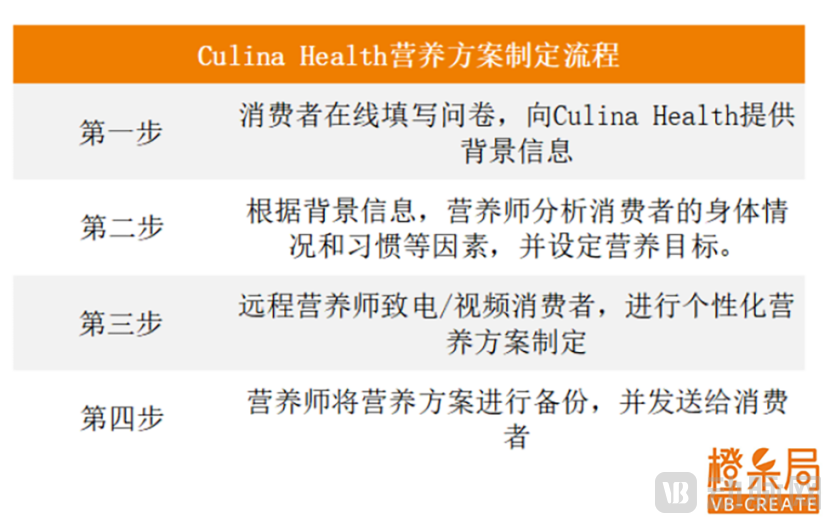 Culina Health Nutrition Program Development Process
As a result, personalized nutrition becomes a dynamic process in which consumers can completeUnderstanding Your Body - Personalized Nutrition Plan - Implementation and Feedbackclosed loop:
First, Culina Health utilizes mainstream international remote data collection methods in nutrition science by distributing questionnaires to assess consumers’ various physiological metrics—such as body weight, blood glucose levels, DNA, and gut microbiota—and generates a personalized nutrition plan tailored to each individual.
Next, centered on this plan, the nutritionist and the consumer engage in in-depth communication, with the nutritionist providing a detailed explanation of the nutritional plan, including food types, portion sizes, and dietary structure. After the consultation, the nutritionist shares a series of recipes and dietary products. The consumer then puts the plan into practice by purchasing, cooking, or consuming these foods, and provides feedback on the resulting health indicators.
It is worth mentioning that, to ensure effectiveness, the communication between Culina Health dietitians and consumers willLasting for 3 months, and during this period, the dietitian will also regularly contact consumers to assess their adherence to the nutrition plan and adjust the plan to meet their evolving needs.
Prioritizing Professionalism in a Traffic-Driven Landscape
The user base for personalized nutrition management is extensive, encompassing athletes, pregnant women, children, and individuals in a “sub-health” state. In most cases, the sector is perceived as being driven primarily by traffic volume; its low level of professional specialization also implies low entry barriers, leading to intensified competition among enterprises.
An analysis of Culina Health reveals that the true differentiation in personalized nutrition lies in—Professionalism and Experience, which involves various aspects such as the platform’s nutritional guidance personnel, service processes, fulfillment of needs, and the continuous experience, services, and outcomes during the subsequent improvement process.
Therefore, in the process of providing personalized nutrition to consumers, Culina Health has establishedReputation and ProfessionalismComposed of professional registered dietitians, Culina Health’s health advisory team initially targeted specific populations—including patients with cancer, cardiovascular diseases, or diabetes; pregnant women and children; fitness enthusiasts; and individuals seeking weight loss—before expanding its services to everyday life, ultimately focusing on the “sub-healthy” population under high life stress.
According to the “Top 10 Key Trends in Global Food Nutrition 2020,” personalized nutrition customization will become one of the development directions in the field of food, nutrition, and health over the next five years. The global market size for personalized nutrition is projected to grow from USD 8.2 billion in 2020 to USD 16.4 billion by 2025.
Currently, Chinese consumers are becoming increasingly affluent and more sophisticated in their spending habits, driving the steady growth of the nutritional supplements market. In 2013, China already became the world’s second-largest market for health supplements. As one of the key future trends in the industry, personalized nutrition holds a significant position in China’s health supplement market.
However, compared with the market growth rate, given China’s current situation, there is a substantial gap in nutritional health knowledge.The Penetration Rate of Professional Dietitian Services Remains Very Low in China, apart from the necessary cooperation during in-hospital treatment, accessing professional dietitian services outside of hospitals is quite a luxury. As of July 2019, there were only slightly more than 5,000 registered dietitians in China, amounting to merely 5.5% of the number of registered dietitians in the United States.
On the one hand, the higher disciplinary threshold for clinical medicine-oriented nutrition science in China has resulted in a scarcity of qualified nutrition professionals capable of entering hospitals or research institutions. On the other hand, there is insufficient societal emphasis on nutrition science. Although most Grade 3A hospitals have established Nutrition Departments, these departments remain marginalized within the hospital system. They primarily serve inpatients and struggle to extend their services beyond the hospital setting, making it difficult to provide professional nutritional plans to the general public or individuals in a sub-health state.
So, how should China's personalized nutrition industry proceed? The most critical factor remainsActively Address Talent Gaps, in terms of higher education training, since 2014, 45 domestic universities have joined the formal training of nutritionists; in terms of policy support, the "Healthy China Action (2019-2030)" released in 2019 proposed that by 2030, China should achieve one nutrition instructor per 10,000 people.
In addition, theIntegration of AI Digitalization with Personalized Nutrition Products, achieving a perfect synergy between product strength and digitalization, and extending high-quality nutritional products from within hospitals to the broader community, may well represent an opportunity for China’s nutrition industry.