

Hillhouse Acquires George Clinical as External Headwinds Fade: CRO Sector Poised for Strong Growth
In 2022, among the 27 companies involved in the CXO (including CRO, CMO, and CDMO) sectors listed on China’s A-share market, all but the six newly listed firms experienced negative growth in market capitalization. The number of leading enterprises with a total market cap exceeding RMB 100 billion shrank from four in 2021 to just one. More than 20 companies saw an average decline of over 35%, resulting in a total market capitalization reduction of approximately RMB 300 billion compared to the beginning of 2022.
Under the dual pressure of economic headwinds and black swan events, industry valuations have plummeted to historic lows. In stark contrast to the dismal stock performance, corporate fundamentals have continued to improve. In the third quarter of 2022, more than 20 companies reported combined revenues exceeding RMB 65 billion, with 22 of them achieving positive revenue growth at an average rate of 49%. This demonstrates that the underlying fundamentals of the entire industry remain stable. With Hillhouse Capital’s acquisition of the Australian CRO firm George Clinical at the end of 2022, coupled with the recovery of the pharmaceutical sector in 2023 and the sustained increase in global R&D investment, the CRO industry is poised for a period of rapid growth.
At the end of 2022, Hillhouse Capital signed an acquisition agreement with George Clinical, with neither party disclosing the transaction price. Hillhouse’s latest move may serve as a bellwether for the industry’s upward momentum.
George Clinical, headquartered in Australia, is a clinical research organization established in 1999. With over two decades of experience as a clinical CRO, the company employs nearly 500 people worldwide and maintains branches in 39 regions globally. Having completed more than 500 studies, George Clinical provides comprehensive CRO services to biopharmaceutical, medical device, and diagnostic clients, covering all trial phases, regulatory registration, and post-marketing studies.
Regarding this acquisition, James Cheong, CEO of George Clinical, stated, “Hillhouse’s acquisition presents a significant opportunity for George Clinical to achieve greater development outcomes in the next phase. Healthcare is one of the key sectors in their investment portfolio, enabling substantial synergies. We will have a larger platform to continue fulfilling our important mission—improving the health of millions of people worldwide.”
According to Frost & Sullivan data, the compound annual growth rate (CAGR) of the clinical CRO market in the Asia-Pacific region was 19.1% from 2015 to 2019, significantly higher than the global and U.S. rates of 8.9% and 8%, respectively. The market is projected to continue growing at a CAGR of 15.2% from 2019 to 2024.
The largest incremental growth in the Asia-Pacific clinical CRO market comes from three major markets: China, Australia/New Zealand, and South Korea. In practice, many Chinese pharmaceutical companies, including Henlius and CSPC Pharmaceutical Group, have chosen Australia as the first destination for overseas clinical trials of their promising product pipelines.
This decision was made due to Australia’s inherent advantages in the CRO industry. First, there is a cost advantage, as Australia offers tax incentives for CRO companies. Second, the approval process is streamlined, typically being completed within five weeks. Finally, clinical data generated in Australia is universally accepted; high-standard clinical trial data from Australia meets the international regulatory requirements of major authorities, including the U.S. Food and Drug Administration (FDA), the European Medicines Agency (EMA), and China’s National Medical Products Administration (NMPA).
It is precisely for this reason that global Big Pharma companies, including Novartis, Merck, and AbbVie, are keen on conducting clinical trials in Australia. As the CEO of George Clinical stated, this transaction with Hillhouse not only validates the value of the platform established by George Clinical but will also provide it with necessary support. In recent years, Hillhouse has invested in numerous biotech enterprises across the Asia-Pacific region, covering stages from seed to late-stage development. In the future, orders from these companies may be directed to George Clinical.
Australia serves as an optimal springboard for pharmaceutical companies to launch multi-regional clinical trials. Over the past year, four Australian CROs—Agilex Biolabs, Avance Clinical, Nucleus Network, and 360 Biolabs—were acquired. Hillhouse’s acquisition of George Clinical aligns with the global development trends in the CRO industry.
For Chinese CRO companies, high growth is inseparable from the rapid development of the global innovative drug industry.
With the development of the industry, particularly the opening up of financing channels, strong support has been provided to China’s CRO sector. Leading domestic companies have already begun to expand into the global market. Corporate financial reports show that Chinese firms, including WuXi AppTec, Asymchem, and Pharmaron, derive more than 80% of their revenue from overseas markets.
In other words, as long as new drug development remains the mainstream direction for the global pharmaceutical industry, the performance of CRO companies operating globally will naturally rise in tandem.
So, what is the development of innovative drugs related to? The answer is the patent term.
In 1984, the United States enacted the Drug Price Competition and Patent Term Restoration Act, also known as the Hatch-Waxman Act. This legislation aims to balance the relationship between the innovative drug industry and the generic drug industry by extending patent protection terms. On one hand, it encourages innovative pharmaceutical companies to continue researching and developing new drugs; on the other hand, it incentivizes generic drug manufacturers to leverage relevant regulatory frameworks to bring generics to market more rapidly, thereby reducing drug prices.
Although specific rules have been adjusted in practice, the implementation of the patent term extension system for innovative drugs has boosted pharmaceutical companies’ enthusiasm for R&D and innovation, significantly accelerating the pace of new drug development in the United States and resulting in a number of innovative drugs that far exceeds that of other countries and regions. Subsequently, dozens of countries and regions, including the European Union, Japan, South Korea, Australia, and Israel, have also established their own drug patent term extension systems.
Although the patent protection period for innovative drugs can be extended, there will always come a day when the patents expire.
In the pharmaceutical industry, the expiration of drug patents, coupled with the entry of generic drugs, leads to a significant drop in drug prices. Consequently, the market share and profits that companies previously enjoyed under patent protection plummet sharply. This phenomenon is known as the "patent cliff" effect.
The emergence of the patent cliff yields social benefits by reducing patient expenditures, while also driving cyclical fluctuations in new drug development. In particular, as blockbuster drugs from Big Pharma approach the end of their patent protection periods, pharmaceutical companies often increase R&D investment to sustain revenue and maintain performance, aiming to develop the next blockbuster drug.
From another perspective, it is precisely this cyclicality that has driven the continuous evolution of the industry. Objectively speaking, as development deepens, the difficulty of new drug R&D increases. To reduce costs and improve efficiency, pharmaceutical companies have begun collaborating with CROs, thereby promoting the rapid growth of the CRO industry.
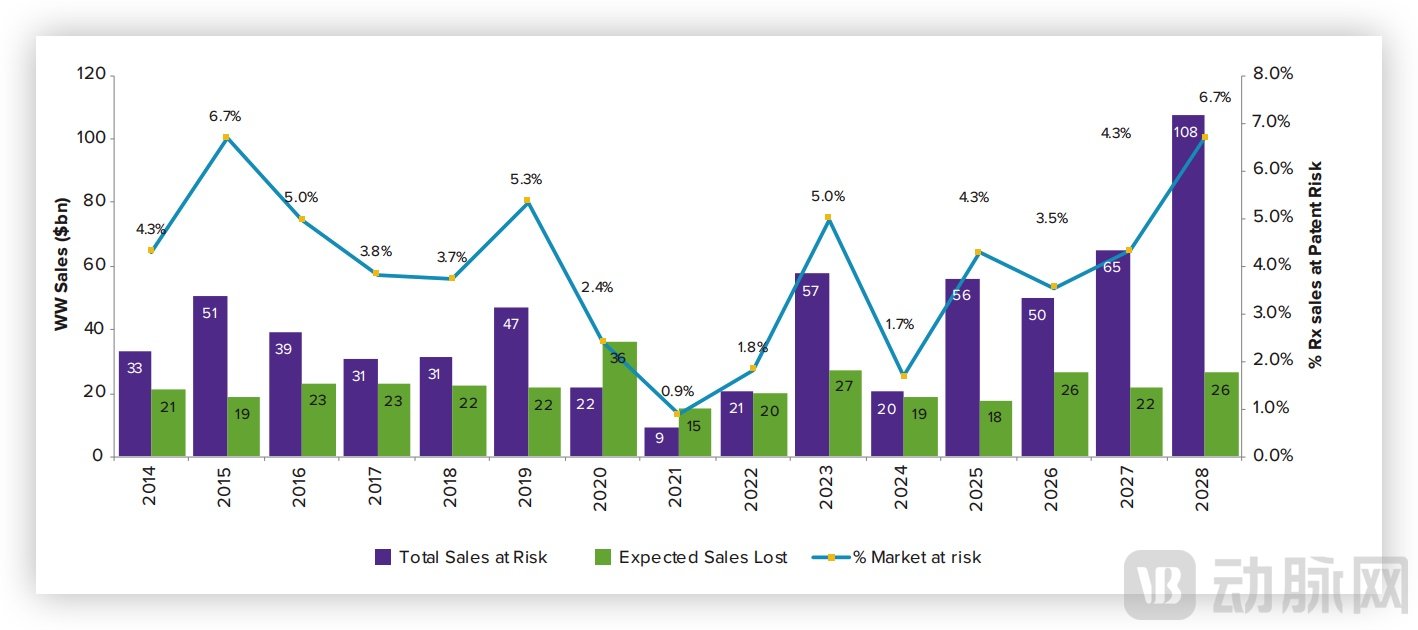
Global Market Size of Drugs Facing Patent Expiration Risks, Data Source: Evaluate Pharma
According to data from Evaluate Pharma, more than 1,500 drug compounds will have their patents expire between 2013 and 2030. In 2023 alone, innovative drugs facing the "patent cliff" are estimated to exceed $57 billion in sales. Taking the 2021 global pharmaceutical sales ranking compiled by the Njarðarson Research Group at the University of Arizona as an example, half of the top 20 best-selling drugs will have their patents expire within the next five years. In 2023, three blockbuster drugs—including Humira, Stelara, and Xarelto—will see their patents expire, with combined sales projected to exceed $37 billion.
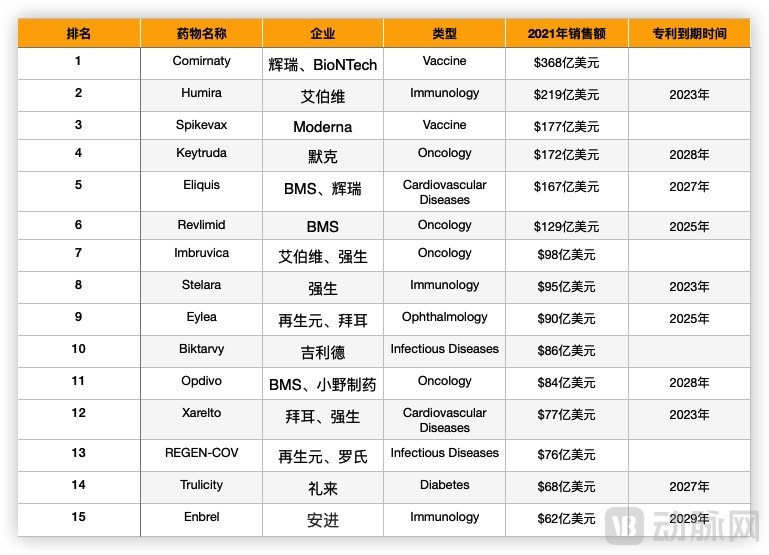
Patent Expiry Dates of the Top-Selling Global Drugs in 2021; Data Sourced from the Njarðarson Research Group and Compiled from Publicly Available Information
Taking Humira as an example, it was approved by the FDA in 2002 for the treatment of moderate to severe rheumatoid arthritis. As of 2022, Humira had ranked as the world’s best-selling prescription drug for ten consecutive years, with cumulative sales exceeding $190 billion according to relevant statistics. Although AbbVie has been striving to defend Humira’s patent rights in recent years, the drug’s patent protection in the U.S. market essentially expires in 2023, at which point at least nine biosimilars are expected to enter the market and compete for its share.
Furthermore, based on the already released 2022 sales data, although pandemic-related medications remain on the list, as the impact of the pandemic wanes, these products will no longer be able to bear the burden of major pharmaceutical companies’ performance expectations. Coupled with the patent cliff effect, market gaps will emerge for emerging drugs to compete, and major pharmaceutical companies will inevitably accelerate their investment in innovative drug research and development.
In the coming years, the robust development of innovative drugs and the year-on-year increase in R&D expenditures by pharmaceutical companies are to be expected; China’s CRO industry is likely to maintain a high compound annual growth rate. This is exceptionally rare in the current macroeconomic environment.
Over the past year or more, the CRO industry has been plagued by continuous negative developments, with black swan events occurring one after another.
In December 2021, rumors that dozens of Chinese technology companies had been added to the U.S. Department of Commerce’s Entity List triggered market panic, causing a sharp decline in the stock prices of multiple CRO firms, including WuXi AppTec, Asymchem, and Joinn Laboratories.
On February 8, 2022, the U.S. Department of Commerce released its Unverified List (UVL), on which two subsidiaries of WuXi Biologics were included. On that day, WuXi Biologics’ stock price plummeted by as much as 31.76%, dragging the entire CRO sector into a sharp decline.
On September 12, 2022, U.S. President Biden signed an executive order on the Biotechnology and Biomanufacturing Initiative, delivering another precise blow to the pharmaceutical industry. Fosun Pharma’s stock price hit a two-year low, Pharmaron fell by more than 13%, Asymchem and WuXi AppTec hit their daily limit down, and Porton Pharma Solutions dropped by over 9%.
Taking WuXi Biologics as an example, its inclusion in the “Unverified List” triggered a massive sell-off of CRO sector stocks in the capital markets. By October 2022, WuXi Biologics’ share price had fallen by more than 60% from its peak. However, stock prices do not necessarily reflect a company’s actual operational performance. According to financial reports, in the first half of 2022, WuXi Biologics reported revenue of HK$7.949 billion, a year-on-year increase of 63.5%, and net profit attributable to shareholders of HK$2.797 billion, up 37.6% year on year. As of the end of the first half, the company’s total backlog reached HK$145 billion, representing a substantial year-on-year growth of 482%.
If revenue and profits represent the past, then a robust order backlog undoubtedly signifies the future.
What underpins WuXi Biologics is its comprehensive global footprint and the core competitive advantage of cost reduction and efficiency enhancement behind it.
In essence, the core driver behind black swan events is to promote the reshoring of industries to the United States. However, in the CRO sector, Chinese enterprises maintain significant advantages in labor and clinical trial costs. According to data from Huaxi Securities Research Institute, the overall costs for domestic CRO firms are only 30%–60% of those in developed countries, with labor costs being half or even lower than those of U.S. companies. Therefore, it will be difficult for global pharmaceutical giants to decouple from their Chinese partners in the short term.
From the perspective of the domestic environment, the National Medical Products Administration (NMPA) has relaxed the requirements for conducting clinical trials and submitting marketing applications in China to encourage the launch of overseas new drugs in the Chinese market, thereby guiding multinational pharmaceutical companies to apply for early-stage clinical trials of new drugs in China. According to data from Frost & Sullivan, the number of international multi-center clinical trials conducted in China increased from 61 in 2017 to 156 in 2019. Furthermore, the quality of domestic clinical trials has steadily improved; in 2021, the number of core clinical trials in China reached 233, surpassing Europe and Japan and ranking second only to the United States.
On the other hand, given the high costs and significant failure rates associated with new drug R&D, pharmaceutical companies find it difficult to resist the cost-reduction and efficiency-enhancing benefits offered by clinical CROs, leading to an increasingly strong willingness among biotech firms to outsource.
According to data from the “2020 China New Drug R&D Industry Analysis Report,” the ultimate approval rate for Phase I clinical drug candidates is only 11.30%, and even those advancing to Phase III clinical trials have a success rate of just 53.40%. Clinical-stage costs account for as much as 70% of total expenditures. Deloitte’s statistics also indicate that the average return on investment for global innovative drugs has been declining year by year since 2014, falling to below 2% by 2019. Although there has been some recovery in the past three years, controlling R&D costs remains a critical priority for pharmaceutical companies.
With the advancement of pharmaceutical R&D in China, clinical and preclinical research demands have been rapidly unleashed. Contract Research Organizations (CROs) are playing an increasingly vital role in the capital-intensive and high-risk drug development process. To achieve cost reduction and efficiency improvement, a growing number of pharmaceutical companies are inclined to collaborate with CRO firms that offer greater systematicity and professionalism. In particular, CROs can help pharmaceutical companies address the challenges of high investment and high risk during the clinical stage, reduce time costs associated with clinical project management, and enhance data management quality, thereby positioning themselves to benefit from the growth of the new drug R&D industry chain.
According to Frost & Sullivan, the share of non-Big Pharma companies globally is projected to increase from 76.0% in 2017 to 81.2% in 2029, with biotech companies increasingly taking center stage in the field of innovative drugs. Such companies typically allocate the majority of their financing to core R&D activities, and driven by the need to accelerate the development of their pipelines, demand for outsourced services has become increasingly prominent. Consequently, the outsourcing rate in China’s drug R&D market has risen rapidly; the outsourcing rate in China’s innovative drug market stood at 39.6% in 2021 and is expected to reach 52.2% by 2026.
Driven by the sustained growth in R&D investment by innovative drug companies and the increasing penetration rate of outsourced innovative drug R&D, demand for CRO services will remain robust. The CRO industry, with cost reduction and efficiency improvement as its primary objectives, is set to enter a new development cycle, during which the clinical CRO market size will experience rapid growth. According to Frost & Sullivan data, China’s clinical CRO market reached RMB 26.3 billion in 2020 and is projected to reach RMB 83.5 billion by 2025, representing a compound annual growth rate (CAGR) of 25.99% from 2020 to 2025, indicating substantial growth potential.
If external environmental factors led to CRO companies being out of favor in the secondary market in 2022, industry players nonetheless delivered strong revenue performance, demonstrating their competitiveness and capabilities. Meanwhile, in the coming years, the global pharmaceutical market is expected to see increased investment by numerous drug manufacturers in novel drug development, driven by the patent cliff effect and anticipated declines in sales of pandemic-related medications, as companies seek to capture the resulting market share and sustain rapid growth. Given that the patent cliff will persist for several years, the CRO sector is poised for intense competition among many participants. Only by leveraging digital tools for refined project management and upholding cost reduction and efficiency enhancement—the core competitive advantages of CROs—can companies gain a leading edge in future competition.