

Probe Capital Files for IPO: The 'Third Force' Navigating Through Investment Cycles in Healthcare

ROBE CAPITAL
Premium Financial Advisory Firm
Investment and financing in the healthcare industry are undergoing cyclical adjustments. The increasing uncertainty in the macro environment is forcing every type of player across the primary market value chain to adapt to new realities. A growing number of investment firms are adopting a wait-and-see approach, deploying capital more sparingly and selectively, while the difficulty of matching projects with funding continues to rise.
How to identify projects with higher certainty amid a highly uncertain macro environment, and how to spot differentiated innovation in early-stage ventures, are questions that investment firms constantly grapple with. For startups, breaking free from “hyper-competitive saturation” within their core businesses and navigating the “funding winter” have become urgent priorities.
This market situation has accelerated the rapid rise of financial advisors (FAs) as a “third force.” Many industry insiders have nearly reached a consensus that today’s capital markets are in greater need of FAs than in the past.
Data compiled by IT Juzi shows that the proportion of investment and financing deals involving financial advisors (FAs) rose from 1.5% in 2014 to 18.61% in 2021. Meanwhile, the share of total investment and financing amount in FA-involved transactions tripled. In 2022, among the thousands of investment deals in China’s primary healthcare market, FAs played a significant role in many major transactions.
Growth is inevitably accompanied by challenges, and within the current cycle, new transformations are brewing within the FA industry.
“From the outset, we have approached our financial advisory (FA) services with a private equity mindset, treating each client company as a portfolio investment. In essence, our FA practice functions as the post-investment management and exit strategy arm of a fund. Rather than merely facilitating a single round of financing, we are committed to helping companies address strategic, market, capitalization, and managerial challenges throughout the process. This enables scientists to focus on technological R&D and ensures that companies do not falter due to non-technical factors."Yan Jingjing, Founding Partner of ROBE CAPITAL, said."
As Yan Jingjing pointed out, the challenges currently facing enterprises are in fact far greater than those of the past.
Entrepreneurs must not only break free from "internal business involution" by dedicating substantial time and energy to market analysis, strategic planning, and iterative refinement of their positioning, but also firmly steer the company’s direction by allocating limited resources in alignment with long-term development needs. Any misjudgment of market conditions or misunderstanding of future trends can plunge a company into deep trouble, causing it to hit rock bottom. Furthermore, as investors in the capital market continuously adjust and shift their investment directions and logic, entrepreneurs face the additional challenge of navigating through capital cycles.
Amid rapid market transformations and the swift growth of enterprises, financial advisors (FAs), as a “third force,” are becoming increasingly vital. The traditional FA model, which focused on quickly connecting companies with institutional investors to facilitate financing, can no longer fully meet corporate needs. Changes in the healthcare industry have raised the bar for FAs’ professional capabilities: every innovative enterprise is developing not in isolation, but by seeking its unique value proposition within the broader healthcare ecosystem. In serving their clients, FAs can no longer limit their scope to transactions alone. Technological advancements, industry trends, policy and regulatory developments, and capital market dynamics have all become essential variables that must be considered throughout the service process.
The structure of the current healthcare industry is becoming increasingly complex, and the vast amount of information further complicates investment decision-making. Faced with a large volume of fragmented information, relying solely on the limited time and perspective of individuals can no longer ensure the authenticity, comprehensiveness, and timeliness of information acquisition. The dispersed channels for obtaining information further increase the difficulty of access. Within limited time frames, individuals or small groups find it nearly impossible to identify valuable key information from the flood of data and construct a complete map of events to help information seekers clarify the development trajectory of the healthcare industry.
Therefore, to stay at the forefront, FA firms must not only provide full-chain services to innovative enterprises but, more importantly, possess the ability to rapidly assess market changes based on industry insights, adjust strategies in a timely manner, identify clear investment directions, and establish forward-looking perspectives. This requires firms to extract key insights from vast amounts of information, uncovering value-driven sectors and companies that lie beneath the surface.
Earlier this year, IT Juzi released the “2022 China Healthcare Financial Advisor Transaction Volume Excellence List,” with “number of transactions” as the core metric. ROBE CAPITAL ranked first in the healthcare sector on this list, having completed 27 financial advisory transactions, many of which exceeded RMB 100 million in value.
Why Is ROBE CAPITAL Able to Buck the Trend and Move Forward Against the Headwinds of a Market Winter?
“Identifying promising sectors ahead of the curve and pinpointing high-potential targets has long been a common challenge for the industry.”Only by truly understanding the clinical and business scenarios of investment, and being familiar with technological pathways, can one accurately navigate direction in an era of rapid iteration in life sciences. Within the investment window of emerging tracks, it is possible to identify high-yield, high-potential “non-consensus opportunities” that have not yet come to light. Meanwhile, we also strive to provide a beacon for capital allocation in the capital markets, based on the preferences of different funds and the investment strategies of various institutions. Achieving this success relies both on the establishment of ROBE CAPITAL’s four-in-one business system and on the implementation of its early data transformation strategy.“Yan Jingjing told VCBeat.
VCBeat has learned that, on one hand, ROBE CAPITAL has established a data-driven, four-pronged business framework integrating “financial advisory, direct investment, corporate consulting, and startup services.” In addition to providing financial advisory services, the firm offers multidimensional post-investment management and value-added corporate services beyond financing, including clinical resource matchmaking, identification and insight into commercial opportunities, and coordination of industry resources. This approach truly accompanies companies throughout their growth journey while helping them better identify potential market opportunities.
On the other hand, ROBE CAPITAL has consistently adhered to a research-driven investment philosophy. Building on an annual output of dozens of in-depth industry reports, it fully leverages data to empower both research and transaction activities, and in 2022 officiallyLaunch of the AI-Assisted Investment Decision-Making Platform “Shennong No. 1”。
In the past, advanced insights into market sectors and technologies were typically held by a few exceptional individuals and could not be shared as collective intelligence. Venture capital in the healthcare industry has largely transitioned from the initial 1.0 resource-driven model to the 2.0 experience- and insight-led model, and is now advancing toward the 3.0 data-driven model.
Benefiting from the demographic and economic dividends of the era, China’s investment ecosystem has evolved through exploration. In the early stages, deal sourcing and investment decisions relied primarily on the personal networks and resources of key principals at investment firms. As breakthroughs in life sciences increasingly translated into practical applications, a growing number of industry professionals entered the investment sector, giving rise to investment strategies grounded in deep industry insights. Meanwhile, driven by monetary expansion and a flourishing venture capital ecosystem, competition among VC firms has intensified. Simply providing capital is no longer sufficient to secure access to high-quality companies; additional value-added services have become standard practice in investment, marking a new phase for the VC industry.An arms race centered on information technology.
To this end, after years of development, ROBE CAPITAL officially launched the investment decision support platform “Shennong No. 1” in 2022, aiming to systematically share forward-looking insights and rapidly enhance team capabilities. Industry understanding will thus shift from individual efforts to collective intelligence, enabling the team to deliver better services to enterprises.
In fact, this data-driven and research-driven business model has enabled ROBE CAPITAL to seize numerous “non-consensus opportunities.” In the field of synthetic biology, ROBE CAPITAL has established collaborations with companies such as Bluepha, EnzymeSai, and MoonBiotech. In the realm of digital therapeutics, ROBE CAPITAL is among the earliest institutions in China to have strategically positioned itself and cultivated deep expertise.
Guided by data and research-driven insights, ROBE CAPITAL was among the first to identify opportunities in the digital therapeutics (DTx) sector. Yan Jingjing told VCBeat, “At that time, our extensive research and data analysis revealed that DTx financing in 2019 had increased by 250% compared to 2016; global clinical trial volume in 2020 was five times higher than in 2016; and following the approval of the world’s first DTx product in 2017, regulatory policies worldwide eased in 2019, leading to the approval of more than 20 DTx products. These trends signaled an imminent boom in the DTx space. This enabled us to identify high-potential companies such as Cadence, Zhiyun Health, Jianhai Technology, and Haixin Zhihui, and to provide ongoing support for their development.”
In summary, the data-driven business model vertically integrates ROBE CAPITAL’s overall business processes, creating a seamless end-to-end workflow from customer acquisition and conversion to evaluation and investment. Horizontally, it enables the cross-sector integration of key information and data across the global healthcare industry through the “Shennong No. 1” platform.
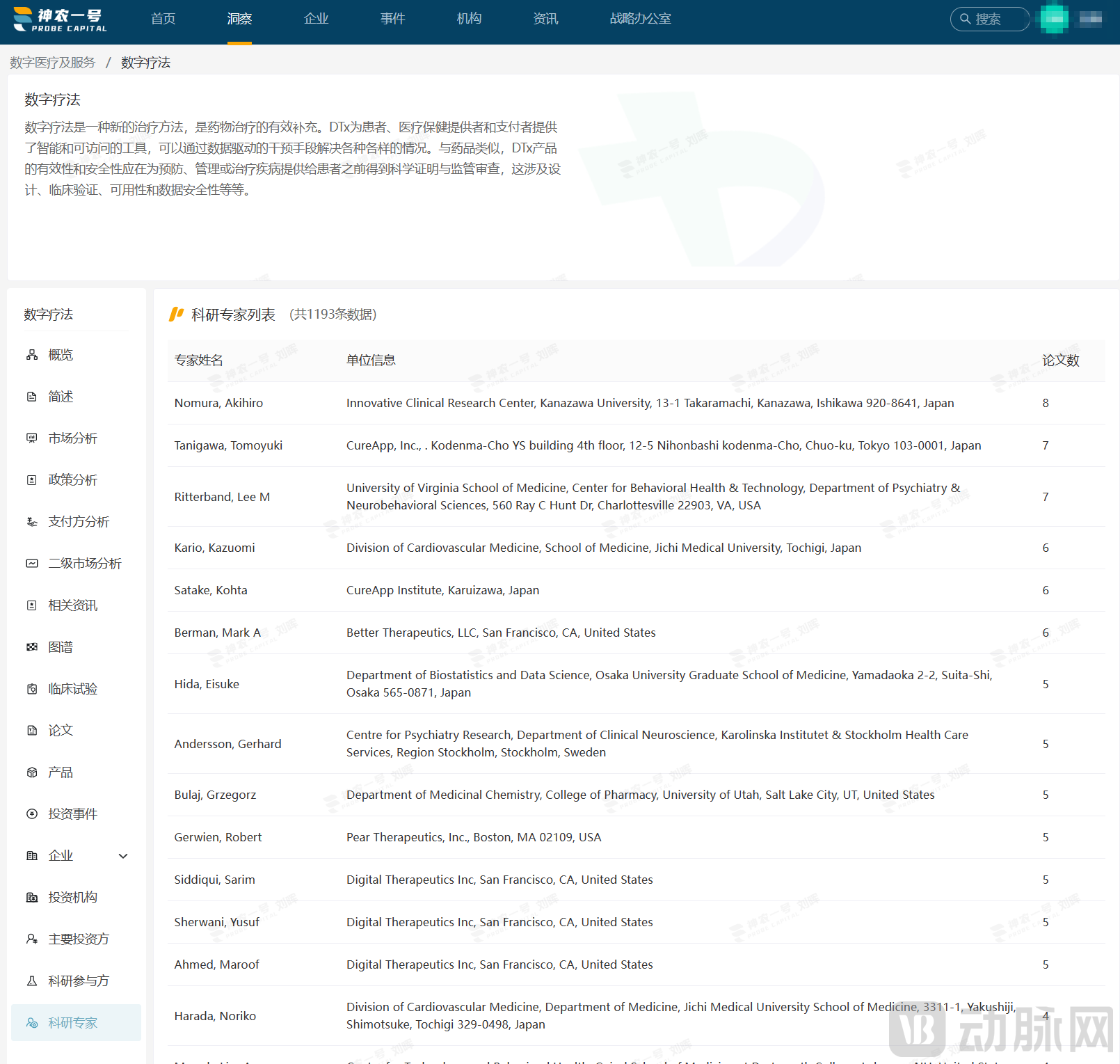
Data for display purposes only
It is understood that,The “Shennong No. 1” system covers over 700 niche segments across the three-tier market, encompassing more than 50,000 pieces of investment and financing information, 500,000+ news articles, policy regulations, industry research reports, and financing events. Meanwhile, the system also integrates multi-dimensional, multi-channel information, including data on research institutions, medical institutions, scientific achievements, and scientists.
The current system has undergone several iterations, achieving partial automation and semi-automated processing across the entire workflow from data acquisition, processing, and analysis to application. ROBE CAPITAL has thereby graduallyBuilding Quantitative Investment Capabilities, empowering investment decisions with data to create a unique competitive advantage in financing and M&A transactions, thereby driving its deal performance.
In the future, ROBE CAPITAL will continue to expand the data within its system while integrating advanced big data technologies and intelligent algorithms. This will enable the company to provide continuous services to clients and explore innovative service models for emerging enterprises.
As the harsh winter sets in, it may well be, as Neil Shen once remarked, that a capital winter is precisely the season for sowing seeds. While investment strategies in the capital markets may tighten, investors will not cease deploying capital. Moreover, the capital winter will endow investors with greater rationality in their judgment and drive entrepreneurs to build genuine core competitiveness, enabling them to weather the downturn and welcome the arrival of spring.
In fact, both the “harsh winter” and intense involution are fundamentally the result of cyclical fluctuations. For enterprises and institutions alike, the most urgent priority is to identify their differentiated competitive advantages while building robust core technological barriers. After all, when the tide of investment recedes, those enterprises and institutions that deliver genuine value, possess innovative capabilities, and can effectively solve problems will still be able to weather the downturn and achieve certainty in transcending economic cycles.
Through ROBE CAPITAL, we can observe the significant enhancement in collective cognition and investment-financing efficiency driven by digital transformation. It not only improves transaction efficiency within the industry and simplifies opportunity identification, but also enables institutions to swiftly uncover undervalued targets that have yet to gain widespread market attention, thereby facilitating early strategic positioning.
Amid the current environment of slowing investment, financial advisory (FA) firms can unlock greater development opportunities when navigating each “darkest hour” by building quantitative investment capabilities, exploring new service models, and developing novel cognitive methodologies. After undergoing transformational exploration, the cycle will eventually pass.
“Never retreat in winter, for spring is just around the corner,” Yan Jingjing said at the end of the conversation.